Catalogue Connection: 25152

  • Castelnuovo-Tedesco piano works review

    Mario Castelnuovo-Tedesco (1895–1968) was a Sephardic Jew born in the Catholic society that was Italy, and while he certainly absorbed the culture of Florence, he also was influenced by Jewish history and tradition. His ancestors were expelled from Spain in 1492 and settled at that time in Florence. Imagine the irony the composer felt when he and his family had to leave Italy in 1939 because of the anti-Semitism of the Fascist regime. He came to America, and became a U.S. citizen in 1946, settling in Hollywood along with so many other refugees. He wrote a number of film scores, and was employed by MGM.

    His music has always shown influences of both his Spanish and Jewish dual heritages, and of course once he started working in the film industry he absorbed various American musical idioms as well. Most of the music on this disc, though, comes from the period prior to his emigration. Only the Notturno in Hollywood and Sonatina Zoologica were composed in America. The latter is a charming depiction of dragonflies, snails, lizards, and ants.

    In fact, “charming” is a word that applies to a great deal of the music here. It is not surprising that the composer was a success in Hollywood. His ear for colors and his ability to create pictures with his music is apparent throughout. His Film Études were composed in 1931, long before he could have envisioned composing film scores. One is dedicated to Charlie Chaplin, and one to Mickey Mouse. Both will bring a smile to your face.

    Alfonso Soldano gives the music good, solid performances. It is possible to imagine a wider palette of colors and a more vigorous rhythmic flair, but it is just as possible to imagine lesser degrees of both qualities. Soldano clearly believes in this music and makes a persuasive case for it. The recorded sound is natural and warm. The helpful and informative notes are poorly translated into English. Companies should really engage people whose native language is the one into which they are translating. It would make for easier reading. Nonetheless, this is a very attractive disc with some very nice discoveries.

  • Castelnuovo-Tedesco piano works review

    Until a few decades ago, the name of Mario Castelnuovo-Tedesco was almost always associated with his guitar works, and the Florentine musician is regarded as one of the greatest composers of the twentieth century for this instrument. Then, fortunately, everyone began to understand that this musician, who left Italy in the aftermath of the racial laws in 1939 to move to America, where he took the citizenship six years later, had left a catalogue of works that covers almost every genre of composition and that, inexplicably, the corrosive action of the time had led to its neglect, despite the fact that his contemporaries (people like Toscanini, Heifetz, Piatigorsky, Segovia, Barbirolli, Casella) had admired him and looked for him to collaborate with. Sometimes, however, if time removes, time gives, and then in recent years there has been a sort of “Castelnuovo-Tedesco Renaissance”, thanks to which it was realized that the Italian-American composer was really a great composer, able to leave a distinctive mark, a trace, a compositional and expressive idea with a decidedly European feel.

    And this new record release allows us to better understand one of the many compositional facets of the Florentine musician, one dedicated to piano works. Presenting it is the young pianist from south Italy Alfonso Soldano who, having made the Ukrainian composer and pianist Sergei Bortkiewicz known in the West (also sketched in an essay-novel, The Border of Deception, published by Florestan Editions), wanted to take back a project left unfinished by his mentor, the great and late Aldo Ciccolini, to bring out the piano work of Mario Castelnuovo-Tedesco. Here, then, in absolute world premiere, pieces like “Notturno in Hollywood” and “Sonatina Zoologica”, as well as “Alt Wien. Viennese Rapsodia “,” Vitalba e Biancospino, Silvana fairy tale “,” Cantico “” 2 Film Etudes “, the debutant ” Cielo di Settembre “and” Piedigrotta 1924 – Neapolitan Rapsodia “, in which a certain “dandystyle” refined and diluted in everyday social life (Castelnuovo-Tedesco was born from one of the richest families in Florence) is employed and set musically by the author to depict emotions, thoughts, images of an inner reality (also made of dreams and fairy-tale visions of which the musician was always fascinated and in which “Vitalba e Biancospino” represents an exemplary case) in which the piano development, in this case, is transformed into a medium through which to align itself with the modern artistic and cultural impulses of its time. Yes, because Castelnuovo-Tedesco despite being a “modernist” is certainly not an “experimenter”, because for him music is above all a story “with” the sounds, with a harmonious and melodic contribution that does not overflow to turn into a search ” of “sounds explained with the birth of a new language, as it will be in the case of Schönberg and Vienna’s Second School.

    Therefore, the image of Castelnuovo-Tedesco will not be forced into the ways of that French tradition (but I would also add those colors, those warm and at the same time sharp tones of a Granados) that left Fauré in the background behind first Debussy and then, above all, Ravel. And here the keyboard really becomes a place for an encounter between the personal impressions of the author with his desire to narrate them, to sketch them with the force of a timbre which is a color patch bounded by ways that sometimes assume the lines and rhythms of a precise and articulated form (think of “Alt Wien” and Opus 1 “Cielo di Settembre”). And also in works in which the historical and personal actuality of the author, as in “Notturno in Hollywood” and “2 Films Etudes”, the result of the work of author of soundtracks for American cinema, for which Castelnuovo-Tedesco worked , salaried by Metro-Goldwin Mayer, become cues of elaboration, this need to tell, to show sound images, does not abandon its creative verve, but is fixed in intense (and tormenting) dialectical brush strokes, able to transmit the intensity of emotion-color.

    It goes without saying that works of the genre, to be best rendered, enhanced in their expressive concreteness, need an interpreter able to show virtuosity (“Piedigrotta 1924” is a clear case) in continuous balance with the desire to tell, without overdoing the first to the detriment of the latter, with the ability to paint with the keyboard the refined palette of colors, without however apologizing in a slavish way the symbolist styles of a Debussy and a Ravel – styles from which Castelnuovo-Tedesco draws, certainly , but not solutions that are an end in themselves. Thus, Alfonso Soldano’s reading turns out to be ideal, probably full of that lesson, of that vision, of that interpretative dimension expressed by his mentor Ciccolini and exemplarily metabolized by him and developed in an exquisitely personal artistic journey. At the piano Castelnuovo-Tedesco requires a tightrope walker capable of expressing subtleties and flashes, discursive phrases and timbre eruptions, even ironic descriptions (“Sonatina Zoologica”) and abyss-like introspective gaps: aspects and peculiarities in which the young pianist from Italy manages wonderfully, giving back an introductory and overall picture coherently accomplished. It is also good sound, able to reproduce perfectly, both in the dynamics and in the detail, the sumptuous timbre of the ‘long tail’ Steinway, as well as the sound stage that even if it appears forward, nothing detracts from the correctness of the sound space produced.

    Artistic value 5 / 5 technical value 4 /5

  • Castelnuovo-Tedesco A.R.G. review

    (comparative review with Somm CD by Mark Bebbington)

    The piano music of Castelnuovo-Tedesco is not played often these days. Except for the five-movement Piedigrotta and the all-too- brief ‘Alt Wien’ there is no duplication between the two releases. The Bebbington was reviewed in these pages as Somm 32 (N/D 2004). Margaret Barela praised Bebbington for his “strength and flexibility”, and found the music lovely. I concur.

    These days Castelnuovo-Tedesco has accu¬mulated a fair representation in the catalog, enough to refer to him as a master who joined many others in finding an alternate universe in Hollywood in the golden age of the motion picture and the insanity of a Europe at war.

    Soldano gives us a little more of the film capital with the charming Notturno in Hollywoood and 2 Film Etudes (‘Charlie’ and ‘Mickey Mouse’). Before you head for the door I must tell you that had I not mentioned the titles you would not have identified them—certainly not any more than Koechlin’s similar efforts on behalf of cinema stars. Once you listen to them, you can see how well their spirit is captured— at least to the extent that pure music can capture anything. Starts and stops, shifting rhythms, melodic fragmentation—all delightfully presented.

    ‘Alt Wien’ is one part of a triptych that that describes the dance history of Vienna. Bebbington included all three movements. It may remind you of La Valse, but ‘Alt Wien’ was written the year before. The fairy tale-like Vitalba e Biancospino and Cantico have an overlay of Impressionism, as does much of the music here, and Sonatina Zoologica in its first recording takes us to a world of ‘Dragonflies’, ‘Snails’ (with its sly reference to Tristan, ‘Lizards’ and ‘Ants’—all described with humor and aplomb. This claims to be their first recording, and they are an enjoyable, self- indulgent musical romp.

    Cielo di September is the composer’s official first piece and was written in 1910 before formal training, but there is nothing amateurish about it. Once again the texture is impressionist.

    Piedigrotta 1924, Rapsodia Napoletana is in five movements and has an often cheeky ambiance. Both pianists capture the composer’s sense of humor well, but Soldano has the added benefit of approving dragonflies and lizards everywhere. He definitely relishes all of the peculiarities of the composer’s writing. Great sound and praiseworthy notes.
    Alan Becker

  • Castelnuovo-Tedesco Piano Works review

    Mario Castelnuovo-Tedesco (1895-1968) was Italian, and one of the foremost guitar composers in the 20th century. In 1939 he went to the US and became a composer for MGM Studios, working on some 200 Hollywood films. He was an influence on other film composers, including Henry Mancini, Nelson Riddle and André Previn, and Jerry Goldsmith and John Williams were his pupils.

    That’s your history lesson; what’s the music like? While a lot is made of his Hollywood links, this doesn’t sound like film music; it’s technical but romantic, and always easy to listen to. This is true even for the first piece, Nocturne In Hollywood, which examines a world between wakefulness and dreaming, and is rather beautiful. (The first section reminded us in places of the BBC’s Going Home music).

    Two Film Studies Op.67 is inspired by Chaplin (Charlie) and Mouse (Mickey), but again, as with the previously mentioned piece, it’s the characters, nonchalant and tragic, and amiable and transparent, that inspire rather than any scenes they might be in.

    While the music might not be filmic it does contain lots of catchy melodic sections: Alt Wien Rapsodia Viennese Op.30 could be the music for a silent but dramatic film; it was in fact written for Winnaretta Singer, widow of Prince Edmond de Polignac, and inspired by the hedonistic life of the island of Brijuni.

    It’s not “heavy” classical piano, no matter how complex the composition may be. This is possibly because, despite his talent, Tedesco was inspired by the outside world more than any inner dialogue. Vitalba e Biancospino, Fiaba Silvana Op.21 was written after he went for a walk among pine-trees, and was told a tale of a fairy and a wood-elf. Sonatina Zoologica Op.187 is inspired by animals and his own childhood, running carefree in the countryside.

    Soldano is a marvellous pianist and the music seems to flow from his fingers like water. The late Aldo Ciccolini began the project of promoting Tedesco’s work and Soldano was one of his last pupils, so perhaps it’s a labour of love.

  • Castelnuovo-Tedesco Piano Works – review

    Alfonso Soldano is the new champion for the music of Castelnuovo-Tedesco. In Mario Castelnuovo-Tedesco – Piano Works (Divine Art dda 25152 divineartrecords.com), the young Italian pianist has expressed a deep urge to understand this composer of an earlier generation.

    Transplanted from Italy to 1940s America, Castelnuovo-Tedesco ended up in the burgeoning music-film industry, where composers were churning out tunes daily under production-line expectations. Still, he never let go of the unique flavour that marks his writing. He always favoured the modernists and held a high regard for the French impressionists. Alt Wien Op.30 and Cantico, Op. 19 both make this very clear. Soldano captures the wisps of Ravel and Debussy that Castelnuovo-Tedesco threads through his work. The Sonata Zoologica Op. 187 is uncannily similar in spirit to Saint-Saëns’ Carnival of the Animals. It’s a brilliant character piece, very demanding, and Soldano plays it with an inner knowledge of exactly where the composer intended it to go.

    The most substantial piece in the disc’s program is Rapsodia Napolitana, Op. 32. It’s a five-movement work highly charged with direct but complex allusions to the place of its title. Landscapes, feeling, winds, emotions and otherworldly things drift across the pages of this remarkable piece. Soldano is very at home with this repertoire, revealing a connection far beyond what academic understanding alone can forge.

    It’s a real pleasure to hear this music presented by an artist who clearly believes in its revival, and who perhaps would enshrine more deeply the reputation of this composer as a national treasure.

  • Castenuovo-Tedesco piano works – Review

    The Italian pianist Alfonso Soldano plays a highly entertaining program from Mario Castelnuovo-Tedesco for Divine Art, including the ‘Notturno in Hollywood’ and, among other works, the Rhapsody ‘Alt-Wien’, the delicious Sonatine ‘Zoologica’ and the ‘Rapsodia Napolitana ‘. The interpretations seem very natural and balanced, leaving in the music the charm that characterizes it.

  • Castelnuovo-Tedesco Piano Works – Review

    Three things about Italian composer Mario Castelnuovo-Tedesco (1895-1968) that need to be remembered. Firstly, he is nowadays best recalled for his numerous guitar works, of which he wrote more than a hundred. His most popular work in the CD catalogue is the Concerto for Guitar, no. 1 in D major. Secondly, he composed more than 250 film scores for Hollywood. He was a ghost writer with very few on-screen credits. He taught film music, and his pupils included Henry Mancini, John Williams and André Previn. And, thirdly, his musical style owes much to Claude Debussy and Maurice Ravel as well as his teacher, the Italian composer, Ildebrando Pizzetti. He has been variously described as an impressionist, a post-impressionist, a classicist, post romantic and part of the 1920s Italian avant-garde.

    I began my exploration of this CD with the delightfully imaginative Sonatina Zoologica, op. 187.This evocative piece of music can appeal to the child of any age. The liner notes point out that Castelnuovo-Tedesco takes the listener to ‘the magical time of his own childhood, running carefree in the countryside of Usigliano di Lari…’ The four movements musically portray ‘Dragonflies’, ‘Snails’, a ‘Lizard’ and ‘Ants’ – creepy-crawlies. It uses a wide range of pianistic devices to create this distinctive imagery. If the listener is looking for some clues as to what this music impact, they need think only of Maurice Ravel’s opera L’Enfant et les sortilèges or his song-cycle Histoires naturelles. The Sonatina Zoologica was composed as late as 1960: it largely ignores contemporary musical styles prevalent in the USA or Italy at that time.

    I was fascinated by the Two Film Studies composed in 1931. The first one examines ‘Charlie Chaplin’ (Charlot), whilst the second gives a portrait of the eternal ‘Mickey Mouse’ (Topolino). These two pieces became an instant success, with the composer declaring that they represented for him, ‘the largest and most complete personalities of the cinema…’ Time may have modified this opinion, but both characters retain their iconic status. ‘Charlie Chaplin’ is portrayed more as a sad, pensive character than a comedian: the music does tend to lack humour, but never interest. ‘Mickey Mouse’ on the other hand is portrayed in a jaunty, brisk manner, yet even here there is a touch of sadness. Lots of chromatic writing and gentle dissonances play in this music. Look out for allusions to Bizet and Puccini.

    The film world is celebrated once again in the delicious Nocturne in Hollywood. In 1941 Castelnuovo-Tedesco had begun his ‘career’ as a film composer which would continue unto his death. This romantic work was composed in ‘down-time’ whilst producing scores for films that often ‘[hovered] between wake and dream…’

    I loved the Alt Wien, Rapsodia Viennese, op.30 originally written in 1923 for two pianos. The present recording is for solo piano. This piece is a pastiche (in the best possible manner), with the composer creating a dreamlike, cityscape that probably never really existed. The music is wayward and often quite dissonant, for a Viennese waltz. There is a curious passage at the end where the typical waltz is metamorphosed into a foxtrot. I understand that Alt Wien was arranged for violin and piano, and became a favourite of Heifetz.

    Vitalba e Biancospino, Op. 21 is a diminutive pastoral fantasy dreamt up whilst a friend was telling a fairy story about a wood-elf and a fairy who lived in the forest. It is translated as ‘Clematis and Hawthorn’. The music is in the form of a rondo that one moment shimmers with sunlight and then introduces rhythmic passages that seem quite out of place in a country lane. Perhaps, Castelnuovo-Tedesco is catching the play of the dragonflies and butterflies, with fairies riding on their backs?

    The world of nature, seen through the eyes of the Christian faith, features in the Cantico per San Bernardino, op.19 which was written in 1920. Beginning with a reticent meditation this work leads the mind into an ‘Augustinian’ presence of God with a long, massive climax. It was inspired by the composer’s preference ‘to pray in the sunlight or under the starry skies, on a rock, by the sea of on top of a hill, between two rows of cypress trees’ as opposed to being in a cathedral, church or chapel.

    Castelnuovo-Tedesco declared that Cielo di Settembre, op. 1 (1910) was written long before he had any formal training. It is a delightful, impressionistic piece that owes much to Debussy. He has developed music that seems to be in stasis, but paradoxically reveals shifting tonal colours and harmonies. The title, ‘The Sky in September’ is well served by this redolent music.

    The liner notes explain that Castelnuovo-Tedesco was sitting on a terrace on the top floor of the Hotel Vesuvio in Naples listening to the guitars and serenades. He decided to compose a Neapolitan Rhapsody. One further point: he was on his honeymoon. The work, Piedigrotta 1924, Op. 32 is named after a collection of Neapolitan folk-songs which were published each year for the historic Festival di Piedigrotta. The Rhapsody is divided into five movements, each taking its title from a poem by local poet, Salvatore di Giacomo (1860-1934). The first is a lively, rhythmic, but somewhat dark ‘Tarantella’. This is followed by ‘Notte ‘e luna’ (Night and the Moon) which is a enchanted fantasy filled with gently shimmering light and ‘lush’ melody. The third movement, ‘Calascuinate’ evokes an ancient local guitar-like instrument that may be more Spanish than Italian in mood. The attractive ‘Voce luntana’ presents the listener with a setting of a typically Neapolitan song, heard from afar. Finally, the work ends with a march-past of the bands, ‘Larlula’. The Rhapsody comes to a clattering conclusion. Castelnuovo-Tedesco’s achievement here is to take local folk-music and synthesise it with his own ideas. The work will impress the listener with its evocation of Neapolitan sights and sounds, the generally lyrical nature of the music and the impressionistic atmosphere created from the fusion of folk and art music.

    The liner notes by Attilio Cantore are a little bit prosy, but generally helpful. The recording cannot be faulted. I could have wished the track listings had not been ‘red printed on reddish brown’: it is difficult to read for aging eyes. Fortunately, it is repeated in a clear font in the insert.

    I have not had the pleasure of hearing Mark Bebbington’s SOMM (SOMMCD 0172) playing of Castelnuovo-Tedesco’s music, so I cannot offer any comparison. There are only two ‘overlapping’ numbers: the Piedigrotta 1924, Op. 32 and Alt Wien, Rapsodia Viennese, op.30. However, the playing by Alfonso Soldano on this present disc is excellent and informed, and is presented with obvious enthusiasm and understanding of this relatively rare repertoire. He has studied Castelnuovo-Tedesco’s work for many years.

    I do hope that Alfonso Soldano (or Mark Bebbington) is going to produce a complete cycle of the piano music of this fascinating and imaginative Italian composer. Alas, there is no sign on either CD cover that these are ‘Volume 1s’. Fingers crossed.
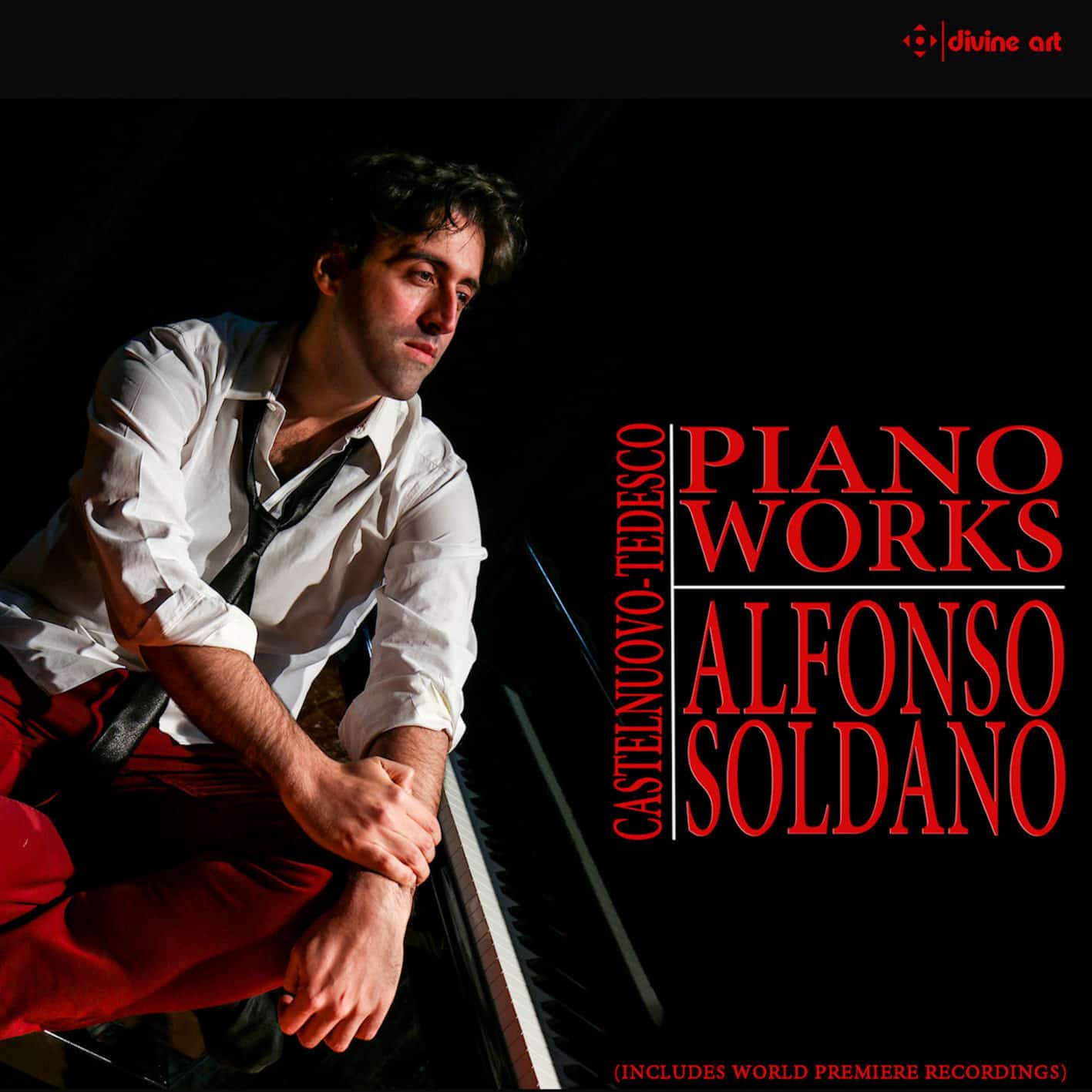
  • Castelnuovo-Tedesco Piano Music review

    Composer and pianist Mario Castelnuovo-Tedesco was born in 1895 in Florence into an Italian Jewish family. In 1939 he moved to the United States, where, in common with other European composers in exile, he turned his hand to film music, providing influential scores for more than 200 MGM films. A prolific composer, his songs include attractive settings of Shakespeare. He made an important contribution to Jewish music and composed a wide range of impressive guitar works, opera, chamber music, quintets, quartets and duos, as well as concertos for Jascha Heifetz and Gregor Piatigorsky. He also wrote extensively for the piano, often reflecting contemporary French influences, and until forced into exile he enjoyed a fine reputation in Italy as a pianist. Unfortunately his piano music has been largely neglected despite the fact that it is exceptional, impressionistic, and in the best post-Romantic tradition of ‘lighter’ music – though only relatively ‘light’ in that it is written in traditional harmony. Never shallow, but highly suggestive of moods, emotions, places and colors. Many of the works in this album are receiving their first recording and all are played by the brilliant Italian pianist Alfonso Soldano, the last and highly-regarded pupil of Aldo Ciccolini whose debut recording (piano music of Sergei Bortkiewicz) attracted worldwide acclaim. He is naturally attuned to the Romantic which makes him an ideal interpreter of Castelnuovo-Tedesco’s music. Alfonso Soldano won many piano competitions, regularly plays with major orchestras, and just been appointed Artistic Director of the Aldo Ciccolini Academy in Trani, Italy.

  • Mario Castelnuovo-Tedesco piano music: Review

    Just like Arnold Schoenberg before him and Igor Stravinsky around the same time, the Italian composer Mario Castelnuovo-Tedesco fled Europe in 1939. Mussolini’s new racial laws were endangering Italians of Jewish heritage and Tedesco left behind his beloved Italy and found with the help of Arturo Toscanini the much needed sponsorship to migrate to the United States.

    Hollywood in the 1940’s was producing hundreds of films each year, each one needing film scoring. There he became one of 12,000 men and women employed by Metro Goldwyn Mayer, and there he made his living by composing over 200 film scores throughout the war years. In 1946 he chose to become an American citizen, and he and his family chose to remain in the United States. By the time of his death in 1968, Castelnuovo-Tedesco was a respected and prolific composer, whose works were commissioned and premiered by the likes of Piatigorsky, Heifetz, Toscanini, and Segovia.

    Italian pianist Alfonso Soldano has dedicated years to researching, studying and performing the piano music of Mario Castelnuovo-Tedesco. The results of his labors can be enjoyed in his new album, Mario Castelnuovo-Tedesco Piano Works (Divine Art 25152).

    Nicely packaged by Divine Art’s Stephen Sutton, splendidly engineered by Christian Ugenti, intelligently annotated by Attilio Cantore and, most important, played to perfection by Alfonso Soldano on a Steinway concert grand piano, the recording was made over two months in the Concert Hall of the European Arts Academy “Aldo Ciccolini” in Trani, Italy, the album is a gem.

    A member of the generation that followed Italian composers, Otorino Respighi, Ildebrando Pizzeti and Alfredo Casella, Castelnuovo-Tedesco rejected the artistic tendencies that influenced many European musicians coming of age in the 1920’s, choosing instead his own eclectic path, resolutely embracing tonality, disavowing the atonal and serial, and identifying most closely with the literary and poetic sources that inspire his music again and again in a sui generis fashion all his own.

    Listening to each of the 16 tracks in this CD – roughly one hour and fifteen minutes of music – one cannot help but marvel at the variety of moods in this ever-changing music. Some of the titles give away at once the ideas behind the music: Notturno in Hollywood (Hollywood Nocturne), Alt Wien Rapsodia Viennese (Old Vienna – A Viennese Rhapsody), Vitalba e Biancospino, fiaba silvana (Vitalba and Biancospino, a sylvan fable), Cielo di Settembre (September Sky).

    In Sonatina Zoologica (Zoological Sonatina) the music apes, mocks and celebrates the quirky movements of dragonflies, the stasis of snails, the suddenness of lizards, and the industriousness of ants. It is all done with delicate humor and not a trace of coyness.

    Film Etudes, Op. 67 salutes Charlie Chaplin with wistful melancholy and gives Mickey Mouse a friendly high-five. In the five tracks of the Neapolitan Rhapsody that joyously brings the CD to its closing, the composer takes five Neapolitan Folk melodies and elevates them to the level of concert material.

    Whatever the mood, whichever technical hurdles need to be met, no matter how esoteric the material, Alfonso Soldano proves himself a masterful interpreter of this music, managing to both respect the composer’s wishes and imprint the music with his own individuality.

    One need only note the touch of turn of the century Viennese Schlag with which he freely lingers on the second or third beat of the waltz tempo in Old Vienna on the second track. Note by contrast the amplitude and judicious pedaling he brings to the Canticle of St. Bernard, and the light touch, agility and humor he dispenses on Zoological Sonatina.

    Alfonso Soldano is a pianist of the first order and his Castelnuovo-Tedesco album a thing to treasure.

  • Castelnuovo-Tedesco: Piano Music

    Castelnuovo-Tedesco: Piano Music

    Mario Castelnuovo-Tedesco is best known for two things – his evocative guitar music, and his work during his long association with the movie industry in Hollywood, where he produced some amazing scores though never quite receiving the fame of his compatriot Nino Rota. His extensive body of piano music has been largely neglected despite the fact that it is exceptional, impressionistic, and in the best post-Romantic tradition of ‘lighter’ music – though only relatively ‘light’ in that it is written in traditional harmony. Never shallow, but highly suggestive of moods, emotions, places and colors. Many of the works in this album are receiving their first recording.

    Alfonso Soldano is a brilliant Italian pianist, the last and highly- regarded pupil of Aldo Ciccolini whose debut recording (piano music of Sergei Bortkiewicz) attracted worldwide acclaim. He is naturally attuned to the Romantic which makes him an ideal interpreter of this music. He has just been appointed Artistic Director of the Aldo Ciccolini Academy in Trani, Italy.