Back in 38:1 I reviewed a previous disc of short organ works by Carson Cooman, also performed by Eric Simmons, on a disc titled Litany. I liked the music well enough, but had a serious complaint about the modern Dutch organ used in the recording. Here, I have no complaints about the instrument at all—indeed, I’m pleased as punch with the selection of a splendid Cavaillé-Coll organ in the cathedral church of Notre Dame in Saint-Omer in France. Moreover, if anything I also like the repertoire here even better than on that previous disc. With one exception from the year 2000 (op. 186), all of the pieces in this recital drawn from Cooman’s astonishingly fecund output date from 2013 to 2016 (opp. 1046 to 1156). After the arresting, dramatic opening of the title track, Exordium, most of the miniatures that follow are quiet, suitable for reflection and contemplation in a church as preludes and postludes. Several items—the Gregorian Diptych duo and two of the three Hymn Fantasies—draw upon Gregorian chant melodies, while others—the Little Partita and the five-movement A Czech Liturgical Year—utilize native carols. Certainly there is no lack of individuality; the “Easter: Aleluja!” from the Czech suite positively oozes a chipper folk-music character, while the “Prélude jovial” from the Deux petits préludes dances with sprightly aplomb. The proceedings are well recorded; the booklet provides very brief (one to three sentences apiece) notes on each work, photos of Cooman and Simmons, and a list of seven previous releases of the composer’s music on the Divine Art label. While in the past I have found Cooman’s craft somewhat uneven in quality, here he uniformly puts his best foot forward, with felicitous results; unreservedly recommended.
Catalogue Connection: 25154
-
Carson Cooman: Exordium review in ARG
[Erik] Simmons continues his survey of Carson Cooman’s extensive output for the organ. As in the previous volumes the music, playing, and production are of a high standard. These pieces are mostly short, tonal, and in a pleasantly neoclassical harmonic idiom. The more substantial pieces include Exordium, Refrains, Gregorian Diptych, and O Come: Three Hymn Fantasies. Cooman writes effective, approachable church music and I would encourage organists to explore it.
Simmons delivers his usual excellent performances, but the real star is the 1855 (early) Cavaille-Coll organ in the Cathedral of Notre-Dame in Saint-Ormer, France. Although it undoubtedly points toward his later symphonic style in design and tonal character, it retains unmistakable aspects of the Baroque sound – he re-used a large part of the original 18th Century pipework.
Notes on the music by the composer, photos, and specification of the organ.
-
Exordium – Carson Cooman organ music review
Organist Erik Simmons has recorded seven CDs by American composer and organist Carson Cooman. The latest, Exordium – Music for Organ by Carson Cooman (Divine Art dda 25154) is a wide selection of Cooman’s works designed to showcase the main organ of the Cathédral Notre-Dame de Saint-Omer in northern France. The recording uses the Hauptwerk system, which digitally records the instrument note by note, storing the data in a sound library from which a performance and recording can be made anywhere, rather than in the confines of the church. The authenticity of this recording technology is impressive, creating a final product that is indistinguishable from a recording made in the original venue.
The original organ in the cathedral dates from 1717 and underwent a major restoration in the mid-19th century. Its casework is renowned as one of the most beautiful in Europe.
Many of the works on this recording use the highly coloured smaller stops or combinations of them to demonstrate the intimacy of such a large instrument. Small solo reeds and flutes are richly coloured and beautifully carry the solo melodies.
By contrast, the big divisions set close to full organ are magnificent as shown in the opening track Exordium and again in the closing selection, a fantasy on Veni Creator Spiritus. Cooman’s works are skillfully written with a contemporary harmonic sensibility that always yields to the melody. Simmons understands this and faithfully brings this great Baroque instrument into the service of a 21st-century composer.
-
Exordium review from MusicWeb
Carson Cooman’s workload seems to be immense: organist and composer in residence at Harvard, writer, critic, performer – as on another recent Divine Art release1 – and consultant. One wonders how he finds the time to compose so much – over 1100 works – and such varied music.
Much of the output is for the organ: this is Erik Simmons’ fifth Cooman recording for Divine Art, with several more planned. The earlier volumes are:
Litany DDA25116
Masque DDA25127
Preludio DDA21229 (2 CDs)
Hymnus DDA25147 – available in mp3, 16- and 24-bit lossless with pdf booklet from eclassical.comand with the Slovak National Orchestra and Kirk Trevor: Liminal DDV 24161.
The two [MusicWeb] reviews of Liminal encapsulate what I imagine will be complementary views of Cooman’s music. If I lean towards David R Dunsmore’s ‘interesting … but not original enough’ rather than John France’s more enthusiastic response, I nevertheless cannot deny the qualities which the latter finds in the music: ‘beautiful, inspiring and seductive in equal measure … charged with wonder, mystery and a deep sense of engagement with the world of nature and society’.
Of some of the pieces, such as the Advent section of A Czech Liturgical Year (track 7) I would even add ‘ethereal’. Much of the music is in this quiet vein, but Cooman does allow the organist to let rip, as in the opening Exordium and the Gregorian Diptych (track 13). On the whole this is late-evening listening with a glass of wine. I don’t mean that to sound disparaging and I shall be investigating the earlier Hymnus via eclassical.com and some of Cooman’s other music on Divine Art, Naxos, Albany and other labels via Naxos Music Library.
Erik Simmons seems to be Cooman’s chosen interpreter of his music; he certainly makes a strong case for it.
The recording, made live using the Hauptwerk system, sounds very good, especially in 24-bit format. If there is any disadvantage in using this digital virtual organ system, I didn’t find it on this recording. There’s certainly none of the downside associated with electronic organs.
The notes are brief but informative – more about the organ than the music.
I hope that I don’t seem to be damning this release with faint praise. I enjoyed hearing it and I’m sure that I shall return to it in the right mood, though it’s not an urgent recommendation. I do, however, recommend all those with access to the invaluable Naxos Music Library to try Cooman’s music out there.
1 Andreas WILLSCHER (b.1955) Symphony No.5: DDA25150. Preliminary listening from Naxos Music Library suggests that this 2006 organ symphony on the theme of St Francis preaching about poverty, in a style not unlike Cooman’s own, is well worth investigating. It’s typical of Divine Art’s pioneering work that this appears to be the first album completely devoted to Willscher’s music.
-
Carson Cooman organ music: Exordium
To a certain degree one could compare the music of Carson Cooman (b. 1982) to that of Olivier Messiaen, in the sense that it’s obviously very much inspired by events that occur throughout the liturgical calendar, but is best suited to a concert venue rather than a church setting. I’m convinced that some ministers or clerics officiating a service would find this music overly expressive and evocative, and therefore liable to distract the attention of the members of the congregation away from the actual ceremonial proceedings. But then again, it could have the opposite effect and bring some closer to God.
Carson Cooman being himself an organist, his major output has been for the pipe organ, but he also writes symphonies, piano music, and choral works at a prolific pace. For example, Exordium, the opening piece on this CD was composed in 2016 and is his Op. 1152. It certainly makes for a great beginning (the latin word Exordium means beginning) with an energetic opening motif, powerful chords, conflicting rhythms, all leading to a robust coda where the mighty pedals reiterate and emphasize the opening motif during which the hands hold down a bright and powerful chord, all of which pushes the organ’s and organist’s limits to their full potential. Besides the closing Veni Creator Spiritus also being a full on all-stops blazing type of piece, most of the other pieces sandwiched in between are soft, lyrical and evocative works, all great at displaying a pipe organ’s individuality and range of stops. I was immediately impressed by the short Romanza, Op. 186, with its beautifully melancholic melody on a flute stop over what sounds like a combination of Viola da gambe and Voix céleste registration (I’ve been playing this one over and over). I also admire organist Erik Simmons‘ choice of registration for Nettleton by which the main hymn tune really stands out. Each and every piece on this disc has a distinct style and unique sound, unlike many other composer’s collections that bring on ear fatigue after a while. I believe this is the sixth recording that organist Erik Simmons and composer Carson Cooman have collaborated on and they certainly complement each other. Each release has been an enriching listening experience.
The instrument you hear on this recording is the 1855 Cavaillé-Coll Organ of the Cathédrale Notre-Dame de Saint-Omer, France. This recording was produced in live performance via the Hauptwerk system, which involves MIDI and virtual models of actual instruments. It would take too long to explain clearly how this works, but it is certainly worth your time to investigate it further. It’s almost like being in two places at once, or rather like playing an instrument remotely in real-time. If you have a MIDI keyboard and computer at home, you could be playing this Cavaillé-Coll pipe organ in your own living room, by simply downloading the required software. Quite fascinating!
-
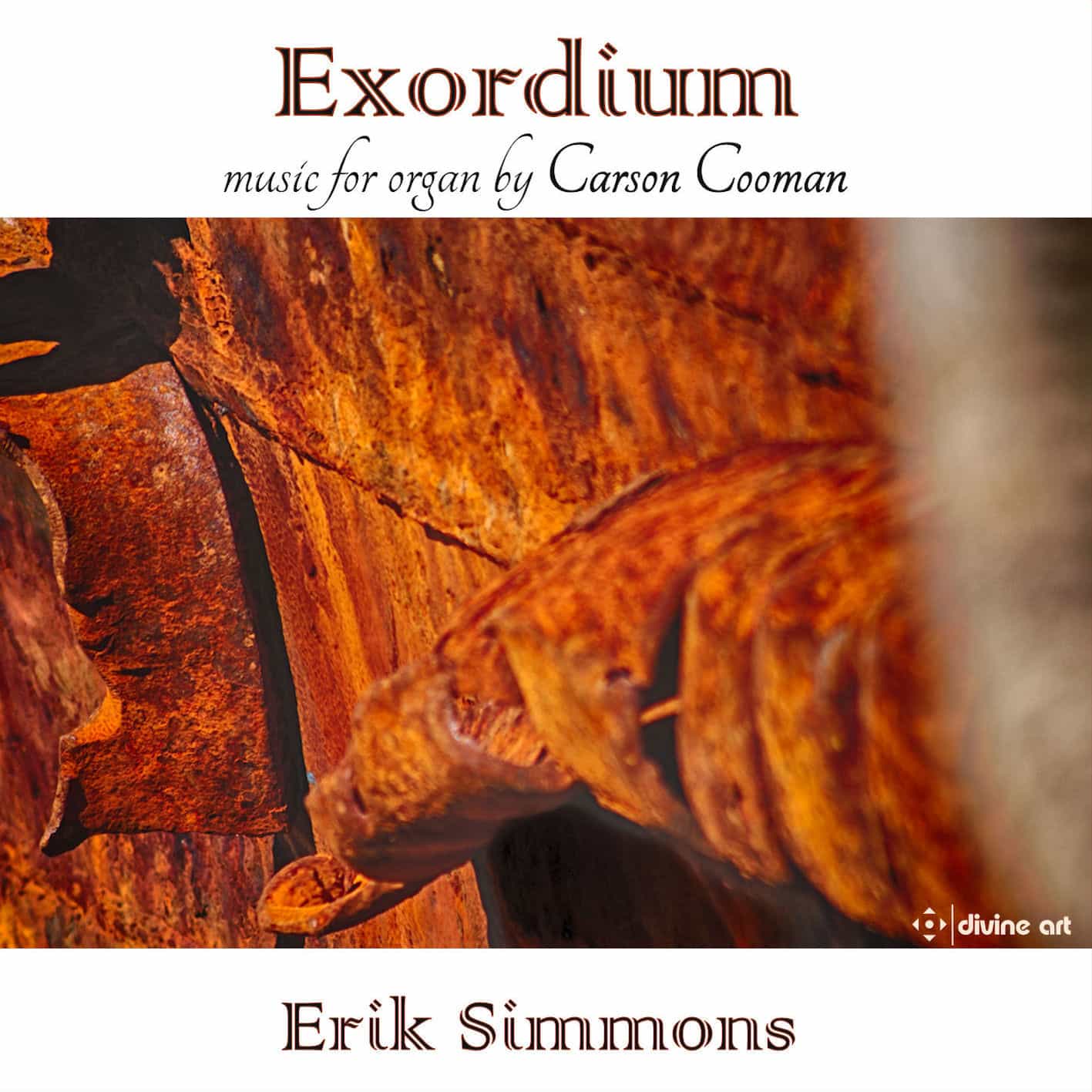
Exordium: Organ Music by Carson Cooman
Carson Cooman is many things musical – organist and Composer in Residence at the Memorial Church, Harvard University; writer, critic and consultant, concert organist, and above all a highly prolific composer of music in a wide variety of genres, from orchestral to song.
His organ compositions come in many styles, from those inspired by the Renaissance, to liturgical models, to more gritty and substantial pieces such as his organ symphonies and preludes and fugues. The music here, tonal and accessible though never lacking in complex chromaticism, was all written either as a commission, or dedicated to a person who has known, worked with, or inspired the composer. Some works are overtly liturgical and all are endowed with a deep spirituality.
Erik Simmons is a fine organist, making his fifth Cooman organ album for Divine Art. He is playing the organ of the Cathedrale Notre-Dame de Saint-Omer, France (built 1855) in a live performance recorded through the Hauptwerk system.