Catalogue Connection: 25155

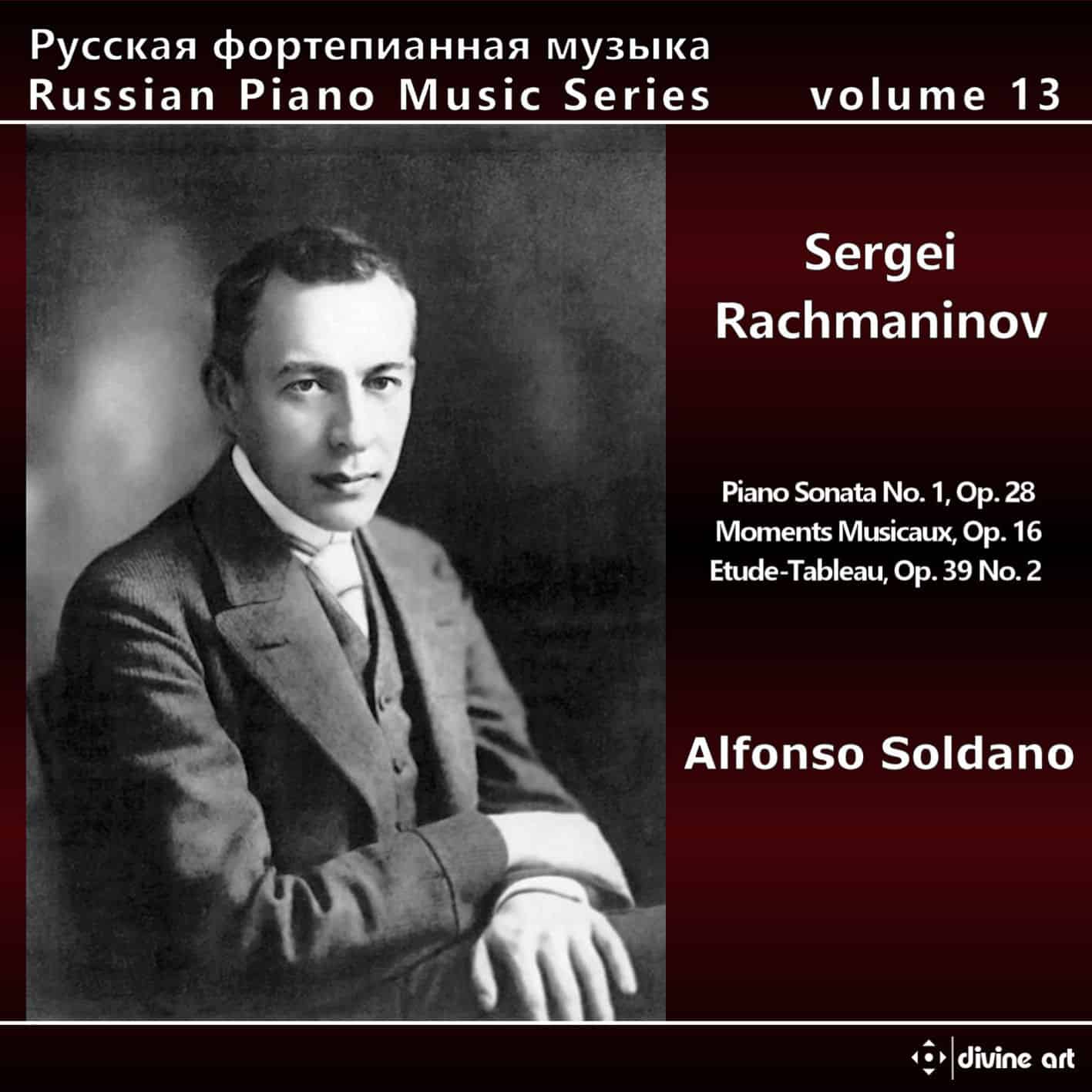
  • Russian Piano Music 13 – Rachmaninov

    It’s been a hard year, so hard we forgot to review this when it came out in February. But now is possibly a better time to promote it: it’s powerful but simple, yet emotionally engaging and some fine music to sit and reflect on the year. Or just chill out for Christmas with a glass of something.

    Most of the reviews we looked at concentrated on Soldano’s technique: he is professor of piano performance at the Giordano Conservatory in Foggia, Italy, following similar posts at Santa Cecilia Academy in Rome and in Trani. He’s very good. But knowing his technique and how it fares against the score isn’t much of a recommendation to a punter who wants some nice music.

    So: these are pieces that create an ambience rather than having killer tunes. The music seems to be about feelings: the sleeve notes talk about bitterness, love, inextinguishable pain and the “spiritual, emotional and formal tension” in Rachmaninov’s work. Rachmaninov’s “immense instrumental abilities to give life to a sweeping language” are mentioned at one point and that’s probably it: there’s a lot of emotion gone into this work, the aim being to create something beautiful from a mood rather than music that reflects any particular mood. It’s obviously technically difficult so Soldano must have practised but the sound is relaxed, a guy who just sat down and started to play. The opening Etude-Tableau in A minor, Op. 39 No. 2 is perhaps the weightiest piece on the album, Moments Musicaux, Op. 16 less weighty and the closing three movement Piano Sonata No. 1 in D minor, Op. 28 more sombre but still less heavy.

    All in all, an engaging and enjoyable collection of atmospheric piano music.

  • Rachmaninov piano music | International Piano review

    INTERNATIONAL PIANO ALBUM OF THE MONTH
    (November/December 2020 issue)

    Alfonso Soldano is a relatively unknown quantity outside his native Italy. Lavishly praised by Adam Harasiewicz and Aldo Ciccolini, he is a young pianist audaciously and indelibly in love with ‘Romantic Agony’ – that deep-dyed violence and melancholy at the heart of Russian Romanticism. In his curtain-raiser, Rachmaninov’s A minor Étude-Tableau Op 39/2, Soldano’s intense rubato and tremulous phrasing convey all of the music’s baleful poetry. No opportunity for drama and rhetorical declaration escapes him.

    Even when placed beside Lazar Berman’s legendary recording of the Moments Musicaux, Soldano’s daring and lack of compromise, his indifference to conventional procedure, are mesmeric. He gives us the revised version of No 2 (a clarification of its first, over-ornate form), and in No 4 his engulfing power and fury are the reverse of, say, Moiseiwitsch’s cool-headed, feline magic. In No 6, that massive carillon of Moscow bells, Soldano unleashes a storm of bravura while in the First Sonata (a welcome change from the overplayed and too often badly played Second Sonata) he is again inimitable, even when set beside Alexandre Kantorow’s sumptuous and richly expansive account for BIS. Whether in the bittersweet central Lento or in the finale’s churning momentum, Soldano tells you that, even if flawed, the First Sonata is a monumental masterpiece.

    This is Rachmaninov ‘through a glass darkly’, leaving you awed and shaken by such an eloquent and anguished interpreter.

  • Rachmaninoff piano music – fanfare review

    This is Volume 13 of Divine Art’s Russian Piano Music Series. Rachmaninoff’s titanic First Piano Sonata, placed last on the program, is a test for any pianist; Alfonso Soldano passes convincingly. The first movement is rhythmically flexible but always musical; the all-important inner-voice lines are projected well. The middle section of the second movement builds up to an extraordinary level of tension. In the third movement Soldano produces impossible amounts of sound. At 40:20, Soldano’s is the longest of the dozen or so versions of this sonata that I have reviewed, but he never seems slow. Only in places does the playing seem a bit underinflected, and in the coda of the second movement Soldano’s touch is a bit heavy. Still, this is one of the more compelling versions of this sonata.

    I was less convinced by Soldano’s reading of the Moments musicaux. No. 1 is unsubtle and plods a bit; in the reprise Soldano plays undifferentiated sextuplets (see the discussion of this passage in my review of Karine Poghosyan’s recording, also in this issue). He plays the revised version of No. 2. In No. 3 he skips the repeat. This piece seems harsh and percussive here, even at mf. The rhythmic shifts in No. 4 seem arbitrary, and No. 5 has a heavy touch. In No. 6 the playing seems la¬bored; there is too much emphasis on the bass line, and in the B section the melody in the inner voices is swallowed up by the figuration. In the Etude-Tableau in A Minor, op. 39/2, Soldano fails to make his extremely slow tempo cohere; the Poco piu vivo is much faster.

    Soldano is by far most convincing in the sonata; still, he isn’t quite at the level of Martin Cousin, Hannes Minnaar, and Rustem Hayroudinoff in this work. Recommended only for serious students of this sonata, and not for the other works here.

  • Rachmaninov piano – Musicweb review no. 2

    This is volume 13 of Divine Art’s “Russian Piano Music Series”, to which pianist Alfonso Soldano has also contributed volume 12, a selection of music by Bortkiewicz. Both volumes have already been praised on this site. The CD opens with the most mature work on the disc, the Étude-Tableaux op.39/2 in A minor from 1916, amongst his last works written before leaving Russia for exile. It is among the most haunted of his piano works, not least because it is a meditation on his idée fixe, the plainchant Dies Irae. Soldano plays it hauntingly too, really taking his time – in fact his 8:15 makes it among the slowest that I know on disc. From the fairly recently praised complete recordings of Op.39, Osborne (Hyperion in 2018) takes 6:04, and Giltburg (Naxos in 2016) 6:45. That’s a noticeable difference in quite a short piece, but Nicolas Angelich (Harmonia Mundi in 1995 reissued 2014) also takes the most time, and his 8:22 achieves a similar mood of melancholy self-absorption. No-one manages to illuminate Rachmaninov’s puzzling reference, offered to Respighi when the latter was orchestrating it, to “the sea and seagulls”! But Soldano has a refined touch and makes his tempo sound right and inevitable, and he is effective in increasing the unrest in the swifter middle section.

    The Moments Musicaux. Op.16 are often seen as the first examples of the characteristic Rachmaninov piano style. These six pieces from 1896 bring the more complex textures and greater technical difficulty that will be a hallmark thereafter. Soldano again lingers over the opening B flat minor piece, his 8:50 contrasting with the 7:16 of Giltburg (on that same Naxos disc as his Op.39). Here the tempo is less persuasive, giving a slight sense of attempting to wring more from the music than might be there. In No.2 in E flat minor his tempo is closer to the norm, and though he is a minute slower than the 2:49 of Rachmaninov’s own recording, so is almost everyone else. That these pieces can of course work at different speeds is shown by the lovely No.3 where it is Soldano’s nicely flowing 4:42 that fits the marked andante cantabile better than Giltburg’s 7:31, but both are full of feeling. In No.4 Soldano is again splendid, not least in the poetry of the highly characteristic descending bell motif. His poetic feeling is abundant also in the rocking barcarolle rhythm of No.5, which is beautifully phrased, while in the Maestoso of the final item – one of the composer’s most challenging technically – Soldano makes an impressive close to this fine account of Op.16.

    Rachmaninov’s Piano Sonata No.1 in D minor from 1907 has increasingly come to seem to me his finest large-scale piano work, less well-known than the Second Sonata, and until recently much less recorded. But in recent years more young players have been drawn to it enough to spend the length of time needed to master its scale and difficulty. There is a programme which deploys the Faust legend, and though Rachmaninov never published that he claimed the work could be better understood through it. But this First Sonata makes perfect sense, once one knows it, without any programme, so logical is its unfolding, and so satisfying its organic method, with so much derived from its opening material, and with potent recall of themes at key moments.

    Alfonso Soldano is clearly a master of this demanding work, but with an overall timing of 40 minutes there are generally broad tempi, but always in service of Soldano’s conception. This is most evident in the great second subject of the first movement, a wonderful ‘chant’ motif (track 8, 2: 56). Here this is very deliberate in its motion, to the extent that someone coming new to the work might struggle initially to discern the theme’s musical shape. But it is compelling nonetheless, wreathed in thickets of figuration which Soldano expertly controls. The dramatic shape of the whole movement too is well delineated, each of its high points making its mark. The exquisite slow movement enchants the listener here as much as Gretchen did Faust, its lyrical flow (and polyphonic texture) realised in an expansive reading which is often spellbinding. The headlong passages of the finale generate plenty of excitement in Soldano’s hands, and he recalls motifs from earlier in the sonata with fine judgement for the unfolding drama, right up to the equivocations of the work’s coda. This is a terrific performance of a tremendous work.

    The booklet notes are helpful, and the recorded sound is realistic, rich and full, quite close but with sufficient ambience, and captures the pianist’s often dramatic dynamic range. This is a very fine disc, with a version of the Sonata that can stand alongside the several other strong accounts of recent years such as Luganski (Naïve, 2012), Xiayin Wang (Chandos, 2014), and Hayroudinoff (Onyx, 2017). All these are coupled with the revised version of the Second Sonata.

    It is worth mentioning for those new to the First Sonata that Hayroudinoff’s recording has outstanding notes by the pianist himself, a much expanded version of which can be downloaded from the label’s website, which elucidates the structure with great insight on the Faust connection. The online note has some music examples, but is non-technical mostly and can be followed with the references to his own timings on the CD. This will tell you more about both sonatas than any of the standard English language books on the composer have managed.

    But if this coupling appeals, then Alfonso Soldano’s very fine disc will certainly satisfy.

  • Rachmaninov piano – American Record Guide review

    This is fresh and beautiful. He doesn’t sound like anyone else, and he doesn’t sound like he’s been playing these pieces all his life and refining his approach. I took out Vladimir Ashkenazy’s recording on Decca—a real contrast to this. Ashkenazy sounds like the Moments Musicaux are effortless and familiar. He’s faster and smoother, well-oiled, subtle, natural in flow and phrasing. Soldano is swept off his feet by them and sweeps us off our feet with their breathless beauty. He really digs into them where Ashkenazy just tosses them off. Pianists must be in awe of Ashkenazy for his Rachmaninoff; he’s been playing it for a long time and knows every nook and cranny, every trap and splash. But Mr Soldano seems to be discovering it as he plays it (not the case, or he couldn’t possibly play it so well!). He is thrilled and moved, and so are we.

    The piano (Steinway D) is beautifully recorded—almost sensual. The sheer beauty of the instrument will take your breath away, and you will be grateful that some pianists and recording engineers let us revel in it.

    The Etude Tableau in A minor (Op. 39:2) is a sweet prelude to the fireworks and emotional turmoil of the Musical Moments. The sonata is pretty formal, as sonatas are, and I don’t think Rachmaninoff shines in such music. In fact, I think you almost have to be a pianist to like his two sonatas. And I can’t get deep enough into the music to judge fairly (that is, comparatively) whether Soldano does it full justice.

  • International Piano review – Rachmaninov-Soldano

    Soldano’s recital (part of Divine Art’s Russian Piano Music series) builds from the glowing lyricism of the Etude-Tableau Op. 39/2 in A minor via the op. 16 Moments musicaux to the towering First Sonata: a clear and compelling trajectory.

    Soldano, who has previously recorded Castelnuovo-Tedeso and Bortkiewicz, shows a great deal of affinity for Rachmaninov’s music. The long lines of the Etude-Tableau reveal a fine interpreter; the second of the Op. 16 set is another highlight, scurrying lines meticulously pedalled. While the characteristic Rachmaninov bells are underplayed, Soldano captures the glowing grandeur of the final Maestoso with fingers of steel.

    The First Sonata is a strong performance, tempestuous and full of contrasts. Both Leslie Howard and Howard Shelley excel in this sonata, but Soldano keeps his head held high. The central Lento is the centre of gravity, unhurried in its grief. A little more depth to the piano recording would have sealed the deal.

  • Audiophile Audition review Rachmaninov piano

    Alfonso Soldano (b. 1986), a student of Aldo Ciccolini, currently serves as Professor of Piano Performance at the Conservatory U. Giordano in Foggia, Italy. For this disc of Rachmaninov (rec. 1-4 July 2019), Soldano plays a Steinway D-274.

    Soldano opens with an especially lucid reading of Rachmaninov’s expansive Etude Tableau in A minor, Op. 39, No. 2, a fantasy that exploits the composer’s fascination with the Dies Irae from the Requiem Mass. Even in its various permutations in brilliant, upper register filigree, we can hear references to the Liszt model, Totentanz. A lush improvisation, the piece juxtaposes mortality and sensuality, in the manner of the morbidly curious who compose beauty in the aftermath of WW I.

    The set of six Moments Musicaux – after Schubert – derive from 1896, revealing aspects of Schubert, Liszt, and Russian doxology. The first piece, a nocturne (Andantino) in B-flat minor in triplet sixths, proves the longest – in four sections – and it could easily be compared to extended, impromptu works in Liszt or Chopin. The composer’s sense of elaboration and embellishment clearly takes its cue from Chopin and Liszt. The No. 2 Allegretto in E-flat minor will run and soar into the major mode, its etude status uplifted by marvelous triplets in both hands, most effective in Soldano’s realization. The Andante cantabile No. 3 is subtitled Canto, a B minor study close in spirit to the Prelude in the same key composed later, Op. 32. We encounter a noble march in spread ninths, twice played, the first version simple, the second ennobled by staccato octaves. The E minor No. 4, Presto, has a militant demeanor to portray charging cavalry, the sustained rhythm in sextuplets’ supporting a rising melody first, then a new motif in thirds. A favorite of Benno Moiseiwitsch, the piece allows the pianist to exploit the entire range of the keyboard in bold colors. The huge bell tones conclude with a fortissimo climax worthy of the excellent sound reproduction from Christian Ugenti. The Adagio sostenuto No. 5 in D-flat Major bears the hallmarks of Franz Liszt. A sweet barcarolle, the piece exudes a moment of relative calm, especially before the storms of No. 6, Maestoso in C Major. Inspired by Chopin’s “Ocean,” in C minor, Op. 25, No. 12, beset by rapid figuration and massive, surging melody. A perpetuum mobile of sorts, the piece tests articulation and stamina. Some find a connection to the composer’s song Fountain Op. 26, No. 11, while others hear only some of the most potent chords ever devised for the instrument.

    Since Liszt had composed Eine Faust-Symphonie, Rachmaninov felt compelled to write a “Faust-Sonata,” his 1906 Sonata No. 1 in D minor, Op. 28. In a letter to Medtner, Rachmaninov called the work “naturally wild and infinite.” Once more, the Dies Irae’s reminder of mortality suffuses the piece. Rachmaninov both lamented and boasted when he wrote, “No one will ever play this composition: it is too difficult and long.” Ironically, amid the masses of notes and Dies Irae permutations, the score relies on deceptively uncomplicated means: repeated notes, fifths, and diverse scales in registers that traverse the scope of the keyboard. The music conforms to the shape Liszt assigned his programmatic symphony: Faust, Gretchen, Mephistopheles.

    Rachmaninov utilizes rising and falling fifths to portray Faust, the ceaseless quester after knowledge, even that beyond “earthly meat and drink.” Scalar passages indicate the breadth of Faust’s searches, culminating in a soaring theme that obsessively concentrates on the tone A. This theme assumes a hymnal character and develops in whirling and frenzied figures. We hear intimations of Russian doxology, as if Faust were groping for some metaphysical consolation, even in the throes of doubt and cascading despair.

    The Lento movement opens with three sets of falling fifths. Gretchen, like Dante’s Beatrice, embodies innocence and purity. The music several times achieves a distinct height and other-worldly character, though the raptures could easily assume a “Wagnerian” character in their erotic possibilities. The thematic links to the Piano Concerto No. 3 seem all too obvious. The extended descending scale of the coda may imply a more “mundane” consummation than the aerial pyrotechnics had suggested earlier in the movement. The liquid harmonies in the upper registers – the trills could be pure Scriabin – seem appropriated more from Franz Liszt, who bore the key of F-sharp Major as a sign of transcendence.

    The Mephistopheles movement, Allegro molto, owes a debt to Berlioz, whose “Ride to the Abyss” from The Damnation of Faust has set the motile progression of galloping frenzy. Undulating fifths and rising and falling scales carry Faust and Mephistopheles together, the “visual” implications of wind and fire. A moment of polyphony moves to a tolling-bell effect that ushers in the ubiquitous Dies Irae, but not before we have a glimpse of Rachmaninov, the master of Romantic melody. Long sequences seem lifted directly from the D minor Piano Concerto, the themes and motifs superimposed upon one another. Faust has visions of Gretchen and the life of romantic fulfillment he has sacrificed in the name of forbidden knowledge. The Dies Irae catapults downward, converting the few moments of divine consolation into shrieks of Dantesque despair. The martial impulses – some reminiscent of the Suite for 2 Pianos, Op. 17 – assume a particularly percussive and bravura character, as if Soldano’s hands cannot move fast or broadly enough to subsume the diabolical contradictions – including soft touches of recalled bliss – of musical energies. Liszt’s lesson in using repeated notes has become, for Rachmaninov, a plainchant for the damned. The extended coda has Soldano magnificently in the throes of a spiraling passion, and we barely can distinguish between pleasure and pain.
  • Rachmaninov piano music – MusicWeb review

    For me, the highlight of this new CD from Divine Art is Rachmaninov’s Piano Sonata No.1 in D minor, op.28 (1908). Most enthusiasts of his music know the massive Second Sonata which has retained its popularity and importance in the repertoire. But turning to the First Sonata, the numbers tell a different story. Currently the Arkiv Catalogue lists some 89 versions of the Second Sonata compared to only 30 of the First. One reason why it has been ignored is the ‘awesome difficulty ‘and maybe its ‘sprawling’ duration. The composer himself wrote that ‘No one will ever dare to execute this because it is too difficult, long and discontinuous on the musical level…’

    The Piano Sonata No.1 was begun in November 1906 whilst Rachmaninov was living in Dresden. Other projects at this time included the magnificent Symphony No.2 and the unfinished opera Monna Vanna. The Sonata was completed by 14 May 1907 and was premièred in Moscow by Konstantin Igumnov the following year.

    I tend to listen to this Sonata as a piece of ‘absolute’ music, but the composer did provide a ‘programme’. Apparently, it was inspired by Franz Liszt’s great Faust Symphony. The liner notes quote the Rachmaninov in a letter to fellow composer Nikolai Medtner where he says that he has not written ‘a music program in the true sense of the word even if the sense of the Sonata will be better understood if this subject is kept in mind.’

    Alfonso Soldano deals with all the difficulties of this ‘epically proportioned work’. Here, along with the remarkable Piano Concerto No.3, is a compendium of ‘all the musical and instrumental experiences of the composer.’ The pianist’s technical prowess and interpretative skills are stretched to the limit. Massive passage work is balanced by ‘lush sensuous harmonies and haunting melodies.’ Rachmaninov’s own description of the Sonata as ‘naturally wild and infinite’ holds good, but couple to that a sense of intimacy in many bars and we have a perfect description of this demanding work.

    The CD opens with a great performance of the Études-Tableaux op.39, no.2 in A minor. It was composed in 1916. Rachmaninov gave the piece a subtitle of ‘The Sea and the Seagulls.’ This was to help Italian composer Ottorino Respighi complete his superb orchestration of five of these Études. This number is quiet, lyrical and, for Rachmaninov, relatively easy to play, apparently! The interest in this fragile work is maintained by the gently shifting tonality. Although some commentators have suggested that the restrained nature of this Étude can lead to monotony, I find this is one of the most beautiful of the set. It is played here with a touching and sympathetic hand, with Soldano brilliantly contrasting the relative drama of the middle section with the tenuous opening and closing passages. For the record there are two sets of Études-Tableaux: op.33 and op.39. The title simply means ‘study-pictures’ that are designed to ‘investigate the transformation of rather specific climates of feeling via piano textures and sonorities.’ (Max Harrison)

    I have always enjoyed the six Moments Musicaux. These are relatively early works having been composed in 1896 when Rachmaninov was in his early twenties. The basic concept of these pieces is an exploration of musical forms from a previous generation. Each Moment has an underlying form: nocturne, impromptu, a song without words, an étude, a barcarolle, and another study, this time a perpetuum mobile. These pieces were written after the less than encouraging première of Rachmaninov’s Symphony No.1. They owe much to Schubert’s own Six Moments Musicaux, D.780 (Op.94). The Moments Musicaux can be played individually, but I feel that they are better programmed as set. Then the powerful finale, played ‘maestoso’, can provide an ideal and satisfying conclusion to this remarkable set of piano pieces. Musicologist Maurice Hinson has described this collection as being ‘brilliant salon pieces written in full blown late romantic style.’ Perhaps a little damning with faint praise, but I get the drift. They are superbly played here by Soldano.

    The liner notes are excellent and provide enough information for listeners both familiar and unfamiliar with these works. The sound reproduction is ideal. As for the playing, I was both impressed and amazed. I have long known the Piano Sonata No.1 in D minor, however this was the first time that it made sense to me. In other words, I think I have ‘got it.’ Italian pianist Alfonso Soldano is brilliant in every way – from presenting a compelling technique to displaying an intimate relationship with some of the truly dreamy passages.

  • Russian Piano Music vol. 13 – Sergei Rachmaninov

    Russian Piano Music vol. 13 – Sergei Rachmaninov

    The major work in this second album of Rachmaninov’s works in the Russian Piano series is the First Sonata, a pinnacle of high late Romanticism. Less well known are the Moments Musicaux but they too are masterful pieces.

    Alfonso Soldano is professor of piano performance at the Giordano Conservatory in Foggia, Italy, following similar posts at Santa Cecilia Academy in Rome and in Trani. He was a student of Ciccolini and is renowned for his virtuosity. He was awarded the International Gold Medal for ‘Best Italian Artist’ in 2013 and has won many other competitions, and is also a busy writer and transcriber. His previous recordings for Divine Art, of the music of Bortkiewicz and Castelnuovo-Tedesco, received glowing reviews. His Rachmaninov (Rachmaninoff for the American readers!) is equally magical.