Catalogue Connection: 25156

  • Prokofiev Piano Music | Fanfare

    On her debut release, young Italian pianist Stefania Argentieri makes a strong impression with both her technical confidence and her interpretive flexibility, providing confident, high-contrast performances that are more varied in perspective than those of many competitors in this repertoire. She certainly knows how to mine the Romantic underpinnings of this music (listen to the First Sonata or the second theme in the first movement of the Sixth)—and she can sing out Prokofiev’s lyricism with disarming sweetness (exemplified by the caress of the opening of the Amoroso that closes the Cinderella set). But there’s nothing weak about the playing: the climaxes are solid, the technical challenges surmounted (try her biting account of the last Etude).

    At times, though, she flaunts her virtues to such an extent that the music is undermined. Take her flexibility: it’s refreshing to hear Prokofiev released from the rhythmic tightness that often imprisons his music; but as is evident from the very first band on the disc (“Cinderella and the Prince”), the extremity of Argentieri’s rubato can swerve into fussiness. Similarly, her technical facility, which allows her to etch out all the details on the page, often leads her to engulf us with secondary material (the radiance of “Cinderella Goes to the Ball” is certainly blocked by the excess of the figurations). Add to this her preference for spacious tempos and her coolness toward Prokofiev’s irony (for instance, in the second movement of the Sixth) and you have performances that, too often, turn insistent in a way that sacrifices long-range trajectory for momentary emphasis and that consequently betray the music’s basic spirit. Certainly, her assault on the Suggestion diabolique, thrilling as it is, lacks the paradoxically deft and claws-out pounce of the composer’s own feline reading. In sum, there’s a lot of fine playing here, especially in the First Sonata and sporadically in the Etudes, and Argentieri shows herself to be a newcomer well worth your attention. As a contribution to the bursting Prokofiev discography, though, especially in the Sixth, she’s not yet a major contender.

  • Prokofiev piano music – ARG review

    This is Argentieri’s first solo recording, and she shows considerable potential. Her repertoire and concert schedule includes piano duo and chamber music as well as solo piano. All of her training and current teaching work is in her native Italy, but she has performed in the US, Russia, and many parts of Europe. This generous Prokofieff program is designed to show the wide variety of music the composer excelled at over the years 1909-1944, Opus 1 to 102. It is the second all-Prokofieff recording in Divine Art’s Russian Piano Music series. At 14 volumes, it shows no sign of ending and has supplied me many hours of listening enjoyment.

    While Argentieri was not quite 30 years old when this recording was made in 2019, Prokofieff was only 18 when he wrote Piano Sonata 1 in 1909. He was already establishing himself as rule-breaking and unconventional. Still, this work has significant romantic elements that show the clear influence of the older generation of Russian composers.

    The Etudes are Op. 2 and already display more of the style we expect from Prokofieff. By the time we get to the last piece of the Op. 4 set (Suggestion Diabolique), we have arrived at the iconoclastic style most associated with him. Argentieri moves through these works with ease. She is not quite at the same speed or diabolical level as Prokofieff himself, but always musical, with an excellent understanding of the music.

    Sonata 6 is a very demanding work, both for the listener and the pianist. It is the first and largest of the three War Sonatas, even though it was completed in 1940 before Russia was invaded by Germany in 1941. It is likely that its tragic and unsettled nature is more of an anti-Stalin inspiration than the horrors of war yet to come. Argentieri manages all of the demands for an effective presentation of work. She is better in the more lyrical parts than the furious sections.

    The set of pieces from the ballet Cinderella was arranged for solo piano by the composer. These are not heard as often as the Romeo and Juliet pieces, but bear much similarity in the pianistic writing and the musical content and style.

    Booklet notes are an awkward English translation of the original Italian. The selections and the sound are both quite good.

  • Prokofiev piano music review by The Whole Note

    Prokofiev began his career as a concert pianist: hence it comes as no surprise that piano music comprises a significant part of his output – three concertos, nine sonatas and more than 100 pieces of various types written over a 40-year period. His continual quest for freedom from typical 19th-century styles resulted in a particular eclecticism, clearly evident in this attractive program on the Divine Classics [sic] label, performed by Italian pianist Stefania Argentieri.

    This disc is the second in the Russian Piano Music series devoted to Prokofiev and includes his first and sixth sonatas, Six Pieces from Cinderella Op. 102, Four Etudes Op. 2 and the Suggestion Diabolique.

    The Piano Sonata No. 1 from 1907 – but later revised – owes more than a passing reference not only to Schumann, but also to Rachmaninoff and Scriabin, the style lushly Romantic. In contrast, the sixth sonata, written in 1940, is pure pianistic gymnastics, technically beyond the capabilities of many pianists. Here, Argentieri demonstrates a true command of this daunting repertoire, meeting the challenges with apparent ease. Equally demanding are the Four Etudes, music of a confident 18-year old pianist/composer eager to demonstrate his skills. The set was originally intended as a “slap in the face” to conservative audiences, but it also earned him a loyal following.

    Cinderella is one of Prokofiev’s most popular ballets and while the set of piano transcriptions from 1944 is equally delightful, it’s the youthful Suggestion Diabolique where Argentieri once again proves her pianistic prowess, Aptly marked Prestissimo Fantastico, the piece demands extraordinary virtuosity – a true perpetuum mobile, with a surprisingly calm conclusion that the brings the disc to a subdued, but most satisfying conclusion.

  • Prokofiev piano: review from Musicalifeiten in Holland

    Quite unnoticed, Divine Art’s series of Russian piano music has reached part 14. Earlier attention was paid to the rather unknown Vladimir Rebikov (part 2). But this is about Prokofiev with some of his not-so-obvious piano works.

    The performance has been entrusted to the young Italian pianist Stefania Argentieri. It is striking that for her debut recording she has chosen compositions by Prokofiev. But it soon turns out that she has a lot of affinity with his idiom. Most surprising here, temperamentally played like a fire devil is Suggestion diabolique which she completes within three minutes. By way of contrast, this is contrasted by the touchy, abstract Piano Sonatas no. 1 and 6, and the few ballet moments from Cinderella which are more lighthearted. The few études contain more serious material, as befits study exercises.

    As far as I am concerned, she will be well able to include on a future recording the Visions fugitives, Op. 22 or the Sarcasms, Op.17, material for which she seems predestined. She has the necessary muscle strength and good vision and the fact that she sometimes uses some rubato enhances the melodic character of her playing.

  • Prokofiev piano – MusicWeb review

    When listeners think of Prokofiev’s piano music a few still mistakenly associate him only with a brash, motoric and sardonic style. However, most now are aware he could also be lyrical and passionate and even child-like, often in the same work, sometimes in the same movement of a work. He was multi-faceted, probably one of the reasons he wrote music in virtually every major genre, from stage works to symphonies, from orchestral suites and concertos to film and choral music, and from solo instrumental and chamber music to song and children’s works. With this recording we see many sides of Prokofiev, and fortunately so does young Stefania Argentieri, who is able to adjust her interpretive approach to capture these varied aspects quite effectively most of the time.

    First, a brief note about her. After extensive studies in several prominent Italian music conservatories and first prize victories in a string of competitions in Italy, Ms. Argentieri went on to capture the International Award Gold Medal Maison Des Artistes in Rome. She has concertized throughout the United States and Europe and teaches piano in her native Italy at both the Umberto Giordano Conservatory of Music, Foggia, and at the Tito Schipa Music Conservatory, Lecce. This is her debut recording.

    Like most of Prokofiev’s transcriptions, the Op. 102 pieces divulge the more lyrical and tuneful side of the composer. Yes, “lyrical” and “tuneful”, but not necessarily bright and happy as evidenced by the dark-tinged waltzes, Nos. 1, Cinderella and the Prince, and 4, Cinderella Goes to the Ball. Here, Ms. Argentieri points up their ominous aspects with slower tempos than usual (especially in No. 1) and with her detailed style of playing, where textures are vivid, notably in harmonic bass lines. Yet, her expansive tempo in the first piece may seem to impart an overly analytical manner to her playing, though she never loses her focus or lets the music sag. Her best performances come in Nos. 5, Pas de chale, and 6, Amoroso. She catches the wit and playfulness of the former piece, enacting its sense of mischievous laughter most effectively, and she fully captures the melting lyricism of the latter piece with great attention to detail, the running, swirling notes in the left hand having a gorgeous sense of flow to underpin the beautifully phrased love theme. Again, in both pieces she employs slow tempos, but makes them work quite nicely.

    To stay on the lyrical side for the moment, let me turn to her account of the Op. 1 Sonata, a very early piece that is a rare instance of Prokofiev showing the influence of Rachmaninov. Here the pianist delivers a big-toned bold account of this single movement work, imparting both a lush and fiery manner to its lyricism. Again, detail emerges with clarity, and main and secondary lines are well balanced. The alternate theme is especially well phrased, sounding as resplendent here as in any performance I know. This eight-minute piece has rarely sounded as vital and beautifully played as here.

    In the Op. 2 Four Etudes and Op. 4 Suggestion Diabolique Argentieri is also quite fine, though I think her clarity of detail can be too much of a good thing sometimes. For example, in Op. 2, No. 1, her big tone and somewhat restrained tempo hold back the excitement this piece needs to fully succeed. Thus, the performance is effective in certain respects, but could have more drive, more of a sense of abandon. In Nos. 2 and 3 she is quite convincing, the latter piece one of the most difficult in the repertory, though it doesn’t sound that way. Evgeny Kissin said of it: “Prokofiev presents pianistic difficulties that Liszt himself had not thought of…” It seems not to challenge Ms. Argentieri’s technique, however, as her performance is facile and quite colorful. The jazzy No. 4 is full of energy here and while the famous Suggestion Diabolique sounds appropriately threatening and ominous, again a somewhat faster tempo would add even more excitement.

    The most important work here is the great Sixth Sonata, the first of the so-called “War Sonatas.” Like Nos. 7 and 8, it is full of symbolism and profound meaning. Not surprisingly it is a complex and dramatic work, whose opening four-note motto quickly evolves into a vehement rhythmic theme that at once sounds defiant and heroic. Argentieri plays it at about the same measured tempo of Cliburn (RCA) and Richter (various labels), though not with the latter’s bluntness but more with Cliburn’s grandeur. Thus, she imparts a bigness to the theme while giving it a springy, elastic quality as well. She gives a somewhat serene, thoughtful account of the lyrical alternate theme but points up the agitation it gradually conjures with subtle use of dynamics and accenting. The development section builds nicely and reaches a grand climax, while the ensuing recapitulation is very well played.

    Her second movement, once again, features a slower tempo than is usual, like the Cliburn and Trull (Sorel Classics) versions. Ultimately, despite fine phrasing throughout, Argentieri is not quite as effective as the best of the competition here. The third movement waltz is gorgeous in her hands, even if the tempo could be just a little more animated. That said, much significant detail emerges, and notes are caressed lovingly to produce both great passion and a sense of regret, in the end yielding a most convincing account of this emotionally tortured music. Once more, you notice the clarity of lines in the finale, and in the propulsive third and fourth themes Argentieri attacks the music with a big tone and sense of drive. The middle section is thoughtfully played and she delivers the movement’s latter half with her usual clear textures and brawny tone. The coda comes on threateningly and powerfully and the final downward slide of chords (which is a veiled version of the first movement motto) is played most convincingly, as rarely occurs in other recordings. This, along with the Cliburn and Richter accounts, is as fine a rendering of this sonata as I’ve heard in the twenty-five or so recordings of it that I possess. Kudos to Ms. Argentieri.

    The sound reproduction on this recording is excellent, the piano sound particularly rich and detailed. I already spoke of the competition in the Sixth, but as for the less popular First Sonata, it’s still plentiful largely because of the many cycles of the sonatas. I would say Argentieri and Natalia Trull are as compelling in the First as any others you’ll find. In the Cinderella pieces Boris Berman on Chandos is very good, as is Lev Vinocur on Arte Nova. Berman is probably more refined than Argentieri, even if he can be a little too straightforward at times. In the Four Etudes and Suggestion Diabolique you can find better individual performances, but collectively Argentieri’s are fully competitive. At 79:39, this recording is a real bargain showcasing a new talent who has much to say in Prokofiev’s brilliant music. Her Sixth is particular is outstanding.
    Robert Cummings
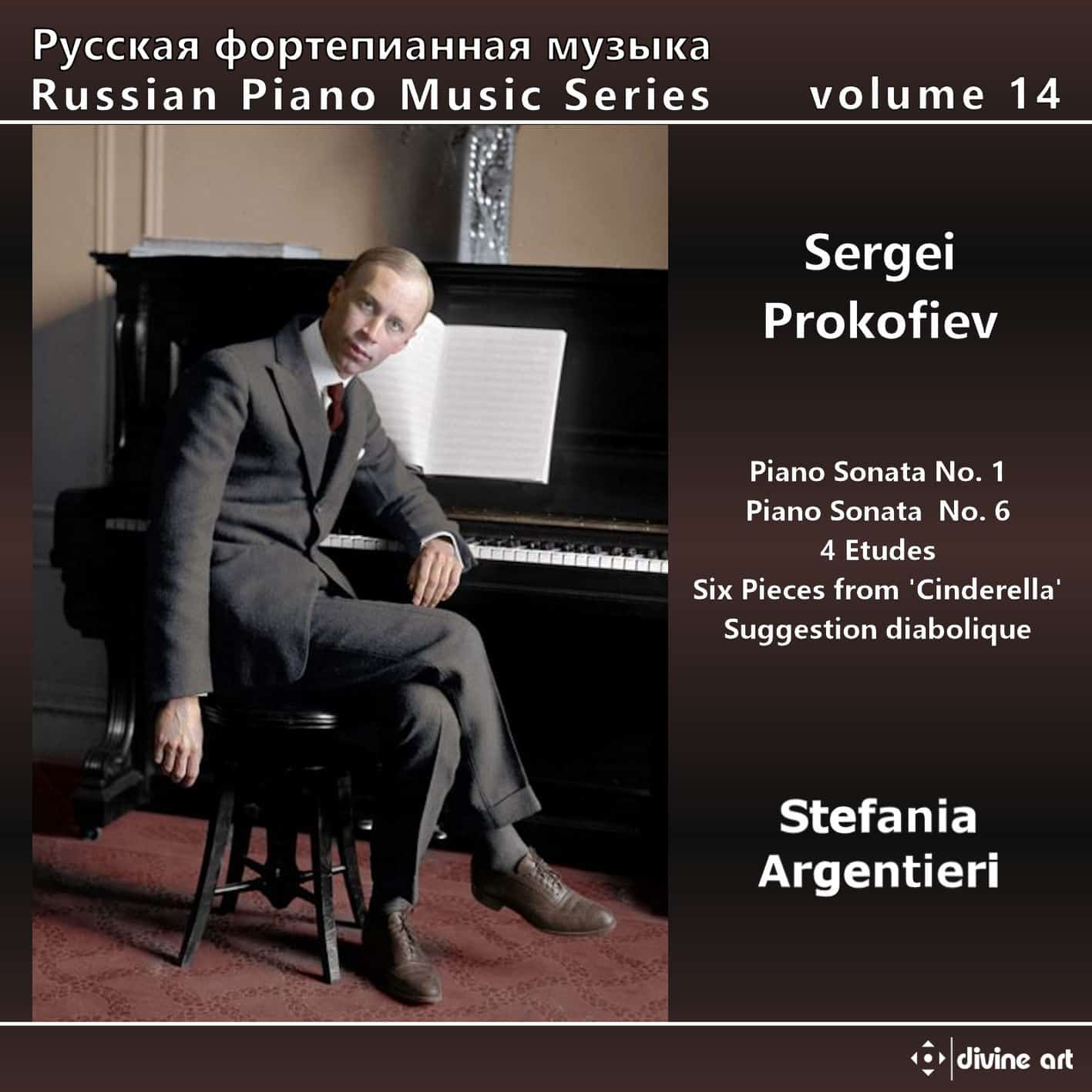
  • Russian Piano Music vol. 14 – Prokofiev

    Russian Piano Music vol. 14 – Prokofiev

    This is the second album in the Russian Piano series devoted to Prokofiev and includes his first and sixth Sonatas and other works demonstrating his wide ranging soundworld. His eclecticism has enabled him as a very ‘serious’ composer of post-Romantic, neo-tonal works – often modernistic and at times aggressive – to be appreciated by a wider general audience than many of his contemporaries.

    Stefania Argentieri is a young Italian pianist of consummate skill, necessary to give full expression to the music of Prokofiev. She has won many awards and has performed at prestigious events in Europe and the USA. She teaches at the Giordano Conservatory in Foggia and is also working as a music editor. Stefania has made recordings with her chamber ensemble and this is her first solo album, no doubt one of many for someone who has the brightest of futures.