Catalogue Connection: 25158

  • English Piano Trios – Fanfare review

    Here’s a CD of chamber music well away from the beaten track. In passing I would suggest that there is nothing overtly English-sounding about this chosen repertoire. I should also add that I am no indiscriminate flag-waver for English music. I never feel that I have to loyally “do my bit” for neglected English composers. The Rosalind Ellicott Trio is a thoroughly engaging piece, bursting with confidence, deeply lyrical and passionate. Her name is new to me, but on this evidence she de¬serves to be as widely known as some other contemporaries of Elgar. Her early successes were a Dramatic Overture and a cantata, but she gradually became more preoccupied with chamber music. At 29 minutes her trio is easily the biggest work here. Strangely it is described here as being in F Major, whereas it is clearly G Major. Its effortless lyrical fluency and fine craftsmanship are equally remarkable. Mendelssohn and Schumann are unsurprising influences, while the unhurried Brahmsian expansiveness feels like Ellicott’s natural mode—not in any way inflated.

    The better-known Coleridge-Taylor was very highly regarded in his day. When declining a commission from the Three Choirs Festival, Elgar recommended his younger contemporary—“I wish, wish, wish you would ask Coleridge-Taylor to do it… he is far and away the cleverest fellow going amongst the young men.” His Trio in E Minor is attractive, though perhaps more worthy than inspired, cliched at times and not as individual as the Ellicott piece. Nevertheless I was grateful to hear such a pleasing work. One would not guess that the composer was only 18 when he wrote it.

    Rutland Boughton (1878-1960) was once popular for his Celtic-inspired opera The Immortal Hour. (Elgar described it as “a work of genius,” while Ethel Smyth, Arthur Bliss, and Vaughan Williams added warmly appreciative remarks.) This Celtic Prelude: The Land of Heart’s Desire dates from 1921, a year before that opera. It is very episodic but nonetheless engaging throughout.

    James Cliffe Forrester (1860-1940) won the 1917 Cobbett Competition with his Folk Song Fantasy, a well-made piece if the least remarkable of the rarities on this disc.

    The Trio, op. 22, by Harry Waldo Warner (1874-1945) is the second longest piece here at 20 minutes. Warner became viola professor at the Guildhall School of Music, played the viola in the London String Quartet—a position later occupied by William Primrose—and won the Elizabeth Sprague Coolidge Prize with this trio in 1921. It is a compelling, ambitious three-movement work with a certain unpredictability providing some piquancy. Noticeable but intermittent, non-pervasive influences include French and quasi-oriental. How come a composer of such mastery and musical personality is almost unknown? This is a fine piece which demands to be heard again.

    Following their debut CD, Romantic Piano Trios, which received some terrific reviews, this Trio Anima Mundi recording again explores very unfamiliar territory. As the group is based in Australia I should imagine that they are relatively unknown in Europe or USA, so once again we are indebted to the CD industry.

    Other typos—apparently Forrester was born in 1960 and died in 1940. The Forrester appears as either “Folk-song Phantasy” or “Folk Song Fantasy”; the Boughton is either “The Land of Heart’s Desire” or the incorrect”… Hearts’.” The text itself is compiled by the performers and generally tells us exactly what we need to know. The recorded sound is very well balanced and natural.

    These five trios will strike many listeners as surprising and pleasurable discoveries, with the bonus of outstanding performances.

  • English Piano Trios – Chronicle review

    English composers are featured on this album and only two were familiar to us, Rosalind Ellicott (from her performances at the Three Choirs Festival, Hereford, Gloucester and Worcester, back in another life on the Malvern Gazette) and Samuel Coleridge-Taylor, he of Hiawatha. The sound is similar throughout, although the music gets more complex/ sophisticated as the programme plays through; there seems to be a chronology from oldest (Ellicott, died 1924) to Warner (d 1945). The fact that it’s a trio gives the music a certain sparseness and, to our ears, it has that rather prim and proper sound of music from a century ago. It might be flowery and romantic, but it’s always polite.

    Ellicott opens and the sleeve notes say the opening allegro of her trio is “not unlike Brahms”, while the rest of the piece is rather sombre. Coleridge-Taylor’s piece is more dramatic. He also had links to the Three Choirs Festival, Worcester boy Edward Elgar declining a commission but recommending Coleridge-Taylor, “far and away the cleverest fellow going among the young men”.

    Rutland Boughton’s Celtic Prelude starts off gently but genteelly builds, adopting a rather gentle Celtic tone (by way of a Wild West campfire) before calming down.

    James Cliffe Forrester’s Folk Song Fantasy is next. It won the piano trio category of the fifth Cobbett Competition in 1917. The stipulations stated that a work for piano trio be written to be as near to a quarter of an hour as possible, that the writing touch “the golden mean” as regards technical difficulty, and the thematic material be taken from the folk song of the country to which the composer belonged. Forrester used folk songs Rosebud In June and Twankydillo (a song about a rich farmer called Roger Twangdillo). Mr Twangdillo came from a more carefree time and this, like the rest of the programme, is refined.

    Harry Waldo Warner’s trio closes and is perhaps the warmest of the pieces. Back in his day, Warner (d. 1945) was professor of viola at the Guildhall and a well regarded performer and composer; philanthropist Walter Willson Cobbett supported him and once told of a “critic enthusiastically appraising the second phantasy of Waldo Warner under the mistaken impression that it was the advertised Schoenberg quartet for which it had been substituted”. The trio was the winning work of the Elizabeth Sprague Coolidge prize in the US.

    Cobbett knew his stuff: he was editor/author of Cobbett’s Cyclopedic Survey of Chamber Music and commissioned works of chamber music from emerging and leading British composers of his time, including chamber works by Benjamin Britten, Frank Bridge, Ralph Vaughan Williams, Arnold Bax and Eugene Goossens.

    A pleasant and diverting collection of music, a little dry perhaps but stimulating. Trio Anima Mundi is one of Australia’s finest chamber trios; since its founding in 2008 it has won several international awards and makes efforts to unearth and perform “forgotten but worthy works”, which sums this up well.

  • English Piano Trios – American Record Guide review

    Two of the best works are by composers new to me—Rosalind Ellicott (1857-1924) and Harry Waldo Warner (1874-1945). Ellicott’s Trio dates from 1889. I opens with a pleasant 6/8 melody before the movement becomes darker and more compact. The slow movement is more soulful, with a strong striding theme followed by lengthy melody with a cogent arc of development. III has forward motion from balanced antiphonal phrases, with structurally good harmony in its contrasting passages. The work leaves an agreeable after-impression with its suave, fluid writing. An interesting aspect of the music is its comparative freedom from Brahms’s influence.

    Warner’s Trio (1921) is an even better find. It has a dramatic ascending theme with tangy harmonic accompaniment. The development has engaging faux-orientalisms with some of the best integration of whole-tone phrases I’ve ever heard. II opens with a toccata-like piano part. The theme has whole-tone piano glisses under it as accompaniment. The trio uses an elegant violin melody, taken up by the cello with even more distinction. Ill begins by alternating descending string lines with rhetorical piano interjections before returning to the playful spirit of I. In a contrasting slower segment, the mood grows mysterious, mixing meters with adroit skill. The whole piece is a delight.

    Samuel Coleridge-Taylor’s 1893 Trio is a teenage effort. Its brevity still allows audible scope for the young composer’s talent. Boughton’s Celtic Prelude (1921) has a pleasing theme in the Mixolydian mode, its development ably distributed among the players. The second theme has a distinctive accompaniment of crushed piano arpeggios. The work ends in a 6/8 dance in the Vaughan-Williams style.

    James Cliffe Forrester’s Folk Song Phantasy (1917), though it tends to amble about, is still a quarter-hour of good British musical landscaping. As the piece proceeds, it builds in richness. A good arranger could turn it into a fine orchestral fantasy.

    The performances are adept, with sensitivity to dynamics, excellent phrasing, and precise articulation. The music all has merit, but Warner’s Trio makes this worth getting.

  • MusicWeb review English Piano Trios

    This welcome new album from Trio Anima Mundi features piano trios from five English composers. The best known, Coleridge-Taylor, gained widespread fame for his cantata Hiawatha’s Wedding Feast, while Rutland Boughton had significant success with his opera The Immortal Hour. Incidentally, both were students of Sir Charles Villiers Stanford at the Royal College of Music in London. Probably the greatest appeal of this album is the works from the other three composers who are much lesser known, namely Rosalind Ellicott, James Cliffe Forrester and Harry Waldo Warner. According to Trio Anima Mundi, all five works are world premiere recordings.

    Cambridge born Ellicott, who is a new name to me, studied piano at the Royal Academy of Music and was an accomplished singer. Later Ellicott became a composition student of Thomas Wingham and went on to achieve some success with her Dramatic Overture in 1886 and the lyrical cantata Elysium in 1889. Here Ellicott is represented by her three movement Piano Trio No. 1 from 1889. Substantial at just under half-an-hour, this attractive and elegant work is beautifully crafted and full of interest. Especially enjoyable is the slow middle movement Adagio, imbued with a gentle yearning and containing a central Poco andante section of a more serious character, described in the notes as ‘funereal’. Whilst listening to Ellicott’s score I was at times reminded of the engagingly Romantic tendencies of Mendelsohn and Schumann with works from a generation or two earlier.

    Coleridge-Taylor was born in London to a Sierra Leone doctor and an English mother. When aged fifteen Coleridge-Taylor was admitted to the Royal College of Music. From his late teens, Coleridge-Taylor’s Trio in E minor for piano, violin and cello from 1893 is contemporaneous with his first published work, the noted Piano Quintet. In three movements, at just under nine minutes this is a very short work, but it certainly makes an impact. Stormy with steely determination, the opening movement is followed by the upbeat and vivacious Scherzo while the Finale, marked Allegro con furiant, just sparkles with life.

    Buckinghamshire born Boughton was in his mid-forties when he found success with The Immortal Hour. Shortly before his landmark work found fame, Boughton in 1921 wrote his Celtic Prelude: The Land of Heart’s Desire. A product of his interest in the so-called ‘Celtic Twilight’ movement, this atmospheric work with its marked folk song influence displays ‘a number of themes in contrasting moods and keys’.

    Another new name to me, James Cliffe Forrester was sixteen when he entered the National Training School (the forerunner of the Royal College of Music). Forrester won the 1917 Cobbett Competition for a Folksong Phantasy (in the trio category) with his Folk Song Phantasy, which W. W. Cobbett described as ‘a musicianly work of melodious charm.’ In three continuous sections, this trio of considerable appeal takes thirteen minutes here to perform and contains traditional Sussex folk tunes, namely Rosebud in June and Twankydillo.

    H. Waldo Warner studied at the Guildhall School of Music, becoming viola professor there. A founder member and violist of the London String Quartet, Warner remained with this group for over twenty years. Warner composed four Phantasies for the Cobbett competitions and had considerable success, obtaining fifth prize in 1905 for his Quartet: Phantasy in F Major and first prize in 1917 with his Quartet: Folksong Phantasy in G minor. There was an early Piano Trio unplaced in the 1907 Cobbett competition but the later Piano Trio, Op. 22, which is played here, was awarded $1000 for winning the fourth Elizabeth Sprague Coolidge prize in the USA in 1921, chosen out of sixty-four works it seems. Taking almost twenty-minutes to perform, the three movement Piano Trio holds my attention from the first bar to the last. In the opening movement Quasi fantasia it’s interesting how the main theme of a sentimental yet straightforward quality returns in various guises – one has a particularly distinctive Eastern flavour and another a rather bucolic character. At just over four minutes, the short Scherzo features ebullient writing flanking a calmer more romantic central section. With such exciting playing, full of energy, the memorable Finale is contrasted with passages of yearning romanticism.

    Throughout this fascinating and engaging recital programme, I can’t fault the playing of the Trio Anima Mundi who impress with their directness and level of expression, so consistent in teamwork. Beautifully recorded at the Music Auditorium, Clayton, Victoria, the sound is clear and well-balanced. The booklet essay provides most of the necessary information although there are a couple of irritating mistakes in the liner notes.

    This delightful album of English Piano Trios is certainly worth obtaining and for H. Waldo Warner’s Piano Trio alone.

  • English Piano Trios review: International Piano

    This eminently worthwhile release from the Australian Trio Anima Mundi opens the window on a neglected corpus of English chamber music, the coal-smoke nostalgia of Muriel Draper’s Music at Midnight a rustle away.

    Boughton’s Celtic Prelude (1921) wends a thoughtful journey, bearing repetition. Climaxing in a ruddy setting ‘Twankydillo; from a 1719 text, Pills to Purge Melancholy, Forrester’s Folk Song Fantasy (Cobbett Competition, 1917), evokes lanes and yarrowed Sussex hedgerows.

    Warner’s Trio (Coolidge Prize, 1921) is crafted and transparently spicy/impish, with a deft central scherzo. Primarily a violist, he could turn an efficient set-piece. Going too often through the motions, Samuel Coleridge Taylor’s early effort (1893) catches the attention less. Contrastingly, Rosalind Ellicott’s First (1889), the discovery of this album, is a full-blown vision with a comely central Adagio. Weaving notes, casting spells, generating tension, structure building was her strength. No Victorian drapes here.

    If there’s a message that comes across from these period-specific works on either side of the First World War, it’s that the Stanford/Elgar/Bantock/VW example wasn’t the only English one; that the folksong revival was to take many forms; and that the Mendelssohn/ Brahms/Leipzig school wasn’t the Holy Grail for all. Escape was possible.

  • British Music Society review: English Piano Trios

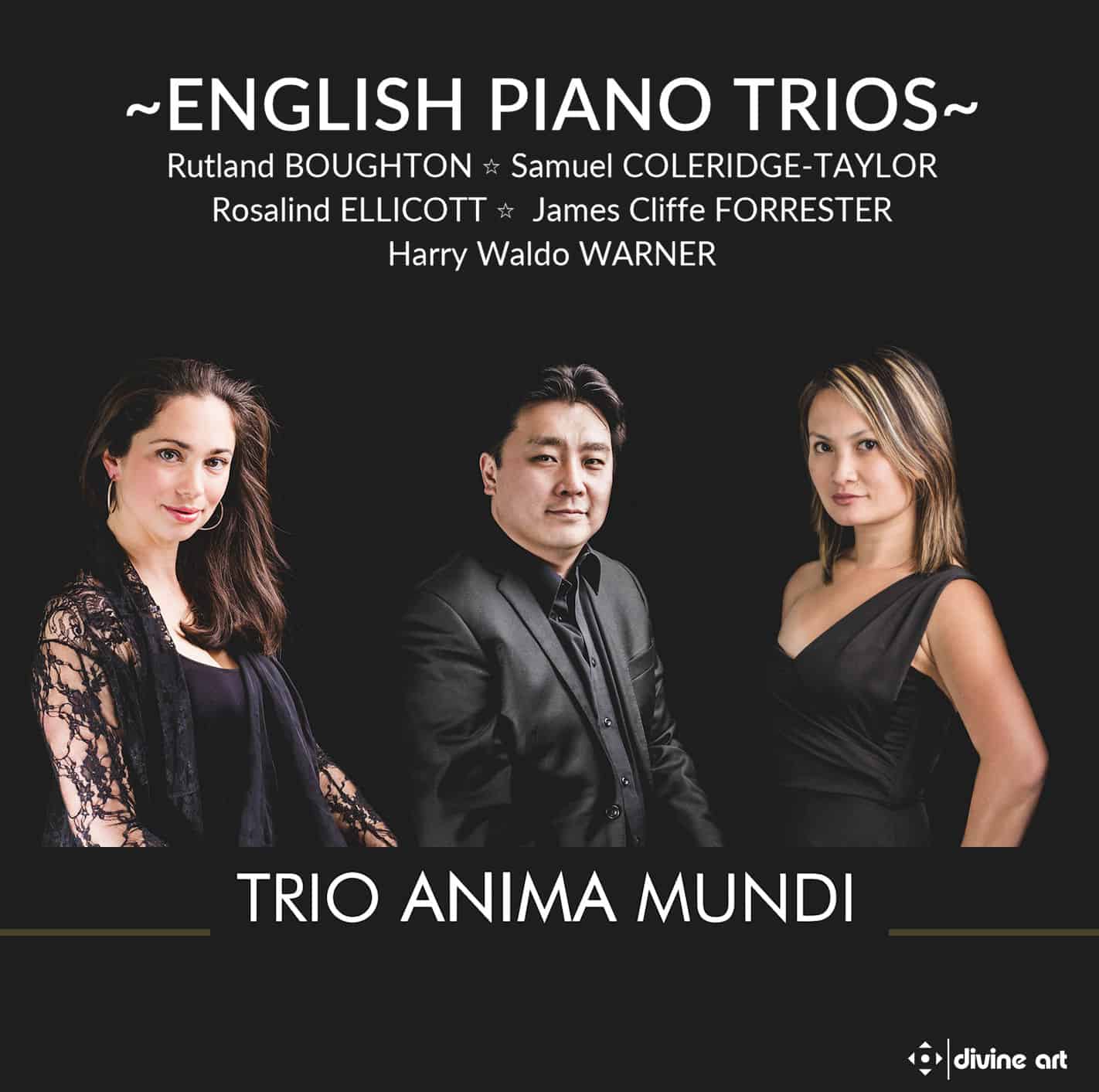
    Dr Kenji Fujimura, piano, Rochelle Ughetti, violin and Noella Yan, cello, are Trio Anima Mundi. Based in Melbourne, the Trio are one of Australia’s most celebrated chamber ensembles.

    Since their foundation in 2008, they have become renowned for their ‘Piano Trio Archaeology’ – the unearthing and performing of forgotten works for the medium. Alongside trios by composers whose names at least are known like Rutland Boughton and Samuel Coleridge-Taylor, they offer first ever recordings of works by late 19th and early 20th century English composers, who despite producing works of remarkably fine quality have been unjustly forgotten.

    As they are one of Australia’s premiere chamber ensembles, it does not need me to say that all five performances are of top quality. What astonishes me however is that all of the music, and two of the trios in particular, are absolutely outstanding.

    Rosalind Ellicott (1857 – 1924) was ‘considered to be one of the leading female composers of her generation’. This first recording of her ‘Piano Trio No. 1 in F major’ puts her up there with the best, eg, Brahms was suggested in her day. The themes she uses are instantly attractive and the shaping of each of the three movements is superbly well crafted.

    The opening Allegro con gracia blends the three instruments so well together. The second movement, the longest, brings out the qualities of the three instruments individually, especially the strings, then the clever combination of instruments that marked first movement returns for the finale. There are sparkling moments for the piano too for you to enjoy throughout the work.

    The other really fine piece on the CD is quite different but every bit as appealing. Harry Waldo Warner (1874 – 1945) was for many years the viola player of the London String Quartet. His Piano Trio Op. 22 is more edgy but still easily approachable. It has great energy particularly in the second two movements with dazzling piano writing driving thrilling rhythmic intoxication. He also gives the music a decidedly oriental flavour, especially in his piano writing.

    Samuel Coleridge-Taylor’s Trio in E minor is full of drive and energy. Rutland Boughton’s ‘Celtic Prelude’ has a marvellous passage for muted strings with bell-like piano, and then the ‘Trio: Folk Song Fantasy’ by James Cliffe Forrester expands delightfully on the Sussex folksong ‘Rosebud in June’ a Steeleye Span favourite, followed by ‘Twankydillo’.

  • Musicweb review English Piano Trios

    RECOMMENDED RECORDING
    Although I have searched the Internet, I have not come up with a definitive opinion as to whether this CD presents five previously unrecorded chamber works. Normally CD companies would trumpet this fact, but no mention is made in the booklet, the track listing or the advertising blurb. My working assumption is that they are premier recordings but look forward to being proved wrong on this point.

    A little problem occurs with the opening work, the beautiful Piano Trio No.1 in G major (c.1889) by Rosalind Ellicott. The track-listing on the CD cover insists that this is written in the key of F major, the embedded information in the CD concurs. Grove’s declares that it is in G major, as does the score and the programme notes. So, G major it is. [note: this error was noticed after the first pressing/printing and affects only a small number of copies of the CD. The digital booklet is correct.] The Trio is presented in three movements with the slow ‘adagio’ conventionally placed second. The opening ‘allegro con grazia’ is a delight. Written in 6/8 time, Ellicott has taken to the crotchet-quaver melodic line, which propels this music along. The second movement, by contrast, is quite introverted: the liner notes suggest ‘funereal’. This ternary movement has a gorgeous romantic tune in A major. This, for me is the emotional highlight of the entire work. The finale is dynamic. This ‘allegro brillante’ does what is says ‘on the tin. Back in the home key, it is full of energy and vigour propelling the movement to a powerful close, with several loud reiterated G major/C major chords.

    What does the work sound like? I guess that Brahms springs to mind. Mendelssohn and William Sterndale Bennett (her teacher) also lie close to the surface. But this is not fair. Rosalind Ellicott has written a minor masterpiece. It holds it own against much that went before and came after it. And I would swap many works for the elegant tune in the slow movement! In 1891 Ellicott was to produce her Piano Trio No.2 in D minor. This has been recorded by the Summerhayes Trio on Meridian CDE84478.

    The problem with Samuel Coleridge-Taylor’s Trio in E minor is that it is too short. The entire work lasts for less than nine minutes. Additionally, I felt there was an imbalance between movements in this work. The first is longer than the other two combined. But that is not all. The powerful opening gesture seems to me to be destined for a much longer and more expansive work. Furthermore, there seems little contrast between the ‘moderato’ and the ‘allegro’ sections of this movement. The liner notes suggest that this is a little rondo, yet I felt the episodes lacked distinction. The second movement is a vivacious ‘scherzo’ lasting for less than two minutes. Again, there is little distinction between the minuet and the trio parts. The finale brings little respite to this ‘fast’ work. There is terrific energy in this ‘con furiant’ movement that just seems out of scale with such a short work. Another issue with this Trio is the lack of a slow movement as such. Even the episodes and contrasting themes in each movement fail to present anything approaching repose. On the other hand, there is much superb writing for the Trio here. Melodic material seems to tumble from the composer’s pen. Despite my criticisms, I did enjoy this work and hope that as a result of this premiere recording it will gain traction with concert promoters, ensembles and listeners.

    I have always wanted to hear Rutland Boughton’s Celtic Prelude: The Land of Heart’s Desire. I recall I came across the score of the work in the Royal Academy of Music Library many years ago and the title took my fancy, as well as what I could hear in my mind’s ear. The Prelude was composed in 1921, the year before Boughton began his best-known work, the opera The Immortal Hour. The liner notes suggest that it may well be a preparatory sketch for that opera. Michael Hurd in his book-length study of the composer, explains that Boughton wrote the incidental music for Yeats’s play The Land of Heart’s Desire, which was performed at Glastonbury on 24 January 1917. He later worked up this score into the present Trio. The rhapsodic formal structure would seem to be through-composed, with a plethora of tunes, fast and slow, tumbling over each other. Somehow, all these various melodies seem to be hewn from the same material. The robust opening theme is reprised near the end of the Trio, before the mood changes to a lively jig. Hurd was not over impressed with this short Prelude. He concedes that it is ‘tuneful and unpretentious’ but it is a ‘slight work – its modal melodies, episodic formal structure, and unsurprising harmonic content creating an impression that it is pleasant rather than powerful.’ I think it is these things that give the piece its sense of innocence and wonder.

    I have waited many years to hear a performance of this piece: I think that the wait has been worthwhile. This is a delightful work that is full of Celtic melancholy and lively-ish dance, but never descends into Tartanry or Irishry. I hope that several piano trio ensembles will take this work up. It deserves to be popular.

    I have not come across the composer James Cliffe Forrester before. Googling did not really help. Most ‘hits’ were associated with the present CD. The liner notes give the briefest of notices of his life and works. Born in 1860, (not 1960 as printed on the CD rear cover track listing) Forrester attended the National Training School (the forerunner of the Royal College of Music). After completing his studies, he held posts as organist and choirmaster at St John’s Church, West Ealing, and as music master at Princess Helena College in Hertfordshire. Remarkably, he was at this college for more than five decades. I searched the British Library Catalogue and found no references. The liner notes refer to some song settings of texts by Longfellow, Shelley and Browning. WorldCat reveals a couple of piano pieces: In Springtime and Rosalind, a minuet for piano. Which makes the situation very puzzling indeed? Based on the remarkable Trio: Folk Song Fantasy heard on this disc, he would seem to be a composer with considerable gifts. There must be some more information out there somewhere…

    Turning to the Trio, we are told that it was written for the 5th Cobbett Chamber Music Competition held in 1917. The rules of this competition were that the work be around quarter of an hour, relatively easy to perform and must derive its melodic material from folksong, from the country of the composer’s birth or residence. Betsi Hodges in her admirable thesis about the Cobbett Competitions lists the winners of the 1917 competition. The trio section was won by Forrester’s Trio with the second place going to Arnold Trowell’s Trio on Ancient Irish Folk Tunes. Forrester’s work was duly published by Novello. Walter Willson Cobbett, in his Cobbett’s Cyclopaedic Survey of Chamber Music, vol. 1, A-H, described the work as ‘a musicianly work of melodious charm.’ That’s it.

    The Trio is written in the usual arch form, with the slow middle section. The programme notes identify the main theme as the Sussex folk tune ‘Rosebud in June’. This is presented in several guises with contrasting, but typically melancholy, moods. The final section utilises a brisk tune called ‘Twanky Dillo’, which is an anthem for a blacksmith. This was sourced from a volume compiled in 1791 entitled Pills to Purge Melancholy.

    This splendid Trio makes an ideal entry point for someone wishing to enter the world of British Chamber music of the first half of the 20th century. There is nothing challenging here. It is not avant-garde and does not ramble as so many folk song inspired works are liable to do. Witness the irruption of the final theme in the middle of the slow section – a masterstroke. This is a moving, exciting, well-constructed and thoroughly enjoyable work. It just cries out to be in the repertoire of all Trio ensembles.

    The last work on this imaginative CD is Harry Waldo Warner’s Trio for piano, violin and violoncello, op. 22. The work is dedicated to the American pianist, patron of music and socialite, Mrs Elizabeth Sprague Coolidge. In fact, it won the Coolidge Prize for 1921 and was duly published by Ricordi. Apparently, there were some 64 competitors from ten nations, so it was a wide field and (presumably) a well-deserved win.

    The first movement is something of a ‘fantasy.’ After an opening flourish the composer presents three discrete sections that seem melodically related to each other but presenting various moods. The second section is much lighter in tone than the surrounding music which is typically turbulent and restless. The piano part here adds so much to the success of this movement. The ‘scherzo’ is light-footed with some wonderfully will o’ the wisp piano interjections. There is much of the Orient about this music with lots of bare ‘fourth’ (e.g. C-F) chords. The ‘trio’ section is a little more romantic in tone, with a well-poised melody. There is a reference here to the first movement before the ‘scherzo’ theme brings the work to a close. This entire movement would make a wonderful encore to any recital. (However, I do not usually advocate lifting movements out of context!!) The finale is complex in design. It begins with a slow, melancholic introduction played on strings with piano interruptions articulating the main theme of the opening movement. Very soon the main theme of this ‘sonata rondo’ is presented. Here there are constant changes of metre creating a deliberate sense of instability. This is a melody that presents drama and just a hint of aggression. The ‘second subject’ or ‘episode’ is a reflective tune that brings some peace into what is typically turbulent music. The movement progresses through several twists and turns before heading for the massive ‘climactic, affirmative close.’ The entire trio is characterised by chromatic writing, especially in the piano part.

    Even a superficial hearing of Waldo Warner’s Trio will explain why this work won first prize in the Coolidge Competition. Everything about this work suggests genius. It is a masterpiece (an overused word, I concede). Listening to this music makes it hard to believe that it has been ignored largely for a century. There is so many good things in this three-movement work.

    The playing by the Trio Anima Mundi (a profound name, the ‘World Soul’!) is magnificent throughout. I managed to ‘follow’ three of these works (Ellicott, Boughton and Waldo Warner) with the score and was continually amazed at the brilliant interpretation of this music. Despite the drop-offs noted above, the liner notes and packaging are excellent. Divine Art, as usual, give an outstanding recorded sound to this CD. I cannot fault it.

    If these are all ‘premiere performances’ this new release will give chamber music enthusiasts plenty to think about. Each one of these five ‘trios’ are special and deserve our attention. I look forward to many more releases by this ensemble, with their continuing enthusiasm for ‘musical archaeology’.
  • New Classics Review English Piano Trios

    Of the five English composers featured here, only two are really known at all – the intriguing Samuel Coleridge-Taylor (for his cantatas inspired by on the epic poem, Song of Hiawatha, by American Henry Wadsworth Longfellow) and Rutland Boughton (for his fairy tale opera The Immortal Hour), but all wrote wonderful music in Romantic style.

    Born in 1857, Rosalind Ellicott became one of the leading female composers of her generation, having much success with performances in the 1880s before moving from orchestral to chamber music. Comparatively little of her work has survived apart from a few songs and instrumental works, including the Piano Trio No. 1 included here. James Cliffe Forrester, composer of the delightful Folk Song Fantasy, was less prolific, concentrating on his teaching career, but has a fine impressionist voice. Harry Waldo Warner studied at the Guildhall School of Music in London as a pupil of Orlando Morgan and was well known as a violist and member of the very successful London String Quartet. He composed two operas, over a hundred songs and several chamber works, including this Trio for piano, violin and cello.

    These world premiere recordings of rarely heard but masterful compositions are played with sensitivity and panache by the excellent Australian ensemble Trio Anima Mundi – Kenji Fujimura (piano), Rochelle Ughetti (violin) and Noella Yan (cello). This acclaimed Trio is one of Australia’s finest chamber ensembles and since its founding in 2008 it has won several international awards, including the Elizabeth Sprague Coolidge Prize. The Trio has often unearthed and performed unjustly forgotten works as well as playing some of the newest pieces of today.

  • English Piano Trios

    English Piano Trios

    Of the five English composers featured, only two are really known at all – Coleridge-Taylor for Hiawatha and Boughton for The Immortal Hour – but all wrote wonderful music in Romantic style – rather under the shadow of Elgar, Delius, other prominent figures. Rosalind Ellicott had much success and performances in the 1880s before moving from orchestral to chamber music; Forrester was less prolific, concentrating on his teaching career, but has a fine impressionist voice. Warner was very well known as a violist and member of the London String Quartet; he was very busy as a composer with several chamber works, two operas and over a hundred songs to his name. The Trio featured here won the Elizabeth Sprague Coolidge Prize.

    Trio Anima Mundi is one of Australia’s finest chamber trios; since its founding in 2008 it has won several international awards and made special efforts to unearth and perform forgotten but worthy works as well as the newest pieces of today. Their previous Divine Art album won rapturous acclaim.