Catalogue Connection: 25162

  • Andreas Willscher Organ Symphonies review

    Organist-composer Andreas Willscher (b. 1955) makes his Fanfare debut with this disc, though not his debut on CD; his Organ Symphony No. 5, also performed by Carson Cooman and issued by Divine Art, preceded this release but was not received for review. In any case the acquaintance is a most welcome one. Willscher composes well-crafted music of real inventiveness in a thoroughly tonal idiom that makes liberal use of medieval modes and modern dissonances. Occasionally I hear traces of the influence of the mature Hindemith, but Willscher’s voice is definitely his own.

    The two organ symphonies featured here both date from 2017, are laid out in five movements, and were given their world premieres by Cooman (interestingly, No. 20 made its debut before No. 19). The “Hallelujahs” Symphony takes for its subject five Biblical canticles of praise: by the Hebrews in Exodus 15, after they cross through the Red Sea and witness the drowning of the pursuing host of Pharaoh; by Hannah in I Samuel 2, when her state of barrenness is lifted with her conception of the prophet Samuel; by King Hezekiah of Judah in Isaiah 38, when the Lord God heals his deadly illness and extends his life for another 15 years; by the prophet Daniel’s three companions in the deuterocanonical “Song of the Three Young Men,” upon their miraculous deliverance by an angel upon being cast by King Nebuchadnezzar into a fiery furnace for refusing to worship an idol; and the command to John by the angel with the golden ruler in Revelation 22 to “Worship God!” Its five movements alternate in a loud-soft-loud-soft-loud sequence. The first movement is assertive, with an angular thematic motif suggesting hieratic ceremonial gestures; the second subdued but cheerful. The third pulsates with the energy of some modem rock music songs (Willscher has also been a keyboardist for jazz and rock ensembles), but without the annoying aspects of those genres. The fourth suggests a mysterious suspension of the natural order, while the finale utilizes a varied strain of the third movement, but one punctuated with sustained dissonances depicting the other¬worldly nature of the angel and the vision of his work.

    The “Laetere” Symphony, as the Latin title indicates, concerns various aspects of mankind rejoicing in the goodness of God. The first, third, fourth, and fifth movements are based on ancient Gregorian chants to various Mass Propers: “Vocem jucunditatis” (A voice of joy), from the Fifth Sunday after Easter, “Ubi caritas” (Where there is charity) from Maundy Thursday and the Feast of Corpus Christi, “Laetere” (Rejoice, O Jerusalem) from the Fourth Sunday in Lent, and “Urbs Jerusalem” (The city of Jerusalem) from the feast for the dedication of a church. The second utilizes a medieval French melody, “Lou Boun Dieu” (The Good Lord). The mood here is predominantly quiet and contemplative; only the fourth movement and the opening of the first movement move beyond a pianissimo to mezzo-forte dynamic range into louder and more dramatic perorations, with concomitantly more adventurous harmonies beyond a basic diatonicism and modalism.

    Die Seligpreisungen (The Beatitudes) is a four-movement work from 1974, when the compos¬er was only 17; it was his op. 3 before he stopped cataloging his works with opus numbers. Here the Beatitudes are the four recorded in Jesus’ Sermon on the Plain (Luke 6:20-23) rather than the better-known set of eight from the Sermon on the Mount (Matt. 5:3-12), which declares those to be blessed who are poor, who hunger, who weep, and who are hated for the sake of Jesus’ name. It is clear that the composer’s personal style was in place early on, though there is perhaps more evidence here of influence by Messiaen and other contemporary French organ composers, not to men¬tion Bach. The first and fourth movements are extroverted and celebratory; the two middle ones introverted and meditative.

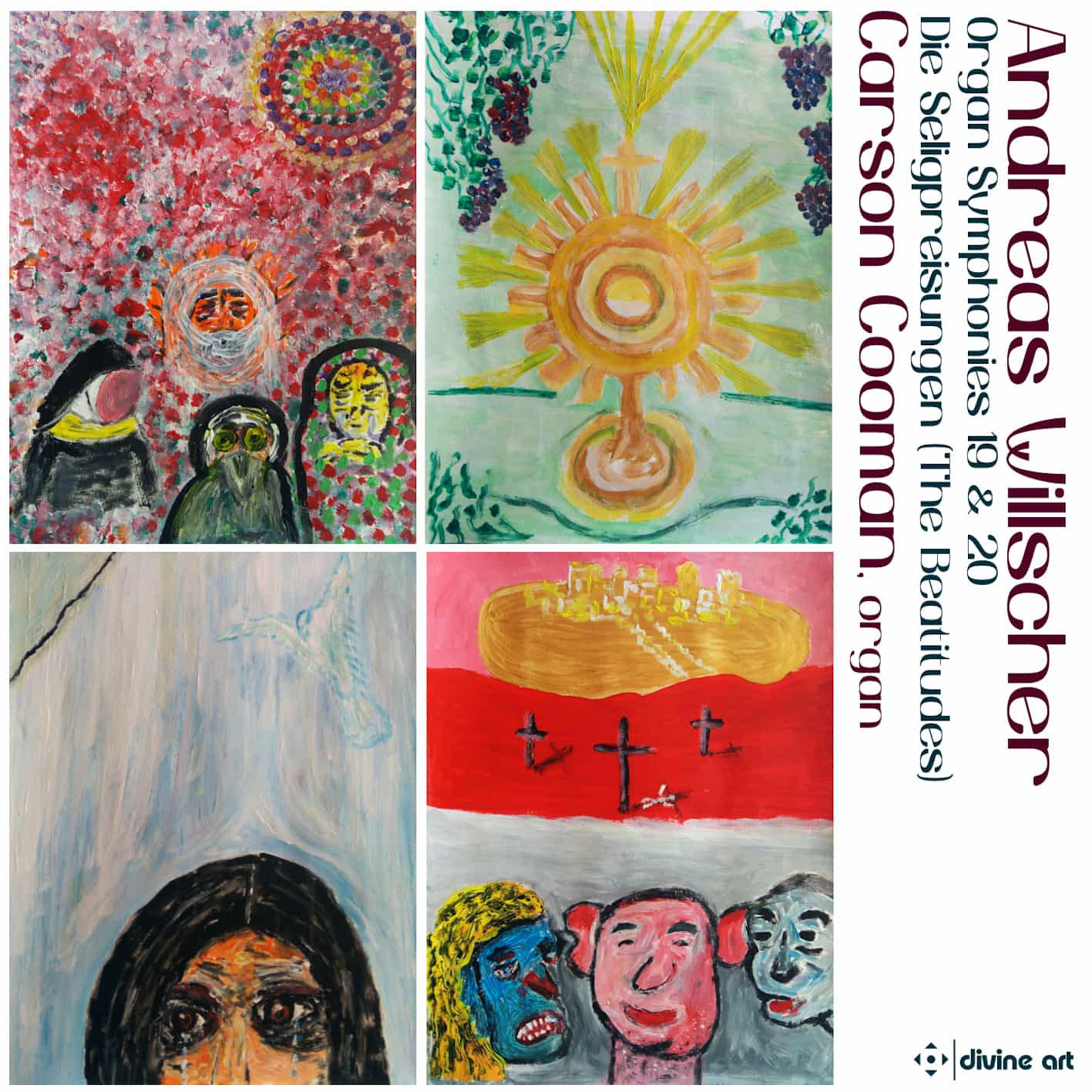
    I have previously reviewed several discs by Carson Cooman as a composer, but this is the first time I have encountered him as a performer. Once again, the new acquaintance is welcome; the playing here is absolutely terrific, with Cooman at every point making the best possible case for his friend and colleague’s music. While Cooman has dedicated himself as a composer and performer to advancing contemporary tonal music, this makes me really curious to hear what he would do with older masters such as Bach and Widor. The 1869 Edmund Schulze organ of St. Bartholomew’s Anglican Church, Armley, in Leeds, England—the complex history of which is detailed in the intriguing booklet notes—is a splendid instrument, and beautifully recorded. The booklet also contains the organ’s specifications, Cooman’s edited translation of Willscher’s detailed notes on his own pieces, and composer and artist bios and photos. The only minor drawback is the unappealing booklet cover, which features four paintings by Willscher, based on the four Beatitudes, in the currently trendy “crude art” style; let’s just say that Willscher would be well advised to keep his current day job instead. Fanciers of modern organ music seeking to expand their repertoire need not hesitate to acquire this disc; enthusiastically recommended.
  • Andreas Willscher organ music – musicweb review

    It is always good to hear contemporary music for organ and this CD will give a great deal of innocent pleasure. The music is tuneful, easy on the ear, but perhaps not especially memorable, despite the best efforts of the Divine Art recording team.

    The composer, himself an organist, has studied and worked principally in Hamburg.

    The organ is a notoriously difficult instrument to record, and the engineers have achieved wonders in capturing the organ of St Bartholomew’s, created by Edward Schulze. The Schulze dynasty, which dates back to the time of Bach, built the organ in Germany for use at Meanwood House, owned by Thomas Kennedy, who commissioned the organ for his wife, Clara. The first recital at Meanwood Towers was given by Samuel Sebastian Wesley. The organ was sold when Clara became ill and it was then placed in the Church of St. Peter in Harrogate (it was too big in tone, and sound was muffled). In 1879 it moved to Armley and has undergone various amendments and reconstructions. Thanks are due to David Butcher – who has worked on the organ – for his excellent essay on the organ in the accompanying leaflet. There is also very useful information at Lavender Audio which supplements the essay with further detail.

    It is interesting to compare the capabilities of this organ with the sound of the contemporary Father Willis instruments, which are perhaps more familiar to English listeners (Salisbury Cathedral has perhaps the ultimate example). The St Bartholomew’s organ has not often been recorded – I can currently find only Graham Barber’s collection, ‘Christmas at Armley’, recorded on a Priory disc, and a recital by Tom Bell of Brahms’ works for Organ, coupled with Schoenberg – a rather more challenging recital than the one on this CD.

    Willscher’s music falls easily on the ear and offers scope for colour – Carson Cooman’s sensitive playing shows very well the capabilities of the instrument. But, in a sense, there is the rub. The two organ symphonies and Die Seligpreisungen are pleasant and accomplished but I found in them nothing very distinctive. They could have been composed at almost any time in the last hundred years or so. They are biblical in inspiration, as their titles make clear. Organ Symphony No. 19 draws its name ‘Hallelujahs’ from five specific instances of praise in scripture, four from the Old Testament, the last from the visions in the Apocalypse, providing a joyous ending. Organ Symphony 20, ‘Laetare’, perhaps the most interesting of the three works, and here played by its dedicatee, is, as the title suggests, about instances of praise, though based on texts from across the Church year. (The title is potentially misleading: ‘Laetare’ Sunday refers to the 4th Sunday in Lent, when, by tradition, rose rather than purple vestments are worn: the name comes from the opening word of the Introit. Only the third of the five movements refers specifically to this Lenten mass). The symphony includes a variety of forms, whether variations in the second movement or settings of Gregorian melody in the third.

    Production values are very high, and this is a rewarding disc for lovers of the organ.
    Michael Wilkinson

  • Willscher – Organ Symphonies 19 & 20 review

    Composed in early 2017, the ink can barely have dried on Andreas Willscher’s latest symphonies before these recordings were made in the accommodating acoustics of St Bartholomew, Leeds. Carson Cooman follows his nimble account of Willscher’s Fifth Symphony with the 19th (Hallelujahs) and 20th (Laetare) Symphonies, the former setting five Biblical texts with contrasting deftness, the latter a low-key and contemplative blend of Gregorian chant melodies and a sacred folk tune. Despite the shared themes of rejoicing, the accent is largely – an intriguingly – on the understated, Cooman’s advocacy never less than committed and eloquent.

    The earlier (1974) Die Seligpreisungen (‘The Beatitudes’) boasts a sparkling toccata clearly relished by Cooman.

  • Andreas Willscher Organ Symphonies 19 & 20 review

    As an organist, Carson Cooman continues to add new recordings to his growing catalogue of ‘virtual’ pipe organ performances. Andreas Willscher Organ Symphonies 19 & 20 is the latest and once again uses the increasingly ubiquitous Hauptwerk digital sampling system. The instrument captured on this recording is the 1868 Edmund Schulze in the Church of St. Bartholomew, Armley, Leeds, England. It’s a substantial instrument of 55 stops over five divisions. Judging from the acoustic space heard in the recording, the church is large and suits the instrument perfectly. A curious piece of history recounts how the organ was originally placed in a building too small for its size and volume, lasting only a decade there before being sold and installed in its present location.

    Cooman’s program for this disc focuses on the work of German composer and organist Andreas Willscher (b.1955). His compositional language for the instrument is deeply traditional yet freely incorporates catchy contemporary rhythms along with carefully applied contemporary tonalities. The 1974 work Beatitudes is a remarkable piece for a then 19-year-old composer. The major works on the recording, the Symphonies 19 and 20, are both far bolder expressions. They also reflect Willscher’s lifetime experience writing for the organ , learning to exploit its vast range of colours and dynamics.

  • Willscher organ symphonies review

    Andreas Willscher has won many awards for his compositions, which range widely from symphonic forms and oratorio to cabaret jazz and rock. His organ works are especially fine and varied – involving often a mélange of post-tonal modernism, minimalism, and jazz and rock elements. Willscher is also an active writer of literary and scientific articles and as a collector and preserver of ‘lost’ and forgotten music of the past. Organ Symphony Nos 19 and 20 were both composed in 2017 so are truly contemporary. They are lively, thrilling works with great rhythmic vitality. The third work is a suite – The Beatitudes – composed in 1974 at the beginning of the composer’s career. Carson Cooman is organist of the Memorial Church at Harvard University and this is his second recording of Willscher’s music for Divine Art as performer. It was made on the Schulze organ (1868) in St. Bartholomew, Armley, Leeds in a live performance using the Hauptwerk system.

  • Willscher: Organ Symphonies 19 & 20

    Willscher: Organ Symphonies 19 & 20

    German composer Andreas Willscher has won many awards for his compositions, which range widely from symphonic forms and oratorio to cabaret jazz and rock. His organ works are especially fine and varied – involving often a mélange of post-tonal modernism, minimalism, and jazz and rock elements. Willscher is also an active writer of literary and scientific articles and as a collector and preserver of ‘lost’ and forgotten music of the past.

    Organ Symphony Nos 19 and 20 were both composed in 2017 so are truly contemporary. They are lively, thrilling works with great rhythmic vitality. The third work is a suite – The Beatitudes – composed in 1974 at the beginning of the composer’s career.

    Carson Cooman is organist of the Memorial Church at Harvard University and also a most prolific composer, writer and teacher.
    His works have appeared in many recordings and have been played in every inhabited continent. This is his second recording of Willscher’s music for Divine Art as performer (the first was of Symphony No. 5), and the label has already released thirteen CDs of Cooman compositions with many more planned.

    The recording was made on the Schulze organ (1868) in St. Bartholomew, Armley, Leeds in a live performance using the Hauptwerk system.