Catalogue Connection: 25163

  • Owl Night (Carson Cooman Organ music v. 8 – Chronicle review

    (note: this reviewer is writing mainly for a rock/pop audience)
    We’d like to be the first to compare organ music with Phil Collins.

    This latest in the never-ending series of CDs by Cooman and/or Erik Simmons (who plays) is the one we like best. Organ music can be a little formal or even ponderous, and there’s that whole echoey in a church thing going on, too. Not this time.

    This new CD sees the organ at the more meditative end of the repertoire and the songs are shorter, and thus allow no excessive noodling. Indeed, track two Postludium, has the organic equivalent of shredding (heavy rock, fast guitar solo) as Simmons whips his fingers up and down the keys repetitively.

    The title track is quiet and of “expendable duration”, which we think means the organist can stop when he gets bored. It was this track that flagged our attention as it almost forces the mind to relax — it’s ambient music, of a piercing nature admittedly.

    Cantio Mystica, dedicated to German composer and organist Wolfram Graf, is similarly atmospheric and mystical.

    Concerto Piccolo is a memoriam to Eberhard Kraus (1931–2003) and opens with an organ fanfare. The notes say Kraus “developed a personal blend of 12-tone technique (no idea) and the music is based on a 12-tone row used in Kraus’s own concerto …”. To our ears, ignorant of 12-tone techniques, the structure in the first movement is mid-career Genesis, mixed in with a splash of ELP (helped by the fanfare). It makes it sound modern. The proggy feel continues in the second movement, and we’d suggest that Comman is familiar with ELP’s Abaddon’s Bolero — it’s slower but the melody is similar in places.

    Two Fantasias, dedicated to German organist and composer Raimund Schächer, are the pieces that brought Phil Collins to mind. The melody could easily be adapted to a pop tune and the sound, say the sleeve notes, is “bittersweet: warm and sad”, the qualities that Collins evoked. The song also follows a poplike pattern. The same applies in Preludio Staccato, dedicated to German composer and organist Markus Nickel. It’s still an album of organ music, but gentle and more accessible than most.
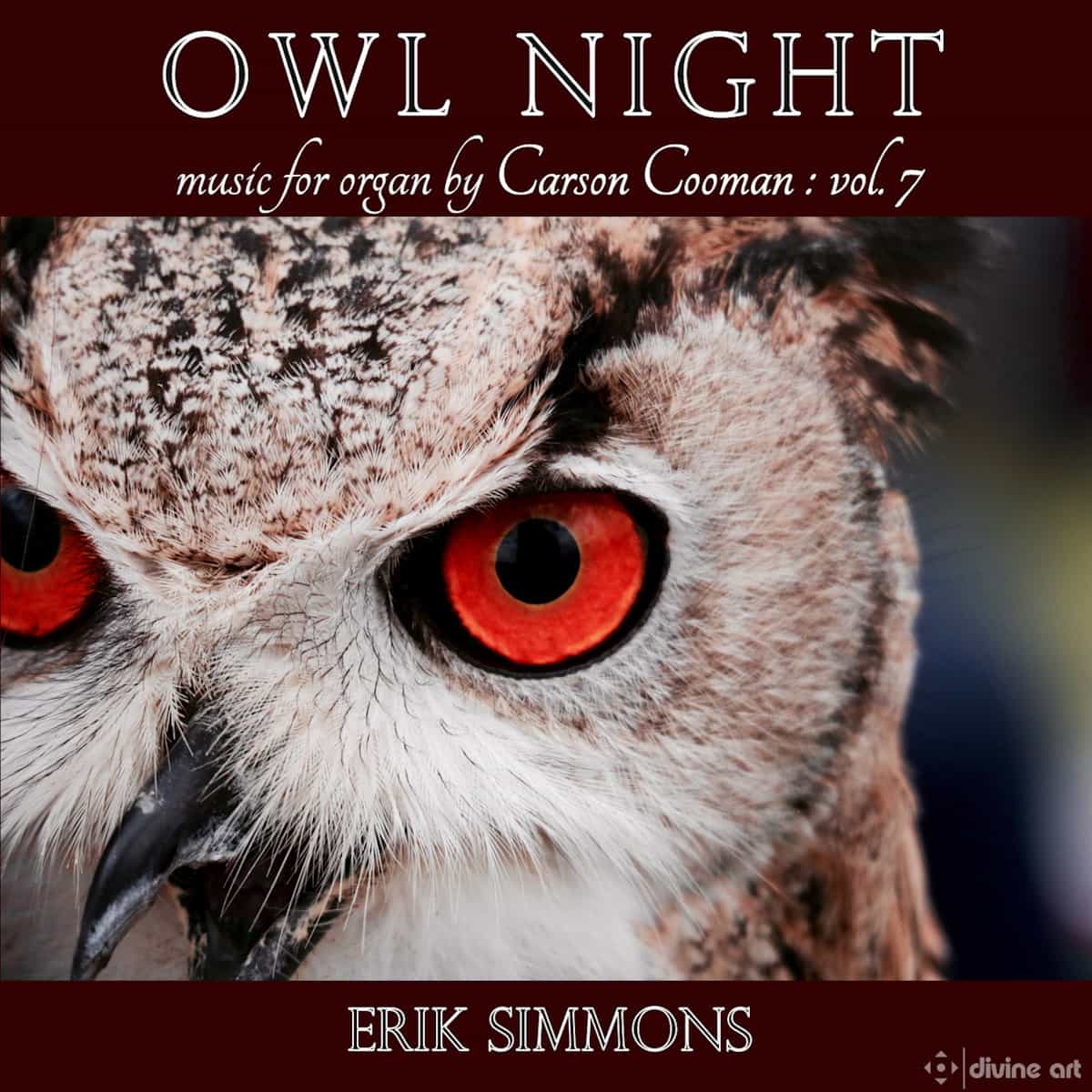
  • Carson Cooman ‘Owl Night’ – Fanfare review

    This is now Volume 7 in Divine Art’s series of discs devoted to the organ works of the extraordinarily prolific Carson Cooman, who seems well on his way to challenging Telemann for the title of most prolific composer in history. I gave approving reviews to Volumes 4, 5, and 6 in issues 38:1, 41:2, and 41:4. This new volume is cut from much the same cloth as its predecessor. Most of the works are of short duration—the closing Toccata, Aria and Finale is an exception for Cooman in being 12:02 in length—and predominantly on the quiet, meditative end of the spectrum. Once again, various pieces were written for (or in memory of) or dedicated to various other organists—Felix Brauer, Eva-Maria Houben, Eberhard Kraus, Wolfram Graf, Lucca Massaglia, Raimund Schacher, Reiner Gaar, Dietrich Hopfner, Markus Nickel, Erich Koch, and Flemming Hansen—as well as non-organists (Burkhard and Petra Mohr, and in memory of Dorothy Virginia Garman Blankenship). The idiom is always tonal, though some selections are leavened with varying degrees of dissonance, with tracks 2, 6, 10, and 17 being the most pungent. The five preludios have consecutive opus numbers (1171 to 1175) and form a kind of miniature suite that is my favorite section of this disc.

    Overall these works provide for pleasant if not memorable listening. I will confess to finding one work, the second of the Two Mantras (track 2), intensely irritating due to its monotonous use of a rapidly pulsating figuration *, and I also was not particularly taken with the closing Chorale of the Concerto piccolo (track 6), from which readers would rightly infer that Cooman’s spikier works are less to my taste.

    As usual, Eric Simmons is an able advocate for the composer, and is well recorded. As with the previous disc, Hauptwerk software is used for remote access to the organ actually heard, in this instance the Cavaille-Coll instrument of the Abbey of Saint-Etienne in Caen, France. Cooman’s brief booklet notes mostly provide basic data regarding his compositions (title, opus number, date, dedicatee) and a one-sentence characterization. As before, cordially recommended to the composer’s fans.

    * note from divine art: the reviewer is referring to a piece called ‘mantra’ inspired by the religious/meditational chanting of that name – which by its very nature is a repetitive pulsing figure……

  • Carson Cooman organ music vol. 7 Owl Night review

    Organist Erik Simmons’ new release Owl Night – Music for Organ by Carson Cooman is the seventh volume in this series. All the recordings use the digital modelling technology of the Hauptwerk system, enabling the recording to be made off-site. In this case, the Cavaille-Coll pipe organ of 1882-85 in the Abbey of Saint-Etienne, Caen, France is the instrument featured on the disc.

    Cooman is an American composer and organist whose output volume is astonishing. This recording presents recent compositions from 2016 and 2017. As a performer, Simmons has an affinity for contemporary organ music, and his exposure to Cooman’s work is extensive. The music takes full advantage, especially under Simmons’ hands, of the imaginative and emotionally evocative colouring of which the Abbey organ is capable. The title track Owl Night is an excellent example of this. Simmons uses a mellow flute rank to portray the extended hooting theme that recurs throughout the piece. Preludio Staccato is another example of the remarkable orchestral effects available on this instrument. Here, the mutation ranks create a lovely bell-like shimmer to the upper lines.

    The repertoire is well chosen and makes for very satisfying listening as a digital concert. The Toccata, Aria and Finale that concludes the program is suitably grand, and even on a mid-range sound system there’s no doubt about the power and grandeur of this magnificent pipe organ.

  • Cooman – Owl Night organ music review

    The prolific Carson Cooman has been producing an enormous output. Hundreds of works. An earlier volume of his organ music, Litany, I covered on these pages last March 11, 2014. Today we consider the latest volume of his organ music, Volume 7, Owl Night.

    I have not heard anything from Cooman that was not well-crafted and engaging. Owl Night is that and a good deal more. It is orchestral-depth organ music in the grand tradition that characterised the French school from Franck to Messiaen. That is not to say that you readily hear an influence so much as it has a beautifully dynamic mysterium and big sweep, not unlike the most ambitious French School organ music that we who love organ music find so appealing.

    The music on this volume was written in the second half of 2016 and the first half of 2017. It covers a good deal of ground. So “Two Mantras” manipulates repeating figures and variations on them as well. “Owl Night” is a moody, quiet reverie. “Concert Piccolo” uses a 12-tone row previously utilized by Eberhard Kraus in a work of the same name. The piece is in memoriam.

    “Two Fantasias” utilizes the same musical materials for contrasting movements, one bittersweet atmospherics, the other triumphant and majestic. Finally five Preludio, a Postludium, and a “Toccata, Aria and Finale” send us off with flair. Quietude and extroverted majesty alternate for a most fitting conclusion.

    There is a deeply organ-ic experience available in this volume. There is much to assimilate and richly so. It is not un-Modern, it is un-self consciously Cooman Modern. And it is a very good thing, that. I recommend this to anyone who loves the organ. And anyone who has not yet experienced Carson Cooman and seeks a living voice of distinction in New Music. Good music. Very good. Worthy of your ears, certainly.
    Grego Edwards

  • Cooman: Owl Night – Review

    Another entry in this immensely rewarding series, propelled as it is by Cooman’s apparently preternatural fluency in composing for his own instrument – everything here was written in 2016 and 2017 – without any suggestion of repeating himself. This volume reveals the composer’s range more than some of the previous ones, all of which had a different emphasis to the program. The pieces here range from grand and ceremonial (the second Fantasia, the Maestoso and Festivo preludes, which are fairly traditional (though always fresh and original) in idiom, to extrovert recessionals (the second Mantra, the Toccata and Finale) to more restrained pieces that could be used, for example, instead of the traditional Communion Chant during the Liturgy of the Eucharist. But some pieces here also remind us that Cooman is a versatile composer with well established modern credentials, such as the Ricercare, which employs Cooman’s system for generating modes of more than twelve notes, across different octave registers, which is capable of producing unusual harmonies and some striking dissonances, or the Concerto piccolo, which uses a note-row by the in memoriam dedicatee Eberhard Kraus (1931–2003), clothed in Cooman’s own harmony, or the Postludium, with its non-minimalist repeating patterns and vaguely Mediaeval melody.

  • Owl Night – Carson Cooman Organ Music vol. 7

    Owl Night – Carson Cooman Organ Music vol. 7

    Carson Cooman is many things musical – organist and Composer in Residence at the Memorial Church, Harvard University; writer, critic and consultant, concert organist, and above all a highly prolific composer of music in a wide variety of genres, from orchestral to song.

    His organ compositions come in many styles, from liturgical models, to more gritty and substantial pieces such as his organ symphonies and preludes and fugues. The music in this programme, all composed in 2016 and 2017, is varied and consists of concert pieces (though suitable for church use) as opposed to explicitly liturgical works.

    Erik Simmons is a fine organist, making his seventh Cooman organ album for Divine Art. He is playing the Cavaillé-Coll organ of the Abbey of Saint-Etienne, Caen, France in a live performance recorded through the Hauptwerk system.

    This is volume 7 of this highly praised series. Volumes 8-13 are now also available.