Catalogue Connection: 25165

  • Schwartz & Broadstock – Performing Arts Review

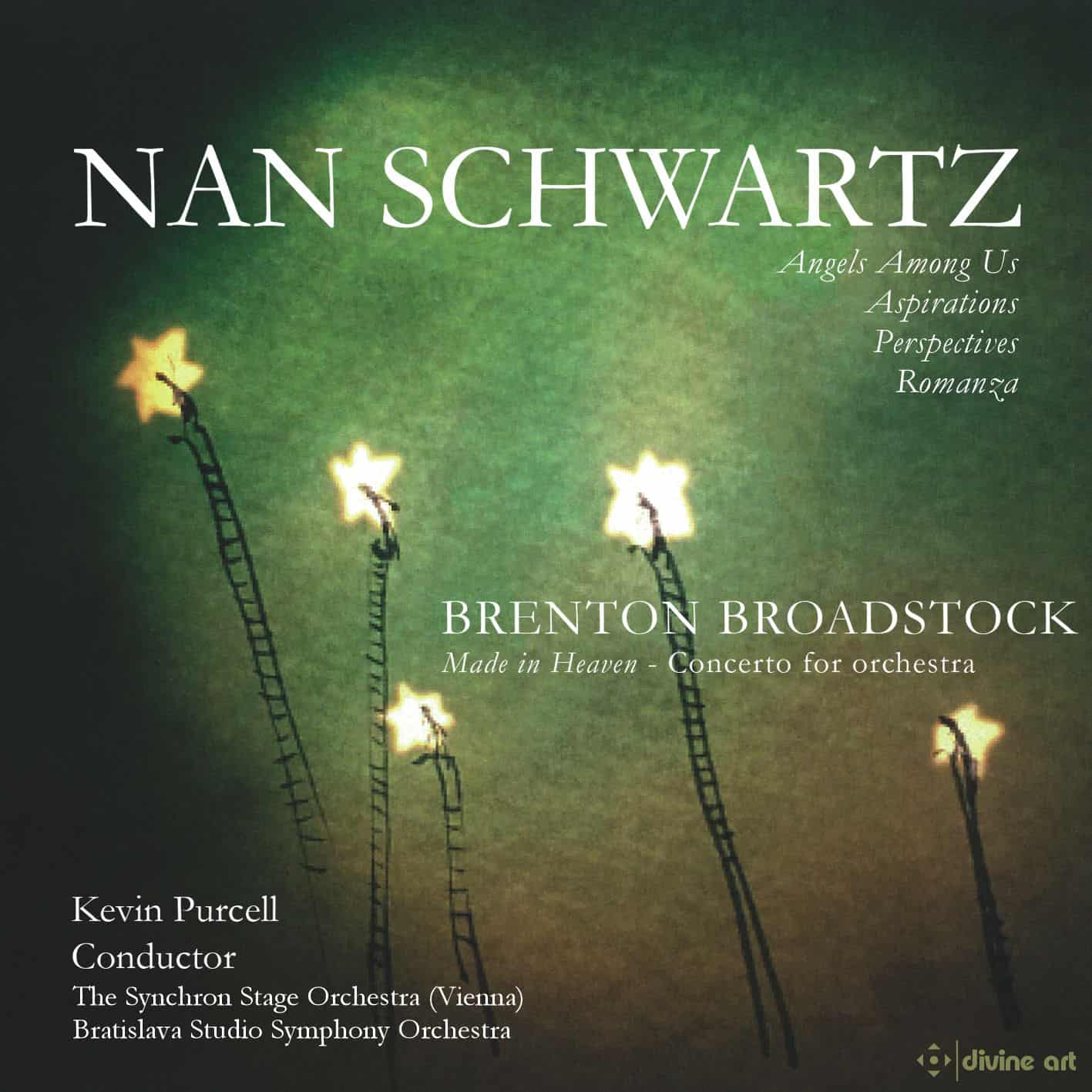
    Hollywood-based film and television composer, arranger, songwriter, conductor, producer and powerhouse Grammy Award winner (best arrangements for Natalie Cole), five time Grammy nominee and seven time Emmy nominee Nan Schwartz has released a fascinating disc of her orchestral music on the Divine Art label (2018) that recounts her journey as a master of composition and genie of the magic carpet ride that is orchestral color, harmonic purpose and narrative landscape rooted in personal experience. This disc presents premiere recordings of four Schwartz orchestral works – Aspirations, Perspectives, Romanza and Angels Among Us.

    Sharing the CD is a premiere recording by Australian composer Brenton Broadstock, his four-movement Made in Heaven: Concerto for Orchestra. Recipient of a 2014 AM – Member of the Order of Australia – for significant service to music as a composer, educator and mentor, Broadstock was Professor of Music and Head of Composition on the Faculty of Music, University of Melbourne from 1982 to 2007. His orchestral and chamber music, including six symphonies, several orchestral works, four concertos, three string quartets, a chamber opera and a raft of chamber music for diverse instruments is performed regularly by the major orchestras and chamber groups of Australia and throughout the world.

    Antipodes literally and figuratively – Schwartz lives in Los Angeles, Broadstock in Melbourne; hers has been a career in the hardscrapple world of Hollywood filmmaking, his rooted in academia – both nevertheless enjoy common ground in their love and respect for jazz that is deliciously palpable on this disc. A mastery of compositional lyricism and inventive orchestration seals the bond between the two composers and makes this CD so interesting.

    Schwartz has been awash since childhood in encounters with legendary jazz artists who were regulars at her parents’ home in Hollywood. Her music is infused with that aesthetic. Aspirations, which opens the CD features soloists Harry Allen tenor sax and pianist Lee Musiker and speaks vividly to Schwartz’ understanding of the art of orchestration and her unerring sense of harmonic movement; purposeful, emotive and full of textured character. Perspectives features Jon Delaney on electric guitar in a mellow, convivial dialectic with pianist Musiker to sophisticated jazzy orchestral asides à la Henry Mancini. Violinist Dimitrie Leivici is the soloist for Schwartz’ Romanza, where the composer’s careful construction of emotional electricity and frisson colors the narrative beautifully.

    Angels Among Us features trumpeter Mat Jodrell and is the most sophisticated of the four Schwartz works on this CD. The opening bars of the piece shimmer with suspense; Schwartz’ use of the trumpet’s low register creates an evocative and touching narrative ambiance; jazz colors abound discreetly; a solo trumpet cadenza and vibrant coda end the quasi-concerto in a splash of breathtaking chutzpah. Trumpet soloists, take note!

    Brenton Broadstock’s Made in Heaven Concerto For Orchestra (2009/2013) is an abstract tribute to the iconic jazz recording Kind of Blue (1959) that featured a royal family of jazz artists including Miles Davis, Cannonball Adderley, John Coltrane, Wynton Kelly, Bill Evans, Paul Chambers and Jimmy Cobb. The concerto’s four movements – So What?, Flamenco Sketches, Blue in Green and All Blues are cyphers, Broadstock’s compositional language opaque rather than literal. Like Schwartz, Broadstock is a master of ebb and flow, managing the vast orchestral soundscapes of Made in Heaven with magical realist results, like the sound imagery in Flamenco Sketches, the quizzical temperament of So What? and moody introversion of Blue in Green. Rhythm and pulse the heart and soul of jazz, bring Broadstock’s visionary homage full circle with the playful last movement All Blues.

    Two wonderful orchestras, the Synchron Stage Orchestra Vienna (Schwartz) and the Bratislava Studio Symphony (Broadstock) perform splendidly under conductor Kevin Purcell.
  • BBC Music Magazine short review Schwartz and Broadstock

    Evocative and tuneful music from Schwartz and Broadstock, with the former’s given a top drawer reading by some of Vienna’s finest players. A disc I’d definitely spin again.

  • Schwartz & Broadstock – Limelight review

    This release pairs film/television composer and orchestrator Nan Schwartz with Australian composer Brenton Broadstock in a program of orchestral music with its roots deep in jazz.

    Raised at the heart of the Hollywood music scene, Schwartz’s sound has a lithe, film-score clarity, showcased in lucid performances by Australian conductor Kevin Purcell and Vienna’s Synchron Stage Orchestra. The brooding Aspirations and nostalgic Perspectives – shot through with (another Aussie) jazz guitarist Jon Delaney’s atmospheric solos – were written almost two decades apart for The New American (later Henry Mancini Institute) Orchestra. Angels Among Us sees Mat Jodrell’s trumpet evoke distant, elegiac longing, while Romanza’s wistful violin (Dimitrie Leivici) floats above cool strings.

    Broadstock wrote Made in Heaven – a love song to Miles Davis’s iconic Kind of Blue – in 2009 as a concerto for James Morrison (on multiple instruments) during his tenure as the Melbourne Symphony Orchestra’s Composer in Residence, revising the work as a ‘concerto for orchestra’ in 2013,. Here Purcell conducts the Bratislava Studio Symphony Orchestra.

    The movements correspond to tracks on Davis’s album; the first, for instance, takes the simple repeating cell from So What, expanding and transforming it in broad orchestral colours. It’s a work of glittering colour and gleaming brass – a perfect companion to the Schwartz.

  • Nan Schwartz & Brenton Broadstock review

    Los Angeles-based composer Nan Schwartz has been multiply nominated for Grammys and Emmys. Her pedigree is impeccable: Her father played with the Glenn Miller band and her mother worked with the likes of Tommy Dorsey as well as being a studio singer for legendary names such as Sinatra and Dean Martin. Schwartz herself has worked on films such as Life of Pi and Harry Potter and the Deathly Hallows, Part One. Excerpts of her work can be found at her website, nanschwartz.com.

    The present disc presents four of her works. Schwartz names Ravel, Walton, and Shostakovich as her principal musical loves, and certainly there is a Ravelian lushness (and expertise) to her scoring. Premiered in 1984, Aspirations frequently evokes a dream-state. The performance is magnificent. Conductor Kevin Purcell has a fine ear for sonority, and supporting that, the recording is demonstration standard, with great perspective. The long tenor sax solo is expertly done by Harry Allen.

    Initial hints of Copland are soon subsumed into a more mysterious argument in Perspectives, a title that refers to the multi-functionality of notes themselves in certain situations; a reflection of this is the multiple perspectives people have on a variety of issues. The guitar solo, played in wonderfully laid-back fashion by Jon Delaney, is superb, owing much to Pat Metheny. The piece Romanza has a pronounced solo violin part, here sweetly delivered by the Romanian Dimitrie Johann Leivici, who has freelanced in the Hollywood Studios since 1977.

    Receiving its first performance on this disc, the tone poem Angels Among Us is actually a commissioned work for a specific occasion; unfortunately, the event itself was not to be, but the work remains. The title refers to those unseen forces that may help us to keep us on track in life (the angels of the title, and our guides, perhaps). There is a sense of space around this piece as well as mystery. There’s no missing the filmic basis to the aspirational brass melodies, but throughout it is the sensational solo trumpet of Mat Jodrell. Jodrell’s legato is impeccable, his sense of line faultless and, in the unaccompanied solo towards the end of the piece, his registral command is beyond criticism. He moves from the top end of the trumpet’s range to the very bottom with perfect ease.

    The 2009 (revised 2013) piece Made in Heaven by Australian composer Brenton Broadstock is designated as a “Concerto for Orchestra”; it receives its premiere recording here. It is also a musical tribute to the jazz recording Kind of Blue (a disc whose line-up included Miles Davis, John Coltrane, and Bill Evans). The four movements are each inspired by one of the tracks on Kind of Blue (“So What”; “Flamenco Sketches”; “Blue in Green”; and “All Blues,” in that order), while the title of Broadstock’s work comes from the liner notes to Kind of Blue. While “So What” may be decidedly unsettled, “Flamenco Sketches” finds repose in its outer sections (which house a more extrovert Spanish-style dance). The stillness of “Blue in Green” is however less settled; the peace of “Flamenco Sketches” was clearly illusory. There is huge, heart-rending beauty in this movement before the swirling opening of “All Blues” marks the onset of the headlong finale that ends in a blaze of light.

    Two recording venues were used, one in Austria, the other in Slovakia, and the technical excellence of the recording is consistent throughout. There is also, it should be noted, a lot of fun to be had here.

  • Nan Schwartz & Brenton Broadstock – Fanfare review

    In 40:2, I wrote about the Concertino for Euphonium and Piano by Australian composer Brenton Broadstock, calling it “a major addition to the concerto repertory of the euphonium.” Needless to say, I was quite enthusiastic to receive this CD for review, for in the meantime, I’ve read somewhere (not in Fanfare) that this composer’s Made in Heaven—Concerto for Orchestra was being called a 21st-century masterpiece. You’ll get to my review and opinion of the work shortly, but I will also mention here that Nan Schwartz is a new composer to the Canfield ears, as well to the pages of our esteemed magazine. Since she is presented first on the disc, I’ll start with a few words about her and her works.

    Schwartz grew up in a musical household (her clarinetist father created the famous Miller” sound, while her mother was a singer who performed with many luminous musicians including Tommy Dorsey), so perhaps her career in music was foreordained. It wasn’t, however, her original intention, which was to be a TV producer. Instead, a skiing accident laid her low for nine months, the enforced rest giving her the opportunity to pursue her secret dream of being a Hollywood composer. Her compositional break came when Los Angeles icon Jack Elliot encountered her music and commissioned her to write a piece for the New American Orchestra of which he was the co-founder and director. This commission resulted in her Aspirations, which opens this concert. She has gone on to receive a Grammy Award and seven Emmy nominations for her music for television.

    Given her lineage from parents steeped in the big band tradition, and the fact that Elliot’s orchestra was also well connected with the jazz and film worlds, one might expect that Schwartz’s music would display influences from her heritage, and that it does. However, it also the case that some of her favorite composers include Ravel, Walton, and Shostakovich, and these have made their mark on her style as well. What one hears, then, is a music showing lots of disparate influences, but skillfully put together into a personal style that is Schwartz’s own. Not only does she have a very good ear for orchestral color, but she also has mastered the critical component of flow in a piece of music, such that her music never stagnates or wears out its welcome. Thus, in Aspirations, the piece begins in a rather classical idiom, with a gorgeous sweep of ideas, but around the six-minute mark takes a turn towards the jazz world, where a sultry and silky tenor saxophone solo takes over for a good portion of the remainder of the work. It’s neither completely jazz nor classical, but a very pleasing synthesis of the two worlds, and is absolutely gorgeous to my ears.

    I confess that despite my writing, writing about, and listening to classical music almost exclusively, I have a soft spot in my heart for jazz and even good easy listening music. The latter was what I listened to on the radio when I was in my early teens and babysitting my younger siblings after they’d gone to bed, and this kind of music kept me—somehow—from falling asleep myself. So it would seem our esteemed editor (doubtless serendipitously) sent this CD to exactly the right reviewer. Thus, if Schwartz’s music sometimes verges into easy listening territory, it’s so good that I cannot help but like it. This style carries over into her other works including the following work, Perspectives, which features solo guitar and piano that weave in and around each other in clever interplay. The piece has a pronounced big band beat in certain portions of it, and sensual suavity in others. Perhaps my favorite of Schwartz’s works heard here is her Romanza for violin and orchestra—the violin is my favorite instrument, after all. It opens with just about the most gorgeous sequence of chords I’ve ever heard, and the beauty continues with the elegant lines in the violin all the way to the close of this five- minute work. I am left wanting more, in part because of the beautiful tone of violinist Dimitrie Leivici. Angels Among Us is the longest of the four works and features a trumpet solo throughout, and is more classically oriented than most of the other works. The trumpet a good hit of the time assumes a lyrical rather than heroic or military style, but occasionally wanders up into the jazz stratosphere, including the final lick that almost exceeds the kilohertz frequency that my ears can hear.

    Melbourne-based Brenton Broadstock (b. 1952) studied with my friend, composer Don Freund (only five years his senior), although at a time before the latter joined the composition faculty of Indiana University. Broadstock also worked with iconic composer Peter Sculthorpe and is the composer of six symphonies and concertos for euphonium, tuba, piano, and saxophone, as well as several string quartets and even a chamber opera. He has received wide recognition in Australia, including the prestigious Don Banks Award from the Australian Council for his contribution to Australian music. Now, he seems to be in the process of bridging that big body of water between “Down Under” and “Up Above,” i.e., here in the North American continent.

    His Made in Heaven is a four-movement concerto for orchestra, written in a pleasing tonal style that immediately thrusts its tunes and catchy rhythms into the listener’s brain. Like the music of Schwartz, this work is highly influenced by the jazz idiom, although to call it even “Third Stream” might be going too far. Prominent in the first movement is a two-note motive played mainly by the solo trumpet. The second movement is entitled “Flamenco Sketches,” but seemed much too laid back for that title until it finally got cranked up several minutes into it, while the third, “Blue in Green,” suggests to my ears a summer scene lounging around on the beaches along the Australian coast (which are quite a sight to behold, as my wife and I discovered on our visit there in 2009). The final movement, “All Blues,” is a lively affair, but not really blues to my ears. The opening, in fact, sounds as though it has wandered over from Ginastera’s Estancia, and a certain Latin flavor continues throughout the work, although I also hear echoes of Antill’s Corroboree Ballet. The piece does not attain the masterpiece status accorded it in the other magazine, but is very enjoyable to listen to, and many listeners would find it as delightful as I did, although I find the subtitle, Concerto for Orchestra, a hit misplaced. If you’re hoping for something along the lines of those written by Bartók, Lutoslawski, or Kodály, you may be disappointed.

    To sum up. if your listening is confined to “long hair” music in whatever style, these works probably won’t be your cup of tea, but if you’re built of broader musical stock, I believe you’ll find much to savor in these five works. All of them could hardly be better and more idiomatically per¬formed than they are by Kevin Purcell and the Synchron Stage Orchestra in Vienna, who recorded Schwartz’s music. Purcell didn’t have far to travel to record the Broadstock work in Bratislava, Slovakia, which is only about an hour’s drive from Vienna, and the orchestra there does an equally fine job in presenting Broadstock’s music in the best possible light. Recommended then to—well, you know who you are.

  • Nan Schwartz – accolade

    To say that Nan Schwartz is one of America’s significant gifted composers is an understatement.

    On her recent recording “Aspirations” the composer unleashes her masterly skill to create a swirling impressionistic and breathtaking work.

    While comfortably at home in the jazz idiom, Nan creates a full symphonic score to give her music dimension, scale and colour. Here the depth and texture of a grand orchestral setting sits completely at ease with her chosen swing ensemble. This fusion has an infectious momentum which underpins the composer’s lavish and inventive orchestration. Only one who commands such an ingenious imagination combined with a composed dexterity can make these challenges of musical juxtaposition seem so effortless.

    In this new work, Nan Schwartz allows the listener to journey into the full weight of her inner writing.
    The ebb and flow of music is untroublesome and this work draws upon her experience in threading together story and drama. The constant tension and release is utterly masterful in its musical concept and execution.

    I am privileged to work with some of the world’s finest composers and musicians and day-by-day experience the thrill of having music enrich my professional and personal life, and it delights me to hear the originality and creativity in this world-class work from Nan.

    Although being a person of elegant modesty, Nan’s epic work displays a proficiency rare in today’s contemporary music. These expressive pieces give acknowledgment to a thoroughly unique and engaging modern voice amplifying the notion that Nan Schwartz is one of our great treasures to be heard and relished.

  • Brenton Broadstock – Made in Heaven review

    Brenton Broadstock has something to say (or hear) and he makes the four sections of the concerto melodic and listenable. He knows how to start and end each section with a dominant theme that involves the listener and captures your interest. The intervening themes are interesting, and he returns to a slightly altered original theme at the conclusion of each section. I found the concerto thoroughly enjoyable.

    The orchestra plays very well for conductor Purcell. Excellent sound.

    [edited from longer review including other works]

  • Schwartz and Broadstock orchestral music

    If you’ve ever played your favourite album of film soundtrack music and thought: “Hmmm, if only they’d thrown in some jazz guitar, this would be perfect,” then this is for you.

    To make it clear: most of this album is palatable and listenable but it’s not lightweight classical film fare.
    This is music with gravitas, but melodic and made easy on the ear by the skill of the composer. It’s (mostly) a long way from the jazz/easy listening music of Henry Mancini; it’s not just Mancini with George Benson thrown in, and the jazz is only occasional.

    There is a Mancini connection though: Nan Schwartz’s father was Willie Schwartz, whose clarinet created the “Glenn Miller Sound” and who played on nearly every Frank Sinatra recording, before becoming one of Hollywood’s most in-demand studio musicians. Her mother, Peggy Clark, sang on such chart-topping hits as Sunny Side of The Street and Chicago. Family friends included Mr Mancini.

    The opening piece Aspirations opens seriously, with a romantic sound, slightly windswept and dramatic (in a film it would be a woman in a billowy dress striding across the moors). In places it has a spatial majesty (the notes we made mention Holst and Mars) but then towards the end comes an easier jazz section, with the sax of Harry Allen.

    Perspectives starts off gently with strings; Schwartz includes a rhythm and percussion section to give the piece a jazz feel and there is a Pat Metheny-inspired guitar.

    Praise should go to the Synchron Stage Orchestra, whose members are session players with the skill to learn complicated pieces quickly; the third piece, the lovely Romanza, was equally quickly created. Schwartz needed one more piece to fill the album, and had a piece her heart wasn’t in, so started afresh and gave the starring role to concertmaster of the Synchron Stage Orchestra, violinist Dimitrie Leivici.

    Brenton Broadstock contributes the second half of the programme, Made In Heaven, a musical tribute to the iconic jazz recording Kind of Blue (Miles Davis et al). It does not quote any melodies but is a serious composer’s attempt to write a work inspired by jazz. It is orchestral and divided into four movements recognisable from the Miles Davis: So What, Flamenco Sketches, Blue in Green and All Blues. The Davis version of So What has that distinctive opening and Broadstock copies the structure, though without knowing you’d not connect the two. Made In Heaven fits in well with the Schwartz; serious music but listenable and with a spring in its step.

    This is out now on Divine Art, DDA 25165. It features the Bratislava Studio Symphony Orchestra and Synchron Stage Orchestra.

  • Schwartz & Broadstock orchestral

    These highly approachable, thoroughly tonal works make up a most appealing programme. The conductor offers a spirited defence of their credentials in the booklet, though it is not clear by whom they were under attack. Both composers, in rather different ways, have been influenced by jazz, and both have written works with some ‘crossover’ appeal, but there is no suggestion that these are anything but finely crafted concert works, enjoyable by anyone with a taste for lush neo-romanticism. Schwartz is a multiply-awarded film composer and arranger for big names in jazz, who writes in her program note about her affinity for jazz and her ‘classical’ listening tastes – harmonic sophistication and soaring melodies. Like most successful film composers, she does ‘soaring melodies’ rather well, and both Aspirations and Perspectives emerge as skillful examples of romanticism-influenced high-quality film music suites in the form of tone poems which give way to discrete episodes of actual jazz, with jazz soloists, and then resume their concert music style. Angels Among Us has a concertante trumpet part with jazz inflections, but unlike the other two large works its concert style is influenced by John Adams-like post-minimalism. The bittersweet little Romanza was written to feature the solo violin of the concertmaster of the orchestra here, and was written for this recording. We encountered Broadstock as a full-blooded neo-romantic a decade ago on a now-unavailable ABC disc. This work is a four-movement tribute to the iconic, star-studded 1958 jazz album “Kind of Blue”. Without quotation it borrows from jazz harmonies, blues motifs and flamenco in a sumptuous, jazz-infused piece of concert music.

  • Schwartz & Broadstock Orchestral Music: MusicWeb review

    Since first hearing Earl Wild play Gershwin’s Piano Concerto in F major with the Boston Pops Orchestra under Arthur Fiedler, I have enjoyed ‘Symphonic Jazz.’ As the years rolled on, I have discovered several works that have become firm favourites including less well-known exemplars such as Leonard Salzedo’s/David Lindup Rendezvous for jazz band and symphony orchestra and Mátyás Seiber’s Dankworth Improvisations for Jazz Band and Symphony Orchestra. My all-time Desert Island Disc (in this genre) is Richard Rodney Bennett’s Jazz Calendar for twelve players. So, I was delighted to discover several more splendid examples of the genre on this present CD.

    Let’s begin with Australian composer Brenton Broadstock’s superb Made in Heaven: Concerto for orchestra. This long four-movement work is a sheer delight to listen to. The composer writes that it is a ‘musical tribute to the iconic jazz recording Kind of Blue made [by Miles Davis] in 1959.’ Other players on that ground-breaking album included Cannonball Adderley, John Coltrane and Bill Evans. Broadstock is keen to point out that Made in Heaven is not an arrangement, nor a transcription, and does not actually quote any material from the album. It is simply a starting point for an exciting fusion of jazz, rock and classical music. The composer defines it as a ‘symphonic metamorphosis.’

    Broadstock’s work was composed in 2009 and had five movements, paralleling the five original tracks on the album. In 2013 the work was revised, with a movement deleted and the others reordered. The title reflects drummer Jimmy Cobb’s comment that Miles Davis album was ‘made in heaven. The four movements are ‘So What’, ‘Flamenco Sketches’, ‘Blue in Green’ and ‘All Blues’. Miles Davis aficionados will know that the missing movement was ‘Freddie Freeloader.’

    There is no need to analyse Made in Heaven. It is just quite simply outstanding from end to end. I have listened to it at least three times as a part of my review: it has already become a ‘favourite.’ Although Brenton Broadstock states that it not meant to ‘recapture the jazzy coolness’ of the album, for me it is cool, laid back and thoroughly delicious. Details of the composer and his music are available on his excellent webpage.

    I then turned my attention to the four works by Nan Schwarz. I must hold up my hand: I have never listened (consciously) to any of her music. And the reason is simple. Her massive reputation is largely, but not entirely, built on film-scores both as an arranger and as a composer. I do not watch much television, and when I do, it tends to be DVDs of old favourites such as the Ealing Comedies, Carry On Films, The Avengers and other such light-hearted stuff. I very rarely go to the cinema (too much popcorn crunching for my taste nowadays), so tend to miss out on that experience. So, looking at her entry in the Internet Movie Database, does not tell me much, except that she is extremely prolific and highly regarded in the world of contemporary film music, most of which I have neither seen nor heard of. The present album turns away from the film studio into the concert hall: my interest was immediately aroused.

    Four contrasting pieces are presented here. Each feature one or two soloists. The opening Aspirations was composed in 1984 and was commissioned by Jack Elliot. At that time Elliot was Musical Director of The New American Orchestra. This organisation’s aim was ‘to present works that blend the classical European style orchestra with modern American jazz style.’ Influences on Schwartz at that time included Ravel, Walton and Shostakovich: all these had composed jazz-influenced works.

    Aspirations is a through-composed piece that continuously unfolds, rather than expounds, develops and recapitulates. The saxophonist Harry Allen and pianist Lee Musiker bring considerable jazz-inspired, and often ‘smoochy,’ playing to the latter half of this gorgeous and totally satisfying tone-poem. The mood balances jazz harmonies with film music style as well as being an enduring take on the late-romantic musical style.

    Schwartz’s second piece is Perspectives. The concept here is twofold: any musical idea, theme or note can be looked at from a different angle or ‘perspective’ and ‘a note can function differently and have a different emotional payoff in a different harmonic context.’
    A full rhythm and percussion section is used to ‘propel the music in contemporary jazz fashion.’ Jon Delaney contributes a Pat Metheny style guitar solo. Whatever the philosophical underpinnings of this piece, the music is once again a subtle balance of jazz and classical. It is a sheer pleasure to listen to this ‘cool’ music.

    The third piece, a short Romanza (undated) does not seem to have a programme or philosophical underpinning. Schwarz writes that her aim was ‘to simply write something beautiful that touched me…’ This is well-achieved here.

    The violinist Dimitrie Leivici provides a classically-balanced and often passionate solo part. This is the least jazz-inspired work on this CD: this timeless ‘Romance’ is as good as anything written in this form from the time of Beethoven onwards.

    Angels among us
    was composed in 2003, for ‘a trumpet player and well-known symphony orchestra.’ However, the work was not given at this time. It is finally presented on this CD in its ‘premiere performance.’ The ‘concertante’ part is played by trumpeter Mat Jodrell. The piece opens with an atmospheric film score type of effect, before the soloist begins his sulky explorations. And there is just the odd hint of ‘Reichian’ minimalism.

    There is a theological element to this music: Schwartz writes that ‘the music depicted the internal struggle between evil and good.’ And naturally we are aided and abetted by our ‘good’ or ‘Guardian’ angel. I put this concept aside and just enjoyed this thoughtful tone-poem and Jodrell’s evocative trumpet playing.

    The liner notes are excellent, with explanatory essays by the conductor Kevin Purcell, the composers and Conrad Pope. There are the usual brief biographies about the composers and performers. I was unable to find a birth date for Nan Schwartz. The notes are presented in Japanese and Traditional Chinese as well. I cannot fault the vibrant recording of all five pieces. The balance of jazz soloists and symphony orchestra is ideal. Clearly all the performers enjoyed this music and entered the spirit of this stunning cross-over music.

  • Schwartz and Broadstock orchestral music review

    Until Divine Art Recording Group sent a copy of a CD of Nan Schwartz’ music and that of Australian composer Brenton Broadstock, I had never heard of either composer, both of which are featured in a handsomely designed and annotated CD of original works for symphony orchestra.

    Nan Schwartz has worked for years as a much in demand arranger of music for film and TV, and her compositions evidence her prowess as an orchestrator. In her own notes on the recording she acknowledges William Walton, Maurice Ravel, and Dmitri Shostakovich – all three composers who, like Ms. Schwartz wrote for film, as favorite influences. Indeed, in the opening bars of Aspirations there are hints of Ravel’s Daphnis and Chloe, and at the turn of the corner there is a tenor sax given a soulful reading by Harry Allen that is unpredictably and simply pure jazz.

    In Perspectives, Nan Schwartz briefly flirts with polytonality, creating initially a conversation for Jon Delaney’s guitar and Lee Musiker’s keyboard which then breaks out into an up tempo. In Romanza, the elegant Dimitrie Leivice is featured in a sweeping violin solo. In Angels Among Us, the lengthiest of the four tracks, the composer gives the terrific trumpet player Mat Jodrell a soliloquy against a backdrop of obstinato figures from strings and woodwinds. A juxtaposing of tempi, dynamics, tonality, and the alternating of soloist and ensemble give much of Nan Schwartz’s appealing music a uniquely sui generis sound.

    Neither ‘classical’ nor jazz the music of Brenton Broadstock is most intriguing and in no way derivative, even though on first and then a second hearing I kept hearing riffs that reminded me of some of Duke Ellington’s larger works and passages with echoes of some of Max Steiner’s film music. But let me be clear, as evidenced by this album, this composer is a true original who succeeds in this for him rare foray outside the world of the concert hall.

    Commissioned by the Melbourne Symphony Orchestra in 2009, Made in Heaven – Concerto for Orchestra shuns the traditional concerto structure opting instead for a tone poem structure that divides the work into four separately-titled movements: So What, Flamenco Sketches, Blue in Green, and All Blues.

    The superb Bratislava Studio Symphony Orchestra, magisterially conducted by Kevin Purcell, who also helms the Synchron Stage Orchestra of Vienna in the first four tracks of the CD, plays Broadstock’s and Schwartz’s eminently tonal, richly melodic music with the same care it would give a Beethoven symphony.

    Hats off to the composers, the conductor, and the musicians of both orchestras!

  • Nan Schwartz & Brenton Broadstock – Orchestral Music

    Nan Schwartz & Brenton Broadstock – Orchestral Music

    As a woman composer who has carved an enviable reputation inside the crucible of the Hollywood Film Music business, Nan Schwartz nonetheless remains an enigma to orchestras and concert music audiences around the world. This apparent anomaly can, in part, be ascribed to the imbalance in respect to opportunities for women composers generally, but given that Nan is a Grammy winner, 5-time Grammy nominee and seven-time Emmy nominee, it remains perplexing that the classical music world has taken so long to recognize her indisputable genius.

    This album beautifully directed by the eminent Australian conductor, Kevin Purcell, brings to light through these premiere recordings the extraordinary music of this iconic, contemporary, American composer.

    The album further includes the premiere recording of a new Concerto for orchestra composed as a paean to Miles Davis’s 1959 iconic Jazz album, ‘Kind of Blue’, by leading Australian composer, Brenton Broadstock.

    BOOKLET IN ENGLISH, JAPANESE AND TRADITIONAL CHINESE