Catalogue Connection: 25166

  • A Garland for John McCabe review in American Recorder

    John Turner organized A Garland for John McCabe as a tribute to the noted English composer (1939-2015) and Turner performs on 12 of the 19 tracks. McCabe’s dual career as pianist and composer placed him in contact with many in the art music world; the 19 composers who contributed these pieces include his friends, colleagues and students.

    The sequencing of pieces on this disc crates an engaging flow of sound. The notes from each composer combine with the essay by the composer’s widow Monica McCabe to create a moving text tribute that heightens the impact of the music.

    All of these short pieces (durations range from 1’53” to 7’42”) are combinations for recorder, clarinet, viola and piano (with one piece a viola solo and another a piano solo). The musical languages are tonally centered, and the affect largely contemplative (but not mournful). The timbral combinations – including use of very high and low recorders – capture the listener’s ear.

    The recording quality of the disc is excellent. A viable alternative is either the high definition (such as HD 24-bit) or the CD quality (FLAC 16-bit/44k) downloads,

    Divine Art Recordings deserves much praise for providing the booklet online. They deserve further praise for making the recordings available via YouTube.

  • A Garland for John McCabe – review in The Clarinet

    John McCabe (1939-2015) was a distinguished English pianist, composer and writer on music. His compositional output was sizable, specializing in concerti and chamber music. There was a special affinity for the clarinet in his catalog: no less than ten chamber works included clarinet, in addition to an unaccompanied piece and a clarinet concerto.

    It is through this lens that we are appreciative of all the composers associated with A Garland for John McCabe, an anthology of tributes from 19 composers to the memory of McCabe. Of the 19 works on the album, 12 feature the clarinet. The instrumentation varies within the quartet of instruments: clarinet, recorder, viola and piano. None of the works are longer than 6 minutes and 20 seconds, excellent for inclusion on concerts of any length.

    Peter Dickinson’s rag for the quartet is a charming minor-key take on the genre. The pieces on this album utilizing both recorder and clarinet prove to be a viable pairing, especially the low clarinet in octaves with the thinner recorder. Saxton’s Prelude is based on the upper case letters of McCabe’s name. The intricate counterpoint arrives at a satisfying conclusion. Highland Song by Howard Skempton, for recorder, clarinet and viola, evokes the Scottish soundscape of that region. A lovely clarinet soliloquy is followed by a pastoral trio. The clarinet and viola duet that concludes the piece is expertly wrought.

    Elis Pehkonen’s Lament for the Turtle-Dove is based on one of his favorite medieval plainchant melodies, Benedicamus Domino. Inspired by the birds in and around Pehkonen’s garden, Lament is set as a theme and variations. This performance highlights delicate, crystalline piano playing, showcasing the contrasting shades of the ensemble. Lament is an exquisite piece and one of the highlights of the album. Robin Walker’s quartet is, in a sense, a prequel. The title is the opening question, answered by the melody of the 1930s song I’ll Walk Beside You. The viola and recorder combination lends itself to pastoral country scenes. This quartet evokes that spirit beautifully. In Memoriam John McCabe for clarinet, viola and piano by Malcolm Lipkin is the first work with clarinet on this album that incorporates a theme from a Haydn piano sonata. McCabe was the first pianist to record all of Haydn’s piano sonatas.

    Rob Keeley’s Elegy for clarinet and piano is another tribute based on the letters of McCabe’s name. Angular and prickly, the clarinet attempts to soften the edges with some fine legato playing. The “changes” implied in James Francis Brown’s Evening Changes for recorder, clarinet and viola are primarily stylistic, with a medieval tinge leading to a more contemporary, cadenza-infused finale. Kudos to John Turner, recorder, for some excellent multiple articulation work.

    Gunning’s Dance of the Ants for recorder, clarinet and piano is as bouncy and charming as its title. This piece is infused with a happy counterpoint brimming with sunshine. John Turner’s technical command on this piece is excellent, notably his ascending leaps. David Matthews’ Chaconne for clarinet, viola and piano is a peaceful meditation on McCabe’s life in music, as well as a fine addition to the terrific repertoire of clarinet, viola and piano.

    Howard’s Outback, for recorder, clarinet, viola and piano, references the Australian landscape of which McCabe was so fond. Sparse, angular textures predominate. For those of us that enjoy single malt whiskies (and the rare bass clarinet sighting), Edradour for recorder, clarinet, viola and piano is right up our alley. Gary Carpenter serves up an energetic quartet in honor of one of McCabe’s favorite beverages.

    Linda Merrick, noted recording artist and principal tutor at the Royal Northern College of Music in Manchester, performs splendidly. This album is a fitting remembrance for one of England’s finest musicians.

  • Garland for John McCabe – fanfare review 2

    John McCabe (1939-2015) was indeed a composer with a remarkable talent. I consider him to have been a genius, and have ever since I first became acquainted 30-plus years ago with his music through an EMI LP that contained his Chagall Windows and Symphony No. 2. He was also a superb pianist, and graciously promoted through performance the works of many composers in and outside of the UK. Thus, these tributes are well placed. The group of instruments that these 19 composers utilized is a non-standard group containing recorder, clarinet, viola, and piano. Perhaps this particular instru¬mentation was chosen because of that very fact. The present collection, actually, is not the only group of tributes collected from various composers by John Turner, the recorder player in this recital, there being another set of choral and organ works, and perhaps one day that collection will also be recorded.

    So, what of the music written in McCabe’s honor (which I should spell as “honour” given his nationality)? I trust the reader isn’t expecting a detailed analysis of all 19 works, which are all short (timings ranging from 1:53 to 7:42, with an average length of around four minutes). Even the titles of the pieces will strongly suggest the stylistic diversity of the pieces. Opening the recital is one of the light¬est and most jocular, A Rag from McCabe by Peter Dickinson, a lively tongue-in-cheek affair. From this delightful opening the works take a decidedly somber turn, beginning with John Joubert’s Exequy for viola. “Exequy” is a funeral procession, but hearing the piece, one might guess the definition with¬out having to be told, and the piece traverses emotions from quiet reflection to outbursts of grief.

    Various of the composers have come up with different ways beyond that one to remember their departed friend. Robert Saxton, Rob Keeley, and Martin Ellerby all use a succession of notes derived from the musical letters from McCabe’s name to generate their respective works. Malcolm Lipkin, on the other hand, includes a brief quote from a Haydn piano sonata in his In Memoriam John McCabe, re¬membering the composer’s recording of these works. Another approach was taken by William Marshall in his Little Passacaglia for recorder and piano. Here, the link to his deceased colleague is through the use of a 12-tone series that McCabe had employed in his Five Bagatelles for Piano. Another approach was to reflect something of the composer’s personality in the work written in his memory. This was done by Christopher Gunning in his Danse des Fourmis, in which he seeks to portray (and I think successfully so) McCabe’s delightful sense of humor. Still another inroad to the composer comes in musically depicting some place or thing that he was fond of. The former is demonstrated in Outback by Emily Howard, and the latter in Gary Carpenter’s Edradour, one of McCabe’s favorite malt whiskeys.

    Of course some of my favorite works on the recital have no expressed connection to McCabe by the composer in his notes. One of these is Robin Walker’s And will you walk beside me down the lane?, an absolutely enchanting quartet for the four players. Another favorite is the Evening Changes of James Francis Brown, a piece that affirms life even as it remembers one who is no longer living. However, I found every one of these tributes quite moving, and doubtless John McCabe would have been brought to tears by any one of them. Given that the pieces are well performed by all involved, I have no trouble at all giving this collection an enthusiastic recommendation. I believe you will be touched, too.

  • Garland for john McCabe Fanfare review 1

    In many ways, this disc makes me very happy. I encountered John McCabe (1939-2015) a number of times, always at a distance and always in awe and admiration of who he was and what he stood for. A Mozart concerto performance with the Hallé was the first occasion (the Concerto No. 19, I seem to remember: He used music, but what a tender central movement). Performances of his wind music followed, and then concerts of his music in various locations around the UK. He was often present at these performances. The list of composers here shows in what high regard was held; a more eloquent in memoriam could hardly be imagined, and all credit to Divine Art for hosting this tribute from a total of 19 composers. The project was overseen by the recorder player on the disc, John Turner. McCabe’s wife, Monica McCabe, speaks eloquently of McCabe’s generosity towards his fellow composers; she also mentions his contributions to the musical world pianistically, not least in the field of Haydn sonatas and Nielsen piano music.

    My own memories of my brief encounters with McCabe remember him as a happy, enthusiastic man. It is fitting, then, that the present disc should begin with the happy A Rag for John McCabe, which quotes from the introduction to McCabe’s own Lamentation Rag (a BBC commission for the 250th anniversary of Haydn). Scored with a deliciously light touch, the message is clear: Let us celebrate the man and his music, as well as his infectious enthusiasm. John Joubert’s Exequy is at the other end of the emotional scale, a lament for solo viola that quotes the Russian Kontakion, a chant for the dead; it also uses a musical cipher of McCabe’s name. A more touching performance than this, by Alistair Vennart, is difficult to imagine. While Joubert uses a number of compositional ploys for his excellent piece, Edward Gregson’s John’s Farewell for recorder and piano succeeds through its charming, heartfelt simplicity. It is a sarabande, stately and dignified.

    The disc mixes up the combinations of the four instrumentalists involved, with occasional tuttis. One such tutti is Robert Saxton’s evocative A Little Prelude for John McCabe, another piece which plays with the letters of its dedicatee’s name (the last four, in this case, acting as a cantus firmus). One of the most aurally beautiful contributions, Saxton’s piece is all the more eloquent through its simplicity of compositional means, the overlapping descending fragments leading to a final, radiant, consonance. Skempton’s Highland Song exudes the nostalgic regret of music of that territory while, indeed, nodding to McCabe’s connection to Haydn (the latter composer’s Scottish Songs). Tender and febrile, Skempton’s piece settles for a low dynamic, restrained yet utterly heartfelt, and beautifully performed here with utter control by Turner, Merrick, and Vennart.

    It is plainsong that underpins Elis Pehkonen’s Lament for the Turtle-Dove (Benedicamus Domino). A theme and variations that leads to a lament and inspired by a succession of birds (the final lament is for the turtle dove, but there is no missing the birdsong; even a non-ornithologist like myself can spot a cuckoo). The clarinet lament is beautifully done by Linda Merrick. As a possibly even more fascinating background construct, Robin Walker takes a late-1930s song I’ll Walk Beside You (recorded by English tenor Webster Booth), providing in his piece a question for the answer of the song title. Walker’s piece is delightful, but look a little deeper and there is a deft compositional hand at work.

    Inevitably for McCabe, the name of Haydn has already cropped up a number of times in this review, as it does again in Malcolm Lipkin’s In Memoriam John McCabe (a transposed snippet from one of the piano sonatas); all the more surprisingly here, given the disjunct nature of the lines. Just as notable is the weight of sadness borne by some of the chordal structures Lipkin works with, heard bare on the piano; the lachrymose colorings of clarinet and viola garland the chords with grief.

    The potentials of any 12-note row are huge, so it is a nice touch that William Marshall, in his Little Passacaglia for recorder and piano, uses a row from McCabe’s Bagatelles for Piano of 1964. Palindrome meets ground in a fascinating excursion; it is almost like being taken for a dodecaphonic walk. The piano provides a complex, spider’s web type of texture over which the recorder seems to cogitate in a parallel reality. Marshall’s work is dedicated to the performer here, John Turner.

    A six-note cypher (HCCABE) is the basis for Martin Ellerby’s Nocturnes and Dawn (Patterdale) for viola and piano. Even the title here is a tribute (a translation of the title of McCabe’s Notturni ed Alba plus Patterdale in the Lake District of England, a favored place of McCabe’s). More Haydn (a well-disguised Symphony No. 47 finale) follows, but what I find really impressive here is the sense of peace, as if seen through a window in the rain. (Could that, perhaps, be a reference to the Lake District, too?) The sheer control of Alistair Vennart on the viola is remarkable. It’s lovely to see some music by Rob Keeley here. More cypher is at work in the Elegy for John McCabe for clarinet and piano; Keeley’s stated intention is to move from the austere to the lyrical, and he does so in patterned autumnal lights and shadings.

    The combination of recorder, clarinet, and viola is a fascinating one. James Francis Brown’s Evening Changes invokes earlier eras effectively, while using evocations of pealing bells as a sound that has continued through the ages. The crepuscular writing is underlined by the warm timbres of clarinet and viola, lightened by the pipings of the recorder. This is one of the most fascinating pieces on this particular cornucopia. The first piece in the collection to touch on Minimalism, Gerard Schumann’s Memento for solo piano utilizes a simultaneous major/minor dissonance to shattering effect. The performance by Peter Lawson is beautifully unhurried, judged perfectly, the chords consistently intelligently placed and voiced.

    Recorder, viola, and piano form the trio for Anthony Gilbert’s The Flame has Ceased. Reflective and sophisticated, Gilbert presents a lament that speaks powerfully through sparse textures: Less is decidedly more here. In contrast. Christopher Gunning’s Danse des Fourmis honors McCabe’s sense of humor deliciously, with recorder and clarinet engaged in a dance over the piano’s staccato background. This is a wonderful pairing of pieces. I have waxed lyrical about the music of David Matthews a number of times in the pages of this august publication: Particularly recommendable are the discs of his string quartets on Toccata Classics. Deliberately honing down the mode of writing, his Chaconne for Clarinet, Viola, and Piano makes its effect through its sparseness.

    While I remember McCabe in Mozart, composer Raymond Warren remembers him in Ravel, and as part of his tribute he consciously adds a hint of French harmony to his In Nomine for recorder and piano, which he casts in the form of a French Baroque overture. Given the restricted dynamic range of the recorder, this inevitably becomes a rather internalized French overture. The restrained yet playful fast portion of the piece has something slightly sinister underlying it, its atmosphere strangely reminiscent of that of Britten’s opera The Turn of the Screw.

    The title of Emily Howard’s Outback (for recorder, clarinet, viola, and piano) was suggested by the composer’s wife. It revisits Howard’s earlier work for piano Sky and Water, placing them within a portrait of a bleak, open landscape. Often on the threshold of audibility, the piece almost seems to depict a retreating.

    More memories come flooding back with the name of Gary Carpenter, as I was present in my early, pre-university days at a composition competition at the Royal Northern College of Music in Manchester that he won. His piece Edradour, for all four instruments involved in the disc, sports a title which refers to the name of a single malt whisky beloved of McCabe. It is an active, bright, dancing piece whose occasional shadows only serve to emphasize the indomitable spirit of John McCabe, its dedicatee.

    The disc is a wonderful tribute to a major compositional talent for whom full recognition is yet to come. Oftentimes, death can lead to exaggerated post-mortem claims; in John McCabe’s case, it has offered us an opportunity to see just what an influence he had as well as just how beloved he was. The next step is a fully fledged re-appraisal of McCabe’s own music, of course.
  • ARG review – A Garland for John McCabe

    I am a latecomer to the music of John McCabe, only after his recent passing in 2016. This record demonstrates the wide-ranging influence he had on the musical community.

    19 composers have contributed works in his memory, ranging from solo to chamber groups, outwardly lyrical to contrapuntally intricate. Many of them use some kind of musical cipher based on his name, while others include references to the music of Haydn, of whose piano sonatas he was a particular champion. McCabe’s humorous side is celebrated in Dickinson’s rag and Gun¬ning’s ‘Danse des Fourmis’ (Dance of the Ants), each for all four instruments.

    There are far too many pieces to cover in one review, so I will note my favorites. The elegiac [piece by Ellerby] is a beautiful, lyrical nocturne for viola and piano. Gregson’s ‘John’s Farewell’ for recorder and piano is emotional and expressive, with a strik¬ing performance from Turner. ‘The Flame Has Ceased’ (Gilbert) warrants special mention, for its thoughtful exploration of McCabe’s stylistic development.

  • Garland for John McCabe – Gramophone review

    Three years on from his death, John McCabe shows no signs of being forgotten. His music is still performed and recorded (including the start of a survey of his complete piano music) and tributes and memorial events such as the present disc continue to appear. Such is the affection for a composer and performer who balanced creative genius and generosity of spirit in equal measure, with nary a trace of ego.

    The 19 works collected here, all composed in 2016, form a wonderfully balanced sequence of pieces large (Raymond Warren’s In nomine runs close to eight minutes long; the pieces by James Francis Brown, Joubert, Robin Walker and Elis Pehkonen are around six) and small. Although the prevailing mood is elegiac-to-wistful, encapsulated by Joubert, Gregson, Saxton and Keeley, there are plenty which remember John’s engaging, pithy sense of humour: A Rag for McCabe by Gramophone contributor Peter Dickinson, Brown’s Evening Changes (one of the few ensemble pieces to omit McCabe’s own instrument, the piano) and Christopher Gunning’s delightful Danse des Fourmis (all featuring John Turner’s recorder prominently); Gary Carpenter’s Edradour closes proceedings by celebrating John’s love of single malt whisky!

    The musical styles are many and varied, from the formally dramatic, as in Gerard Schurmann’s Memento, the only piece for piano alone, the abstract (David Matthews’s Chaconne, Marshall’s Little Passacaglia), and straightforwardly tonal (Gunning, Skempton), to more complex harmonic tapestries, as in Anthony Gilbert’s The Flame has Ceased. Several works evoke Haydn, whose sonatas McCabe famously recorded in the 1970s and which have remained a benchmark recording ever since, or use musical ciphers derived from McCabe’s name, while Emily Howard’s Outback evokes McCabe’s Desert series. Beautifully performed by all four players and recorded to match, John would have been delighted.

  • Garland for John McCabe – review

    This disc presents nineteen tracks written in memory of the composer John McCabe, who, sadly, died in 2015, I say composer, although he is chiefly thought of as a pianist, with many fine recordings to his name, his set of the Haydn piano sonatas for Decca (443 785-2), being a highlight. But a composer he was, and I was happy to have met him once at a performance of one of his works, there are also a number of fine recordings of his music that attest to his talent and uniqueness in this form, with one of my favourite recordings being of his String Quartet No. 5 by the Vanbrugh Quartet on Hyperion (CDA67078) with its allusion to the life cycle of the bee.

    Each of the pieces recorded here were composed in 2016, and pick on a specific aspect of John McCabe’s life, music or his name, and develop these into musical tapestries that form a fitting memorial to the great man. The impetus for this disc came from a concert held in Manchester at the Royal Northern College of Music in which thirteen of the pieces presented here were performed. The emphasis here is to take either a theme or an aspect of McCabe’s character and weave a short work around this, something which has been done here with great aplomb. I will discuss a few pieces here rather than all nineteen works.

    The disc opens with A Rag for McCabe by Peter Dickinson and with this piece the playful nature of McCabe is captured well, it is scored for clarinet, recorder, viola and piano, and whilst this might sound an odd combination, the instruments blend together well to produce a fine introductory piece.

    Both Edward Gregson and Robert Saxton employ the piano in a manner in which McCabe would have been proud. Gregson’s Sarabande also using the recorder to great effect in this piece, whilst Saxton uses all four instruments in a piece based upon the notes corresponding to the letters in joHn mcCABE.

    Malcolm Lipkin, who himself has, sadly, died recently, cleverly uses a quotation from a Haydn piano sonata in his piece, and so harks back to McCabe’s role as a recording artist, and a composer with which he will always be associated.

    Christopher Gunning in his Danse des Fourmis for recorder, clarinet and piano once again highlights the humorous side of McCabe’s character, and this is followed by a beautifully plaintiff Chaconne by David Matthews, which again is based upon the letters of his friends surname, and which is I think, my favourite track on the whole disc.

    The disc ends with a celebration of single malt whiskies, one of McCabe’s favourite vices, by Gary Carpenter. Composed for all four instruments, this is a fitting conclusion to this disc, as it not only brings in an aspect of McCabe’s character, but also an aspect of memorial in the slower sections of this piece.

    As a whole this is a wonderful set of pieces, with a great variety of styles and make up of ensemble, but throughout the performances are excellent. Peter Lawson’s piano playing is thoughtful and at times evocative of McCabe’s own style, whilst John Turner’s tone is, as ever, beautiful throughout, with the same being true of both that of Linda Merrick and Alistair Vennart, with all performers having a significant part to play in my enjoyment of this disc. The sound is very good and this helps to get the best from the music, as do the booklet notes, a heartfelt introduction by Monica McCabe, and a short introduction to each piece by the composer. This is a fitting memorial to John McCabe, one which I feel he would have both enjoyed and been embarrassed by for all the attention.

  • A Garland for John McCabe – review

    This is a fascinating collection of short pieces taking listeners on a highly charged emotional roller-coaster ride, boasting some exceptional compositions convincingly delivered by some exceptionally talented instrumentalists.

    The 19-piece anthology – pulled together over recent years by the eminent British recorder player, John Turner – is a fitting tribute to the outstanding Liverpudlian pianist and composer, the late John McCabe, who sadly passed away in 2015. It is a magnificent musical monument in memory of a great man.

    Expressive compositions enshrine a microcosmic world of many contrasts. Moods of happiness, sadness, melancholy, humour and sheer mischief make this release far more than a dirge. It is a mesmerising taste of ingenious creativity which expresses heartfelt thanks for McCabe’s brilliantly creative musical life. A posthumous garland indeed.

    A former president of the British Music Society, McCabe was popular among his colleagues and he fought hard for their rights as an active member of the Performing Rights Society. The arts world in general and his surviving family will be very proud of this rare honour.

    An arresting combination of minimal but clever scores for piano, strings and woodwind flex the muscular power of music which has all the impact of a full scale symphony orchestra.

    Here are finely-tuned and articulate contributions, particularly from the versatile clarinet of Linda Merrick, (she is also principal of Manchester’s Royal Northern College of Music). Impeccable finger-work from John Turner (recorders) and Alistair Vennart (viola) bring these small scores to life. Vibrant keyboard playing from the expert hands of Peter Lawson (piano) give constant successful support.

    This is well-conceived music, negotiating powerful journeys. It travels through the mournful and plaintive, Exequy or The Flame Has Ceased through to the haunting and mellow Highland in direct contrast with the perkier and rhythmic works like Rag for McCabe. This is a celebration rather than funereal music.

    Lament for the Turtledove written by Elis Pehkonen gives a tremendous display of Ms Merrick’s highly-accomplished clarinet playing which enjoys thoughtful piano support.

    The longest piece In nomine by Raymond Warren (7:42) features some dreamy recorder playing with chirpy piano accompaniment. Robert Saxton joins the memorial celebration with a charming two-minute contribution appositely entitled A Little Prelude for John McCabe.

    This is small-scale but edifying music from 19 composers that are all well worthy of lauding the hallowed McCabe name.

  • Garland for John McCabe – Musicweb review

    In an overview of this new CD, the John McCabe website states that, ‘The concert of pieces composed in memory of John McCabe and performed on 29th October 2016 as part of the Rawsthorne Day at the Royal Northern College of Music, was an entire success. Thanks to the efforts of recorder player [and Manchester music ‘impresario’!], John Turner, who took part in the performances, both at the McCabe celebration and also in the evening, 13 works were performed, all relating in some way to John. Some were written utilising letters of his name, some took off from his particular musical loves, while others referred to non-musical interests.’

    On this CD, another six works have been added to those thirteen numbers. They are all written for some combination of recorder, clarinet, viola and piano and the generational spread includes a wide range, from Memento for solo piano by Gerard Schurmann (born 1924) to the attractive Little Passacaglia for recorder and piano by William Marshall (born 1992). This latter work is based on a 12-note series used by McCabe in his Bagatelles (1964) and is the most ‘advanced’ work on this disc.

    A glance at the batting order (McCabe was a great cricket fan) reveals a prodigious and diverse group of composers. I do not intend to comment on all nineteen tracks; I will just mention six pieces that especially caught my eye (or ear):

    Peter Dickinson’s A Rag for McCabe, for the complete ensemble, opens tentatively before dropping into a ‘classical’ 16-bar ragtime tune. It is a ‘light hearted celebration of McCabe’s personality and achievement.’

    The late Malcolm Lipkin (died 2017) has contributed In Memoriam John McCabe, a thoughtful miniature for clarinet, viola and piano. There is a tiny quotation from one of Haydn’s piano sonatas, reminding the listener that McCabe recorded what is for many the definitive versions of Haydn’s Piano Sonatas.

    The funereal Exequy for solo viola by John Joubert, born in 1927, is one of the most moving pieces on this CD. The composer has allowed himself nearly six minutes, longer than most of these pieces, to develop a heartfelt tribute.

    I loved Martin Ellerby’s Lake District-inspired piece for viola and piano, Nocturnes and Dawn (Patterdale). Perhaps I am biased, as this village at the foot of Ullswater, one of McCabe’s favourite haunts, is also my favourite part of the National Park. Listeners who know McCabe’s music, will recognise that the title is a translation of Notturni ed Alba, which is one of his most successful and well-known pieces. The piece includes a musical cipher on the name McCabe – HCCABE – as well as another Haydn quotation.

    Returning to the ‘senior’ composer on this CD: Gerard Schurmann’s Memento for solo piano is in a sub-minimalist style, illuminated by some delightful dissonances, achieved by juxtaposing major and minor chords. The piece conveys a deep ‘sense of loss and sadness.’

    The final work on this CD alludes to John McCabe’s enjoyment of a ‘wee dram’ o’ the malt. ‘Edradour’ is the smallest traditional distillery in Scotland, and, in many connoisseurs’ eyes, one of the best. Gary Carpenter’s eponymous piece for the full ensemble is delightful and comes without a hint of a Hielan’ tune or tartanry.

    The performances by all the artists are convincing, competent and thoroughly engaged. I was impressed by the CD sound, which is clear and well-balanced.

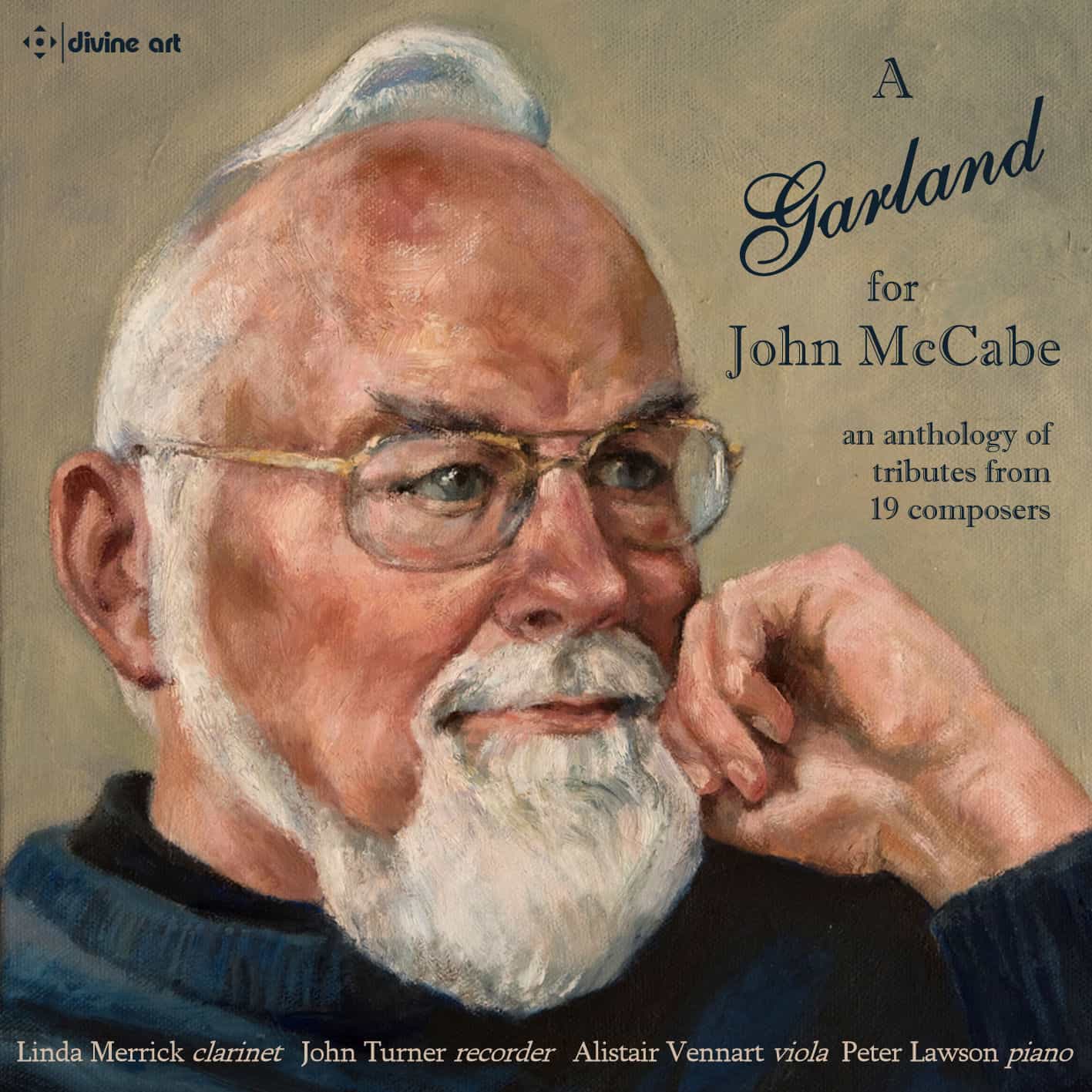
    The liner notes are excellent: after an introduction by the composer’s widow, Monica McCabe, each work is given a brief, but helpful, introduction by its composer. There are the usual biographies of the performers. The rear cover includes a good photograph of the composer towards the end of his life, and his portrait is on the front cover.

    This is altogether a charming ‘Garland’ for John McCabe. Do not expect all these works to be masterpieces, but they are all well-crafted and highly memorable. I am not sure what will happen to them next; I would like to think that performers will include them in their own recital programmes. It may be that their brief nature, their ephemerality and their instrumental requirement will prevent this from happening. That would be a pity, as there is much here to delight, enchant and call to mind one of the most important and best of ‘modern’ composers. I believe John McCabe would have been delighted with this heartfelt tribute from his friends, fellow composers and former pupils.
    John France

  • A Garland for John McCabe

    A Garland for John McCabe

    John McCabe was almost a legend in his own lifetime, acknowledged as one of the foremost British composers of our time and also as a brilliant pianist who championed the work of many contemporary composers. Following his recent death, 19 composers wrote pieces in tribute for an ensemble of clarinet, recorder, viola and piano (and variations of the mix) which are now collected into this album which is lovingly dedicated to John’s memory and also to his widow Monica, who was a tireless support and who now works to promote his musical legacy. We are grateful for her contributions to this project.

    Leading instrumentalists include Linda Merrick (clarinet) who is Principal of the Royal Northern College of Music; Alistair Vennart (viola) whose career is blooming both as soloist and founder member of the Solem Quartet; John Turner, one of the leading recorder players of today and former member of many world-renowned early-music ensembles, and pianist Peter Lawson, another highly regarded performer who has played with most top British orchestras and a long and distinguished recording and teaching career.