Catalogue Connection: 25171

  • Artyomov: The Way to Olympus – review on WTJU

    Volume four of Divine Art’s Vyacheslav Artyomov series features a wide range of works — everything from a full orchestra (“The Way to Olympus”), to a solo piano (“Preludes to Sonnets”).

    While the forces may vary, there’s a consistency throughout all these works. Artyomov’s deeply spiritual philosophy imbues every composition. The music alternates between suspended time and bursts of activity. Harmonies are post-tonal, yet not atonal.
    “The Way to Olympus” is the first installment of Artyomov’s four-symphony cycle, “Symphony of the Way.” It begins with a long, slow introduction that gradually builds in texture. The entire work is an intro of sorts. Artyomov further develops its themes in the subsequent three symphonies.

    Still, “The Way to Olympus” arrives at a satisfying conclusion, so it works as a stand-alone piece. If you’re looking for an introduction to Artymov’s music, this is a good place to start.

    Artyomov notes that “Preludes to Sonnets” is his only work for solo piano. That’s too bad. This is a quiet, introspective work that demands subtlety rather than showmanship from the pianist. Anton Batagov’s sympathetic performance is as finely nuanced as one could hope.

    “Gurian Hymn” is based on a West Georgian Easter song. It’s treated as a cantus firmus, always present in some form. Three violin soloists work and rework the material, floating above the sound of a chamber orchestra. Like a crystal mobile, the music sparkles and shimmers as it turns again and again. “Gurian Hymn” satisfies at a deep emotional level.

    “Concert of the 13” was written in 1967, the earliest work on the album. And it sounds like it, too. The piece is full of youthful energy, as motifs are tossed from instrument to instrument. Percussion plays a major role, driving the music ever forward. And yet there are moments where everything pauses, giving us a foretaste of the mature Artyomov’s style.

    These recordings were originally issued on Melodiya, and the sound quality is quite good. Artyomov’s music is often quiet, with very subtle changes. All those details came through in this recording.

  • The Way to Olympus – Chronicle review

    Artyomov is a modern composer from Russia writing with the ambition and scope of a man who knows his work is important. From what we read, his life in Russia has been hard, so perhaps a belief in your own standing in the history of music is crucial.

    He writes big, ambitious tunes; listening to his music — and this is the fourth CD we’ve had — we always feel small; Artyomov is a being who understands and has mastery of the universe while we are merely hairless monkeys on a speck of dust on the distant tip of the Sagittarius arm of the Milky Way.

    This feeling is partly because he writes epic music but also because he writes to sound mystical; he wanted to be a physicist and studied science while also studying music. The sleeve notes say that Artyomov considers music a science, “the concentration of the soul’s experience” and, side by side with astrophysics, one of two main fundamental sciences.

    Artyomov prefers not to call his music “contemporary”; he includes it into the tradition of “musica perennis” (eternal music). While he uses an orchestra, the sound is sparse: he goes for atmosphere, not sounding busy.

    The title piece comes first and intends to convey “the idea of overcoming inertness and passivity for the sake of movement, an aspiration for perfection”.

    It opens with wind instruments, lone and then mingling, playing a little chaotically, if gently. Presumably this is the inert state before the strings come in with more urgency, with brass gradually coming in as a call to action, before a calmer acceptance. The mid-section is livelier, then the effort of doing something succumbs to inertia.

    The second piece is the opposite end of the Artyomov spectrum, Gurian Hymn being gentler and almost personal — it’s a meditative work. Violins lead the way mournfully, though (tubular?) bells bring some mysticism part way through. It’s powerful stuff.

    Elsewhere, we like Concert Of The 13 which, as well as having a title like the work of an evil genius from a superhero film (or a Bond movie, the sleeve photo of the composer and poet, Valeriya Lyubetskaya is very Bond-esque) is a lively piece, so lively it touches experimental jazz in places.

    As you can gather it’s meaty fare, but not unapproachable or even particularly “difficult”; it’s the scope of his ambition that’s hard to take in.

    The USSR State Academic Symphony Orchestra performs.

  • Artyomov – The Way to Olympus short BBC review

    Vyacheslav Artyomov’s one-movement symphony is the atmospheric centrepiece of this disc – the layering of sounds is hypnotic and the effect is powerful. (Four stars awarded).

  • Musicweb review – Artyomov ‘Way to Olympus’

    Artyomov’s name at least has hovered around the peripheral consciousness of many lovers of Russian contemporary music – in the 1990s when this repertoire started to crop up on newly available Melodiya CDs I picked up a copy of his massive Requiem, which made a big impression on me. I suppose his relative anonymity (compared to Schnittke, Denisov and Gubaidulina to name three close contemporaries) has something to do with the eagerness of Western record companies (and concert programmers) to take advantage of Perestroika and market the music of these composers, not least due to their regular adherence to a perceived polystylistic aesthetic which sat well with local audiences who at least found elements in the music with which they could readily identify (I vividly recall, for example, the impact that the tango in Schnittke’s ‘Faust’ Cantata had on the audience when that was performed at the Huddersfield Contemporary Music Festival in the early 90s.)So perhaps the perception of an innate ‘Russian-ness’ in Artyomov’s music has militated against it as far as the recording companies are concerned. As John France observed in his perceptive review of the present disc, the composer’s website lists 25 discs of his music that have been available at one time or another; revealingly only one of these appeared on what might be regarded as a Western ‘major’ label – a compilation that was briefly available on BMG which co-incidentally included the very performances of the Symphony and the Gurian Hymn that feature here.

    So kudos indeed to Divine Art for giving a considerable leg-up to a composer whose music I believe deserves much wider currency. Over the last few years they have been issuing an Artyomov Retrospective which includes some of the best of the old Melodiya items as well as some newly-recorded fare. The present disc starts with the symphony The Way to Olympus. This quite literally emerges from a single bell-stroke and an extended drone on the flutes, one gradually becomes aware of other, more indistinct timbres, namely sporadic tremelando string figures and a commentary from a distant violin. The implacable D flat of the drone is never far away – this is slow-moving, slow-burning music. The listener knows something is about to happen. Eventually the strings gnaw at the drone, while the flutes begin to squabble; a sonic storm seems to threaten, subside and threaten again, before an assertive trumpet blasts out a strident motif against dissonant brass. The air clears and the orchestra makes a more conventional presence felt. Shards of melody, and occasional cracks of the whip peek through its thick textures. There is a prominent riffing saxophone. At about 9’30 the orchestra adopts a march -like tread. This is weird, elusive music and it’s challenging even for an experienced listener to place. At points, as it proceeds, Honegger begins to emerge as a likely influence – further research on Artyomov’s website confirms that the Symphonie Liturgique (Honegger’s Third) is indeed one of the composer’s desert island pieces. At roughly the half way point an organ emerges from the texture and takes over.

    The programme of the work seems to involve the unquenchable human spirit striving to conquer unattainable heights. Artyomov is basically saying, ‘Win or lose, The Way is all we have, the route to the spirit involves enjoying the ride’ The music continues on its unpredictable quest, briefly evoking lounge-jazz and Varèse en route. This account of the Symphony was its third recording, and is evidently the one preferred by the composer. It is quite impossible to take in all of its garish whimsy at one hearing, while the recording to me sounds cluttered and boxy at regular points. But chaotic or not The Way to Olympus is singularly compelling, and certainly a piece to which I shall return.

    Gurian Hymn is a real keeper. It seems to adopt a strategy not unlike the one Charles Ives used in The Unanswered Question. Essentially four different instrumental groups seem to interact completely independently. Low strings repeatedly play a Georgian Easter Hymn, the ‘Gurian’, which acts as a cantus firmus. Isolated bell notes suggest the divine – their high sounds merge with the cantus firmus to create a foreground which is filled by three solo violins – the ‘everyman’ of the narrative, whose interactions with a deindividuated society, here represented by the rest of the string orchestra create the external and spiritual conflicts which inform the whole work. Needless to say the individual in this story survives Earthly destruction to attain spiritual immortality. The layers of sound gently rise and subside in a beatific arch of orchestral sound; this is music of profound consolation. If the concept sounds a little hackneyed its execution is an absolute triumph. Gurian Hymn is an enthralling composition and one that deserves to be far better known. It is sublimely played and recorded.

    The airy and elusive Preludes to Sonnets for solo piano occupy similar aesthetic territory to late Scriabin or perhaps early Roslavets. The three pieces are slow-fast-slow, they are quietly mystical; pleasant and contemplative as they certainly are they break little in the way of fresh ground. They are expressively played by Anton Bagatov, while the 1990 recording is appropriately atmospheric.

    The final work on the disc is the earliest; the astringent Concert of the 13. Scored for wind, brass and percussion, with a solo piano most obviously prominent in its final movement it combines the confrontational and the playful. The first movement employs brief fanfare like material in the wind and brass set against rather abrasive percussion. While it is not hard to imagine this music being written in the Soviet Union of 1967 it is more difficult to envisage performances at the time, but performed it was –it was even recorded in 1970. (This recording under the direction of the late, great Gennady Rozdhestvensky dates from seven years later) After a more restrained slow movement, the third is a spiky allegretto while finale is a jazz-inflected tour-de-force featuring some mean and maniacal piano playing. It’s an interesting, rather noisy piece and it provides a fascinating contrast to what precedes it on this disc, while providing an insight into the music of Artyomov’s twenties. The instrumental textures of the first three movements evoked Messiaen although the melodic and harmonic material most certainly did not.

    This fascinating disc provides a decent starting point for listeners keen to investigate the strangely diffuse but parallel worlds of a Russian composer whose oeuvre seems consistently unpredictable. While the riotous Symphony gets the top billing, I would actually dare to suggest that the deeply impressive Gurian Hymn is well worth the disc’s asking price on its own.

  • Artyomov – The way to Olympus – review

    The album up for discussion today as far as I know is the third such album devoted to the music of Vyacheslav Artyomov on Divine Art Records. I’ve covered the other two on these pages. Taken as a whole we find a composer of decided importance. He is Modern in Russian ways that perhaps come out of a lineage which includes Scriabin in his most mystical phase, but then no it is really an experience far more than of some lineage when you take it all in itself and for itself. This new release is called The Way to Olympus (Divine Art 25171). The centerpiece of the program is the 33 minute “Symphony: The Way to Olympus.” It is a beautifully paced, sprawling and highly evocative sound poem for orchestra, here recorded some time ago but sounding gloriously well. The USSR State Academic Symphony Orchestra perform the work nicely under the baton of Timur Mynbayev. The name of the orchestra indicates an earlier recording date, of course. The work is very dramatic, moving, original. Artyomov’s story has been a sad one of a life of unrecognition, state hostility to his art, a difficult and lonely time and a heroic determination that perhaps can be sensed in the deepest recesses of his orchestral expressions. I hear a penetrating inwardness and a contrastingly outward skyrocketing elation to the music. “Gurian Hymn” has a lovely unfurling with three solo violins nicely weaving delicate filigrees of sadness and mystery over a rather strikingly evocative orchestral palette. The piano “Preludes to Sonnets” follow and they have a searching post-Scriabinesque poetic clout that sets us up well for the rarified brightness of the following “Concert of the 13” for piano and chamber ensemble. The piano part is bracing! It is another significant segment to a very significant program. I find the performances and recording quality highly appropriate and appealing.

    Artyomov deserves our undivided attention. I would go so far to say without hesitation that Artyomov on the basis of this volume and the others comes before us as a tragically underappreciated Modern master, a Russian Ives in terms of creating beautifully advanced music in spite of social neglect and isolation. His time has come. By all means listen to this album. Then if you are as impressed as I am get the others too!

  • Artyomov – The Way to Olympus – Musicweb review

    I am not conscious of ever having heard any music by Russian composer Vyacheslav Artyomov; in fact, I have never heard of the man himself. Based on the four-excellent works on this new CD from Divine Art, this is a major oversight on my behalf.

    Looking at the background of this disc, I see that there are some 25 CDs issued by the Gramzapis Label dedicated to his music. Rob Barnett and Michael Cookson have reviewed the two previous issues of Artyomov’s music on Divine Art (DDA25143, DDA25144) for MusicWeb International. These include the Symphony – On the Threshold of a Bright World (1990 rev. 2002) and the Symphony – Gentle Emanation (1991 rev. 2008).

    There is a detailed biography of the composer on his website. Just a few notes are necessary here. Vyacheslav Artyomov was born in Moscow on 29 June 1940. He studied piano and composition. For several years he worked as a music teacher, répétiteur, theatre musical directorships and music editor. Since 1977, Artyomov has concentrated on composition. In 1990 he was Composer in Residence at the University of Nevada. Artyomov’s early music was ‘neo-folkloric in style’; he was also interested in traditional music from the Orient. With other musicians, Artyomov formed a group performing on non-classical folk instruments. His other inspirations included Arthur Honegger’s Symphonie Liturgique, and the music of Edgar Varèse, Olivier Messiaen and Luciano Berio.

    What does Artyomov’s music sound like? I would suggest that if listeners are comfortable with Alban Berg and late-Scriabin, they will enjoy this CD. Other parallels would include the music of Arvo Pärt, Krzysztof Penderecki and even some modern film music. Sometimes the mood heads toward a big-band sound. Don’t take these comparisons as hard and fast; just use them as a yardstick.

    The opening track is the main event – the Symphony: The Way to Olympus which was composed in 1978 and dedicated to his wife, the poet Valeriya Lyubetskaya. It was premiered in Moscow on 13 January 1987. The composer writes that the symphony ‘conveys the idea of overcoming inertness and passivity for the sake of movement, an aspiration for perfection, for finding integrity in one’s inner development.’ I am not sure what this really means: perhaps it has lost a little ‘immediacy’ in the translation. The symphony is the first of four in the cycle ‘Symphony of the Way’ and serves as an introduction to these following three works: ‘On the Threshold of a Bright World’, ‘Gentle Emanation’ and ‘The Morning Star Arises’. The score is headed with a quotation from the Roman poet and playwright Seneca: ‘… and then, maybe, you will achieve the peaks, or that places about which you alone will know that they are not yet the peaks’. Again, I am sure that this needs ‘unpacking.’

    The Way to Olympus represents the first steps on a long journey by the musical hero, who may or may not be the composer himself, that leads towards Olympus, the source of life and salvation. Written in ‘sonata form’, this is a complex, thoughtful and ultimately satisfying symphony. If it had a chance, I believe it could be one of the ‘great’ examples of this genre for our time.

    I was struck by the meditative quality of Artyomov’s Gurian Hymn. It was composed in 1986, once again dedicated to his wife, Valeriya Lyubetskaya, and based upon a West Georgian Easter Song, ‘Christ has Arisen.’ Lyubetskaya writes that this tune is used as a ‘cantus firmus’ and is deployed in the deepest registers, signifying that this ‘religious tradition is the true basis of conscious existence.’ Laid over this fundamental structure is a strand of small bells, vibraphone and [larger] bells, creating a numinous background. A third layer of this work is the trio of solo violins. This is meant to symbolise ‘heroes’ living in an ‘angst ridden’ world. Each responds to hopes, sufferings, despair and optimism. The final strand of this music is the string orchestra which acts as the world at large: the ‘popular masses.’ This force almost obliterates the ‘heroes’. However, all is not lost. The work ends with ‘salvation’: the hero ‘finds comfort and consolation in [their] faith, impregnated with a premonition of [their] own immortality.’ Whether one wishes to listen to this heartfelt music with the ‘religious’ or ‘philosophical’ (Übermensch?) meaning in mind, or prefers put that to one side, it is a gorgeous work that is both inspiring and thoughtful. The concept of the four disparate layers working out their own destiny is memorable and moving.

    I enjoyed the contemplative and enigmatic Preludes to Sonnets. This would appear to be the composer’s only work for solo piano. It was composed after reading Bohemian-Austrian poet Rainer Maria Rilke’s (1875–1926) Sonnets to Orpheus, translated into Russian by Valeriya Lyubetskaya. These highly symbolic poems were written in 1922 and explore the legend of the Greek god who was a musician, poet and artist. I guess the key element of these Preludes is the fact that Orpheus’s harp music was so perfect and serene that even the passions of the wild beasts were stilled. Vyacheslav Artyomov’s music parallels the beauty of the sonnets, with its emphasis on the everlasting cycle of life and death. They remind me of late Scriabin; truly stunning.

    The final work on this CD is the Concert of the Thirteen Wind, Piano and Percussion Players, written in 1967 for an ensemble of two flutes, oboe, two clarinets, bassoon, two trumpets, trombone, piano (plus celesta or glockenspiel) and percussion instruments (three players). This is probably the most challenging of the four works presented on this CD and is certainly the most ‘modernist’ in its sound world. However, it is both approachable and musically enjoyable.

    The Concert of the 13 is written in four, well-balanced movements. There is an Overture, followed by an intense slow movement featuring the oboe, then follows a dynamic scherzo. It concludes with what the composer describes as a ‘miniature piano concerto.’ The liner notes suggest that the work is like a game in which all thirteen musicians compete and often cooperate in various groups and combinations. It is an exhilarating work, full of energy and fun; there are even elements of jazz in the final movement.

    The booklet has been a tremendous help in my reviewing this CD of music that is totally unknown to me. There is an introduction to the composer’s life and times, several paragraphs on his ‘musical philosophy’ and a general overview of his compositions. The programme notes are written by the composer, with supplementary details by Valeriya Lyubetskaya. The booklet is presented in English and Russian. I have spelt (I hope) the names of performers etc. as written in the insert: there are, it seems, several ways of transliterating the Russian language. The CD has been well-remastered from the original Melodiya recordings; for example, the clarity of the Concert for 13 dating from 1977 is, for me, perfect.

    This CD is an interesting musical exploration that is both compelling and satisfying, even if some of the philosophical underpinnings are a little obscure.
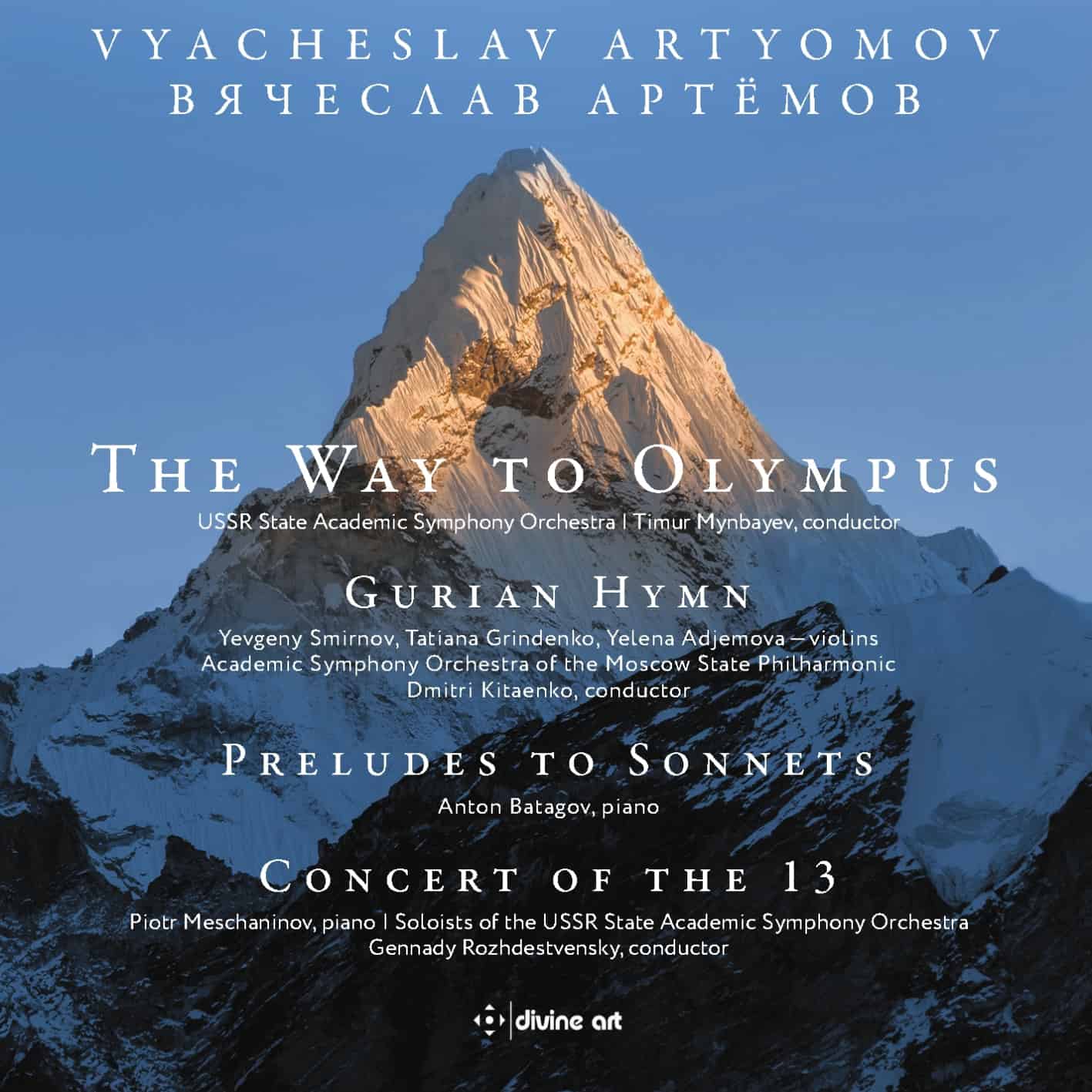
  • Artyomov: The Way to Olympus and other works

    Artyomov: The Way to Olympus and other works

    Vyacheslav Artyomov is considered by many to be Russia’s greatest living composer. After the fall of the Soviet regime his music has travelled the world to great acclaim. It is deep, ultimately spiritual and brilliantly crafted, with influences from the Russian symphonic tradition colored by Mahler, Scriabin, Honegger and Messiaen to name a few – but melded into a unique voice.

    The Divine Art Artyomov Retrospective continues with the magisterial symphony The Way to Olympus, chamber orchestral works and Preludes to Sonnets, Artyomov’s only solo piano work.

    Recorded at the height of achievement of the major Soviet orchestras, conducted by major figures including the universally acclaimed Rozhdestvensky.