Catalogue Connection: 25172

  • Artyomov: Symphony of Elegies review on WTJU

    Divine Art continues their reissue of Vyacheslav Artyomov recordings with “A Symphony of Elegies.”

    Artyomov’s 1977 “A Symphony of Elegies” was written during a trip to the mountains of Dilijan, Armenia. To me, the work forms a fascinating contrast to the mountain-inspired symphonies of American/Armenian composer Alan Hovhaness.

    Both composers eschew the standard notion of “symphony,” and both depict timeless solidity of mountains — and their primal spiritual significance. Artyomov is even less concerned with tonality than Hovhaness, and therein lies the difference.

    Artyomov’s symphony is a slowly swirling cloud of sound. The solo violins sometimes float atop the string orchestra, other times they’re obscured by it. But always there’s a tension between the two. Violinists Oleh Krysa and Tatiana Grindenko are the soloists, and they are also the performers for “Awakening.”

    Artyomov dedicated “Awakening” to Krysa and Grindenko, who premiered the work in 1978. Artyomov considered it a postlude to the symphony. Listening to the two works back-to-back I could hear why. “Awakening” inhabits the same audio world as the symphony. With just two violins, Artyomov strips the music down to its essence. The violins must both generate the sustaining tones and the melodies above them. It’s a remarkably intimate and haunting work.

    For me, the most interesting of these three very interesting works was “Incantations.” Artyomov conducts the Mark Pekarsky Percussion Ensemble and soprano Lydia Anatolyevna Davydova in this recording. These are the artists he composed the work for, so I consider this the definitive performance. Artyomov deconstructs the human voice, separating vowels, consonants, and other sounds into discrete blocks. He then uses them — along with various percussive sounds — to create something that’s more than the sum of the parts.

    Alfred Schnittke described “Incantations” as “a strikingly realistic and vivid sound image of primeval magic.” I agree. I’d even say that all three works evoke a mystical sonic realm only attainable through Artyomov’s creative imagination.

  • Artyomov: Symphony of Elegies – Fanfare review

    As with earlier Divine Art releases devoted to Vyacheslav Artyomov’s music, these are not new recordings, but rather reissues of recordings that Melodiya made in the 1980s and 1990s. Some of these appeared outside of the Soviet Union on the Olympia CD label, so check your shelves before pulling out your credit card. Furthermore, just to make things confusing, Incantations was previously issued under the title Invocations; the music (and the recording) are the same.

    I have written positively about this composer’s music as recently as Fanfare 42:2. I find this release even more consistently interesting than the two that I reviewed in that recent issue because the music is on a consistently high level and is more focused. A Symphony of Elegies, the composer’s first symphony, was composed in 1977 while he was visiting Armenia. The title should be taken literally; there are three movements, titled Elegy I, Elegy II, and Elegy III. Elegy I starts with a dark, slowly roiling cloud of strings from which individual violins gradually free themselves. Ligeti’s micropolyphonic writing for orchestra or string ensembles seems to have been an influence. Elegy II continues the process, and gives the two solo violins greater prominence, separating them more clearly from the orchestral textures. Pale, washed-out colors and slow glissandos also suggest the music of Gloria Coates. Then, in Elegy III, which is the longest movement (20:40), percussion instruments come into the foreground. Even more slowly than in the previous movements, the colors and textures evolve, and the two violins seem to be swallowed up by the sun, which leads to a long disassembly of the structures that Artyomov had been building not just in this movement but also in the entire work. Despite being over 43 minutes long and essentially slow throughout, A Symphony of Elegies is intense and gripping, and it is played with understanding by these musicians.

    The composer calls Awakening, composed a year later, “almost… a postlude” to the symphony. Now the two violins are by themselves and, at the start, seemingly in a state of suspended animation. Over the course of 11 minutes, they awaken and stretch their arms out toward new consciousness. Although the title could be taken literally, the awakening that the composer was thinking of appears to be of the metaphysical kind. Within small note intervals, the violins do a lot of sliding around, and again, the pale colors and slowly melting textures suggest Gloria Coates’s music. One imagines that this was considered to be beyond outré when it was presented to Soviet audiences in the very late 1970s. The performers here also were the original performers, and I am not sure how anyone could make a better case for this odd music.

    Incantations is weird too, but in a different way. There are four movements: “Incantation of Fate—Of Serpents,” “Incantation of Stars—Of Birds,” “Incantation of Souls—Of Wind,” and “Incantation of Sounds—Of Fire.” The soprano has no text per se. Instead, sometimes as a chant and at other times as a coloratura roulade, she sings nonsense or onomatopoeic phonemes, rolling her “r”s and blowing raspberries to beat the band. The last of the four movements is the most active. Soprano Lydia Davydova comes off as a Russian Cathy Berberian, and I mean that as high praise indeed. When she isn’t channeling Cathy, she seems to singing an alternate version of Messiaen’s Harawi, or something by George Crumb, and I mean that as high praise too. The percussionists play a variety of instruments, both pitched and unpitched, and sometimes they get into the act vocally. Again, the music is slow but not dull. Listening to this, you might feel that you are on a National Geographic expedition and, in the middle of a clearing, have found the last surviving member of a tribe previously known to civilization. Schnittke called the work “a strikingly realistic and vivid sound image of primeval magic,” and that description strikes me as perceptive. Peter J. Rabinowitz reviewed this particular recording all the way back in Fanfare 12:2, and he was beyond being underwhelmed by it. No criticism of Peter implied, but this work, and this performance of it, both work for me.

    This is pretty wild stuff, but Artyomov’s sincerity is not in doubt, and this recording could be a good place to start, if you are curious about him.

  • Artyomov – Symphony of Elegies review musical opinion

    For the past half-century, Vyacheslav Artyomov (b1940) has proved himself again and again to be one of the most individual and distinctive composers not just in the music of his native Russia but in Western Classical music as a whole. His musical style and expressive purpose position him somewhere between the so-called holy minimalism of Arvo Pärt, the Christian-rooted gravitas of Sofia Gubaidulina, and the supercharged intensity of Alfred Schnittke. Yet Artyomov never sounds like any of these; he is his own man, a truly original voice, all the more shockingly so in that he emerged as a creative force in the repressive conditions of the Soviet Union under Brezhnev.

    That his output is not as well-known as it should be is down to a number of factors: paucity of performances outside of Russia—his impact concentrated on early recordings by Melodiya, of which the three works here, set down in the 1980s, are reissues—the success of composers like Pärt whose music is superficially more appealing and more easily assimilated, and the challenging nature of Artyomov’s scores which are the polar opposites of Pärt’s, outwardly straightforward but far more complex and challenging. As Robert Matthew-Walker rightly states of A Symphony of Elegies, Artyomov’s first symphony composed during a two-month sojourn in Armenia, “one must abandon most preconceptions regarding Western symphonism”, but he might as justly have said ‘of Western music in general’, so unorthodox are the internal processes in the work; just listen to the subtle and undemonstrative percussion writing, ideally judged.

    That might also be said of Gorecki’s Symphony of Sorrowful Songs, another large-scale work in slow tempi. A Symphony of Elegies, however, is a much stronger work than Gorecki’s over-hyped work. Artyomov’s harmonic and rhythmic patterns, and its underlying pulse, while almost glacially slow at times are more varied and never static. Rather, the music seems at some stratospheric height, its invention stretched out over an entirely different timeframe, or timeframe of reference. Its three movements are captivating, mesmerising, utterly compelling.

    The couplings are scarcely less so. The violin duo Awakening was written the year following the symphony and for the same violinists, Oleh Krysa and Tatiana Grindenko, who played the premiere of it and the symphony and duly recorded both, reissued here. The song cycle Incantations (1979-81) is the same work as that previously recorded as Invocations (as on the Olympia reissue); the booklet note sadly gives no clue as to the reason for the retitling. The performances still sound terrific, the recordings clear and bright, brilliantly re-engineered. Superb.

  • Artyomov – Symphony of Elegies review in American Record Guide

    Vyacheslav Artyomov is a member of the generation of experimental Russian composers that came to prominence in the 1970s. Members of this group, which included Sofia Gubaidulina, Alexander Knaifel, and Edison Denisov, were blacklisted by Tikhon Khrennikov in 1979. Like Knaifel and especially Gubaidulina, Artyomov is a composer of mostly religious (but not liturgical) music. All three composers use their experimental techniques to express the mystical unknowable qualities of divinity, while also capturing grounded, emotional spirituality. Artyomov’s religious style is intense, yet on a broad, slowly shifting scale—not unlike Bruckner. His music reminds me of Messaien, with his considerable attention to texture and color.

    This is most apparent in the album’s centerpiece, Symphony of Elegies for two violins, percussion, and strings. Written spontaneously during a trip to Armenia, the work is influenced by Christian and Zen mysticism. I is one of the most stunning sections of music I have heard in recent memory. The solo violins play in their uppermost registers, encircled by a dense, shifting mass of strings, before separating from the orchestra. This spatial movement evokes the perception of a divine entity, moving from the earth to observe from above. The mountains of Armenia had a profound effect on the composer.

    The two solo violins return for the duo ‘Awakening’, another piece that explores changing perceptions thru changing texture and register.

    The colorful Incantations for soprano and percussion quartet is another type of mysticism entirely. Varese and Berio are clear influences here. The soprano sometimes mingles with the layers of the ensemble with percussive, non-vocal sounds. Otherwise, she sings fragmented text distilled to the barest of phonetics, fraught with quarter-tones and glissandos. It is striking piece, seemingly out of time and space. I highly recommend this album, but as with Knaife’s music, some may find it to be an acquired taste.

  • Artyomov Symphony of Elegies Musicweb review

    The Russian composer Vyacheslav Artyomov was born in 1940, which makes him slightly younger than the Georgian Giya Kancheli (born 1935), the Estonian Arvo Pärt (also born 1935) and the Ukrainian Valentyn Sylvestrov (born 1937). All four grew up under the Soviet system but, despite official disapproval, each eventually discovered modernism from which each evolved a personal idiom which tends to be slow-moving, atmospheric and evocative. They are all, I think (I am not quite sure about Kancheli) religious believers, something else which was frowned on in Soviet days. They have also each attracted something of a cult, so are greatly admired by their enthusiasts while, of these four, only Pärt has been accepted into the larger international repertoire.

    Kancheli, Pärt and Sylvestrov I have known for some time, but this was my first encounter with Artyomov. He acknowledges influences from Prokofiev, Stravinsky, Messiaen and the Polish avant-garde but in particular Honegger’s third symphony, the Symphonie liturgique, Berio’s Sinfonia and the works of Varèse. Here we have three works, all reissued from recordings made in the 1980s but very well transferred so that no one need fear poor sound quality. The disc is, rather touchingly, dedicated to the memory of the sound engineer Vadim Ivanov, who worked on all these recordings.

    The Symphony of Elegies seems to have been Artyomov’s breakthrough work. It was composed quite rapidly during two months in 1977, while the composer was visiting Armenia. It is scored for two solo violins, a small string orchestra and a large percussion section requiring six players.

    There are three movements. The first opens with very quiet, slowly shifting complex chords; think of the opening of Ligeti’s Requiem, or of Scriabin’s Prometheus. There is a very gradual increase in volume and a move from the bass into the treble. There are occasional arabesques and interjections from the two solo violins. Gradually one of them – or it might be both – spins an independent line, high, sweet and remote. If you think of a latter-day Lark Ascending you would not be far off the mark.

    The second movement begins with winding lines including one soaring into the heights and hovering high above deep and dark strings. The third, almost twice the length of the first two, makes great use of the percussion, particularly gongs and bells. It evokes a vast expanse of space and time – Prometheus again – before winding down with arabesques like those in the first movement. The whole Symphony is a haunting and powerful work.

    Awakening is a kind of sequel to the Symphony, written for two solo violins on their own. The similarity is enhanced by being played here by the same two soloists as played in the Symphony, and who were the dedicatees and the first performers. This is in a similar idiom, with some use of drones. A very resonant acoustic adds to the atmosphere.

    Incantations is for soprano and percussion to be played by four players. It does not set normal words, in Russian or any other actual language, but phonetic sounds which evoke a primeval language. I mentioned that Artyomov admired Varèse, and it was that composer’s Equatorial which I was reminded of. The work sounds like a primitive ritual, or rather like the evocation of a primitive ritual by a sophisticated modern. Unlike the two previous works it also introduces an element of vigorous rhythmic writing, which comes as very welcome after a great deal of slow, albeit beautiful music.

    The performances are by artists well established in Russia and Eastern Europe and are extremely impressive. I have wondered whether the idiom might be a bit limited but I would need to hear more Artyomov before making up my mind about that. He has certainly written a good deal, notably two cycles of symphonies: Symphony of the Way, which is a tetralogy consisting of Way to Olympus, On the Threshold of a Bright World, Gentle Emanation and The Morning Star Arises, and The Star of Exodus, a trilogy consisting of In Memoriam, In Spe and In Gloriam (the last possibly unfinished). Some parts of these have been recorded, along with other works, and the enterprising Divine Art label is in the process of reissuing them. There is also a Requiem, apparently the first to be written in Russia since the 1917 revolution, which has been much praised.

    The disc comes with a very helpful sleeve note (in English and Russian) by Robert Matthew-Walker, who has written a book on the composer. I look forward to exploring more Artyomov.
  • Artyomov Symphony of Elegies – review

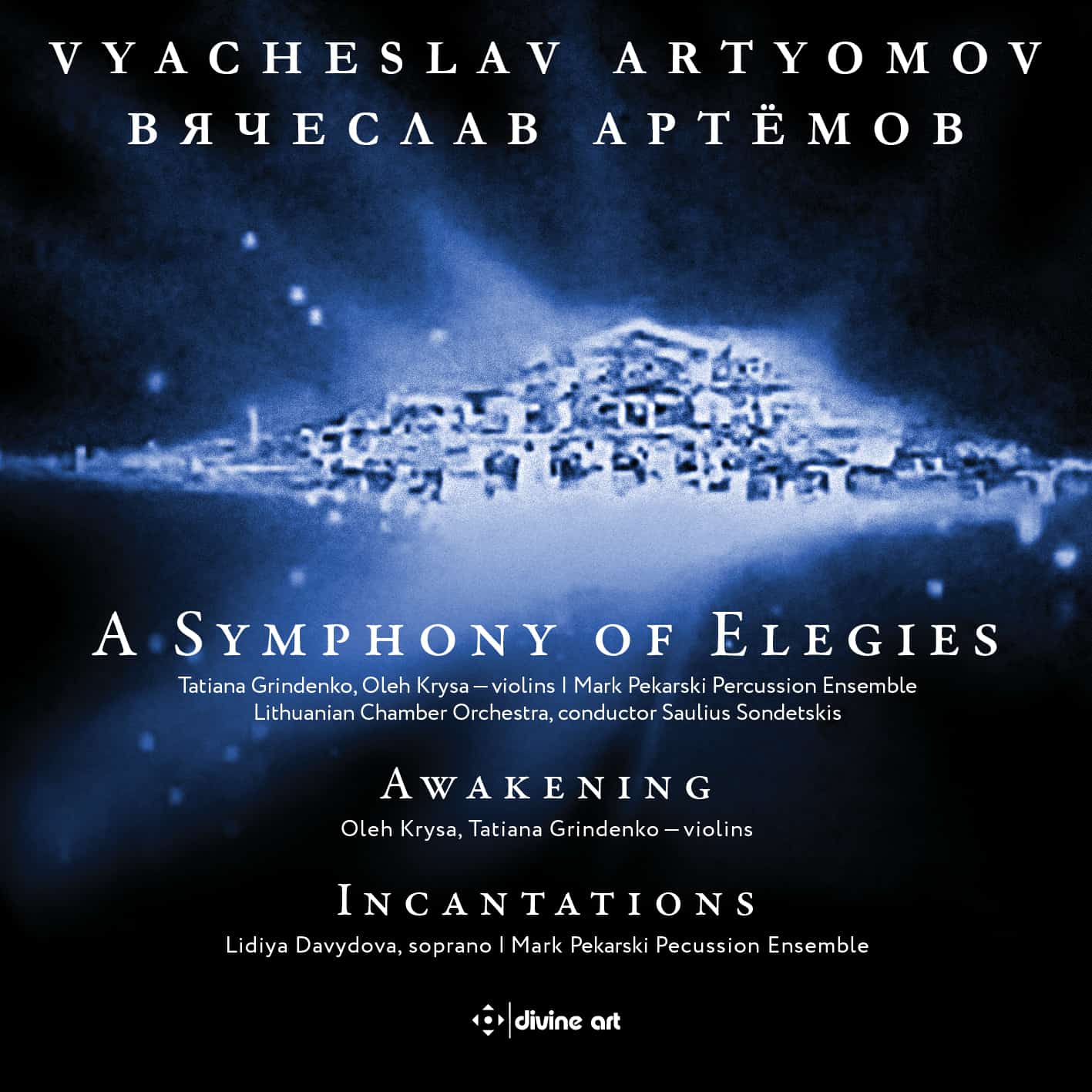
    The series of issues and re-issues of the music of Vyacheslav Artyomov on Divine Art is to me one of the primary revival events of the past decade. (Type his name in the search box above for my reviews of other volumes.) Happily there is more, two more anyway. Today the very welcome A Symphony of Elegies (Divine Art dda 25172).

    The album covers three major works. There is the phenomenal orchestral “A Symphony of Elegies,” the violin duo “Awakening,” and “Incantations” for soprano and percussion ensemble.

    “A Symphony of Elegies” constitutes one of Artyomov’s masterworks. It is in fact his very first symphony, which he composed in the mountains of Armenia in 1977. It is a sonically stunning, major and essential foray into meditative moodiness that somehow manages to straddle later Messiaen and Morton Feldman in his quietly mysterious phase, yet in the end it is pure Artyomov. There is a breathtaking beauty to the way Artyomov hangs in the sunlight delicately ethereal clouds of mysterious sustains with beautifully grey and luminescent pastels of colored light-sound. This music for all its 44 minutes heightens the floating sensation of inner-outer chambered yet vast expanses of space. There is notable space for two upper-register solo violins who according to the composer represents observing from above. They are violin bridging figures. intimacies that continually tie before with after–almost like the string part of a Gagaku piece, then gradually become more overarchingly continuous. A D.T. Suzuki quotation serves to help set the mood for the the work: “All these are but moments in our innermost life, which revives and touches Eternity.” This is ravishing music.

    “Awakening” continues and extends the mysterious and reflective mood, this time with two violins alone. They epitomize an entire universe of sound with compact means and so manage to evoke a great deal in the most eloquent and elegant of ways. Ravishing.

    “Incantations” sprawls into space with four fairly compact musical movements. It has a very lively vocal part and hews nicely to the sort of percussion group middle ground, neither always pulsating nor strictly event-in-space minded, yet then in the end it bursts forward with ritual pulsations that evoke some mythical ritual world in very unique terms, evoking perhaps Ima Sumac and Messiaen’s middle period vocal works via a certain atmospherically “ethnic” panorama, but in no case derivative but rather completely Artyomov-idiomatic. It is a fittingly upbeat and, as the work proceeds, a rather haunting ending to a very nicely moody and reflective program.

    And so we have it, an intriguing and rewarding new volume in what I hope will be a very widespread and lasting Artyomov revival. He is a Russian master that has suffered neglect for far too long. It is time we celebrate his music. I do very much recommend this one to you. It is High Modern in a very evocative way. It is not easily forgotten once you give it your full attention! Bravo!

  • Artyomov – A Symphony of Elegies New Classics review

    Born in Moscow in 1940, Vyacheslav Artyomov is regarded as Russia’s greatest living composer. As a young man, he developed a profound interest in Russian folklore and traditional music of the East, as well as the works of Prokofiev, Stravinsky, Messiaen, Arthur Honegger, and the Polish avant-garde. Artyomov’s warm, expressive compositions reflect his interest in the archaic, Christian motifs and Eastern meditation.

    He prefers not to call his music ‘contemporary’, using instead a specific term for including it into the Tradition ‘musica perennis’ (eternal music). As he says, ‘music is the only way for the cognition of the sense of existence’. Since the fall of the Soviet regime his deep, spiritual and brilliantly crafted music has travelled the world to great acclaim. His works are in the grand symphonic and post-Romantic traditions and he has been called ‘the Bruckner of the 21st century’. This is the fifth in Divine Art’s series devoted to Vyacheslav Artyomov, which has included recordings of his ‘Threshold’ and ‘Gentle Emanation’ symphonies.

    The Symphony of Elegies is the composer’s own favourite among his symphonies composed so far – and it is very different from the others, being exceptionally ethereal, mainly very quiet, and meditative as well as sorrowful. The Lithuanian Chamber Orchestra is conducted by Saulius Sondeckis. The album also features two other important works by Artyomov. ‘Awakening’, played here by Oleh Krysa and Tatiana Grindenko, requires virtuoso playing but not of the ‘fireworks’ kind. ‘Incantations’, featuring the Mark Pekarsky Percussion Ensemble and the marvelous vocal talent of the late soprano Lydia Davydova, is a percussion piece that was formerly recorded under the title Invocations.

    ‘Artyomov brings glory to our country and to Russian art.’ – Mstislav Rostropovich.

  • Artyomov: A Symphony of Elegies, etc.

    Artyomov: A Symphony of Elegies, etc.

    Vyacheslav Artyomov is considered by many to be Russia’s greatest living composer. After the fall of the Soviet regime his music has travelled the world to great acclaim. It is deep, ultimately spiritual and brilliantly crafted, with influences from the Russian symphonic tradition colored by Mahler, Scriabin, Honegger and Messiaen to name a few – but melded into a unique voice.

    The Divine Art Artyomov Retrospective is a mix of new recordings and former Melodiya releases. It continues with the Symphony of Elegies – a total contrast to his other massive and intense symphonies, being ethereal, generally very quiet and evoking a sense of timelessness.
    The album is completed by two more major works – ‘Awakening’ for violin duo, and ‘Incantations’ featuring the heavenly voice of the late Lydia Davydova with four percussionists. (note that on early Melodiya recordings, this work was described as ‘invocations’). An album full of really inspired masterpieces.