Even if the USSR was living its last moments in 1988, during the writing of this Requiem, Artyomov undoubtedly had some daring to present a mass “for the martyrs of Long-suffering Russia”, that is to say, for the victims of the communist regime. It must be said that he was part of the Seven of Khrennikov, these musicians vilified in 1979 by the National Union of Composers: we understand that his relationships to the Party were not the most cordial. We can compare this mass of the dead to that composed twenty years later by Tigran Mansurian to commemorate the Armenian genocide. But where the latter seeks above all the purity, the sobriety, the recollection, Artyomov chooses to play the card of monumental pathos: his Requiem is a vast cry that alternates revolt and elegy, vehemence and lamentation. The mass of the choruses is combined with a powerful orchestra that is further strengthened by the organ and the bells. From the dissonance of the most tense moments (Dies Irae, Tuba Mirum), to the plaints of feminine voices rising in calmness, everything is done to upset the listener, to force him to face the suffering of the Russia. In an irony of history, Khrennikov, who had organized the boycott of Artyomov, also ends up recognizing the greatness of his enemy in his hearing of this work … We would almost think of Salieri faced with the Requiem of Mozart in Amadeus.
(Awarded four stars)
Catalogue Connection: 25173
-
Artyomov Requiem: review by Classica
-
American Record Guide Review of Artyomov Requiem
Back in the 70s and 80s, there were folks working overtime at the Union of Soviet Composers, seeing to it that Vyacheslav Artyomov’s music would not see the light of day. His works were banned from performance, his name couldn’t be mentioned in official circles, and he was not offered public money for his efforts. But Mstislav Rostropovich became a champion of Artyomov’s work, which resulted in major commissions and a measure of acclaim in the West. Since those days, of course, the Soviet regime has passed from the scene, and Artyomov (b 1940) has become one of Russia’s most celebrated living composers. Every so often, thank goodness, the cause of aesthetic justice is served.
This Requiem to the Martyrs of Long-Suffering Russia is a full-length traversal of the Roman Liturgy for the Dead—a Requiem Mass in Latin. The only overt tip of the cap to Russian Orthodoxy I can hear is Artyomov’s ’Domine Jesu’ There he has the choir intoning an exquisitely quiet Slavic-sounding hymn as flutes, bells, and heaven knows what else pierce the sense of repose from above. There are other placid interludes, such as an ‘In Paradisum’ that seems suspended in air, surrounded by the gentle calls of birds. The rest of the way, though, this is a dark, visceral, gut-wrenching affair crafted to grate on the conscience of mankind. There are eerie hisses and whispers (‘Rex tremendae’); and when the liturgy unleashes itself into primal scream therapy (‘Tuba mirum,’ ‘Dies irae’) the effect is overwhelming. Most affecting of all is Artyomov’s writing for his soloists, who represent Mother Russia weeping for her untold millions of children. By the time this thing ends, you’ll know you’ve been somewhere.
But there is a major problem with the recorded sound. The booklet informs us that the master copy of the premiere performance recorded by Melodiya in concert (1988) was not usable. As a result, this release (like an earlier incarnation that was made available by the Moscow Studio Archive in 2006) comes from recordings made at the rehearsals before the premiere. There are places where balances collapse and important contributions go distant. So while this issue is “definitive” in musical terms, we await a recording blessed with state-of-the-art sonics. A blockbuster of a work demands to be heard in blockbuster sound.
-
Artyomov’s Requiem reviewed on MusicWeb
Printed verbatim in the booklet is the speech Vyacheslav Artyomov gave to the audience prior to the performance (not this recording of the work’s premiere from nine years earlier) of this mighty Requiem on 7 November 1997, the 80th anniversary of the Bolshevik revolution. It is a scathing critique of the stranglehold the Communist Party had on Russia for almost a century, of its continued existence and its legacy. One cannot but wonder what impact a public speech of this ilk would have in today’s Moscow. But like its subject matter, the speech is a fact of history, and it is instructive for listeners to read it and have some sort of a handle on Artyomov’s ambitious undertaking here. His goal was nothing short of a large scale work which would act as a vehicle for national expiation.
The barking brass and organ fanfare which begin the Kyrie let one know instantly that this is no work of unalloyed consolation. The tiny intervals that infuse the first chorus suggest ghosts. The moaning chorus is upended by eerie strings, insistent low piano octaves, woodwind and, eventually, brass and percussion, especially bells. Inevitably, the latter play a huge part in the piece. The basses inaugurate another section which builds inexorably to a huge cataclysmic choral climax underpinned by strident percussion and what I think is a flexatone. The chromaticism and violence of this music manages to out-Schnittke Schnittke himself. At times the bleakness of some of the older composer’s music sometimes seems somewhat contrived and over-cinematic to these ears, an impression that seldom occurs with Artyomov.
The second part of the Dies Irae incorporates indubitably mournful yet oddly beautiful combinations of vocal soloists. Artyomov’s harmonisation is masterly, indeed this Dies Irae in each of its sections seems to defy cliché and at times appears to project comfort rather than wrath. Such moments may be short-lived: the reveilles and hunting-horns of the Tuba Mirum for example augur tumult and chaos. Their fervour subsides with a ticking clock, high bells and the uproar subsides into whispers. The Recordare begins with a sad, traumatised chorus in the high voices which gives way to a baritone solo above which hovers a plangent, beatific (and rather distantly recorded) solo violin. Listening to this music again after a few years really brings home what a sensitive ear Artyomov has, and amplifies how carefully and tellingly he deploys his huge resources, especially piano and percussion, in this work. His vocal writing is also expert, both for soloists and chorus. Often there is a sense of note spinning in this kind of repertoire, but in its very different way this work reveals Artyomov’s adeptness in writing for voices. At times he is as directly communicative as Benjamin Britten in his more renowned (War) Requiem. For all the terror, catastrophe and violence implied in this piece, its extremity is somehow reined in. It never gets too much, and there is a profound formal elegance at play. The staccato monosyllables spat out by the singers during the Confutatis maledictis section of the Dies Irae are genuinely terrifying in their restraint. This gives way to a grim Lacrimosa, totally in keeping with what has gone before, and with our world. Grim yes, but far from ‘ugly’. A huge organ chord suggests a mighty climax, but it withdraws to reveal a subsiding passage of transcendent mourning.
As we reach the Offertorium, the Domine Jesu Christe is a magnificent, truly moving choral prayer, commented upon by strident, yet respectful instrumental phrases. This is unquestionably the emotional core of this Requiem, and is followed by a Hostias et preces section which revisits some of the earlier choral material and features rather ‘Slavic’ solos from a couple of the three sopranos. The choral portamenti/glissandi at the conclusion of this section will certainly make the hairs on listeners’ necks stand on end. It elides more or less seamlessly into a Sanctus dominated by the unusual vocal stylings of a Slavic ‘treble’. The chromatic choral effects suddenly give way to an almost jaunty ensemble of vocal soloists. The Hosanna in Excelsis that concludes the Sanctus with its tinkly percussion, high piano and harps shimmers radiantly and builds unforgettably. I find this passage profoundly affecting prior to its resolution in a radiant major chord. After a brief, questioning Benedictus, with airy solos, quasi- Ligetian choral phrases and creepy organ arpeggi we are on the home straight.
The flutes that open the Agnus Dei are the harbingers of a reflective tenor setting (the listing in the booklet has this wrong – it’s certainly not a soprano). In fact its tentative second section features a rather jagged ensemble of soloists alternating with chromatic choral harmonies and ethereal solo violin and harp figures. There is a sense of utterly sincere and heartfelt pleading here. The more strident Libera me follows, and grows with ever more intense and despairing statements of the phrase by the choir. This is by far the most tortured section of the work, but even here there is a sense that Artyomov is desperately seeking to prevent his structure from toppling into the abyss. As the percussion become more intense and dissonant brass and organ strain at the leash, the Requiem aeternam arrives, and offers qualified solace with its pained, Mahlerian strings. Its melody unfolds in canon with a sad trombone before the choir numbly intone the ten words of the requiem prayer, alongside the solo violin’s tragic, tortured serenade. It dies.
The In Paradisum acts as an epilogue/postscript. It occupies a different, ethereal plain, all celesta, strumming harp and soft strings. Some of this music projects stylistic parallels with Artyomov’s serene Gurian Hymn. But it gathers pace before the chorus reconvenes and sing in the least consolatory fashion listeners might ever have heard for this text. This time the words seem infused with anger and catastrophe before the work dissolves in swirls of strings, tuned percussion and harp.
However one responds to Artyomov’s Requiem, I think most listeners would find it hard to question the composer’s authenticity, his ‘earnestness’. This is not just another ‘Russian Requiem’ – nor is it appreciated or grasped in one hearing. I have known it for not far short of twenty years and it still grips, moves, and surprises at every turn. Divine Art’s documentation for their reissue of this work is extremely detailed, and includes a biography of the composer and an insightful introduction to the Requiem as well as the text of the speech to which I alluded earlier. There is a note to the effect that the original Melodiya tapes have somehow been compromised. The present recording therefore derives from the composer’s own masters. The sound is not perfect – this performance involved a large group of musicians recorded in a notoriously resonant hall. Artyomov uses his forces in often unconventional combinations, and at times details are inevitably lost; but that barely detracts from what I found to be a riveting performance of a moving and important work. I can only reiterate my colleague Rob Barnett’s complimentary remarks directed at the Divine Art label. There are many fascinating Russian composers, (as there are from other former Soviet republics) who go completely under the radar on this side of what we used to think of as ‘Europe’, so we should be grateful that Artyomov’s compelling music at least has not met such a fate.
-
Artyomov Requiem – MusicWeb review
Vyacheslav Artyomov, a prolific composer, is a graduate of the Tchaikovsky Conservatory in his birthplace, Moscow. If you need to orientate yourself with this composer then try the site’s reviews of The Way to Olympus, Sola Fide and the symphonies. Robert Matthew-Walker’s now very rarely-found book on Artyomov was published in 1997 by DGR Books of St Austell while, more accessibly, the composer’s satisfyingly detailed website [has more information].. He has made a renewed impact in the last two years and this is largely due to the recording label, Divine Art. I say ‘renewed’ because in previous decades his music has been available thorough Olympia, Melodiya-Gramzapis, Boheme and Mobile Fidelity. Currently no other company does and will do as much as Divine Art to propagate this composer’s music.
Artyomov’s Requiem carries the superscription “To the martyrs of long-suffering Russia”. It’s a major structure in seven parts across which there are sixteen subdivisions, each allotted a track on this CD. This is punctiliously reflected in the track-listing. The language of each title, and of the sung words, is Latin. The text is given in full in the booklet. In keeping with expectations associated with Requiem this work is a grand statement. Its subject matter is as much about Russia, its people and their tragic history as about Christianity and Eternity. Artyomov’s musical language is hard-hitting but not avant-garde in any West Coast or London Round House sense. The massed forces deployed make a big sound with a lot for the orchestra and choirs to do. The voices often sing, usually in parallel with the always engaging instrumental web, as if from a mystical distance. Brutally rough approximations of facets of this work point towards Tavener (Akhmatova Requiem) and Williamson (Mass of Christ the King) but Artyomov is his own man. The performers in this recording gave the Moscow premiere. This recording was previously issued as Melodiya SUCD 10-00106.
The work opens with a short, harshly grinding and grating brass ‘fanfare’ before the choir enters, wailing in quiet mystery. The restless Kyrie eleison progresses in rising panic through the choir and chanting bells. For the two-section Dies Irae the choir are caught in a massed staccato whisper while the orchestra chatter and the whole ensemble is then swept up in whirling violence. There is an element of Ligeti here. The Tuba Mirum subsides into a burble of remote-seeming singing and fanfares. The gentle Recordare echoes yearning and aspiration and mingles this with the desolation of empty distances and immeasurable fatigue. A solo male voice resoundingly underlines the message but with operatic fervour. The blend of anxiety and threat in the Confutatis maledictis shivers and shudders. Next, the thumbscrew of tension is gradually turned and the atmosphere becomes more concentrated: do not listen if you suffer from headaches. This carries over into the Lacrimosa. After the elevated mysteries of the Domine Jesu there comes stratospheric devotional soprano singing amid a deluge of silvery and piercing activity from the orchestra. The insinuating blade of Artyomov’s writing makes way for a Benedictus in which multiple solo voices and high-pitched bells develop a pitch of pressured hysteria relieved by carillon writing.
The static dream that is the conjoined Agnus Dei and the start of the Libera Me is evoked by the tone of intercession projected by a solo man’s voice. The end-course of the Libera me is the exact opposite of static. Its music features lots of high running violins and sheering metallic sounds. It forms a prelude to the penultimate and very moving Requiem aeternam. The orchestra’s voice is again one of chanting and cycling note-cells – a mirror held up to desolation. This section of music comes to what feels like a sorrowing close: a sob woven into the fabric, not mere sadness. The solo women enter the sound-scape in velvety quiet singing. This bespeaks inwardness and prayer. It most certainly is not a proclamatory Apostrophe to the Heavenly Host (Healy Willan). The final In paradisum is, at first, clothed in a Holstian tapestry of birdcalls which somehow suggest dove-white wings. The music ascends to an overflowing choral climax. This possesses (at some remove) the sense of similar ecstatic moments in Howells’ Hymnus Paradisi and Holst’s Hymn of Jesus. The sound falls away and the last few pages have about them something of Messiaen, but stranger and more direct-speaking.
The capacious booklet covers much territory. The notes are by Valeriya Lyubetskaya and Yuliya Yevdokimova; the latter’s essay is specific to the Requiem. Far from an also-ran are two pages of the composer’s opening speech preparing the ground for the premiere of his Requiem. The second part of the booklet is in Cyrillic. Divine Art then confidently set out its stall with its six CD covers illustrated. There are also details of three more discs ‘in the works’. A plenitude of photographs purposefully decorate the booklet. It’s a pity that the sung words are not linked to the disc’s 16 tracks although the track-and section schema on p.2 makes this clear enough.
-
Artyomov: Requiem
Vyacheslav Artyomov (b. 1940) is considered by many to be Russia’s greatest living composer. His Requiem, dedicated to ‘the Martyrs of Long-Suffering Russia’, may as well have been dedicated to the whole world based on today’s state of affairs. It’s a dark, plaintive, tortured work lamenting the plight of the Russian people during the Soviet era. It is scored for large forces, including three sopranos, tenor, baritone, treble, organ, choir and boy’s choir, and of course large orchestra. Within the music I discern the sound of Ligeti, Penderecki and Silvestrov underpinned by echoes of the ancient Orthodox style. It is at times moving, at times disquieting and disturbing. For example, the opening minute or so of the Kyrie Eleison is extremely ominous and foreboding, so much so as to provoke the willies, and the final minute of the Libera Me builds to a frighteningly powerful climax where you can still hear one of the soprano’s powerful supplication over the deafening din of the choir and orchestra. This recording features mostly the same performers that were involved in the world première performance in 1997. It was recorded in Moscow by Melodiya and remastered in 2018.
It is worlds apart from the Mozart and Fauré requiems for example, and instead has the same sense of ‘finality’ as do the Berlioz and Verdi scores, but with a much more universal overtone to it, and has a way of lingering in your mind long after audition. It was written for the millions of Russians who suffered and died by the hands of tyranny, but still resounds today for all of those killed due to greed and intolerance.
-
Artyomov: Requiem – Musical Opinion review
Here is a great masterpiece, and no mistake. The first-ever setting of the Roman liturgy by a Russian composer, this great work appeared in the final days of the Soviet Union, which caused something of a sensation at its Moscow premiere – not only for the fact of its existence, but also for the originality and masterly quality of the composer’s invention. Artyomov is without question one of the greatest living composers, yet his music has not made the impact in the West it manifestly ought to have done.
At last, this masterpiece is now generally available on disc, in a performance of thrilling and moving impact. “Artyomov sees himself as heir to the great Romantic tradition. Apart from this. His compositions are inspired by the Russian spiritual trends which developed in the early 20th century, but were brutally stopped by the terrible events in 1917.” Thus writes the composer’s poetess wife Valeriya Lyubetskaya in the accompanying booklet, comments with which one can only agree. This recording was made at the time of the 1988 premiere, and the performance is both thrilling and moving.
A must for any lover of 20th century music, Russian or not.
-
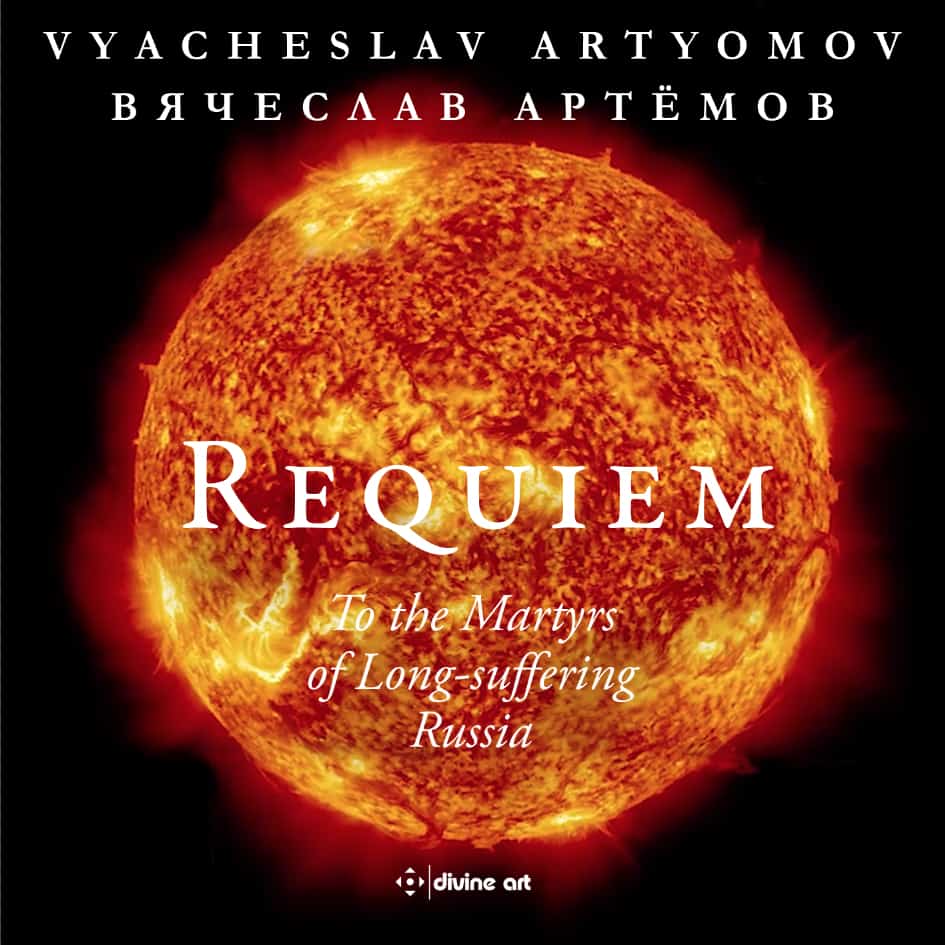
Artyomov: Requiem
Vyacheslav Artyomov is considered by many to be Russia’s greatest living composer. Since the fall of the Soviet regime his music has travelled the world to great acclaim. It is deep, ultimately spiritual and brilliantly crafted, with influences from the Russian symphonic tradition colored by Mahler, Scriabin, Honegger and Messiaen to name a few – but melded into a unique voice.
The Requiem, together with his massive Symphony cycles, was the work which brought enormous acclaim to Artyomov both in Russia and in the USA. It was the first Requiem to be written by a Russian after the 1917 Revolution and the first to be performed in the former USSR. Dedicated ‘to the Martyrs of Long-Suffering Russia’ it is a true masterpiece in which several parts of the mass are given treatments very different from the ‘norm’. Exciting, moving and bristling with power and passion, this is a Requiem to stand alongside the established great Requiems of the past. The performers are those who gave the Moscow premiere, and give a stunning performance.
Soloists: Yelena Brilova, Inna Polianskaya & Lyubov Sharnina (Sopranos); Alexei Martynov (tenor); Mikhail Lanskoi (baritone); Andrei Azovsky (treble);
Oleg Yanchenko (organ); Sveshnikov Boy’s Chorus; Kaunas State Chorus.