Catalogue Connection: 25174

  • Artyomov: A Sonata of Meditations etc… review on WTJU

    Vyacheslav Artyomov has developed his own musical language. It isn’t so much about scales and chords as it is timbres and sound clouds. In other words, the perfect aesthetic for percussion ensembles.

    This release features two works commissioned by the Mark Pekarsky Percussion Ensemble, performed by that ensemble. The earliest work, Totem, is a marvelous study in instrumental potential.

    The work begins with swirling clouds of sound that coalesces into a rhythmic section before dissolving into another ethereal cloud. Artyomov uses 69 instruments, creating interesting combinations of wood, metal, leather.

    In A Sonata of Meditiations (1978) Artyomov adds another dimension to his mix of tonal and indefinite pitch percussion. Each of the four movements — or meditations — add a player. So the first movement has one performer, the second, two and so on.

    What I admired was how diverse the collection of sounds Artyomov uses even with just a single player.

    A Garland of Recitations is a study in contrasts. Composed in conjunction with Meditations, it uses four performers in an entirely different fashion. Strings provide a continual, slowly evolving sound cloud. Four wind instruments — oboe, clarinet, saxophone, flute — each perform individually over this swirling sound.

    Artyomov pushes the wind instruments to their limits — and it pays off. The stark contrast between the energy and intensity of the soloists with the self-effacing string sound creates a work of exceptional beauty.

    These recordings were originally issued on Melodyia in the early 1990s. There’s a slight softness to the sound, but overall I heard an exceptional amount of detail. And hearing that fine detail is essential to fully appreciate these performances.
    Highly recommended.
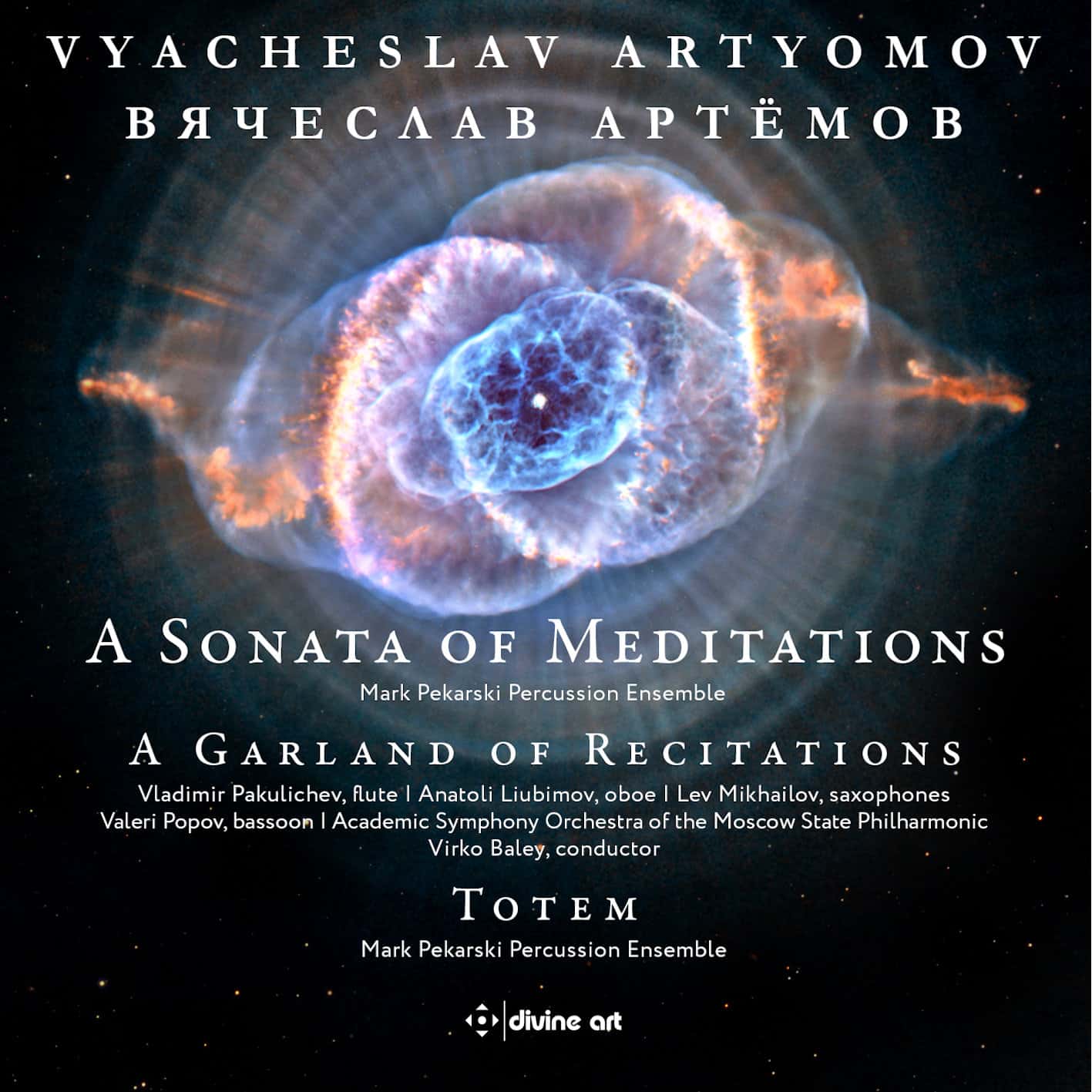
  • Fanfare review: Artyomov’s Sonata of Meditations

    As with earlier Divine Art discs of music by Vyacheslav Artyomov (b.1940), these are not new recordings. All have been licensed from Melodiya and all were recorded in the 1980s and 1990s.

    Artyomov’s music has polarized our reviewers. I have liked several of his works.

    This disc is devoted to music that Artyomov composed in the 1970s. He has composed a number of works for percussion ensemble, with or without other musicians, and two such works are on this CD. A Sonata of Meditations is in four sections, and each section represents a different time of day: “Morning,” “Afternoon,” “Evening,” and “Midnight.” The work is scored for four percussionists: one in the first section, two in the second, and so on. Each section also has a different sound, as a result of the different types of percussion instruments that are used. “Morning” uses only metallic instruments, for example, while “Afternoon” uses only drums. In this way, Artyomov has created ample contrast within this 28-minute work. The composer called it “a musical expression of the spirit of a human being aware of his responsibility to the world and absorbed in his daily round of meditations on the world’s beauty, on the profound significance of creation.” That’s a pretty tall order, and I am not sure the music delivers it. Nevertheless, Artyomov’s fondness for mystery and ritual is evident throughout, and the sounds are intriguing. That said, the Sonata really sounds like a product of its decade, for better or worse, and some listeners, feeling deja vu, might push it aside in boredom.

    Totem, a work for six percussion players who play 69 instruments, was inspired, in part, by Varese’s Ionisation. You will discern that very quickly if you know that particular work. This time, the composer has written that Varese “really was the first contemporary composer to choose percussion as a medium for the expression of deep tragic experience.” Suffice it to say that I would like to hear Artyomov explain what he means by that. Totem is in one movement with three sections, and is more structurally and rhythmically complex than the Sonata, but again, it sounds its age. Both performances, by musicians from the Mark Pekarsky Percussion Ensemble, sound good to me, and the engineering is fine.

    For me, the standout work on the disc is the 29-minute A Garland of Recitations. Suspended over an ominously roiling stratum of divided strings (Ligeti’s Lontano or Atmospheres come to mind), four wind instruments take turns unfolding long solos, which really do sound like recitations. The music seems to dwell in a land before the dawn of history, and the soloists sound like four ancient sages imparting wisdom and warnings in languages that are long dead. I’m really not sure what it all means, but this work definitely held my attention, and the soloists, in particular, give the music their all.

  • Music Web review – Artyomov Sonata of Meditations

    Artyomov is one of a group of Russian and East European composers – others include Kancheli, Silvestrov and Pärt – who grow up in the days of the Soviet empire, discovered European modernism and went on to forge individual and distinctive idioms. They also each tend to be the object of a cult. I was very taken with a disc of Artyomov I had for review last year so am glad to have been able to hear more of him.

    [This disc] features two works for percussion alone. One of the modernist composers Artyomov admires is Varèse, and in these works we can hear the influence of Varèse’s Ionisation of 1931, one of the first works in the Western tradition for percussion alone. A Sonata of meditations is in four movements and requires four players (Varèse required thirteen). Morning meditation features fragmentary phrases and bell sounds. Afternoon meditation concentrates on rhythm and has some impressive timpani glissandi. Evening meditation sounds like a recreation of Bartók’s night music in which a marimba is prominent; there are also some striking spatial effects. Midnight meditation is an irregular dance. The whole work takes you through a cycle of moods linked to the times of the day and I found it compelling.

    The other percussion work here, Totem, is for six players and is much shorter. It is also earlier. This has terrific rhythmic drive. I was surprised at one point to hear our old friend the Dies irae appearing. However, the work seemed to me not completely coherent and the longer Sonata is preferable.

    Between these two comes A Garland of Recitations. Four soloists, on, respectively flute, oboe, saxophones (of various sizes) and bassoon take it in turns to deliver a long solo in front of the orchestra, whose role is largely confined to sustaining long-held chords. For me, this was an interesting idea which long outstayed its welcome.

    The disc was originally recorded in the 1980s but has been expertly remastered and sound well. Most of the tracks were previously issued by Melodiya, but two of them are said to have come from private recordings held by the composer. There is no discernible difference in quality with these. The sleeve notes are by Robert Matthew-Walker, who has written a book on the composer and is the leading English authority on him. These are helpful, but they are a bit lacking in some basic facts, such as dates. The very striking covers are an attractive feature of this series.

    Artyomov is an interesting, indeed impressive composer, though I would resist some of the claims made for him. He is certainly worthy to be considered alongside the three other composers I mentioned at the start. I have yet to hear his Requiem, which is the work which made his reputation. Well worth exploring.

    [edited from joint review of several albums]

  • Artyomov Sonata of Meditations review in A.R.G.

    The composer’s biography begins “Vyacheslav Artyomov’s life under circumstances of unrecognition, official defamation and exclusion from livelihood and—no less important-spiritual loneliness, is truly heroic, and music, created by him in such a totalitarian country is an extraordinary feat.” A contemporary and friend of Sofia Gubaidulina, his interests are vast and include improvising with non-orchestral and exotic instruments, Russian folklore, traditional music of the East, and physics. Written for Percussion Ensemble, A Sonata of Meditations has four movements: Morning Meditation, Afternoon Meditation, Evening Meditation, and Midnight Meditation. Written in thin orchestration and with slowly developing subject material, the work is constructed in such a way that sitting through a performance of it is a true guided meditation. Though each movement has a different energy and encompasses a wide range of moods, I would liken Artyomov here to John Luther Adams: the listener is allowed the mental space to embark on a personal meditation as the music weaves in and out of different sound worlds at a snail’s pace. The second piece, A Garland of Recitations, feels like a slow-moving cloud as the strings merge through eery harmonies, delicate as mist. The soloists take turns giving their individual recitations as per the title of the work. These recitations sound nearly improvised, and they feel earnest, like pleading soliloquies. Fans of Adams and Gubaidulina will find much to enjoy here.

  • Artyomov: A Sonata of Meditations – Musicweb review

    This is music with a welcoming yet far from facile surface. Compare it with the, at times, harsh and unrelenting Edison Denisov, the intriguing density and mysticism of Sergei Zhukov and the entangled psychedelic delights of Silvestrov. Russian composer Vyacheslav Artyomov has been enjoying an invigorating injection of attention courtesy of The Divine Art. The present CD – the seventh in the project – sets out two works for percussion ensemble and one for orchestra. The other six DDA discs include a full-scale and full-on Requiem which was the sixth disc in the series.

    A Sonata of Meditations is thirty, largely quiet, minutes of polished silvery tintinnabulation and percussive hyperactivity. The listener is lead through a chaste world of Meditations: one each for Morning; Afternoon; Evening and Midnight – one track for each Meditation. This work, with its mélange of measured silence, wooden rasps, humming gong, arrhythmia and regular rhythmic figuration is a gift to the Mark Pekarsky Percussion Ensemble. Pekarsky leads what we are assured is the first and elite Russian percussion ensemble. The music is not a stone’s throw distant from the similarly instrumented works of Alan Hovhaness, Henry Cowell and Lou Harrison. As for Totem this is a more kinetic, virtuosic, dramatic and humorous piece by comparison with A Sonata of Meditations. It comes complete with swanee-whistle and rattle-snake noises alongside much else.

    A Garland of Recitations
    is an orchestral work in a single movement and in one track. Against poised, introspectively prayerful strings, which seem to speak of the night-sky, individual solo instruments sing out. They are closely foregrounded by the engineers. The solos are mostly woodwind, often in cool idyllic mode, but once in a while an orchestral piano adds its DNA to the mix. The style is just as meditative and undramatic as that in evidence for the Sonata but with a libation of dissonance, angularity and moaning groans. Good to see that among the solo musicians are Valeri Popov, the soloist in the Melodiya recording of the Bassoon Concerto by Jolivet and saxophonist Lev Mikhailov who turned in an excellent reading of the Glazunov Concerto in 1976; both very different works from the Artyomov.

    The music is recorded with stark fidelity and the solo instruments in the Garland are quite closely recorded. As for the programme notes by Robert Matthew-Walker, they tell the reader about the composer, these three scores and the performers. The notes are in English and Russian (Cyrillic).

    These Melodiya-originated recordings are far from nebulous. One can imagine that a full-score could be prepared from what we hear; such is the candour of the sound.

  • Artyomov: A Sonata of Meditations, etc.

    Artyomov: A Sonata of Meditations, etc.

    Vyacheslav Artyomov is considered by many to be Russia’s greatest living composer. Since the fall of the Soviet regime his music has travelled the world to great acclaim. It is deep, ultimately spiritual and brilliantly crafted, with influences from the Russian symphonic tradition colored by Mahler, Scriabin, Honegger and Messiaen to name a few – but melded into a unique voice.

    The Divine Art Artyomov Retrospective is a mix of new recordings and former Melodiya releases. It continues with the seventh album containing two works for percussion ensemble and one orchestral – all typifying Artymov’s true genius as a truly individual composer who can make thoroughly modern music listenable and demanding further regular hearings. The three works on this album are all typical of Artyomov’s individual and impressive genius

    Mark Pekarsky leads the first percussion ensemble established in Russia and still the foremost group in that country. They perform A Sonata of Meditations and Totem while Russian-American conductor Virko Baley directs the superb Moscow Philharmonic in A Garland of Recitations.