Catalogue Connection: 25175

  • Artyomov: In Memoriam – Fanfare review

    Based on their titles alone, you might guess that the works on this CD are a real downer. You would not be wrong. I don’t recommend playing this CD, particularly in one sitting, if you’ve had a bad day at work or are feeling depressed. When I wrote about the Requiem, back in 2006, I compared parts of it to Penderecki’s Magnificat and St. Luke Passion. The works on this CD also suggest Penderecki, but during his neo-Romantic period. While the music sounds modem, it is predominantly tonal, and there is nothing experimental about it. In its unrelieved glumness, it hardly lives up to Soviet ideals.

    In Memoriam is derived from a youthful violin concerto, and even now, it is a violin concerto in everything but name. It opens slowly, with an extended solo, but the tension and density steadily ramp up as the work progresses. One might say that it starts with Shostakovich and that it ends with Schnittke. Lamentations, in three sections, each about four minutes in length, features orchestral strings (with percussion) and an organ. Its material is derived from choral sections of the aforementioned Requiem. It is hard not to hear the first section of this work and think of Penderecki’s Violin Concerto No. 1 or The Awakening of Jacob. The second section opens with a melody so sad but comforting it might have come from a film score, but the keening strings soon return and shatter hope. A brief, dissonant climax in the middle of this section suggests the Adagio from Mahler’s 10th. The third section follows a similar pattern, and the melting string glissandos at the end once again suggest Penderecki.

    The Pietà is a common subject in the visual arts, but less common in music, unless you consider the Stabat Mater to be its equivalent. Again, this is a concerto, for cello, in all but name. To have this work follow Lamentations seems like a miscalculation, as keening orchestral strings are prominent here as well. As with In Memoriam, the music picks up energy and density as it progresses. The ending is something new, however: After a quiet cello cadenza, the orchestral strings re-enter, and with the help of bells, send themselves and the soloist into an outer space tremolando.

    Parts of Tristia I sound like very much like Charles Ives’s The Unanswered Question. That’s not a bad thing; if you’re going to pay homage to other composers, it’s good to remember Ives, because he was one of the original bad boys of Modernism. Against divided strings and a piano, who seem to be doing their own respective things, harmonically and rhythmically, a lonely trumpet calls out and receives no response. The composer writes, “Nevertheless, this piece is a sad poem about life which slowly descends into eternal sleep.” Last one out, don’t forget to turn off the light!

    The soloists on the CD are somewhat familiar in the West, or became more familiar later on, and they do not disappoint. The orchestral playing is very good too, but the engineering is a little glassy. I don’t think anyone will complain about the performances, as long as they can accept the fact that these works take an emotional toll. Artyomov has written, “Despair begets faith,” and you will need faith to get through this CD intact. Artyomov is a gifted composer and I am glad that Divine Art has decided to reissue (now) eight CDs of his music, but there are not a lot of smiles to be had here.
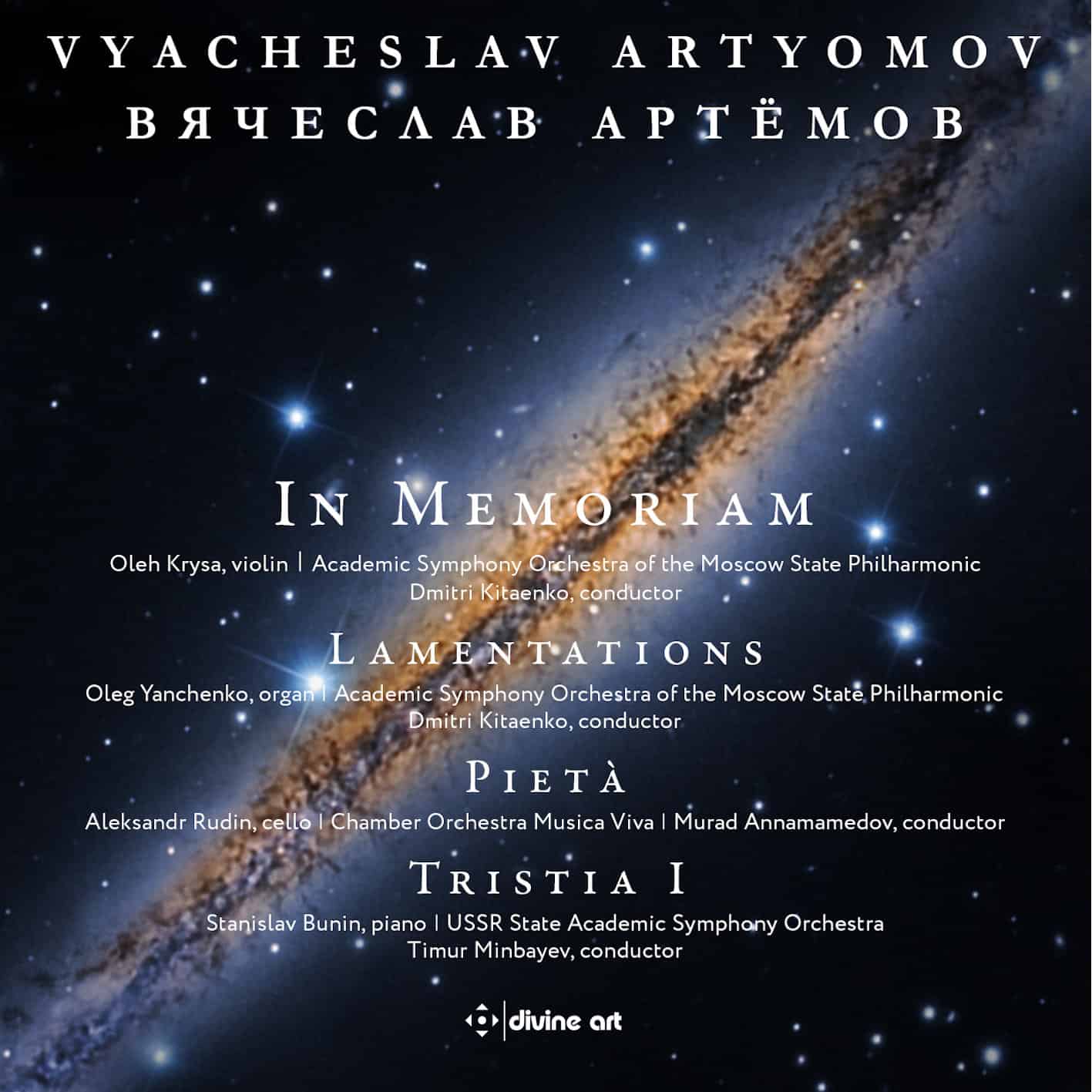
  • Artyomov: In Memoriam review from American Record Guide

    The recordings date from 1986, 1987, and 1984 and all but Pieta have been reviewed previously (July/Aug 1994; Jan/Feb 1992). Pieta arranges music from the Requiem (Jan/Feb 1992). Mr De Jong summed up the composer’s style very well: “The music is often dissonant but also has moments of lyricism, and the rhythms are varied. Artyomov lists as influences on his music 19th Century romanticism, Schubert, Bruckner, and Russian folk music; but not all of that is evident in this music. An individual voice is heard sometimes, but frequent glances at the Polish School are also evident.”

    These works are more somber than lyrical, more ecstatic than passionate; luminous clusters of string sound and intense melodies with wide intervals abound. They still sound very good after all these years, and the performances hold up, too. Still, these works are not for the faint-hearted, and I have no compelling reason to keep them in my library.

  • Artyomov – In Memoriam and other works – MusicWeb review

    The excellent booklet that accompanies this CD is in three sections: Introduction, The Music (by Robert Matthew-Walker) and The Composer. The last of these explains the hostile attitude of the authorities towards Artyomov, until the thawing of the icy grip of the Soviet State in 1995 at last permitted artistic freedom of expression. As late as 1979 he was blacklisted by the Sixth Congress of the Union of Soviet Composers, just because some of his works were beginning to be performed in Western festivals.

    If there is ever any question of our politicians interfering in artistic freedom, the experiences of Soviet composers must stand as a potent warning.

    The booklet opines that it was Artyomov’s strong Christian faith that gave him the courage and fortitude to persevere down his artistic path. In fact, it was a performance of his Requiem in 1988 that earned the approval of the notorious Tikon Khrennikov, and which signalled his readmittance to the pantheon of Soviet ‘Greats’.

    The works on this CD are presented as deriving from his religious belief. The first, and earliest work, presented here is In Memoriam, which started life in 1968 as a post-graduate violin concerto. It was subsequently withdrawn and was recomposed in 1984 as his second symphony, the first of a cycle of symphonies, each with a solo instrument appearing almost as a Sinfonia Concertante. In Memoriam is dedicated to the composer’s mother, and the solo violin weaves its way through the orchestral conglomeration, and so becomes an integral part of it. In two movements Adagio and Allegro, it sounds to me as though the composer’s influences range from Shostakovitch (in brooding mode) through Stravinsky, Varese and even Berg. It doesn’t strike me as being particularly original, perhaps representing an all-purpose neo-tonal modernism of its time. The music is intense in the extreme, varying from a dark orchestral agglutination with the violin, to violent percussive outbursts, and the up-front recording emphasizes this fact.

    It would seem that Artyomov’s most significant large-scale work is his Requiem, and the next work on the CD is his Lamentations, which is an arrangement of three initial episodes from it, for organ, percussion, piano and string orchestra.

    The booklet tells us that Artyomov transcribed the choral passages for organ, percussion and string orchestra with an optional piano. I have never heard his Requiem, but I can easily imagine a chorus singing the falling string textures in all three movements and being accompanied / interrupted by the organ and percussion – strikingly, bells. I should think that it would be extremely effective, as indeed is the transcription in representing lamentation, which can reinforce or beget faith. I found this music to have a more personal stamp than In Memoriam.

    It is followed by Pietà, a twenty-one-minute cello concerto dating, in its revised form, from 1996. It depicts the Virgin Mary holding the body of her dead son. As one would expect, Artyomov’s music is strong on lamentation, and as far as I can tell appears to be in five sections. From the development of the music, I interpret them as follows. It begins with an initial quiet lament, as the Virgin holds Jesus’ body. A quarter of the way through, the pulse increases in a section of increasing intensity, featuring repeated glissandi for the orchestra, perhaps representing a more visible level of distress in Mary and the friends accompanying her. Half way through, a short, more quiet section, as Mary calms somewhat. That ends with brief violent chords which constitute an introduction to a long cadenza for the soloist, perhaps representing a lament by Mary. Finally, a section prefaced by high violins, which slowly descends into silence, accompanied by pizzicato chords capped by the quiet ringing of bells.

    The work is impressive in its impact, and I just wish that the melodic line was a bit more memorable. Once again, the recording is somewhat ‘in your face’, with the opening cello chords emanating as if from a gigantic instrument.

    Finally, we have Tristia I, for solo piano, strings, trumpet and vibraphone. Like the other works on the CD, it represents a state of mind which can hardly be described as happy, and so we have music that corresponds. In this instance it has been inspired by a poem written by the composer’s wife Valeriya Lyubetskaya. The work begins with nearly two minutes of slow orchestral keening, underpinned by low organ timbres, which is then joined by the piano playing (apparently) random chords, followed by a lamenting trumpet. The booklet notes explain that these two instruments play in a rhythm independent of the strings. To my ears this yields music that at times sounds almost aleatoric. At nearly seventeen minutes, I found it to be the most difficult of all the works on the CD.

    To conclude, the music is, at times, challenging, and will probably only reveal its secrets to those prepared to commit to concentrated repeat listening. In particular, the last piece makes significant demands upon the listener. The recordings are vivid, if somewhat up-front. The CD is presented in the usual plastic case with a superb booklet that has colour photographs and extremely informative essays in English and Russian.

  • Artyomov In Memoriam: Arts Desk review

    Born in 1940, Vyacheslav Artyomov trained as a physicist before switching to music. He joined forces with fellow composers Sofia Gubaidlina and Viktor Suslin in the mid-1970s to form a group specialising in improvisation with unconventional instruments. Like Shostakovich and Prokofiev before him, Artyomov fell foul of the Soviet authorities, his music effectively banned for several years. Though Tikhon Khrennikov, the famously cantankerous chief of the Composers’ Union, performed a volte-face a decade later and declared that Artyomov’s 1988 Requiem “raised Russian music to a previously unattainable height.” Three sections of that work were transcribed by Artyomov to form Lamentations, the choral parts now played on organ. Angst-ridden and ecstatic, it makes for compelling listening, and it’s prompted me to seek out the source work.

    There’s a sameness of tone to the pieces collected on this latest volume in Divine Art’s ongoing Artyomov series: this music is slow and sombre, the lightness achieved through transparent scoring. Writing slow, serious music never hindered Pärt or Tavener, composers who share Artyomov’s Christian faith. These pieces are worth hearing, and a useful introduction to a figure who deserves wider recognition. In Memoriam began life as a violin concerto written in Artyomov’s twenties, later reworked as a single movement symphony. Some of the solo line survives, beautifully played here by Oleh Krysa. Pietà is an extended work for cello, strings and tubular bells, rich in angular melody and full of striking effects. And there’s Tristia I, a downbeat concertante piece for piano, strings, trumpet and vibraphone which defies our expectations of what a work written for those forces should sound like. The performances are authoritative and well-engineered, several of them recorded back in the 1980s when Artyomov was officially out of favour.

  • Vyacheslav Artyomov: In Memoriam and other works

    Vyacheslav Artyomov: In Memoriam and other works

    Vyacheslav Artyomov is considered by many to be Russia’s greatest living composer. His music is deep, ultimately spiritual and brilliantly crafted, with influences from the Russian symphonic tradition colored by Mahler, Scriabin, Honegger and Messiaen to name a few – but melded into a unique voice. The Divine Art Artyomov Retrospective is a mix of new recordings and former Melodiya releases. This is the eighth instalment, containing three orchestral works, with an over-arching sorrowful cast – remembering, like his Requiem, the suffering of the Russian peoples under Soviet rule (and for In Memoriam, a tribute to the composer’s mother), and all typifying Artyomov’s true genius as a truly individual composer who can make thoroughly modern music listenable and demanding further regular hearings.

    Three fine orchestras and conductors, and superb soloists, provide a rich and satisfying program of substantial modern orchestral music.