Catalogue Connection: 25176

  • Artyomov: Star Wind on Review Corner

    (joint review with DDA 25164 and DDA 25184)

    We find ourselves repeating the same things about Artyomov and with Divine Art releasing his work at regular intervals we thought we’d promote a bunch together. Artyomov is one of Russia’s greatest living composers. He writes music that’s galactically huge, by which we mean it gives the impression of space and endless time; the music of the spheres. The introduction of Sola Fide is only flute and piccolo (?), followed by strings, but within seconds he’s up there, floating in the vastness of space. This is clearly not just us; the sleeves all nod towards outer space.

    It’s imposing in one way, with the feelings it evokes, but it’s not hard to listen to. We play it quite often, as it’s enervating and uplifting, a quick scrub to the brain with a pumice. True, he challenges the listener — Sola Fide’s second movement Separation has a slightly scary choral section — but he always backs away from being downright intimidating and by Revelation he’s surprisingly calm, given the title. Shock is unsettling, the film score for a spaceman whose tether snaps, and he frantically tries to grip onto his craft before … well, we’re not scriptwriters.

    Star Wind (and other works) is slightly more grounded, in that it lacks something of the feel of eternity though it’s still a bit out there. The title track opens and it well represents a wind, leaves blowing around rapidly and stopping suddenly, violin and flute suggesting skittishness. “I meant not only the physical wind but rather inspirational while you are at night on the top of a mountain looking at the immense skyscape,” says the composer in the sleeve notes. Moonlight Dreams is in four movements, and based on 7th century Chinese texts and demands “synchronous breathing” from the performers. Bamboo Solitude’s text starts: “I sit alone in unfrequented grove / I pluck my lute and hum a song of love.” The other three pieces are Autumn Moon (“Fall moon bright, fall wind light / Rustling leaves disperse”), River Village (“My fishing done, the boat is left unmoored / The weary moon and village bring me sleep” and Quiet Night Thoughts (predictable: “I gaze awhile, then bow my head / Where thoughts race homeward bound.” A soprano adds atmosphere to these gentle pieces.

    Elsewhere, Romantic Capriccio, for French horn, piano and string quartet was composed in 1976 and written in memory of Jean Sibelius. The sleeve notes the opening pages “have a character of extreme anger”, concentrating upon the relationship between horn and piano, followed by a more conciliatory stretch as the music warms. We’re not sure about the anger but it is forceful for Artyomov, and calming strings come in quite quickly; one of his more down to earth pieces. In Spe (In Hope) is the hardest of these three and “broke new ground in Artyomov’s writing in its use of polydynamic, everchanging textures while retaining his deep spirituality”. It is a massive work, in one movement but 21 sections playing continuously. It is more unsettling but there are some moments of calm and beauty. He’s worth listening to. Often melancholy in a Russian way, it also contains many moments of beauty.
  • American Record Guide review – Artyomov: Star Wind

    The mini-renaissance of Vyacheslav Artyomov’s music continues. This Russian composer, born in 1940, endured oppression in the early 1980s after the odious Tikhon Khrennikov lambasted him and six other composers in 1979. Melodiya did record some of his music as early as 1984, and Divine Art has been reissuing those along with recordings from his personal archives. We’ve generally been impressed with his vision while noting that passages can be cheap or cloying. Tone clusters, star-lit meditations, religious ecstasy, jazz, and even silly humor all figure in his strange, powerful, and sometimes frustrating music. Like a planet’s unavoidable gravitational pull, his compositions have often drawn us in.

    Most of these pieces are consistently dreamlike, with the unmetered, distant-galaxy writing enhanced by cool, reverberant sonics. Artyomov demands all your concentration, so two or three pieces is usually enough for one sitting. The full string chords in Romantic Capriccio (in memory of Sibelius) offer a brief respite, but by the time Morning Songs (Mattinate) rolls around, I’m ready for some Haydn.

    The one outlier, Scenes, was written in 1971 for a ballet film that was banned after one of the dancers defected. The faster sections are cheeky, peppy, and reminiscent of Stravinsky’s ‘Ragtime’; jazz and spoofed sentimentality appear in the slower parts. The sound is not ideal, but it is clear and listenable, though the piano in a few pieces is shallow and bright, and the violin in Scenes is put under a particularly glaring light. Notes and texts are in English and Russian.

  • Music Web review – Artyomov ‘Star Wind’

    Artyomov is one of a group of Russian and East European composers – others include Kancheli, Silvestrov and Pärt – who grow up in the days of the Soviet empire, discovered European modernism and went on to forge individual and distinctive idioms. They also each tend to be the object of a cult. I was very taken with a disc of Artyomov I had for review last year so am glad to have been able to hear more of him.

    This disc is made of chamber works, all for unusual combinations and sounding to me very much as if Artyomov had just discovered the works of Stravinsky and the second Viennese school and was trying his hand at their idioms. Star Wind is a sextet for violin, cello, flute, horn, piano and glockenspiel and requires a conductor. It is a one-movement work, romantic and expressionist in a manner slightly reminiscent of Berg and without the emotional weight of Artyomov’s orchestral works. I found it beautiful and approachable.

    Variations: Nestling Antsali is a set of variations for flute and piano – the latter here played by Artyomov himself. The title comes from a Madagascar folk tale and the technique sounds serial. The opening flute melody is strongly reminiscent of Varèse’s solo flute piece Density 21.5 and the variations are very varied. Though more jagged than Star Wind, this was also an attractive work.

    Moonlight Dreams is a song-cycle for soprano with alto flute, cello and piano. The words are four Chinese poems in English translation by David Cheetham, sung in English. This may sound like an influence from Mahler, whose Das Lied von der Erde also sets translated Chinese poems, but a closer parallel would be with Schoenberg’s Pierrot Lunaire, as the accompaniment is for alto flute, cello and piano, similar to, though smaller than, the Pierrot ensemble. Additionally, all four poems contain references to the moon. There are instrumental passages before and after each poem. I had better say at once that Artyomov makes much more beguiling sounds than Schoenberg’s rebarbative masterpiece, though there are some quasi-expressionist solos for the instruments. Nelly Lee sings the songs with a lovely tone and accurate intonation, though her words are not very clear. Fortunately, they are included in the booklet.

    Romantic Capriccio rather belies its name. It was, in fact, composed for the twentieth anniversary of the death of Sibelius, and is in turns elegiac and angry. The scoring is for horn – which takes a lead role throughout – piano and string quartet. There are echoes of his violin concerto and also snatches of the stamping chord from Stravinsky’s Rite of Spring. There is a general move from protest to resignation, but I found the work too episodic to be satisfying.

    Mattinate (Morning Songs) is a set of two pieces for violin, flute and guitar, which turns out to be a very happy combination, with the two melody instruments throwing arabesques while the guitar twangs away sympathetically below. A soprano has a brief vocalise at the beginning and ending of the second movement. I count this one as a success.

    As I do the last work on the disc: Scenes (Grand Pas). This came as a complete surprise. It is a short suite composed for the combination of violin, clarinet, bass, piano and percussion (two players); it needs a conductor. I think Artyomov must have been listening to Stravinsky’s Soldier’s Tale, since his is a similar ensemble and the perky and witty music – not at all what I expect from him – is very much in that style. There is one slower number, which is more like Prokofiev’s Romeo and Juliet, but otherwise Stravinsky is very much the presiding spirit and the work as a whole is a jolly romp. I greatly enjoyed it.

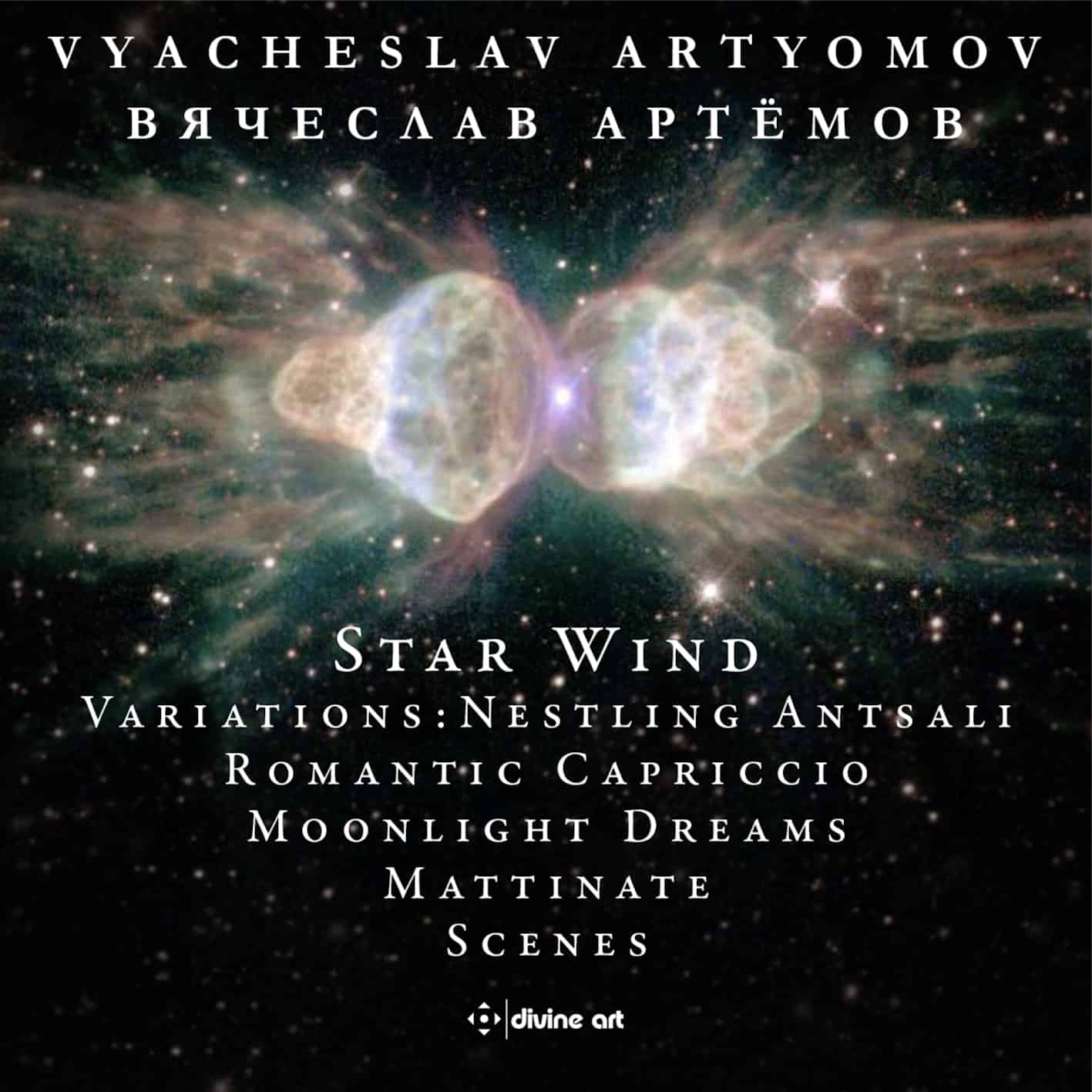
    The very striking covers are an attractive feature of this series.

    Artyomov is an interesting, indeed impressive composer, though I would resist some of the claims made for him. He is certainly worthy to be considered alongside the three other composers I mentioned at the start. I have yet to hear his Requiem, which is the work which made his reputation. But all the discs are well worth exploring. I would start with Star Wind.

    [edited from joint review of several albums]

  • New Classics review of Artyomov’s Star Wind

    Born in Moscow in 1940 in Moscow, Vyacheslav Artyomov is considered Russia’s greatest living composer. As a young man, he developed a profound interest in Russian folklore and traditional music of the East, as well as the works of Prokofiev, Stravinsky, Messiaen, Arthur Honegger, and the Polish avant-garde. Artyomov’s warm, expressive compositions reflect his interest in the archaic, Christian motifs and Eastern meditation. He prefers not to call his music ‘contemporary’, using instead a specific term for including it into the Tradition ‘musica perennis’ (eternal music). As he says, ‘music is the only way for the cognition of the sense of existence’.

    Since the fall of the Soviet regime his deep, spiritual and brilliantly crafted music has travelled the world to great acclaim. His works are in the grand symphonic and post-Romantic traditions and he has been called ‘the Bruckner of the 21st century’. This is the ninth installment in Divine Art’s excellent series of releases featuring his music, including the ‘Threshold’ and ‘Gentle Emanation’ symphonies as well as his ‘Symphony of Elegies’.

    This latest release features six works for varying chamber ensembles, and while embodying the composer’s overall wide ranging compositional style, spirituality and mysticism, the music expresses this in a more intimate, lyrical style than his massive symphonic works. ‘Scenes’ was originally written as a ballet score for a film which was banned by the Soviet authorities and never shown, so the work now stands in its own right as a ballet suite.

  • Artyomov: Star Wind CD reviewed by Music Notes

    In a recent review of a CD of Vyacheslav Artyomov’s music this past November I wrote: “… (his) music is mystical, Russian at the core… a master of orchestral writing and of unusual instrumentation… his melodies have their roots in old Slavonic chant…”

    As I listened to the CD (dda25176) Star Wind, a compilation of Artyomov’s music just released by Divine Art Recordings Group (www.divineartrecords.com) I was once again intrigued by the versatility of the Russian composer’s genre-defying music.

    Artyomov’s music is widely performed in Europe and inexplicably by and large ignored in America. I hope against hope this Russian artist’s long overdue recognition happens soon in these parts. By no means derivative, the music of this Russian master is all encompassing in the way in which it embraces Serial techniques here, Romanticism there, often finding inspiration in folklores of foreign lands, yet severely disciplined and anchored in a rigorously Russian Classicism.

    Star Wind is both the title of Artyomov’s CD and that of the work that occupies its first track: a tone poem for violin, cello, flute, French horn, piano and glockenspiel. Tonally ambiguous but never harsh in its use of dissonances and sudden outbursts of tone clusters the composition is strikingly original.

    Not surprisingly, the chameleonic Artyomov next moves into a dodecaphonic construct in Variations: Nestling Antsali for flute and piano, a set of variations that playfully imitate the fidgeting behavior of the young of a small bird species from the isle of Madagascar.

    Moonlight Dreams is a hauntingly evocative cantata for soprano and a chamber ensemble made up of alto flute, cello and piano, with texts culled from the words of four seventh century Chinese poems: In Bamboo Solitude, Autumn Moon, Village at the River, and Quietly Peaceful Night Thoughts in an English translation by David Cheetham of the poetry of Wan Wan, Li Po and Ssü K’ung Shu. Nelly Lee is the pure-voiced soprano soloist.

    Romantic Capriccio
    for French horn, piano and String Quartet is, as its title implies a bold work that embraces a more tonally and melodically traditional sound than the other works in this CD.

    Mattinate is actually the title of two charmingly Italianate vocalizes for soprano, with violin, guitar and flute accompaniment, here beautifully sung by soprano Iana Besiadinkaya.

    Artyomov wrote for film and for dance, but upon his leaving the Soviet Union, The Moscow Fantasy, the movie ballet for which he composed a score was banned by Soviet cultural apparatchiks. Fortunately the jazzy, sassy, at times rhapsodic, at others sardonic music is extant and is here given a vibrantly rousing performance of seven of its scenes by a top-notch ensemble: Mikhail Tsinman, violin; Igor Abramov, clarinet; Nikolai Gorbunov, bass; Anatoly Sheludiakov, piano; Aleksander Suverov and Valerly Polivanov, percussionists, with Murad Annamamedov conducting.

    As usual with anything divine art issues, STAR WIND (dda25176) is nicely packaged and provided with Robert Matthew Walker’s excellent commentary. The engineering by various teams (this being a compilation of earlier recordings) is uniformly good.

  • Artyomov – Star Wind and other works

    Artyomov – Star Wind and other works

    Vyacheslav Artyomov is considered by many to be Russia’s greatest living composer. His music is deep, ultimately spiritual and brilliantly crafted, with influences from the Russian symphonic tradition colored by Mahler, Scriabin, Honegger and Messiaen to name a few – but melded into a unique voice.

    The Divine Art Artyomov Retrospective (which to date has received wonderful reviews internationally) is a mix of new recordings and former Melodiya releases. This is the ninth instalment, which comprises six works for varying chamber ensembles, and while embodying the composer’s overall wide ranging compositional style, spirituality and mysticism, these pieces express this in a more intimate, lyrical style than his massive symphonic works. ‘Scenes’ was originally written as a ballet score for a film, but as the movie was banned by the Soviet authorities and never shown, the work now stands in its own right as a balletic suite.

    Some of Russia’s finest soloists and chamber players contributed to this album:
    Star Wind:
    Mikhail Tsinman, violin; Alexander Rudin, cello; Konstantin Yefimov, flute; Andrei Kuznetsov, French horn; Anatoly Sheludiakov, piano;
    Alexander Suvorov, glockenspiel; Murad Annamamedov, conductor
    Variations: Nestling Antsali:
    Alexander Korneyev, flute; Vyacheslav Artyomov, piano
    Moonlight Dreams:
    Nelly Lee, soprano; Alexander Golyshev, alto flute; Vladimir Tonkha, cello; Dmitri Alexeyev, piano
    Romantic Capriccio:
    Igor Makarov, French horn; Yuri Smirnov, piano;
    Alikhanova String Quartet (Yevgenia Alikhanova & Valentina Alykova violins, Tatiana Kokhanovskaya, viola, Olga Agranovich, cello)
    Mattinate:
    Iana Besiadinskaya, soprano; Zarius Shikhmurzayeva, violin; Vladimir Pakulichev, flute; Nikolai Komolyatov, guitar
    Scenes:
    Mikhail Tsinman, violin; Igor Abramov, clarinet; Nikolai Gorbunov, bass; Anatoly Sheludiakov, piano; Valeriy Polivanov & Alexander Suvorov, percussion; Murad Annamamedov, conductor