Catalogue Connection: 25178

  • Carlotta Ferrari – Women of History – Fanfare review

    Confused? You will be. There are two female composers called Carlotta Ferrari, and to make matters worse, both of them studied in Milan. The present one was born in 1975 (the other’s dates are 1837-1907). So putting “Carlotta Ferrari” in the headnote hardly helps.

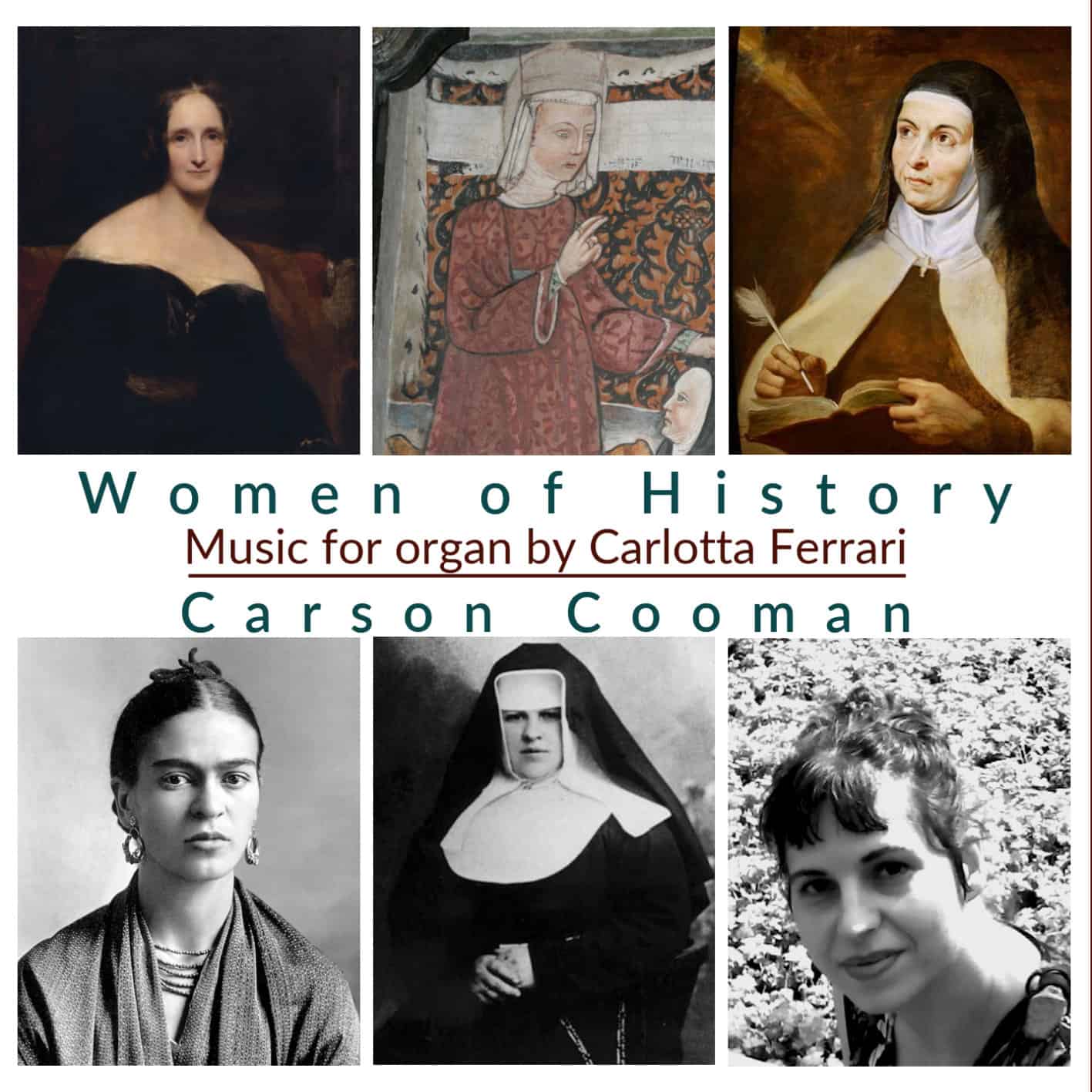
    The present disc is entitled Women of History. All five works herein are inspired by the live and works of significant historical ladies. Ferrari’s music has a modal bent: She has worked with a system called “RPS” (“Restarting Pitch Space”), explained eloquently and in detail by its founder, the organist here, Carson Cooman, at carsoncooman.com/restarting-pitch-space. Perhaps what is important to grasp is the limited transpositions within sets and the general modal feel.

    The first piece, Lady Frankenstein (2016), is a symphonic poem for organ cast in four movements and inspired by Mary Shelley, the literary creator of Frankenstein. Fascinatingly, the composer sees the monster as a projection of Mary Shelley’s feelings of guilt, loss, and anger. The piece begins with the slow-moving “organo pleno” chords of “Mary e la Creatura.” There is certainly a Gothic at¬mosphere to the super-long pedals and imposing chords; a more supplicatory “Imperare la vita” (Learning Life) which seems to be suffused with a sense of awe prior to its agitato 16th notes, follows. The chorale-like sections keep on returning in this movement, almost projecting a sense of hesitant exploration. Cooman offers performances of the utmost respect to the score, and the organ (the main organ of Laurenskerk, Rotterdam, Netherlands) is spectacularly caught by the engineers. The work’s third panel, “L’amore,” is a gentle “Passacaglia in Trio”; the repeated chords of the finale, “La morte it ghiaccio, nel fuoco, nel mare” (Death in the Ice, the Fire, and the Sea) take the work into a very different space: Some sort of comfort, albeit a sadness-laden one, is heard at the very close.

    The piece Maria Restituta (2016) is subtitled “Rhapsody for organ” on the score and is dedicated to the memory of Maria Restituta Kafka (1894-1943), a Franciscan nun and nurse in Vienna who was executed by the Nazi authorities after satirically mocking Hitler in a poem and refusing to remove crucifixes from hospital rooms. In 1998, she was beatified as a martyr. The mode here is Lydian beginning on D. References to church cadence are part of the musical vocabulary here. A faster section (headed simply “Mosso”) attempts to bring movement and maybe even to leaven the mood, but to little avail. Gesturally simple, the piece actually makes for a poignant effect.

    Like the first two pieces, Historia Gullielmae dates from 2016. And like Lady Frankenstein, it is a symphonic poem, this time in five panels. The inspiration here is Guglielma Buema (also Guglielma da Milano), a medieval heretic. Here, it is the Aeolian mode that colors the piece. Guglielma preached the inclusion of women in the church as equals. The movements are to be interpreted as so many panels describing aspects of Guglielma’s life. The solemn “Guglielma e lo Sprito” (Guglielma and the Spirit) leads to subtle metrical play of “II volto rosso di Chiaravalle” (in the early church, the Holy Spirit was seen as an angel with a red face) before the chaconne of “Il guglielmiti di fronte all’inquisitore” introduces its own drama (the recording splendidly captures the rumbling bass pedal; Cooman’s virtuosity is splendid). The harmonic sweetness of “Guglielma e Andrea” leads to the “meditazione” of the final “La santa cena di Maifreda,” the holy supper celebrated by Maifreda as an act of revolution. This finale includes [a] fascinating fugue; and, actually, the almost tentative mezzo staccato pedal notes prior to the fugue itself are a stroke of inspiration, gloriously conveyed by Cooman.

    Inspired by a stunning painting of the same name by the Mexican painter Frida Kahlo, Viva la vida (Live Life, 2017) changes the mood of the disc totally. A wonky, skew-whiff waltz takes us to fairground mirrors and smokescreens. The invitation to enjoy life is clearly there, sonically, and Cooman seems to have a ball.

    Finally, it’s back to religion and its transformative powers in Ecstasy (La transverberazione di Teresa d’Avila) of 2015. The ecstatic visions of Saint Teresa bring about a response from Ferrari that conveys that sense of ecstasy through an emphasis on particular, bright simultaneities: hence the framing use of “organo pleno” (literally, “full organ,” in the sense of full principal chorus). Regal is really the mot juste here.

    The organ used is a completely mechanical neo-Baroque instrument (actually the largest entirely mechanical action instrument in Europe). It is a majestic, beautiful organ and one could hardly ask for a better recording. Cooman’s readings of the scores are impeccable in every way.
  • Women of History – A.R.G. review

    Lush, velvet, alternatingly contemplative and impassioned, this set of five pieces written by Carlotta Ferrari for solo organ are high-definition musical portraits that brilliantly capture their subject’s personalities and stories. The four-movement Lady Frankenstein is a masterpiece of large emotions boldly staring providence in the face. Inspired by the life of Mary Wollstonecraft Shelley, the composer writes that sections of this symphonic poem are “based on the correspondence between Shelley’s life and the events in the life of the Creature. Both their births, the fictional and the real, are in some way related to death—the Creature being created by Frankenstein with parts of corpses and Mary’s mother dying while giving birth to her daughter.” This is an important work for organists, especially ones interested in music by women. It is full of dark, musty, jewel tones and is worth its own journey of plowing emotional depths.

    Maria Restituta is “a rhapsody dedicated to the memory of Maria Restituta Kafka”, a Moravian/Austrian Franciscan nun who worked as a nurse in Vienna and was executed by the Nazi-run Austrian government for mocking Hitler and refusing to remove crucifixes from the rooms of her hospital. The delicate and solid strength that flows through this piece is inspiring. ‘Viva la vida’ is a piece inspired by the painting by Frida Kahlo. It’s a dark, Seussian waltz (short— 2:30) that haunts the inner ear after it is past.

    Carson Cooman is an organist and composer for whom over 300 works by more than 100 composers have been written. With most of these pieces born out of subject material that occupies the space between deep sorrow and unpolluted awe, a performance that is direct, immaculate, and gives such a clear voice to the music itself is essential. And Cooman gives us just that. This set of ears and this heart is incredibly grateful for this work of art and dedication by Ferrari and Cooman.

  • Women of History – short BBC review

    The concept behind this set of organ works is its best feature; a set of compositions inspired by five women from history. Cinematic soundscapes and clever interpretations. (Three stars awarded)

  • Women of History – Chronicle Review

    Albums from organist Cooman are the opposite of buses: you wait no time at all, and another two turn up. The man never sits still.

    This new one is an album of music by the Italian composer Carlotta Ferrari, professor of music composition at the European School of Economics in Florence.

    Ferrari has written many works based on historical figures, and the five works on this album are inspired by the lives and works of famous women.

    The tone is set by the first piece, Lady Frankenstein, for Mary Shelley, writer of Frankenstein; or, The Modern Prometheus, a book some have said was the first science fiction novel (and which created havoc in the English language, as Frankenstein was not the monster).

    The mood is gothic and sombre, a mood ideal for organ; Ferrari writes that she was thinking of the facts that the creature was created by Frankenstein with body parts, while Shelley’s own mother died while giving birth to her daughter.

    The mood stays downbeat and sombre throughout the album. Other women recalled are Maria Restituta Kafka (1894–1943), a nun who was executed by the government of Nazi-run Austria for her public denunciations and resistance; Guglielma Boema, a heretic who lived in Milan at the end of the 13th century (she died naturally, but was posthumously condemned by the Spanish Inquisition and her bones disinterred and burned, while three of her live devotees were sent to the stake); and Teresa of Avila (1515–1582), a Spanish nun who experienced periods of spiritual ecstasy in her devotional practice, claiming that that she rose spiritually into perfect union with God. These were all serious people, and the music reflects that, although it is uplifting in places, and it’s all atmospheric; music for reflecting on life.

    This was recorded on the main organ of Laurenskerk, Rotterdam.

  • Women of History – New Classics Review

    Italian composer Carlotta Ferrari was born in 1975 and is currently professor of music composition at the European School of Economics in Florence. Educated at the Conservatory in Milan, she has composed in many genres, developing a personal language that is concerned with the blend of past and present. Her compositions have been performed frequently around the world and her music appears on several CD recordings, including four by Carson Cooman. The five compositions on this new album are inspired by the lives and works of five women from history, celebrating three religious figures, an artist and a writer. In Ferrari’s distinctive modal style, she creates expressive musical portraits of these women. The first four works employ the ‘Restarting Pitch Space’ (RPS) system of modal harmony first developed in 2005 by Carson Cooman, an American composer with a catalogue of hundreds of works in many forms, ranging from solo instrumental pieces to operas, and from orchestral works to hymn tunes. As an active concert organist, he specializes in the performance of contemporary music and over 300 new works have been composed for him by composers from around the world. On this this recording of the wonderful main organ of Laurenskerk, Rotterdam, Netherlands (Marcussen & Son) was made using the Hauptwerk remote digital access system. The Ferrari works he plays on this new CD are a wonderfully atmospheric Lady Frankenstein, the ethereal Maria Restituta, the lovely Historia Gullielmae, a Felliniesque Viva la vida and the dramatic Ecstasy (La transverberazione di Teresa d’Avila). Highly recommended.

  • Women of History – organ music by Carlotta Ferrari

    Women of History – organ music by Carlotta Ferrari

    The five compositions on this album are inspired by the lives and works of five women from history. Carlotta Ferrari has composed numerous pieces inspired by historical figures as well as pieces inspired by literature and works of art. Several of these directions are brought together in the five compositions on this album, which celebrate three religious figures, an artist, and a writer. In Ferrari’s distinctive modal style, she creates expressive musical portraits of these women.

    Beautifully performed by Carson Cooman, this album features the exquisite sounds of the Main Organ (Marcussen & Son, 1973) of the Laurenskerk, Rotterdam, captured through the Hauptwerk system.