Catalogue Connection: 25179

  • Fragments review in Pan Magazine

    It was a real pleasure to listen to this recording. Much of the music I’ve performed before; works like Bernard Andres’ Algues and Alan Hohvaness’ The Garden of Adonis were a welcome group of movements that I hadn’t heard, and the Andriessen could be programmed much more often, soaring through gorgeous lines between the two instruments. I think my favourite work was Witold Lutosławski’s Three Fragments, as this little set brought another flavour to the programme of works here. I find much of the repertoire for this combination can become soporific, leaning toward very watery moods and colours … beautiful, but often lacking in depth and drive.

    Anna Rosa Mari has a beautiful tone, uses her range liberally and, at times, has a wonderfully husky voice that gives a sensuous quality to the duo’s performances. The Entr’acte by Ibert ticked along vibrantly with a raucous feel in comparison to the rest of the works. The technical demands seemed effortlessly handled, offering pristine interpretations together as a duo. Mari and Jones are extremely accomplished as musicians in their own right, and together they’ve created an appealing recording for their duo.

  • Juniper Project – Fragments – flute and harp review in Fanfare

    Flute and harp is a tried and tested combination, a combination that offers up a garden of delights. Flutist Anna Rosa Mari and harpist Eira Lynn Jones, collectively The Juniper Project, provide a fragrant mix of the well-known and the more obscure.

    After studying in Besançon, Strasbourg, and Paris, Bernard Andres (b. 1941) was principal harpist of the Radio France Philharmonic. His Algues (Seaweed) is a seven-movement suite from 1987 that finds the flute soaring above a multitude of harp sonorities, including “sons xylophoniques”: holding the string at the base of the harp’s soundboard to produce a xylophone-like muted sound. Mari caresses the line beautifully. In contrast come the vivid rhythms of Ibert’s Entr’acte, a piece that was originally part of incidental music to Calderon’s El medico de su honra but soon established its own independent life. It swirls enigmatically, the composer’s harmonies far from predictable. Ibert is one of those composers still to receive his full due, whether in his piano music (there is a serviceable Naxos release that can help in that regard by Hae-won Chang), the operas (Persee et Andromede, recorded on Avie, points to a notable voice here), or the larger-scale orchestral works.

    It’s nice to have a harp interlude in the form of “that” flaxen-haired girl, played here with notable insight as well as intimacy; it is balanced by a sinuously performed flute solo, the famous Syrinx (another piece originally used as incidental music, this time under the title “Flute de Pan” for Mourey’s play Psyche). In between are Lutoslawski’s Three Fragments, moving into another, more harmonically grounded, world. Dating from 1953 and again written for theater (radio plays this time: the first for Theocritus’ play The Spell, the second and third for Odysseus in Ithaca by Parandowski), Three Fragments is contemporaneous with Lutoslawski’s Concerto for Orchestra, and consists of three tiny jewels.

    The name of Jules Mouquet (1867-1946) is new to me. He was a professor of harmony at the Paris Conservatoire, and his Danse greque is part of a fascination the French composers had with ancient Greece. It is a gently lively piece, and The Juniper Project conveys this teasing sense of joy impeccably, just as they do the lilting rhythms of the Vaughan Williams, this latter arranged by the harpist Eira Lynn Jones alongside David Sumbler. A touch of vinegar enters the harmonic palette in Dutch composer Henrik Andriessen’s Intermezzo, a work that delights in playing with listeners’ expectations. Unsurprisingly perhaps, the Rutter “Chanson” is more conservative, heard here in an arrangement by the present harpist (the original is for flute, harpsichord, and string orchestra). Those warm harmonies one associates with Rutter’s music are here in abundance.

    It’s lovely to see some Hovhaness here, in this instance the first, second, and sixth movements of his The Garden of Adonis of 1971. The idea behind the suite comes from Edmund Spencer’s play The Faerie Queen and a garden of rebirth in which souls reincarnate as flowers. The three movements are nicely diverse, the orientalist harmonies of the evocative harp in the finale being particularly appealing in their sophistication. Finally, Derby-born composer John Marson’s jazzy “Can’t stop to talk,” from his Suite for Flute and Harp, is the perfect light-hearted encore.

    The performance standard here is remarkable, the recording perfectly judged. Thank goodness neither of the instruments is forced in front of the listener’s face in terms of recording perspective, either. Beautifully performed, this is a most sophisticated program.

  • Juniper Project – Fragments – flute and harp – American Record Guide review

    Greek-British flutist Anna Rosa Mari and Welsh harpist Eira Lynn Jones constitute The Juniper Project. In their debut recording (titled “Fragments”) they offer a program of 20th Century pieces. There is only a single movement from John Rutter’s Antique Suite and the Suite for Flute and Harp by John Marson (1932-2007). We get all three Fragments by Witold Lutoslawski and a 7-movement suite called Algae from French harpist-composer Bernard Andres (b 1941). Algae or Seaweed is a pleasant set of miniatures written in 1987 for oboe and harp. A few sounds are vaguely aquatic, but the rest is left to our imagination. The next-largest selection is The Garden of Adonis by Alan Hovhaness, whose name is misspelled. It’s a pity the Juniper Project leaves us wanting more by only programming 3 of its 7 movements (well, fragments).

    Both players have a lush sound that is captured beautifully. This program is easy listening in the least pejorative sense. The harp writing calls for Jones to imitate the sounds of xylophone and guitar, and Hovhaness also brings in a touch of Asia, though the title of his work comes from Spenser’s Faerie Queen. The third movement of Marson’s Suite has touches of jazz, and the first Fragment of Lutoslawski’s set aims to be casting a spell, so it is suitably hypnotic. The result of this variety, though fragmentary, is satisfying in every other sense.

  • Fragments – BBC Music review

    A very palatable set of duets for flute and harp. The tone and control of the flute is particularly commendable, and the repertoire is well considered.

  • Fragments – flute and harp – BMS review

    The ‘Juniper Project’ is a flute and harp duo: Greek born flautist Anna Rosa Mari with Welsh harpist Eira Lynn Jones.

    Their new CD entitled ‘Fragments’, is a recital of short pieces, some in several movements making up twenty-one items in all, mostly for flute and harp together, although each of our performers has one solo piece all to herself. All of the music is attractive and tuneful, some of it could be categorised as ‘easy listening’ but there are one or two fascinating ‘off the beaten track’ pieces too.

    The CD includes three well-known pieces, two by Debussy, one by Vaughan Williams. Four of the composers are French, three English, one American, one Dutch and one Polish. In a couple of cases (the pieces by Vaughan Williams and John Rutter) harpist Eira Lynn Jones has had a hand in arranging them for the Duo. Clear informative programme notes are by Phillip Borg-Wheeler.

    The solo pieces both sensitively played are by Debussy, La Fille aux Cheveux de Lin for harp and the most famous of all solo flute pieces, Syrinx. The other well-known work is a delightful performance of Fantasia on ‘Greensleeves’ by Vaughan Williams.

    The CD opens with a seven movement work Algues (Seaweed) by French harpist and composer Bernard Andrès (b. 1941). Fresh free-flowing guileless flute melodies soar atop harp writing that explores different sonorities suggesting French sunshine seascapes. Entr’acte by Jacques Ibert has incisive playing by both instruments, enlivened by a sense of irresistible forward impulse. Witold Lutoslawski’s Three Fragments begin with rippling harp supporting a weightless flute melody followed by a lovely slow movement and a lively dance inspired finale. Danse Grecque by Jules Mouquet has the cool clarity of a classic vase depicting ancient Greek dancers.

    Hendrick Andriessen’s Intermezzo is dramatic and powerfully expressive followed by one movement No. 5, Chanson, from John Rutter’s Suite Antique. Here we are in the realm of easy listening. With the Three movements of The Garden of Adonis by American composer Alan Hovhaness, oriental touches are deliciously quirky, also in the final piece, the third movement from the Suite for Flute and Harp entitled Can’t Stop to Talk by John Marson. Jaunty and almost jazzy, its happy sounding melody give it a splendid air of fun.

  • Fragments – Juniper Project – MusicWeb review

    I would divide this CD into three sections or streams. Firstly, there are several works that were specifically composed for the combination of flute and harp (or possibly with the composer giving other instrumental permutations). Secondly, there are some arrangements of music that were originally conceived for other forces. And, thirdly, despite the performers being a duo, there are two pieces that showcase each instrument as a solo.

    The opening work is Bernard Andrès Algues composed in 1987. It was scored for a variety of instruments including oboe, flute or violin, but always featuring the harp. It is a good introduction to this CD. This is easy listening at its best. Nothing to challenge the listener, just the sheer pleasure of hearing this ravishing sound. The title translates as ‘Seaweed.’ Not sure what the inspiration for this title as, but these seven short movements all seem to conjure up an image of the sea. Quite gorgeous.

    I enjoyed Eira Lynn Jones’ playing of Claude Debussy’s La fille aux cheveux de lin in its harp solo version. I am old fashioned, and prefer my Debussy Préludes played on the piano, for which they were designed. Setting this prejudice aside, it is beautifully played here. Syrinx, originally called ‘Flûte de Pan’, was composed in 1913. It served as incidental music for Gabriel Mourey’s play Psyché. This is an evocative piece of pastoralism, imbued with a good measure of paganism. Its subtle mood is captured in this performance.

    Still in France, Jacques Ibert’s Entr’acte for flute (or violin) and harp (or guitar) was also incidental music, composed for a 1935 French production of the 17th century tragedy, El medico de su honra (The Surgeon of his Honour) by Pedro Calderon. Like many Frenchmen, Ibert was adept at creating an Iberian manner in his music. Whirling Spanish dances and Flamenco-infused music are balanced by a middle section which is a wistful serenade. The work ends with a vibrant ‘stamping’ finale.

    We are in a Greek landscape for Witold Lutoslawski’s ‘Three Fragments for flute and harp’. This work dates from 1953 and was originally written as incidental music for several Polish Radio Theatre plays. The first ‘fragment’ was drawn from The Spell based on an idyll by the Sicilian poet Theocritus, whilst the remaining two were derived from Odysseus in Ithaca, an adaptation of a play by Jan Parandowski. The innocent ear may not clock that these three ‘fragments’ were written by Lutosławski: they lack pitch organisation and certainly do not include any form of aleatory music. If anything, the listener will be reminded of Debussy, Ravel or Poulenc.

    Ralph Vaughan Williams’s ‘Fantasia on Greensleeves’ was one of my earliest musical discoveries. That was in the ever-popular version (1934) devised by Ralph Greaves for string orchestra with harp (or piano) and one or two flutes. Since that time, there have been several arrangements for a wide variety of instruments: piano solo, organ, violin and piano, cello and piano etc. The present version, by David Sumbler and Eira Lynn Jones, is for flute and harp. The magic of this is that the listener gets the full effect of the piece and hardly seems to miss the strings! A lovely version to add to the 120-odd recordings of ‘Greensleeves’ currently available.

    John Rutter is so well-known for his Christmas carols and other choral music, that his orchestral repertoire is often overlooked. The present harpist, Eira Lynn Jones has arranged Rutter’s Antique Suite work for flute and harp alone. The Suite has six movements: the present appealing ‘Chanson’ is the fifth. There is also an edition of the work for flute and piano.

    Jules Mouquet has created a composition in the image of Debussy – if not in actual sound, certainly in mood. The Danse Grecque (1907) is less of a dance, than a little poem evoking the landscape of Arcadia. It is an original work for flute and harp, although it can be played with piano accompaniment.

    The ‘Intermezzo’ by the Dutch composer Hendrik Andriessen was written back in 1950. It is a work that seems to be in a trajectory from Ravel and Debussy. It creates a gorgeous hot summer’s day atmosphere with shifting tempi and stunning figurations for both instruments. There is just a hint of the Orient in several bars. It is my favourite piece on this CD.

    I have never explored the music of Alan Hovhaness. It seems to me that a composer whose opus list extends beyond 400 and who wrote some 67 symphonies may be a project too far. However, it is enjoyable to tinker around the edges of his catalogue, as this present short work proves. The Garden of Adonis op.245 was composed in 1971: it was devised for the current combination of flute and harp. The title is derived from a canto of Edmund Spenser’s The Faerie Queene. The music mirrors the poetic conceit where Spenser imagines a garden of reincarnation, with the souls of the dead appearing as flowers. Hovhaness permeated his music with an Eastern sound, using an oriental scale. Each of the work’s seven movements imagines a different flower. Three movements (I, II and VI) are played on this CD. It is probably best not to get hung up on the ‘theology’ of The Garden of Adonis and just enjoy these sounds from the ‘mystical east.’

    The final work on this CD is extracted from John Marson’s Suite for Flute and Harp (c.1993). The third movement is the ‘jaunty’, jazzy and slightly wayward ‘Can’t stop to talk.’ It is a little gem that deserves to be better known. I would like to hear the rest of what promises to be a charming suite. I understand that a full recording has been issued on Cantilena Records.

    The playing by The Juniper Project – Anna Rosa Mari (flute) and Eira Lynn Jones (harp) – is superb. The sound recording is ideal, and the CD liner notes always helpful. All in all, this is a great CD: It explores many delightful byways of music that surely deserve to be discovered.
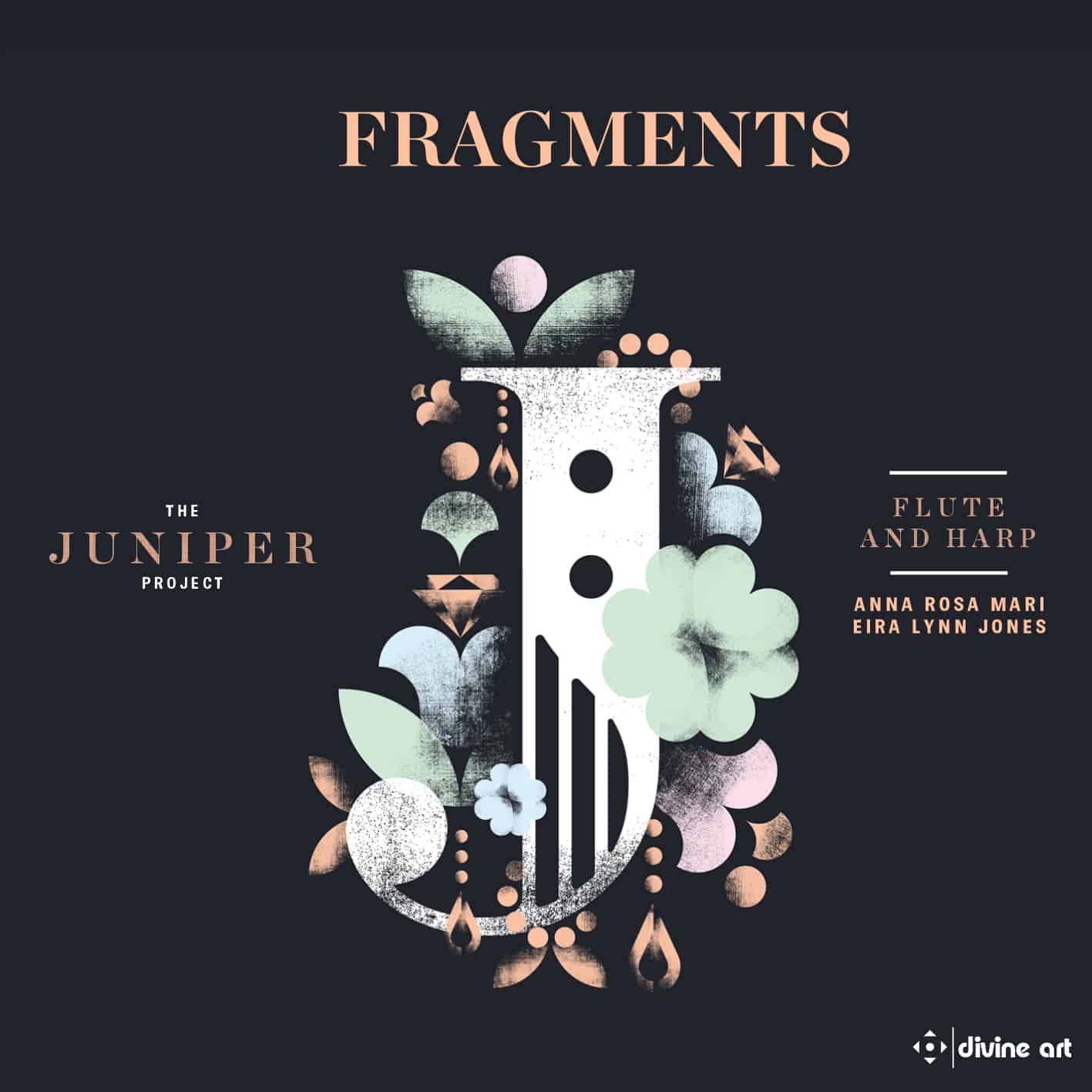
  • Fragments – music for flute and harp by The Juniper Project

    Fragments – music for flute and harp by The Juniper Project

    We present The Juniper Project in their debut duo recording in the format of a concert recital with a variety of Romantic and modern works from Debussy to Lutosƚawski. The album title is named for the Lutosƚawski but also to represent the inclusion of highlight movements from works by Marson and Rutter.

    Greek flutist Anna Rosa Mari is a vibrant performer who has appeared around the world as a soloist, has been principal flute with the Chamber Orchestra of the Greek National Opera and has appeared with the Halle, BBC Philharmonic and many other leading orchestras.

    Eira Lynn Jones is one of the UK’s leading harpists with a wide range of activities including concertising, recording and teaching. A regular freelancer with most top UK orchestras, previously a member of the Manhattan Contemporary Music Ensemble, New York, she is currently also head of Harp at the Royal Northern College of Music.