Catalogue Connection: 25180

  • Walker: Turning Towards You – review from USA

    Recordings by English recorder virtuoso John Turner cover diverse aesthetic and idiomatic approaches – and here I refer primarily to his work with newer compositions. I think his most significant contributions are recordings in which compositions for the recorder reside in the context of a composer’s broader repertory. Turning Towards You, music by Robin Walker (born 1953), is a striking example of [this].

    Walker’s name is not familiar to many American listeners. The works on this disc will resonate well for those who enjoy music of Ralph Vaughan Williams (1872-1958) and other English pastoralists like Gustav Holst (1874-1934), George Butterworth (1885-1916) and Edmund Rubbra (1901-86). Walker’s aesthetic draws on melodic contours and rhythmic gestures evocative of English folk song.  While that applies to all of the pieces on this disc, those melodic and rhythmic features are exemplified in the two tracks (of eight total) on which Turner takes his turn.

     A Prayer and a dance of Two Spirits (Concerto for recorder, violin and string orchestra, 2007), emerged from Walker’s grief at the death of his parents and from the comfort he found in a dream of them “…together in a small boat on a tranquil and glistening lake.”  The music is tranquil and glistening indeed, and is a satisfying tour de force for recorder soloist playing both soprano and sopranino, as well as for the violin soloist (instrumentation suggested to walker by Turner). The unaccompanied soprano solo, A Rune for St. Mary’s (track 7), merits not only repeated listening, but study for technique development and performance.

  • Robin Walker: Turning Towards you – Fanfare Review

    The only prior mention I can find of Robin Walker in the Fanfare Archive comes in 44:1, in a review of a CD of tributes composed by the friends and colleagues of John McCabe. In my review of these 19 works (Colin Clarke also reviewed the disc), I mentioned that one of my favorites in the collection was And will you walk beside me down the lane? by Walker. Thus I looked forward to auditioning the present disc devoted entirely to his music, and I was not disappointed. After studies with David Lumsdaine at Durham University and Anthony Milner at the Royal College of Music, Walker became a serious student of Modernism, as Milner himself was. But sometime during the mid-1980s, Walker reassessed his musical priorities, and came to the conclusion that his instinctual basis of musical composition had been flawed. That realization began a rather lengthy process that led him into a firmly tonal aesthetic that he came to embrace in his recent music.

    This embracing is obvious from the first notes of the disc’s opening work, A Prayer and a Dance of Two Spirits, a repeated series of G-Major chords. However, melodies in the upper register of the violin and treble recorder soon intrude to produce a glassy and quite novel sound, and the harmonies shift into more complex tonal regions. Despite its conservatism, I’ve never heard a piece like quite like this. When possible, I like to compare the music of a relatively unknown composer to someone the reader will likely know, but that’s simply not possible here. There are notes here and there that hint at Bloch, Barber, or Vaughan Williams, but not enough really to suggest the style of another composer. The first movement, rather obviously the “Prayer” of the title, is subtle and gentle, while the second, the dance, takes a couple minutes to get cranked up, but when it does forms a quintessential example of dance found in the British Isles, both lively and folk-influenced. The recorder here sounds a good deal like the penny whistle of Irish folk music, and the violin engages in some fancy folk fiddling. The piece is gorgeous throughout, a characteristic enhanced by the spot-on intonation of the performers.

    The Song of Bone on Stone for double bass solo forms a marked contrast to the preceding work. It opens with some dramatic sounds that may be produced as a Bartok pizzicato, where the string is made to slap against the fingerboard of the instrument. The remainder of the work features much use of natural harmonics, double-stops (down in the lower register of the instrument), and other devices that evoke some kind of prehistoric era. The piece is meant to portray in music a ritual that the composer has adopted: Each time he passes a small stone trough near his home, he bends down to allow his front teeth to touch its top edge, i.e., the bone against the stone. Well, wherever your muse leads you, composers, follow it! If I like this piece marginally less than the preceding one, it’s primarily because I’ve never been overly fond of the double bass as a solo instrument. I Thirst, on the other hand, portrays one of Jesus Christ’s seven last words from the Cross as he per¬formed his atoning work. While Walker is an agnostic, he recognizes the value of the words of Jesus as they speak of forgiveness, selflessness, abandonment by the Father, and (in this depiction) human need. This work for string quartet, then, is a meditation in which the desiccation of Christ, depicted in tonally obscure overlapping chords and sonorities, is “relieved” by a sequence of harmonics. The piece is beautifully constructed and makes a powerful impact, although to my ears, the harmonics suggest rather than quench the thirst of the Savior.

    That the double bass has a special place in Walker’s heart (he studied the instrument for a period of time) becomes obvious with the inclusion of a second work for the solo instrument (although for this one, he adds a piano part). Turning Towards You was written in memory of a friend who guided the composer into a level of self-awareness that he feels he would not have otherwise attained. The “You” of the title is the truth—truth of a sort that his departed friend embodied. This work intersperses highly rhythmic disjointed sections featuring much Bartok pizzicato with moments of quiet reflection, I suppose meant to indicate the self-examination to which he was led by his friend. I like this work more than the previous double bass piece because the low-pitched double-stops of the first one sound like so many grunts, although I by no means imply that The Song of Bone lacks merit. His Spirit over the Waters for solo cello is another work written in tribute to a deceased friend, in this case Keith Elcombe, a prominent musician in the Manchester area. The opening phrase leads the listener believe that Walker is about to launch into the Hebrew chant Kol Nidrei, but it quickly becomes evident that this is not the direction the piece is taking. In the work, he states that he is seeking to represent the emotion of bereavement through lyricism, and through material that is extended and transformed according to the rituals of shaping observed in tradition. Thus, the music forges eloquent melodic lines that ebb and flow, and occasionally cease movement, becoming static repetitions of a given note. There is more scalar activity in this work than is found in any of the other pieces of this recital, and such activity is well melded to form a cohesive and convincing whole.

    The disc closes with a pair of five-minute solo pieces for the two soloists of the opening work. The first of them is A Rune for St. Mary’s, performed by recordist John Turner, whose crystalline tones enhance the beseeching character of the piece. Lastly, one hears She took me down to Cayton Bay, exquisitely rendered by violinist Emma McGrath. The piece effectively fuses the spirit of folk music with the intensity found in romance.

    The music of Robin Walker is engaging and effectively written, and will provide enjoyment to anyone who will give a listen. This is, in fact, precisely what I am encouraging the reader to do in the 1,125 words of this review and headnote.
  • Walker: Turning Towards You ARG review

    This is a well done collection of work by composer Robin Walker. A Prayer and a Dance of Two Spirits is phenomenally captivating; John Turner’s recorder playing gives sparkle and magic with every note; and Emma McGrath’s empassioned, velvet violin lines ooze drama and mystique. The Song of Bone on Stone is an epic, 13-minute piece for solo bass that pays homage to the capabilities of the lowest of the stringed instruments. The title work on the disc, Turning Towards You for double bass and piano, employs a curious set of extended techniques for the bass player. Robin Walker writes in his program notes that “Before performing this piece, Leon Bosch binds his fingertips with tape, and for good reason. In its early stages he has to attack the strings of the instrument with a precise musical ferocity (as though it owed him money), and it is only gradually that melody suggests an alternative course to be taken.” Delightful and immense!

  • Music Web review of Robin Walker: Turning Towards You

    I first discovered the music of Robin Walker a couple of years ago on an outstanding Toccata Classics disc devoted to his orchestral music; while all of the four works are compelling, the half-hour symphonic poem The Stone Maker from 1996 is exceptional – the composer David Matthews has described it as “one of the great orchestral works of our time” and I can only concur – it’s a piece whose growling textures sometimes recall Birtwistle but which are somehow tempered with a Sibelian sensibility. The Stone Maker is appropriately monolithic and exudes an identifiably Northern voice; it has repeatedly absorbed this listener at least from first note to last. His music was certainly a find – and I was further astonished and delighted to find that he was for some years a near neighbour of my late father in the Saddleworth village of Delph (a location which apparently inspired one of the present works on this album) although he has since re-located to Todmorden, another place where the red and white rose counties converge.

    These landscapes seem profoundly important to much of Walker’s music. The Toccata disc revealed a predilection for the deep, rumbling textures that can be drawn from instruments like tubas, timpani and double-basses, sounds which undoubtedly conjure in my mind the wild, unkempt moors that overlook these familiar places. Walker writes quite brilliantly for these forces and this ability manifests itself most obviously in three of the works on this fine new disc – two of these involve double-bass and one is for solo cello. If The Stone Maker evokes the Millstone Grit of the Saddleworth moors, the same earthy tang is certainly detectable in The Song of Bone on Stone for solo double bass, the most recent piece in this conspectus. It essentially recreates the composer’s ritual of touching a local stone-hewn trough with his teeth each time he passes it; a homage from the ‘passing ship’ of humanity (as represented by the ‘bone’ of the bow of the bass) toward the relative indestructibility of stone (the instrument proper). It wavers between abruptly percussive, seismically grumbling and tentatively lyrical material. It seems an essential addition to what is a rather small repertoire for solo double-bass. By way of contrast Turning Towards You for the same instrument with piano eventually employs a more conventional language and attempts in musical terms to embody the elusive (for many of us) quality of ‘knowing oneself’. This piece encapsulates what I feel is one of most appealing characteristics of Walker’s music; it has profound integrity – there is a very real sense of “you may or may not like or admire this music, but it’s absolutely what I meant” about it. There is something rather naked and raw about both these challenging, fascinating pieces. The solo cello item His Spirit over the Waters presents another side of Walker’s essential sincerity; it is an elegy commemorating the Mancunian cellist Keith Elscombe. The work intertwines elements of repose and dance and seems to reference the Prelude of Bach’s first cello suite. It is touching without being remotely mawkish or anguished.

    In a similar vein but on a larger scale, the rapturous and elegant double concerto A Prayer and a Dance of Two Spirits sumptuously marries two unlikely bedfellows, recorder and violin in an even more personal statement. The piece attempts to weave the benefits of temporal distance to process and distil grief, in this case elicited by the passing (in sadly quick succession) of the composers’ own parents. If the notes accompanying this disc are at all representative of his writing, Robin Walker is also wonderfully lucid in succinctly expressing the structural and emotional goals of his music, and as an individual who has attempted to make sense of bereavement in both professional and personal contexts, I was much taken by one of his comments: “In generating an expressive form it is clear to me that feeling should always precede intellect: that is the natural order of things, and without it lyric art is all but impossible.” Of course grieving never ends – we learn over time to deal with its consequences in much the same way that we strive to legislate for all of the tragedies and disappointments life throws at us. Walker’s concerto at once suggests this kind of management; the rapturous Prayer movement aims at solemnity but utterly transcends it, the high-flying lines of the soloists hovering above orchestral textures and harmonic shifts which occasionally evoke Delius. The subsequent Dance is music of resolution and determination, apparently inspired by a ‘coming-to-terms-with’ dream Walker experienced which featured his parents together “on a tranquil and glistening lake”. This experience has evidently paved the way for Walker to practically confront his grief in what is a soaring, memorable work. I suspect listeners familiar with The Stone Maker will be wrong-footed and moved by the flowing lyricism of this work, and by its tangible serenity. And yet closer acquaintance will certainly confirm that A Prayer and a Dance of Two Spirits is cut from the same cloth. Walker is nothing if not a meticulous craftsman. The recorder playing of the indefatigable John Turner is sensitively mirrored and matched by Emma McGrath’s violin and by the strings of the Manchester Ensemble. ASC’s recording is warm and sympathetic.

    The string quartet movement I Thirst is the oldest piece in this collection and perhaps relates to a time when the composer engaged more overtly with organised religion – in his youth he was at one time head chorister at York Minster and studied there with the legendary organist Francis Jackson. The title alludes to the fifth of Christ’s Seven Last Words. Its meditative, consoling nature is tactfully projected by a quartet drawn from the Manchester Camerata in a performance and recording which is by now two decades old; it certainly doesn’t show its age and fits perfectly with the other pieces here.

    The last two items are brief confections for the solo instruments that featured in the double concerto. A Rune for St Mary’s for solo recorder has been characterised by the composer as an ‘incantation’ or ‘enchantment’ inspired by feelings of calm engendered by the carvings in an 11th century relic to be found somewhere among the moors above Delph. Convincing, serious pieces for descant recorder are few and far between. As one who spent a lot of time in my teenage years wandering the Saddleworth hills, I can confirm this little piece effortlessly communicates their spiritual and geographical remoteness as well as the sounds of the avian life that inhabits the area. The affection John Turner clearly has for it is plain in his delivery of every phrase. It’s a magical work which evokes a magical place. Similarly, Emma McGrath plays the solo violin miniature as though it was her own much-loved encore piece. The delightful folk inflections of She took me down to Cayton Bay reflect the joyous feelings that would perhaps be elicited by an imaginary romantic assignation that might occur in that glorious East Yorkshire beauty spot. It concludes a terrific composer portrait.

    Collectively these seven works constitute a rounded portrait of a truly multi-faceted composer. It is abundantly clear listening to this disc, and to its orchestral counterpart on Toccata that the time Walker spent developing an eclectic, distinctive style was not wasted. All of his music I have thus far encountered projects a distinctively Northern English (as opposed to Nordic) spirit and light. It conveys in sonic terms characteristics of terrains and places that seem very familiar. Performances by all the contributors on this disc are both committed and convincing. The recording is intimate yet detailed throughout and the relatively old account of I Thirst certainly does not sound out of place. I fervently hope that there is more music by this superb composer in the pipeline.

  • Robin Walker: Turning Towards You – on Review Corner

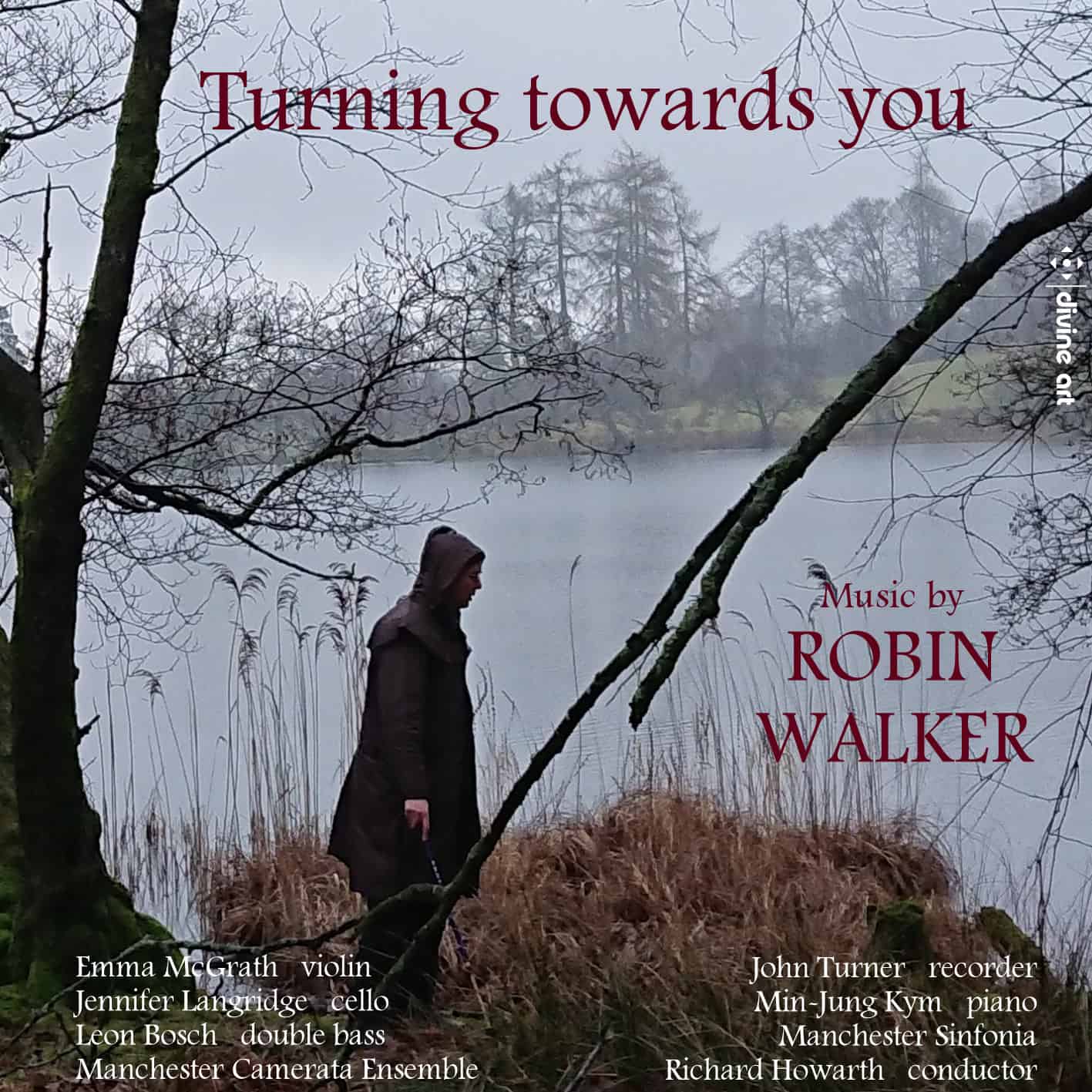
    We like the sleeve image of this; we think it’s supposed to be someone looking out over a lake, but it’s definitely got a creepy feel, in the style of Don’t Look Now.

    Once you see the image correctly, it perhaps suggests rather twee English music: we expected artsong, or at least singing, but it’s nothing like that. We recently reviewed an album of work by a composer whose main living was playing in an orchestra; art’s all well and good but you’ve got to sell tickets, and he knew that. Walker composes in similar vein. He wants people to sit and listen to his music for pleasure, and not sit admiring how clever he is but only listen once. While he is clever, he lives in the Pennines — the Lancashire side we guess, where it’s bleak and you can still see tracks built by unemployed gangs given work by the government 150 years ago — and he combines the pithiness of the people with the beauty of the environment in which he lives.

    All this is clear from the opening piece, A Prayer And A Dance Of Two Spirits, a concerto for violin, recorder and string orchestra. (He explains that he once dreamed his late parents were together in a small boat on a lake, which may explain the sleeve art). “Feeling should always precede intellect,” he writes, explaining how he tried to write a piece that was the antidote to grief. There is a sense of sadness to the music but it also contains acceptance. The ubiquitous John Turner plays a sprightly but earthly recorder. Later on his, His Spirit Over The Waters remembers Keith Elcombe, musician; again there is sadness and lamentation but the beautiful cello of Jennifer Langridge also suggests hope and life going on. Much of the music is fairly conventional (and thus easy to listen to), which can’t be said for the opening of The Song of Bone on Stone, a piece inspired by a Millstone Grit trough near the composer’s home, which he ritually touches with his front teeth (composers, eh?). The double bass opens this with the strings being thwacked, before settling down to a bassy and mournful air. I Thirst is a meditative piece — the title is reportedly from the last words of Christ but it’s more suggestive of dawn over a barren landscape, the opening minute being superrelaxing.

    All in all: a rather low key but outstanding album that’s a real gem. It will appeal to lovers of both gentle classical music and also fans of chilled electronica. This was recorded in a Macclesfield studio, and churches in Stockport and Heaton Moor. The cover image is of Loughrigg Tarn.

  • Musical Opinion review – Robin Walker

    Robin Walker (b.1953) is another of those British composers seemingly ignored for decades by our national arts bodies whose music is original, distinctive and which runs wholly counter to whatever international fashions happen to have been preferred flavours for This Week’s Composers, decade after decade – but whose music is now deservedly appearing on disc.

    This is genuine music by an original thinker – but not so original as to use language incomprehensible to the intelligent music-lover. Walker’s music is by a musician who ‘thinks’ through the structure and instrumentation he has chosen. The result is a true musical voice – and readers are strongly urged to investigate this by no means unimportant release.

    The genuine music-lover, as opposed to dedicated followers of fashion, will be well rewarded by coming into contact with a composer of no little artistic merit. Strongly recommended.

  • The Times review of Robin Walker’s Turning Towards You

    With the British composer Robin Walker, I know exactly where to find him: on his Pennine farm. Experiencing nature in the raw, writing music from intuition, not intellect; magical, indeed spiritual music that deserves far more exposure than it receives. The present album, excellently performed and warmly recorded contains seven chamber works written over 25 years. The most immediately moving is A Prayer and a Dance of Two Spirits, a double concerto for recorder (John Turner) and violin (Emma McGrath), shaded by the deaths of Walker’s parents, where grief is eventually transformed into nature’s universal dance.

    Related trajectories underline a remarkable series of solo pieces. Has any double bass playing ever carried the physical impact of Leon Bosch’s thwacks and harmonics during The Song of Bone on Stone? Miracles like that happen in track after track, making each piece bigger in impact than most of their running ties suggest. Don’t let this pass you by.
    Geoff Brown

  • Music web review of Robin Walker’s Turning towards You

    The opening work on this CD, A Prayer and a Dance of Two Spirits (2007) immediately appealed to me. This concerto for violin, recorder and string orchestra is an elegy for Robin Walker’s parents, written ‘some time’ after their death. The unusual but extremely effective combination of violin and recorder was suggested to the composer by the recorderist, John Turner. Clearly ‘grief’ is the prominent emotion in the opening ‘Prayer’ and thanksgiving for their lives in the ‘Dance’. Stylistically, this concerto is typically ‘Romantic’, with a few ‘modernist’ clichés thrown in for good measure. Here are lyrical melodies and sensuous harmonies. The second movement features some folk-music. I suggest that the listener ignore the composer’s ‘new age’ commentary about the importance of dreams in his music and just enjoy this ‘rhapsodic’ work for what it is, a beautiful meditation on the most basic human condition: death and living. It is a masterpiece.

    The Song of Bone on Stone is a strange title. It derives, apparently, from the composer’s habit of bashing his teeth against a small stone trough. This artefact is near to Walker’s cottage ‘somewhere’ in the Pennines. He describes it as a ‘ritual act of obeisance that has become an essential contact’ between self and nature. Bad for the enamel though. This thirteen-minute solo for double bass represents this ‘liturgical’ event. The player’s ‘bow’ is the ‘Bone’ and the instrument is the ‘trough’. Everyone knows that teeth are made up of pulp, dentin, enamel, and cementum. And that enamel is harder than bone. The analogy holds. So far so good. The opening bars grate – rather like fingernails scraped across a chalkboard. Once again, the liner notes exaggerate the music’s goal. This is really a ‘study’ for double bass that incorporates lyrical material, dance rhythms and certain ‘extended’ playing techniques. On this level it is enjoyable and sometimes even exciting. It does not, I fear, ‘endorse all human passions…’ Nor does it need to be seen live to be enjoyed, despite the composer insisting that the soloist ‘theatrical[ly] addresses’ the double bass. And finally, maybe The Song is a wee bit too long for its own good.

    ‘I Thirst’, written for string quartet in 1994 is an attractive, if lugubrious, work. Clearly inspired by the fifth of the Seven Last Words of Christ, it is an exploration of desolation and innocence. Much intensity is provided by using piercing harmonics. Robin Walker admits that the practice of religious faith is something from his past. But he still finds the need to ‘moor himself’ to something ‘beyond.’ Christ’s words from the cross ‘speak of forgiveness, selflessness, human need, abandonment by the divine, and can be universally subscribed to as such, faith or no faith.’ I agree.

    I enjoyed Turning Towards You for double bass and piano (2014). Reading the liner notes gives all sort of ‘philosophical’ underpinnings to this piece. Ignore them. It is a well-crafted work for an unusual instrumental combination. There is sometimes a ‘jazzy’ mood to this music which propels it along ‘toccata-like.’ Often the composer introduces some Romantically inclined episodes which are thoughtful and meditative. Once again, Walker makes use of bass-fiddle harmonics to give colour and intensity, creating a magical effect. Turning Towards You is a long work, but never lacks interest. The piece was dedicated to Robin Walker’s tutor at the University of Durham, Brian Primmer (1929-2008).

    The final three works on this CD are for solo instruments. His Spirit over the Waters (2003) is written for solo cello and is in memory of Keith Elcome, a Manchester-based musician. Whatever the liner notes suggest, this work is an ‘elegy’ and a study all rolled into one. It is most impressive in every way.

    A Rune for St Mary’s (2003) conjures with an ancient stone located in a field near Robin Walker’s home in the Pennines. There are inscriptions on this stone (runes?) which are undecipherable, but clearly of great antiquity. The solo recorder provides music of a ‘Pan-like’ enchantment with its repetitious ‘incantatory effect.’ It is a rewarding piece that is both timeless, and evocative of the moors above Delph.

    The final piece is She took me down to Cayton Bay (2018). This is no ‘Walk to Paradise Gardens’ as the composer rightly states. In fact, Walker suggests that no one he ‘desired’ ever took him down there. The music reflects how he would have felt if someone had. Once again Walker has written a splendid study, rather than a tone-poem. It is a fetching title which may draw the listener into the seaside mood, rather than just baldly listening to a prosaic Etude. I have been to Cayton Bay several times, and it is certainly a wonderful place – with or without a lover. On balance, the music does evoke that wonderful East Riding beach.

    The composer Robin Walker was born in 1953 in York. He was a chorister at York Minster and a scholar at the School. At Durham University, he studied with the Australian composer David Lumsdaine. After an academic career at the Royal Academy of Music and London and Manchester Universities, he ‘retired’ to a village in the Pennines to concentrate on composition. Various diverse musical elements find their way into his music, including the folk traditions of India and England.

    As noted in the body of my review, the liner notes can be a bit abstruse and ‘new-agey’. However, they are well-written and informative. They include biographical details of the composer and the artists. All performers contribute magnificently to the success of this programme.

    This is a fascinating CD. It introduces several diverse works by Robin Walker composed over a quarter of a century. All are enjoyable, approachable and interesting.

  • Turning Towards You – music by Robin Walker

    Turning Towards You – music by Robin Walker

    Chosen as one of his ‘Records of the Year 2019’by Richard Hanlon (MusicWeb International)

    Robin Walker began his musical life as Head Chorister at York Minster then studied under David Lumsdaine at Durham and Anthony Milner at the Royal College of Music. His early work was seriously modernist but since the 1980s he has worked on an ‘instinctual’ approach involving a relationship with Nature, a sense of Place and our position within it, even including ‘folk-style’ elements – also to some extent informed by studying the music and dance of India.

    Leading soloists and the award winning Manchester Sinfonia present a range of works for solo instruments and the remarkable and inspired Concerto for Violin, Recorder and Strings (‘A Prayer and a Dance of Two Spirits’); the album follows a purely orchestral set recently issued by Toccata.

    John Turner is one of the world’s leading recorder players with a long and distinguished career; Emma McGrath is currently concertmaster/principal violin of the Tasmanian Symphony Orchestra; Jennifer Langridge is a busy soloist and chamber musician and has been principal cello of Psappha for 24 years. Leon Bosch is an internationally renowned double bass virtuoso with over a dozen solo albums to his name; Min-Jung Kym is a Steinway Artist with a very successful career, having already performed with many leading orchestras and she was pianist of choice of legendary violinist Ruggiero Ricci.