Catalogue Connection: 25182

  • Ustvolskaya works for Violin and Piano – Fanfare review

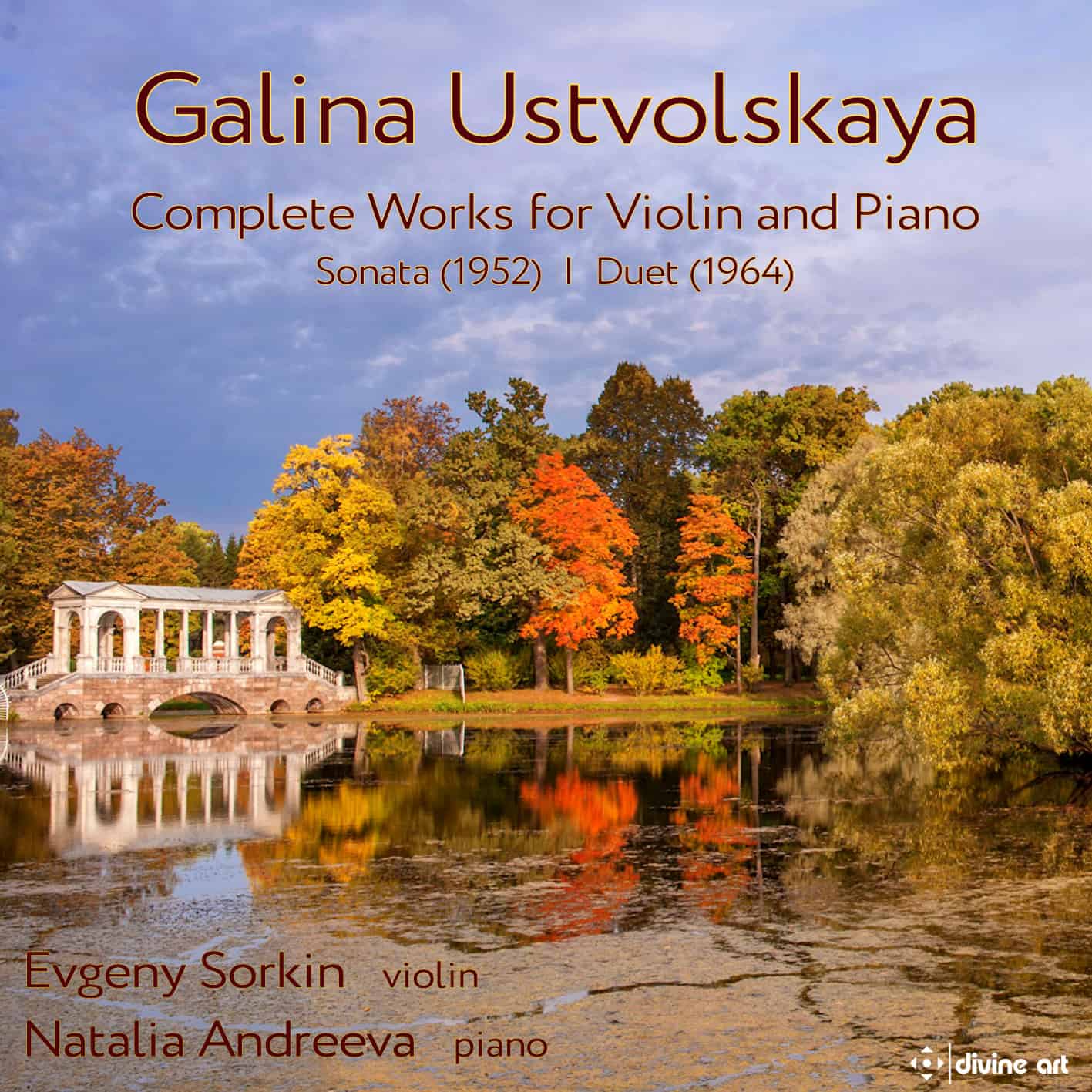
    This release is entitled Galina Ustvolskaya: Complete Works for Violin and Piano, but that turns out to be just two works, both fairly early. Fortunately, they are both substantial—though this is still a short disc—and typical of her austere “desk drawer” style. The Violin Sonata dates from 1952 and the Duet for Violin and Piano from 1964. By 1952, Ustvolskaya was already writing music without much rhythm, or rather, as the liner notes describe, music in 1/4 where there are no weak beats, just a succession of equally stressed quarter notes. The Duet is more varied, its seven movements embracing more varied textures and tempos, and even if the overall mood remains somber, the musical language becomes more varied, with violin harmonics adding an icy sheen to the still insistent piano lines.

    The recording project was initiated by pianist Natalia Andreeva, who recently released a two-disc set of Ustvolskaya’s solo piano works on the same label (25130). Here, she is joined by fellow Russian and fellow Australia resident Evgeny Sorkin, the recording made in July 2018 at the Sydney Conservatorium of Music, where Andreeva teaches. The liner notes are by Andreeva herself and give an idiosyncratic picture of the composer, though an informed one—Andreeva’s Ph.D. thesis is on Ustvolskaya’s piano music. She discusses some textual issues (apparently the published editions vary from Ustvolskaya’s manuscripts, which Andreeva has consulted at the Paul Sacher Stiftung) before going on to some imaginative readings of the music itself. For Andreeva, the sonata speaks of the Stalinist terror and includes highly veiled allusions to chorales and church bells. The Duet is described as a dramatic dialogue between the two players, its “plot” traced by name ciphers so obscure that even Andreeva herself cannot identify them, although she adds that they are only of interest to the performers anyway.

    Given this detailed exegesis, it is surprising how objective and dispassionate the readings are. The recording acoustic is very dry, which only adds to that sense of detachment. Fortunately, the approach feels very much in tune with Ustvolskaya’s uncompromising aesthetic. The performers rarely exaggerate the dynamic extremes—and there are plenty of dynamic extremes notated in the scores— and seem as concerned with maintaining tight ensemble and careful balances as with exploiting the music’s Expressionist drama. Sorkin plays with a controlled vibrato, which adds color, but without tipping the music over into overtly Romantic expression. And the fact that Andreeva is the guiding force behind the project is apparent from the amount of detail and commitment in the piano playing, to the extent that the piano often becomes the center of attention.

    The two works here are available in several other recordings, all fairly recent. A 2017 release from Melodiya (99122) includes the sonata, played by Mikhail Waiman and Maria Karandashova, but is let down by a poorly tuned and dreadfully recorded piano. Also from 2017 (though apparently a remaster), a recording of the Duet by Vera Beths and Reinbert de Leeuw, offers atmosphere, intrigue, and menace. Similarly, the ECM version from 2014, with Patricia Kopatchinskaja and Markus Hinterhauser, is a highly characterful and compelling account. In many ways, it is at the other end of the spectrum from Sorkin and Andreeva, with the violinist dominating, putting across a huge amount of personality, and all in a warm, enveloping ECM sound envelope. Sorkin and Andreeva give an account that needs a little more empathy from the listener, but which remains involving. We might argue that the more nuanced and underinflected playing here is more in the composer’s spirit, but Beths and de Leeuw would still be my first choice.
  • Fanfare review Ustvolskaya Violin and Piano

    Galina Ustvolskaya (1919-2006) wrote just two works for violin and piano, and both of them have been recorded here. This is a somewhat short program, but it gives value for money, as both of these works demand much from the listener, and should not be taken lightly. How she was able to get away with writing such music during the eras of Stalin (the Sonata dates from 1952) and then Khrushchev (the Duet dates from 1964) is hard to fathom. She was taught by Shostakovich (who wanted to marry her, although she refused). He came to admire her music, and he even included quotes from it in his later works. However, by 1952, she had largely gotten his music out of her system. Indeed, at one point she commented that, “There is no link whatsoever between my music and that of any other composer, living or dead.” Listening to her mature works, one can well believe it — she sounds like no one else, for better or worse.

    Still, the Violin Sonata has not yet turned its back entirely on the world; to me, it is not quite a mature work, although by saying so I am not trying to denigrate it. Pianist Andreeva’s heavily foot- noted booklet notes discuss both of these works in detail, including notations in the published scores that seemed unclear to the performers, and that necessitated going back to the composer’s manuscripts. For Andreeva, and I assume for Sorkin as well, the sonata is about Stalinist terror. It plays chess, if you will, in a gray, washed-out terrain where only a few moves remain possible. In the coda, where the violin steadily plays col legno, Andreeva hears the dreaded knocking of the secret police on the door. It’s a harrowing work, but still a human one.

    The Duet, even more fragmented and confrontational, goes off the deep end, and any semblance of what one might describe as a sonata crumbles into dust. Tone clusters, extreme dynamics, extreme registers, and violent gestures converge to create an alienating environment. At many points, one or both of the instruments grab motifs as a drowning man grabs a lifesaver that has been thrown to him, and then they repeat them obsessively until the notes turn black and blue. Gears grind and teeth gnash. At other points, the silences between the notes loom, as if Morton Feldman had been transported to a gulag. The closing section, where the violence abates somewhat, sounds almost like balm, but that is only in relation to what preceded it.

    Both of these works were recorded by Patricia Kopatchinskaja and Markus Hinterhauser for ECM New Series. (They throw in the 1949 Trio for Clarinet, Violin, and Piano, with clarinetist Reto Bieri, for good measure.) Robert Carl give that disc a very high recommendation in Fanfare 38:4, and indeed, Sorkin and Andreeva seem to have had their work cut out for them when they approached this project, although neither of them are newcomers to Ustvolskaya’s music. (In fact, Andreeva’s doctoral thesis was devoted to Ustvolskaya’s music, so she knows of what she speaks, and plays.) It is fascinating to compare these two recordings, because the performers interpret Ustvolskaya’s markings, particularly in the Duet, in very different ways. For me, the difficulty lies in not knowing which is the correct way, but the answer to that problem might be to say that they both are effective. Just listen to the first minute of the Duet and you might be unsure that you are even listening to the same work. If anything, however, Kopatchinskaja is even more terrifying than Sorkin, as her violin seems to be living in a tonal nightmare from which it cannot awaken. On the other hand, I like Sorkin’s more wiry sound in the sonata, and also the way both players work to extract expressivity from the music’s frequent cul-de-sacs. Maybe you had better get both discs. But whatever you do, do get at least one of them!

  • BBC Music mini -review Ustvolskaya violin/piano works

    The passion for this music is evident in the performances of the sonata and duet, every note of the former seemingly a fist raised against the state, the latter seemingly reeling.

  • Review of Ustvolskaya works for Violin and Piano

    This release is entitled Galina Ustvolskaya: Complete Works for Violin and Piano, but that turns out to be just two works, both fairly early. Fortunately, they are both substantial—though this is still a short disc—and typical of her austere “desk drawer” style. The Violin Sonata dates from 1952 and the Duet for Violin and Piano from 1964. By 1952, Ustvolskaya was already writing music without much rhythm, or rather, as the liner notes describe, music in 1/4 where there are no weak beats, just a succession of equally stressed quarter notes.

    The Duet is more varied, its seven movements embracing more varied textures and tempos, and even if the overall mood remains somber, the musical language becomes more varied, with violin harmonics adding an icy sheen to the still insistent piano lines.

    The recording project was initiated by pianist Natalia Andreeva, who recently released a two-disc set of Ustvolskaya’s solo piano works on the same label (251 30). Here, she is joined by fellow Russian and fellow Australia resident Evgeny Sorkin, the recording made in July 2018 at the Sydney Conservatorium of Music, where Andreeva teaches. The liner notes are by Andreeva herself and give an idiosyncratic picture of the composer, though an informed one—Andreeva’s Ph.D. thesis is on Ustvolskaya’s piano music. She discusses some textual issues (apparently the published editions vary from Ustvolskaya’s manuscripts, which Andreeva has consulted at the Paul Sacher Stiftung) before going on to some imaginative readings of the music itself. For Andreeva, the sonata speaks of the Stalinist terror and includes highly veiled allusions to chorales and church bells. The Duet is described as a dramatic dialogue between the two players, its “plot” traced by name ciphers so obscure that even Andreeva herself cannot identify them, although she adds that they are only of interest to the performers anyway.

    Given this detailed exegesis, it is surprising how objective and dispassionate the readings are. The recording acoustic is very dry, which only adds to that sense of detachment. Fortunately, the approach feels very much in tune with Ustvolskaya’s uncompromising aesthetic. The performers rarely exaggerate the dynamic extremes—and there are plenty of dynamic extremes notated in the scores—and seem as concerned with maintaining tight ensemble and careful balances as with exploiting the music’s Expressionist drama. Sorkin plays with a controlled vibrato, which adds color, but without tipping the music over into overtly Romantic expression. And the fact that Andreeva is the guiding force behind the project is apparent from the amount of detail and commitment in the piano playing, to the extent that the piano often becomes the center of attention.

    The two works here are available in several other recordings, all fairly recent. A 2017 release from Melodiya (99122) includes the sonata, played by Mikhail Waiman and Maria Karandashova, but is let down by a poorly tuned and dreadfully recorded piano. Also from 2017 (though apparently a remaster), a recording of the Duet by Vera Beths and Reinbert de Leeuw, offers atmosphere, intrigue, and menace. Similarly, the ECM version from 2014, with Patricia Kopatchinskaja and Markus Hinterhäuser, is a highly characterful and compelling account. In many ways, it is at the other end of the spectrum from Sorkin and Andreeva, with the violinist dominating, putting across a huge amount of personality, and all in a warm, enveloping ECM sound envelope. Sorkin and Andreeva give an account that needs a little more empathy from the listener, but which remains involving. We might argue that the more nuanced and underinflected playing here is more in the composer’s spirit, but Beths and de Leeuw would still be my first choice.

  • De Standaard review of Ustvolskaya

    Anyone who finds the music of Shostakovich oppressive must listen to that of his eccentric student Ustvolskaya. Her notes are sometimes compared to laser beams and bullets. None of that harsh violence is in her violin sonata: this is where the tension from before the eruption sounds. You need all that drama as a performer, making something that is just not possible with this recording. Pianist Natalia Andreeva has researched and played the scores of Ustvolskaya for more than ten years. Every choice she makes here with violinist Evgeny Sorkin is well thought out, but lacks effect: the cool-tapping notes aren’t threatening. Until “Duet” where the music erupts with iron accents, heavy piano hammers and unpredictable, awkward silences, the duo builds a model of increasing urgency.

  • Ustvolskaya Violin-piano music – Chronicle review

    Dutch critic Elmer Schönberger called Galina Ustvolskaya “the lady with the hammer”, not because she whacked the piano with ham-like fists but because she composed using unusual combinations of instruments, and often used piano or percussion to beat out regular rhythms. She was a pupil of Shostakovich, who commented (according to Wikipedia): “I am convinced that the music of GI Ustvolskaya will achieve world fame,” his predictive powers having an off day that morning.

    This album is her music for violin and piano in two major works, a sonata and a duet. The opening few bars do indeed suggest a regular, not to say hammer-like beat, is to follow but this is misleading and it soon softens, although it still sounds Russian; a culture where a teacher could call his most promising pupil “GI Ustvolskaya” and not “Galina”. The composer herself did comment that “My music is certainly not chamber music…” What it is, is atmospheric. It’s harsh in the sense of not being romantic but it’s not strident; it’s thoughtful and sad more than anything.

    The sleeve notes are good, giving an impression of the music and the culture in which it was composed. The sonata was composed one year before Stalin’s death, so Soviet state terror was in full swing “and Russia was not a good place to be”. “People really did sleep in their outdoor clothes, with a ready-packed suitcase, waiting for the secret police to knock,” the notes say. A composer in those times was hardly going to compose gentle rural idylls, although this is not to say there is no beauty in the music.

    The Sonata for Violin and Piano is the gentler of the two, though the sleeve notes indicate it reflects Stalin-era Russia, doors being knocked on and footsteps in halls. The Duet For Violin and Piano is harsher and does indeed feature the instruments beating out a rhythm. The sleeve notes say Ustvolskaya left notations such as “rhythmical beat like a motor”, less hammer-like but more like the steady beat of a machine; in places it takes up the more calming motion of a train. The fourth movement (“not faster”) is almost minimalistic, with the violin plucked in places and the piano interjecting. Music reflecting on the harshness of life.

  • Ustvolskaya violin/piano works MusicWeb review

    I have not heard any music by Galina Ustvolskaya since I reviewed an album of piano music for MusicWeb International back in 2015. I explained there that her work did “not appeal to me in the least”. On the other hand, I understood the “huge importance and massive contribution to Russian music” discovered by many commentators. I have not changed that view.

    The basic story of Ustvolskaya’s musical development is by now well-known. She studied with Dmitri Shostakovich but absorbed precious little from his musical style. Tending towards Modernist music rather than the Avant Garde, Ustvolskaya created a surprisingly small catalogue of music. There are also several pieces written in the style of ‘Soviet Realism’ that she subsequently disowned. Her ideal sound-world is grim, often dissonant and rarely easy on the ear.

    Galina Ustvolskaya developed a nickname: ‘The Lady with the Hammer’. This was consequent on her often percussive and aggressive manner of creating musical texture. Yet, in this new CD of the violin and piano works, there is much that defies that sobriquet.

    The present short programme (a mere 49 minutes) explores her ‘complete’ opus for violin and piano. The Sonata written in 1952 sounds relatively ‘conventional’ with identifiable musical phrases, motifs and regular discourse between soloists. It includes possible allusions to the musical style of Shostakovich and Paul Hindemith. There is even the making of a ‘neo-classical sonata’ here – at least for some of the work’s progress. The opening of the sonata calls for the rarely-used time signature of 1/4, which demands an intense playing style with no ‘weak beats’ and no time to relax. This really sums up the work’s progress – hard going. But the strange thing is that amongst this dark music there are the occasional flashes of light and even beauty. It is not all ‘hammer music’.

    The Duet for violin and piano (1964) is a totally different kettle of fish. Gone are any lingering nods to other composers and ‘in’ is Ustvolskaya’s uncompromising style. Why did she not call this work her Second Violin Sonata? The liner notes do not fully answer this question but suggest that the ‘Duet’ is a ‘Drama’ – a story about two people. Anecdotal evidence suggests that the composer used certain ‘key motifs’ as part of the work’s underlying ‘plot’. Alas their associations have not been identified. Perhaps one is the composer herself? These ‘gestures’ are worked out almost to infinity, rising to a climax and then disappearing into silence.

    The music features considerable use of clusters and ‘extreme’ registers, motor rhythms, harmonics and a general flurry of aggressive gestures. Strangely, amongst all this angst is a short, almost pastoral moment which seems to openly defy the prevailing musical aesthetic.

    The liner notes, in English only, are presented as the soloists’ personal discovery of, and reaction to, this music rather than a standard programme note. They are described by their author as “very emotional and very subjective – more like ‘performer’s notes” than an academic essay. It is effective and provides a useful pattern for others. There are brief biographies about the soloists.

    The performances of these typically unsmiling works are exceptional. They reveal commitment and understanding from both soloists which transcends the bleakness of the music. The sound quality is excellent, as expected of the Divine Art label. I wonder if the Clarinet Trio (scored for clarinet, violin and piano) could have been included on this CD to make up the programme. It is featured on the competitor CD of ‘complete violin works’ released by EMI in 2014. (481 0883, Patricia Kopatchinskaja/Markus Hinterhäuser/Reto Bieri). I have not heard this CD.

    Musically, I do not warm to Galina Ustvolskaya’s two works for violin and piano, although I prefer the Sonata to the Suite. I think that it is the obdurate austereness of this music that puts me off. I accept that it is interesting and unique in the world of music. It certainly justifies Ustvolskaya’s assertion “There is no link whatsoever between my music and that of any other composer, living or dead”.

  • Ustvolskaya Violin and Piano – Sunday Times review

    But there are only two [works for violin and piano]: the 1952 Sonata and the 1964 Duet, the second even sparer than the dauntingly austere first. Both evince a style one can fancy as at once an expression of suffering under Stalin and defiance of his rule.

    In place of the irony of Shostakovich is a sort of masochistic rebarbativeness, bordering on noise. Bow-taps at the sonata’s close evoke the dreaded knock on the door.

    But there are only two [works for violin and piano]: the 1952 Sonata and the 1964 Duet, the second even sparer than the dauntingly austere first. Both evince a style one can fancy as at once an expression of suffering under Stalin and defiance of his rule.

    In place of the irony of Shostakovich is a s ort of masochistic rebarbativeness, bordering on noise. Bow-taps at the sonata’s close evoke the dreaded knock on the door.

    A brilliantly executed centenary tribute.

  • New Classics Review Ustvolskaya music for violin

    Russian composer Galina Ustvolskaya was born in Petrograd in 1919. She studied at the Leningrad Conservatory and as a postgraduate student was taught composition by Dmitri Shostakovich, who was convinced that her music would ‘achieve world fame and be valued by all who hold truth to be the essential element of music.’ Ustvolskaya maintained a close artistic and tender personal relationship with the great composer, though this seems to have ended acrimoniously soon after he proposed to her in the 1950s and her music subsequently retained little influence of his style. He would later acknowledge that she had influenced him, adding that he had failed to influence her. From the 1950s onwards, as a modernist living in the USSR, she had few public performances of her works other than patriotic pieces written for official consumption – only the violin sonata of 1952 being played with any frequency. Ustvolskaya said that there was no link whatsoever between her music and that of any other composer, living or dead. Among its characteristics are: the use of repeated, homophonic blocks of sound (which prompted the Dutch critic Elmer Schönberger unfairly to call her ‘the lady with the hammer’), unusual combinations of instruments, extreme dynamics, sparse harmonic textures, and the use of piano or percussion to beat out regular unchanging rhythms. Ustvolskaya wrote only 21 pieces in her idiosyncratic style, which still sounds ultra-modern today, but her music has become much better known recently. Most performers have concentrated, as on this CD, on bringing out the richness of the works and their innate lyricism. Natalia Andreeva is a Russian pianist of consummate skill who can express the music’s power and beauty of this music. Currently Lecturer in Piano at the University of Sydney, she has studied Ustvolskaya for many years and in 2015 released a highly acclaimed album of the complete solo piano music on the Divine Art label. She is joined here by the exceptionally talented Russian-born violinist Evgeny Sorkin to mark the centenary of Ustvolskaya’s birth on June 17 with these assured recordings of her Sonata for Violin and Piano (1952) and Duet for Violin and Piano (1964).

  • MusicWeb review – Ustvolskaya music for violin and piano

    Ustvolskaya confides in you, but with an unwaveringly intimidating gaze and towering concentration. Performances demand and here receive such qualities. It is made clear to the listener and to artists that there is to be nothing of glamour, neon or La Vegas about the accomplishment of this music.

    This composer stayed and lived in the Soviet Bloc unlike Kancheli, Schnittke, Gudaidulina and Pärt. She was comparatively sparing when it came to numbers of scores produced. However I would mention her symphonies on Megadisc and other music on the Russian label Northern Flowers. Natalia Andreeva wrote the disc’s notes which are in English and which range far and wide and deep. Andreeva’s name should have been familiar to me. In fact she recorded Ustvolskaya’s complete works for solo piano for Divine Art on a quite properly applauded 2-CD set.

    Ustvolskaya’s Violin Sonata of 1952 is calm but oh so bleak There’s no consolation on offer. Instead it is memorable for a wooden pulse and, in track 4, a ticking unpianistic sound. As I have said before when reviewing another performance of the Violin Sonata, this is an implacable piece. There is one instance where the violin makes a pass in the direction of vulnerable humanity. Otherwise the impression given is that the Russian winter has entered the soul. It’s all very sparse and spartan. A dozen years later and the seven-movement Duet refuses to fool about or relax much. There’s variety there and it encompasses bloodless but violent stabs carried by the poniard of the violin (Espressivo) and leaden-booted dissonance as well as a very distant frost of the soul. The fourth movement suggests some terribly cruel planet while the penultimate movement rumbles and is interrupted by dramatic interjections that stab into the body of the music. Only the In tempo final section – the longest – makes a first tentative step in the direction of melody – as if the other movements have paid the dues for such ‘indulgence’.

    Peter Graham Woolf wrote an instructive and invaluable note about Ustvolskaya in the earliest days of this site. It’s still worthy of close study.

    Divine Art are to be thanked for fine accounts of music – well played and recorded – that has little time for conventional sheen or veneer. Somehow, while you are listening the fact that the CD runs just shy of fifty minutes is of little account.

  • Galina Ustvolskaya – Complete works for Violin and Piano

    Galina Ustvolskaya – Complete works for Violin and Piano

    Unfairly named ‘The Lady with the Hammer’ for her uncompromising use of massive thunderous chords and ostinato rhythms, Ustvolskaya was a pupil of Shostakovich but forged her own unique way into many genres. Recently, artists have concentrated, as here, on bringing out the richness of the works and their innate lyricism. This album includes all of the composer’s music for violin and piano in two major works – the Sonata and the Duet.

    Russian violinist Evgeny Sorkin was a child prodigy and performed for Isaac Stern at the age of 10 and was compared at 16 to David Oistrakh by no less than Yehudi Menuhin. He moved to Australia and balanced teaching at Sydney Conservatory with a busy recital schedule.

    Natalia Andreeva is a Russian pianist who is currently Lecturer in Piano at the University of Sydney, Australia. Her 2015 recording of the complete solo piano music of Galina Ustvolskaya was very well received; she is a pianist of consummate skill who can express the power and lyricism which exist side by side in these works