Catalogue Connection: 25184

  • Artyomov: Symphony “In Spe” on Review Corner

    (joint review with DDA 25164 and DDA 25176)

    We find ourselves repeating the same things about Artyomov and with Divine Art releasing his work at regular intervals we thought we’d promote a bunch together. Artyomov is one of Russia’s greatest living composers. He writes music that’s galactically huge, by which we mean it gives the impression of space and endless time; the music of the spheres. The introduction of Sola Fide is only flute and piccolo (?), followed by strings, but within seconds he’s up there, floating in the vastness of space. This is clearly not just us; the sleeves all nod towards outer space.

    It’s imposing in one way, with the feelings it evokes, but it’s not hard to listen to. We play it quite often, as it’s enervating and uplifting, a quick scrub to the brain with a pumice. True, he challenges the listener — Sola Fide’s second movement Separation has a slightly scary choral section — but he always backs away from being downright intimidating and by Revelation he’s surprisingly calm, given the title. Shock is unsettling, the film score for a spaceman whose tether snaps, and he frantically tries to grip onto his craft before … well, we’re not scriptwriters.

    Star Wind (and other works) is slightly more grounded, in that it lacks something of the feel of eternity though it’s still a bit out there. The title track opens and it well represents a wind, leaves blowing around rapidly and stopping suddenly, violin and flute suggesting skittishness. “I meant not only the physical wind but rather inspirational while you are at night on the top of a mountain looking at the immense skyscape,” says the composer in the sleeve notes. Moonlight Dreams is in four movements, and based on 7th century Chinese texts and demands “synchronous breathing” from the performers. Bamboo Solitude’s text starts: “I sit alone in unfrequented grove / I pluck my lute and hum a song of love.” The other three pieces are Autumn Moon (“Fall moon bright, fall wind light / Rustling leaves disperse”), River Village (“My fishing done, the boat is left unmoored / The weary moon and village bring me sleep” and Quiet Night Thoughts (predictable: “I gaze awhile, then bow my head / Where thoughts race homeward bound.” A soprano adds atmosphere to these gentle pieces.

    Elsewhere, Romantic Capriccio, for French horn, piano and string quartet was composed in 1976 and written in memory of Jean Sibelius. The sleeve notes the opening pages “have a character of extreme anger”, concentrating upon the relationship between horn and piano, followed by a more conciliatory stretch as the music warms. We’re not sure about the anger but it is forceful for Artyomov, and calming strings come in quite quickly; one of his more down to earth pieces. In Spe (In Hope) is the hardest of these three and “broke new ground in Artyomov’s writing in its use of polydynamic, everchanging textures while retaining his deep spirituality”. It is a massive work, in one movement but 21 sections playing continuously. It is more unsettling but there are some moments of calm and beauty. He’s worth listening to. Often melancholy in a Russian way, it also contains many moments of beauty.
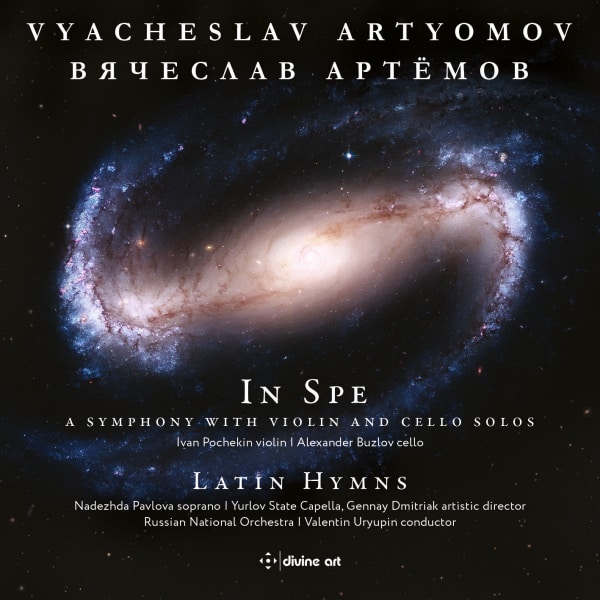
  • Music Web review of Artyomov Symphony In Spe/Latin Hymns

    Artyomov is one of a group of Russian and East European composers – others include Kancheli, Silvestrov and Pärt – who grow up in the days of the Soviet empire, discovered European modernism and went on to forge individual and distinctive idioms. They also each tend to be the object of a cult. I was very taken with a disc of Artyomov I had for review last year so am glad to have been able to hear more of him.

    Artyomov has given much of his career to writing big dramatic symphonies. These he likes to link into cycles. There is Symphony of the Way, a tetralogy, of which three parts have been recorded. In spe (In hope), on this disc, is the second part of a trilogy collectively titled The Star of Exodus, of which the first part is In Memoriam, subtitled A symphony with violin solo, which was completed in 1984 and has been recorded. In Spe had its origin in a request by Rostropovich in 1993 for a cello concerto, but the composer did not begin work on it until 2002 and only finished it in 2014, by which time it had become a symphony, not a concerto, and with two soloists rather than one, with the subtitle A symphony with violin and cello solos. It is therefore much the most recent work on all these discs. It is a massive work, in one movement but twenty-one sections which play continuously. The idiom is more reminiscent of Scriabin’s Prometheus than anything else, but is considerably more turbulent though shot through with moments of calm and beauty. There is a very flowery sleeve note by Valeriya Lyubetskaya, who is the composer’s wife, from which I gather there is a programme which follows the vicissitudes of a hero. I think most listeners will simply follow the changing moods without trying to link them to the story. It is much more of a symphonic poem than a symphony – at any rate, I did not find a symphonic argument I could easily follow. The violin and cello soloists have occasional prominent passages but the work is not a concerto. The third part of the trilogy does not yet seem to have appeared.

    The Latin hymns are four in number: a passage from what in the Vulgate is Psalm 50, but in English Bibles is Psalm 51; the short prayer known in English as the Hail Mary; the Marian antiphon Salve Regina; and the vespers hymn Ave Maris Stella (Sea Star, we acclaim thee). Strictly speaking, only the last of these is a hymn, but no matter. They are set in very rich, indeed lush, late romantic-expressionist idiom, with very full writing for the choir and a solo soprano. I was reminded at times of Szymanowski’s Stabat Mater. From moment to moment they are often beautiful, but there is a certain lack of variety in them. The Latin texts are given but without translations; however, these texts are easy to find online.

    This disc is newly recorded and very well too, in a reverberant acoustic which suits the music. The very striking covers are an attractive feature of this series.

    Artyomov is an interesting, indeed impressive composer, though I would resist some of the claims made for him. He is certainly worthy to be considered alongside the three other composers I mentioned at the start. I have yet to hear his RequiemArtyomov: Requiem, which is the work which made his reputation . But all his discs are well worth exploring.

    [edited from joint review of three albums]

  • Pizzicato review for Artyomov’s “In Spe”

    Divine Arts concludes its series dedicated to the Russian composer Vyacheslav Artyomov with two recent studio recordings of his symphony In Spe and his Latin Hymns. In Spe, a symphony for violin, cello and orchestra, is a rather extroverted, dramatic and for the composer extremely good-humoured work. Very rhythmic, very rich in contrast and brightly coloured, it is, as the booklet says, to be regarded as consolation in a world full of suffering. The four-part cycle Latin Hymns for soprano, choir and strings has a clearly religious connection. The composer uses the solo voice in a very original way, setting it against the commenting choir. With colouristic accents, a fascinating play of shadows and light and sometimes ethereal sounds, it is a work of great emotional spirituality, as well performed as In Spe.

  • Artyomov – In Spe /Latin Hymns review

    This is the latest issue in Divine Art’s series of recordings of music by the great Vyacheslav Artyomov (b 1940), whom I have long regarded as being the finest living Russian composer. As with the previous nine CDs in this series, Divine Art’s presentation is very fine, the quality of the recording most acceptable and with booklet notes by the composer’s wife, Valeria Lyubetskaya, these superbly committed performances can hardly be better presented then they are here. In Spe arose from an undertaking the composer gave (rather rashly, as he admits) to the late Mstislav Rostropovich for a cello concerto, following the UK premiere in 1993 of Artyomov’s symphony ‘The Morning Star will Arise’ – the new work, begun as a concerto, evolved over the years to the 47-minute symphony we have here.

    Falling into 21 sections, each with a programmatic aspect, the one work which structurally In Spe perhaps is reminiscent of is Ein Heldenleben by way of late Scriabin, but the style is entirely Artyomov’s own. It makes a considerable cumulative impression, more so from such totally committed a performance as it receives on this occasion.

    There is no doubt that in the recent large-scaled work, the composer’s aesthetic and musical language are not aspects which immediately reveal themselves even to the attentive listener, who will, however, be sufficiently impressed as to want to explore the symphony fuller through repeated listening – in which case, the recording here offers the perfect solution.

    The four shorter choral works that make up the Latin Hymns are perhaps easier to grasp, but their inherent qualities are no less apparent. Collectors of this most important series need not hesitate.

  • Vyacheslav Artyomov: Symphony In Spe / Latin Hymns

    Vyacheslav Artyomov: Symphony In Spe / Latin Hymns

    Vyacheslav Artyomov is considered by many to be Russia’s greatest living composer. His music is deep, ultimately spiritual and brilliantly crafted, with influences from the Russian symphonic tradition colored by Mahler, Scriabin, Honegger and Messiaen to name a few – but melded into a unique voice.

    The Divine Art Artyomov Retrospective (which to date has received wonderful reviews internationally) is a mix of new recordings and former Melodiya and Boheme releases. This is the tenth album, containing 2018 recordings of two majestic and brilliant works. The Symphony In Spe (In Hope) with concertante violin and cello broke new ground in Artyomov’s writing in its use of polydynamic, ever-changing textures while retaining his deep spirituality.

    Latin Hymns presents four sacred texts in the most virtuosic writing for choir and soloist, not only prayers to the Virgin Mary but recreating her persona in music. The performance by Nadezhda Pavlova is simply stunning.

    NOTE: The digital version of the album has the Symphony (which is in one movement) in a single track. On the CD, the Symphony is indexed into 21 continuous tracks.