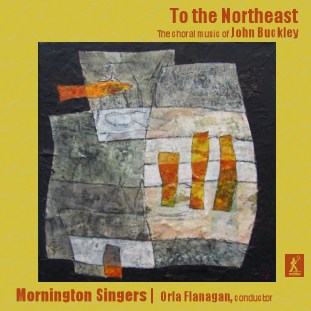
This CD gets off to a wonderful start. Percy Bysshe Shelley’s gorgeous poetic fragment ‘Music, When Soft Voices Die’ is given a near perfect five-part choral setting. The poem majors on the permanence of events and sensations and the power of human memory. The setting was composed in 1984 for the Galway based Cois Cladaigh Chamber Choir. Buckley has nodded to the madrigal traditions of the sixteenth and seventeenth centuries to create his musical canvas. It is a beautiful, restrained setting that uses a largely tonal language to express the haunting beauty of the text, although there are some delicious moments of chromatic writing added to provide contrast.
John Keat’s poem ‘To Sleep’ contrives to create “the delicious drowsiness of the lines” (Andrew Motion). Words such as “embalmer, shutting, gloom-pleased, embowered, enshaded, forgetfulness, lulling, deftly hushed” lend effect to the somnolent mood of the text. John Buckley has maintained this temper throughout most of the work, However, there is a ‘declamatory’ section at the words “Save me…breeding many woes…” which is almost operatic in effect. The work concludes with “a sense of deep resignation” on the line “And seal the hushed casket of my soul”.
Few composers seem to have taken up the challenge of Lewis Carroll’s slightly disturbing nonsense poem the ‘Jabberwocky’. Exemplars included settings by George Whitefield Chadwick and Lee Hoiby. John Buckley has composed a musically diverse version that makes use of just about every choral device in the book including “counterpoint, homophonic block chords, and a type of recitative for the dialogue”. There is even a whispered section. The flow of the music, between harsh dissonance, unison and declamation well-represents the fearsome Jabberwocky. A great piece that deserves to be in all choral societies’ repertoire. The piece dates to May 1996 when it was premiered at the Cork International Choral Festival.
I was not so delighted by the Five Two-Part Songs for Children, settings of texts by the Irish poet Michael Hartnett (1941–1999). I guess that I found the two-part choir a little hard to bear for nearly eleven minutes. They are performed here in the Irish (Gaeilge) original, although John Buckley has provided an English translation in the liner notes. On the other hand, I am aware of a perfect simplicity in these settings that is quite lovely. Themes include, ‘Lullaby’, ‘I have a cat at home’, ‘The beautiful garden’, ‘Spring music’ and ‘Ireland is our country’.
Most people interested in English (and Irish) art song will know Thomas Dunhill’s setting of William Butler Yeats, ‘He wishes for the cloths of heaven’ from The Wind Among the Reeds (1899). I first heard this at a recital given by Janet Baker in Glasgow back in the early 1970s and it remains one of my favourite songs. Other composers have had a go at setting it, including Ivor Gurney, Peter Warlock, and William Denis Browne. John Buckley’s realisation for five-part choir is restrained and contemplative. It succeeds in capturing “the delicate and rarefied poetic imagery, with its mesmeric interweaving of light, colour, and dreams”. This is a truly perfect fusion of words and music.
Equally successful is the setting of ‘There is Spot mid barren hills’, a poem written by Emily Bronte. For all those who have been fortunate enough to explore the austere moorland back o’ Haworth, this piece will literally strike a chord. The composer has selected and reordered Emily’s verses to allow for a satisfactory musical take on the poem’s temper. The first and third verses begin with terse and bleak music before becoming warmer and more dreamlike in the second and fourth verses. It is an ideal balance between ‘Top Withens’ on a windy autumn day and a summer’s reverie in the garden of the Parsonage.
Once again, I would have thought that every choral society in Ireland and the UK would demand to have John Buckley excellent Three Irish Folksongs in their repertoire. The set opens with a charming setting of Yeats’s ‘reconstructed’ folksong ‘Down by the Salley Gardens’ which was later matched to a simple but subtle ‘ancient’ tune. Buckley has produced a gentle version that shares the tune between the tenors and sopranos. There are beautiful descants and spine-tingling harmonies. ‘Kitty of Coleraine’ is a jaunty little number whose melody was used by Beethoven no less. John Buckley takes the syllables of ‘beautiful Kitty’ to create a rumbustious setting of this humorous song. It would bring the house down at any concert. More serious is ‘My Lagan Love’ to a text by the Irish poet Joseph Campbell (1879-1944). The word ‘Lagan’ refers to the river which Belfast is built on. These words are just as much a meditation as a love song. The three folksongs were originally composed for choir and piano in 1983. The present versions for a-cappella choir were made in 2010 (‘Down by the Salley Gardens’) and 2017 (‘Kitty of Coleraine’, ‘My Lagan Love’).
The only overtly religious work on this disc is Lux Aeterna (2017) with words derived from the Roman Catholic Requiem Mass. It is conceived for four-part choir with soprano and alto soloists. Buckley is correct in stating that he has created a “serene work” that presents a mood “of resignation and consolation”. The idea of “eternal rest” and ‘perpetual light shining upon them’ is well imagined.
We turn to the Irish (Gaeilge) with the final work, ‘To the North East’ on this stunning disc. It is a setting of ninth-century Irish lyrics which have been translated/paraphrased by the composer. Buckley explains that the lyrics are “frequently meditative in tone, reflecting on the marvels of nature: land, sea, wind, animals, birds, fish. With an extraordinary freshness of approach, they evoke striking images, which have lost none of their immediacy with the passage of time; the winds still awaken the spirit of the waves, cascades of fish can still remind us of flights of birds, and seals are still joyous and noble”. The three movements are ‘To the North East’, ‘On the Plain of Lir’ and ‘Harbour Song.’ The first portrays musically the mood of a witness looking out over the Irish Sea towards, I guess Scotland. This is deeply felt, almost mystically challenged music. Those walkers and climbers who have looked for the Isle of Man from the top of Scafell Pike, the Great Orme or the Merrick know all about Lir and more especially his son Manannán Mac Lir. This pair were Celtic sea-gods. The latter seems to always shroud Mona’s Isle in [Manannán’s] mist. In this song the ‘Plain’ is the sea itself. John Buckley has created a vibrant impression of the wind – “east wind, north wind, west wind, south wind”. It is a vivacious offering. The final song is ‘Harbour Song.’ This is complex, in fact the most intricate piece on this CD. An eight-part choir is creatively involved in singing both in unison and with wonderful harmonic commentaries on this plainsong-like theme. The composer modulates through all twelve minor keys. Offsetting this tonal resourcefulness is a raft of beautiful chords that progress with slow majesty. The words present an idealised impression of fishermen landing their catch in the anchorage. ‘To the North East’ was written for the present choir in 2016.
The singing is ideal on this recording. Mornington Singers and their director Orla Flanagan present a purity of sound, a perfect balance of parts and an enthusiastic understanding of the music and texts. The liner notes are ideal: they are written by the composer, John Buckley. For information on the composer see his excellent website.
I cannot fault this CD. It is already shaping up to be one of my major discoveries of the year. I am making a belated New Year’s Resolution to explore more of John Buckley’s music at every opportunity.