Catalogue Connection: 25188

  • Ithaka DDA 25188 – Review in IAWM Journal

    We have all heard the phrase: “It’s the journey, not the destination, that counts.” This is the view of the British composer Lydia Kakabadse (b. 1955), and is the ba­sis for her artistic ethic in her CD Ithaka. She maintains that journeys enhance our lives with the “richness of wisdom, expe­rience and knowledge” (liner notes). The CD opens with a seven-part choral suite titled Odyssey. Listeners who expect a synoptical quick trip through the 24 books of Homer’s tome might be surprised at the suite’s format: each movement is based on a historical period of Greek culture and uses a representative text from the era.

    Movement 1 (Archaic, approx. 750­480 BC) begins with the opening lines of the Odyssey, which give a brief overview of the long narrative that is to come. Paired with this text is the somewhat titillating passage from Book 6 (vv. 110-139), where, thanks to the contrivances of the goddess Athena, Od­ysseus washes up on the shores of Scheria, land of the Phaeacians, naked except for a few fig leaves, and frightens some maidens who are playing ball in the sea. An unac­companied soprano sings “Ah” while a trio of male voices eerily introduce the first few lines of Homer’s text in Greek. To depict ancient times, the vocal part is monophonic, with occasional harp glissandos, which be­come more active as Odysseus (sung by a tenor) bemoans his fate. The movement re­flects the period when the city-states were still in inchoate form and the people were nomadic wandering tribes.

    Movement 2 (Classical, 480-323 BC) is choral and presents three texts: 1) Pindar’s ode to the grandeur of the Olympic games, set in the dramatic dithyramb style of the period with a con fuoco rhythmic strumming on the harp; 2) Aeschylus’ tale of the hapless Prometheus, who stole fire for the benefit of humanity but was subse­quently punished by the gods. A solo tenor sympathetically channels Prometheus, chained to a “crag at the edge of the world,” as the female chorus, representing the daughters of Oceanus, calmly come to his aid; 3) Sophocles’ Antigone, lines 44-75, a vibrant dialogue between Antigone and her sister, Ismene, about burying their brother, Polyneices, punishable by death under King Creon’s decree. The harp is featured in this movement, and the text shows three uses of fire: Torch/Triumph, Trial by Fire, and Extinguishment.

    Movement 3 (Hellenistic, 323-146 BC) covers the period when the great Greek philosophers emerged; sadly, it was also the last era of independence, sand­wiched between the death of Alexander the Great and the sacking of Corinth by Rome. This hilarious, tongue-in-cheek setting of Constantine Cavafy’s Beckettian poem Waiting for the barbarian features a hap­py tune, blissfully supported by the harp. The ironic text relates the anxieties of the Greek people, who get dressed up, ready­ing themselves for the barbarians, who do not arrive. The movement opens with the choristers shouting: “What are we waiting for?” Kakabadse makes effective use of echo techniques and antiphonal passages between the male and female choruses. Terrified, the people sing to calm them­selves, and, unfortunately, the destructive Roman barbarians eventually do arrive.

    Movement 4 (Roman, 146 BC-331 AD) reflects the period of Roman rule, and the music is an austere setting of the Kyrie eleison, featuring a cappella choral chant­ing and alternating solo and choral sections written in parallel octaves and open fifths.

    Movement 5 (Byzantine, 331-1453) presents arrangements of two kontakion (thematic hymns) in the homophonic, unaccompanied style of the period. The lovely, richly-harmonized Hymn to the De­fender Mother of God is an arrangement of the beloved sixth-century hymn. The more musically reserved, suppliant Kontakion on the Nativity of Christ was originally penned by a famous Byzantine hymnographer, St. Romanos the Melodist.

    Movement 6 (Post-Byzantine, 1453­1821) depicts the poem Erotocritos by the seventeenth-century poet Vitzentzos Kornaros. The two lovers, Aretousa and Erotocritos, are represented by solo and ensem­ble male and female voices. The lovers, separated by economic class, lament their longing in Sections 1 and 2, and The Poet, in Section 3, narrates that they must settle for fulfillment in the ephemeral, rather than in the real world. Kornaros was a leading figure of the Cretan Renaissance, a period where the arts, particularly literature and painting, thrived.

    Movement 7 (Modern, 1821-present) opens with the Greek national anthem, Hymn to Liberty, sung in Greek and then in English. C. P. Cavafy’s short epic poem Ithaka encapsulates a journey and its pur­pose in a few brief lines that tell us we should not shirk danger (Cyclops, Laistrygonians, Circe) on our journey, but should welcome it as a meaningful experience. Thus does Kakabadse fulfill her musical mission.

    The second section of the CD presents nine art songs, sung effectively by mezzo-soprano Clare McCaldin and accompanied gracefully by pianist Paul Turner. The texts reflect nostalgia for hearth and home and do­mestic dioramas. Themes of poverty, ineq­uity, and spiritual wealth, as well as real and figurative events of traveling and religious devotion, are featured. The musical settings range from darkly austere to sprightly with motifs based on jazz and parlor music.
  • Lydia Kakabadse: Ithaka – MusicWeb review

    I’m not familiar with the music of Lydia Kakabadse but I recall that previous discs of her music have attracted very favourable comments from my colleague Michael Wilkinson so I was keen to sample her music for myself.

    The main offering is the seven-movement Odyssey. Lydia Kakabadse is an alumna of Royal Holloway University of London. In 2018 the Hellenic Institute at Royal Holloway commissioned her to compose a choral work, as she explains, “to portray a musical journey through centuries of Greek history, literature and culture. The lyrics are a synthesis of Greek poetry…. representing the successive eras from Homer through to modern Hellenism.” Odyssey is not a cycle: there is no narrative thread, nor, so far as I can discern, are there any thematic links between the first six movements; rather, each movement is an individual piece though they do constitute a satisfying whole. Most of the texts are sung in English translation, though some are in the original language. Kakabadse’s music is attractive and varied. Mostly, it fits the texts well though I had difficulty with the third movement, ‘Hellenistic’. This sets lines by the Greek poet, Constantine Cavafy (1863-1933) which depicts the reactions of the citizens of Alexandria to the news that ‘The barbarians are due here today’. Apparently, the poem is all about revelations of civic hypocrisy. I was surprised, however, that the music appears to convey no sense of anxiety about the approach of the barbarians; indeed, the music is quite cheerful. I suspect the musical tone is all to do with the pay-off at the end of the poem. The barbarians have not, in fact, come, nor will they: ‘They were, those people, a kind of solution.’ I’m sure it’s my fault that I’m missing something but there seems, on the face of it, to be something of a disconnect between words and music.

    That’s emphatically not the case, however, in the following two movements. Firstly, ‘Roman’ is a setting of the text ‘Kyrie eleison’. Here the music displays links to Greek Orthodox liturgical music. It’s a compelling movement and the quality of the Royal Holloway choir is especially demonstrated at the movement’s radiant close. ‘Byzantine’ sets two hymns for a cappella choir. The music is slow, reverent and beautiful.

    At the start of the final movement, ‘Modern’, Lydia Kakabadse first sets the Greek National Anthem. She then turns again to Constantine Cavafy and his poem ‘Ithaka’. I said earlier that Odyssey is not a cycle, but in her setting of Cavafy’s words Kakabadse draws the work together, partly through the device of referring to material from earlier movements but also through her textural choice. She explains that in Cafavy’s poem, Ithaka “represents the destination of a person’s journey through life [and] suggests that it is the enjoyment of the journey, rather than the destination, which is important.” So, this last movement is a summation of what has gone before and it brings Odyssey to a joyful conclusion.

    Odyssey is a very appealing work and it’s extremely well served here by Rupert Gough and his excellent choir. The singing is fresh, eager and full of vitality. There are a number of important solos taken by members of the choir. All are excellent. So far as I can see, these soloists aren’t named in the booklet; they should have been. The addition of a harp is an inspired decision by the composer. The instrument is not omnipresent but whenever it is involved it adds wonderful colour to the score and always in a highly appropriate way. Cecily Best plays expertly.

    In addition to Odyssey there’s one other choral work, I Remember. Originally composed for children’s choir, we hear it now sung by the female voices of the Royal Holloway choir. They are accompanied by harp and violin and the short piece has a pleasing flow to it. It’s an attractive work. I’m sure its original young performers enjoyed the challenge of singing it.

    The rest of the disc contains nine solo songs with piano accompaniment, all composed between 2018 and 2019. These are sung by the mezzo, Clare McCaldin with pianist Paul Turner in support. The songs set a wide variety of texts, authored by the likes of Charlotte Brontë (an unusual source for a song text in my experience) Henry Longfellow, Thomas Hardy and the composer herself. I can’t recall hearing Ms McCaldin before but she makes a good impression here. Her voice has a rich, warm tint to it but the richness of her timbre does not inhibit good diction. Furthermore, she sings with feeling. Unfortunately, despite her artistry, I can’t say that the songs enthused me greatly. I struggled to think why this should be so and, in the end, after quite a bit of thought, I’ve come to the conclusion that the chief problem lies in the piano accompaniment. This is absolutely no reflection on Paul Turner; the problem for me lies in the nature of the piano parts. These are pretty plain in nature and I don’t think they add any significant thematic, still less harmonic interest. That’s fitting in the last song, Sancte Joseph, where the music is deliberately spare and quasi-liturgical but, elsewhere, I longed for the piano to take a more active role in the music-making. On this evidence, Lydia Kakabadse is more effective as a composer for choirs than for solo voice.

    Odyssey is well worth hearing and since my reaction to the songs is a purely subjective one, I suspect that other listeners will discover more in them than I did. The recordings have been well engineered and the booklet is comprehensive.

  • Ithaka – Fanfare review

    A previous release of music by the UK composer Lydia Kakabadse on this label was very impressive; this present release offers further thoughtful, imaginative music.

    The Hellenic Institute at Royal Holloway, University of London, commissioned Odyssey for its 25th anniversary. Intended as a journey in music through ancient Greek history, literature, and culture, via settings of poetry throughout the centuries. Kakabadse’s response is involving. The musical language is, unsurprisingly, modal in the earlier movements. Each of the seven movements is headed by the name of a different period, beginning with “Archaic.” Languages are mixed, too: In the first movement, the lower voices sing the opening lines of the first book of Odyssey in ancient Greek over a drone bass before the narration begins, with a solo tenor relating Odysseus’s misfortunes. It is the agony of Prometheus that forms the basis for “Classical.” along with an argument between Antigone and Ismene over their brother’s burial, a dialogue effectively portrayed between sopranos and altos. Dialogue again informs “Hellenistic,” this time between the people and their repeated received response to their questions: “Because the barbarians are coming here today.” This music is more definably tonal, almost sing-song in the manner of a nursery rhyme. When we get to “Roman” (choir only, no harp) it is the Kyrie eleison of the Orthodox faith that suffuses the music; the harp is also silent in “Byzantine,” two hymns for SATB choir, sung in Greek, of which the Kontakion is probably the most familiar (the other being Defender Mother of God). A 16th-century text, Erotocritos by Vitzentzos Komaros, forms the basis for the “Post-Byzantine” movement, a delicate setting whereon minor-mode tonality seems to meld with more modal aspects. The solo voices used in this movement, heard with harp, do seem to be very closely miked, though not too much so. The final movement, “Modern,” comprises the national anthem of Greece in its first part before “Ithaka,” representing the destination of the journey of life. The choir is well schooled, with pure-toned sopranos and fine tuning from all concerned, while the harpist Cecily Beer is simply superb.

    There follows a sequence of songs which surround I Remember, a song which unites all concerned in this album effectively. Set to words from Charlotte Bronte’s poem, “Regret, The house where I was born” has a simple piano part which could easily be substituted for by harp or guitar. Clare McCaldin’s rich mezzo is perfect. There is more of a jazz edge to As I Sat at the Cafe, while the storytelling, almost Minimalist at times, of Haunted Houses works well. Offering us the chance to break through our comfort zones, Courage contains much wisdom; Recitative Arioso is taken from a much earlier piece, and an alternative version was included on the disc Concertato mentioned above. McCaldin changes her accent pleasingly during The Ruined Maid, and there is a pleasing sense of folk tale to The Way through the Woods. Perhaps the most impressive song is the final Sancte loseph, initially unaccompanied for the voice until the piano enters chorally, before a final section finds voice and piano exchanging phrases.

    The music here is cleverly constructed without wearing its sophistication on its sleeve; the musical language is everywhere approachable.

  • Ithaka: review in Choir & Organ

    Lydia Kakabadse was raised in the Russian and Greek Orthodox traditions and brings considerable learning as well as freshly accessible music to this Royal Holloway Hellenic Institute commission. The music draws, though in no schematic way, on the succession of styles that dominated the eastern Mediterranean: Archaic, Classical, Hellenistic, Roman, Byzantine and modern. The aim is not to do music history but to portray the progress of a human life, from the monophony of early days to the triumphant recognition that destination is less important than the journey – familiar enough, to the point of cliché, but delivered with honesty and feeling by the Royal Holloway choir.

    There are also songs for mezzo and piano, but it’s Odyssey (‘Ithaka’ follows the Greek national anthem in the final section) that dominates the set and could have stood alone. A fine addition to Kakabadse’s Divine Art catalogue.

  • Ithaka review

    The amazing new fourth album by distinguished composer Lydia Kakabadse (born 1955), of Greek origin – via her mother, Maria Elfriede, born in Athens in 1923 – has just been released by Divine Art. It is an impeccable production and a masterpiece of interpretation of the magnificent “Odyssey” for choir and harp (The Choir of Royal Holloway, University of London / conductor: Rupert Gough / harp: Cecily Beer), made up of 7 movements and set to texts from Homer, Aeschylus, Pindar, Romanos the Melodist, Vitzentzos Kornaros, the poetry of Cavafy and the Akathistos Hymn. It also includes a cycle of 9 songs for voice (Clare McCaldin, mezzo-soprano) and piano (Paul Turner). The approach of the poetic tracks is breath-taking in tonal beauty and you’re left spellbound listening to the whole album. Lydia is a person of rare quality and an active member of the Greek community in London. “Odyssey” was commissioned by the Hellenic Institute of Royal Holloway, University of London to mark its 25th anniversary.

    I urge you to look for this album and get it as soon as possible.

  • Ithaka: review from The Chronicle

    This is probably a must-have CD for anyone who is interested in / enjoys choral music, as Kakabadse (British but with roots in European countries including Greece and Russia) takes the listener on a journey through time.

    “Ithaka” symbolises a journey (from Odysseus’s literal attempt to get home) and each of the tracks in the first piece, Odyssey, takes different styles of choral music, such as Archaic (monophonic, old instruments) Roman (Greek Orthodox liturgy) or Modern (includes the Greek national anthem). Odyssey, in parts, is modern sacred music that sounds surprisingly ancient; other parts are more modern, although the whole is never really going to fool anyone as being ancient, not least the presence of women’s voices.

    The second half of the programme is given over to Songs, which is, well, songs. The first, The House Where I Was Born, is gloomy, based on a Charlotte Bronte poem and almost art-song — all the songs are vocals and piano but we say this because track two is of a different bent, As I Sat At The Café (from a poem called How Pleasant It Is To Have Money*) having a jazz, even bluesy, feel. The Ruined Maid, based on a poem by Hardy, is also quite sprightly, as is The Way Through The Woods, based on a Rudyard Kipling poem. (Aside from Kipling — named for Rudyard Lake — there’s local interest with I Remember, commissioned by the Forest School in Altrincham).

    The other works vary but lean towards operatic, at least to us. Recitativo Arioso is good, a mournful song based on a boy sitting by his mother’s body; it has a lullaby-like quality to it. All in all, essential for anyone with an interest in the variations of the human voice, but enjoyable for anyone else. The [Choir of Royal Holloway, conducted by Rupert Gough], work the magic.

    * This is a poem that satirises the wealthy and it’s as relevant today as it was 100 years ago: the idiots at any live event who still “ … loll and we talk until people look up / And when it’s half over we go out and sup” or think money can solve everything: “And if I should chance to run over a cad / I can pay for the damage if ever so bad.”

  • Infodad review of Ithaka

    The nine songs and one choral work on a Divine Art recording of works by Lydia Kakabadse (born 1955) are in English and are more musically varied than those by Petridou [on the other Greek-inspired Divine Art release DDA 21233]. And the sources of the texts clearly show Kakabadse’s many interests: there are words by Charlotte Brontë, Arthur Hugh Clough, Henry Wadsworth Longfellow, Amelia Earhart, Kakabadse herself, Thomas Hood, Thomas Hardy, John Clare, Rudyard Kipling, plus the Latin Sancte Ioseph. These are individual songs, not a cycle, but they display certain themes that interest Kakabadse, including ghostly tales (Longfellow’s Haunted Houses and Kipling’s The Way Through the Woods); memories of long ago as another kind of ghostliness (Brontë’s The House Where I Was Born and Hood’s I Remember); and the somewhat sullied pleasures of material things (Clough’s As I Sat at the Café and Hardy’s The Ruined Maid). Indeed, Kakabadse’s wide-ranging interests are made even clearer in Odyssey, which is a cycle, and a fascinating one, drawing not only on Homer’s tale of Odysseus’ wanderings after the Trojan War but also on material from many times in Greek history. The seven movements of this work trace Greece from Homer’s era to today, and Kakabadse’s music reflects, to at least some extent, the forms of music in each of the seven eras: monophonic and unharmonized in “Archaic,” dramatic and intense in “Classical,” and so through “Hellenistic,” “Roman” (which uses elements of Greek Orthodox liturgy), “Byzantine,” “Post-Byzantine,” and finally “Modern” (which opens with Greece’s national anthem). The material of Odyssey is more specialized than that of Kakabadse’s songs and perhaps not as widely appealing: the work is a 2018 commission for the 25th anniversary of the Hellenic Institute at Royal Holloway University of London. But even listeners who are not steeped in Greek history and may not be familiar with all the texts in Kakabadse’s Odyssey will find much of the musical material intriguing, and the work as a whole does a very fine job of taking an audience through thousands of years of experience in not much more than half an hour.

  • Ithaka review in New Classics

    Lydia Kakabadse was born in 1955 of Georgian/Russian and Greek/Austrian parentage and grew up in a quiet market town in Cheshire. She worked as a solicitor but has been composing music since the age of thirteen, writing both chamber and choral works that include songs, string quartets, musical dramas, a cantata, song cycles for unaccompanied male vocal choir and a concert Requiem Mass. Her richly textured music reflects Lydia Kakabadse’s wide cultural heritage. This is strongest in her choral music and is also heard to good effect in her chamber works, which are often written in modal intonation. This new album includes the stunning and ambitious choral work ‘Odyssey’, commissioned by the Hellenic Institute at Royal Holloway College in 2018 to mark its 25th anniversary. Its seven movements symbolize an inspiring musical journey through centuries of Greek history, culture and literature. The second part of the album features songs written in 2018 and 2019 and spanning a range of styles from ballad, to arioso to folk jazz, Romantic, antiphonal and minimalistic. The excellent Choir of Royal Holloway, directed by Rupert Gough, perform the beautiful ‘Odyssey’, with Cecily Beer (harp) and Sara Trickey (violin).

    Outstanding Liverpool-born mezzo-soprano Clare McCaldin, accompanied by pianist Paul Turner, sings ten elegant and thoughtful songs with assurance and subtlety. Highlights include The Ruined Maid (based on Thomas Hardy’s wonderful satirical poem) and Way Through the Woods (set to Rudyard Kipling’s evocative poem of the same name, telling of ghostly happenings as well as nature’s power over mankind).

  • MusicWeb review of Lydia Kakabadse’s “Ithaka”

    Born in Southport, Lydia Kakabadse grew up in Altrincham, Cheshire. Her string quartet Russian Tableaux was broadcast by BBC Radio 3 in 2015 and 2017. Her family lineage derives from Greece, Austria, Russia and Georgia. It is at least superficially alluring to think that these (from our stance) exotic elements have played their part in the sound of her music. However that may be, Odyssey and some of the songs featured on this disc do look to the musical cultures of the countries that gather around the Mediterranean seaboard. It was not out of place for this collection to sport the title “Ithaka”, which, apart from its Homeric resonance, also signifies “a person’s journey through life”.

    This disc gathers nine songs for mezzo and piano and Odyssey a work for choir and harp. I remember, a keenly nostalgic song with choir and harp and violin solo is placed among the songs and sets the famous words by Thomas Hood. It’s a lullingly tender invention. The songs are a miscellany ranging from Bernstein and Britten revue style (As I sat at the cafe) to Middle Eastern (Recitative Arioso) to the rural cruelty of Hardy’s The Ruined Maid. They are performed by the dark-toned dramatic Clare McCaldin. Her pianist, Paul Turner is adept at picking up and sustaining styles which are many and varied across these nine songs. The last song, Sancte Ioseph, leans in towards the rites of the Greek Orthodox Church. I cannot quite put my finger on the element they have in common but several times I caught myself thinking of Donald Swann’s Mediterranean songs as collected on Hyperion and, unusually enough also on Divine Art.

    Odyssey, which fits instantly with the title “Ithaka”, was commissioned by the Hellenic Institute at Royal Holloway University of London and was premiered in 2018. Its seven movements are: I. Archaic; II. Classical; III. Hellenistic; IV. Roman; V. Byzantine; VI. Post-Byzantine and VII. Modern. Archaic is all mystery and incense. Classical, with intervention from an hieratic solo male voice, has enlivening breezes blowing through its textures. Hellenistic moved from spoken words, evocative of some rite, to a carol that takes wing. Roman conjures up images of a service in a great cathedral. Byzantine comprises an Akathistic Hymn paired with a Kontakion. This is followed by the plangent and honeyed Post-Byzantine. Modern deploys the Greek National Anthem (vibrantly yet not overwhelmingly sung – amongst the finest of anthems) and harnesses it to the intoxicating yet philosophical life-journey poem “Ithaka” by Constantine P Cavafy (1863-1933), a poet championed by Forster, Toynbee and Eliot. The harp is a constant and beneficent presence across Odyssey.

    Kakabadse, as a composer whose always melodic music is thoroughly approachable, features in commercial recordings that have been pretty liberally documented by this site: including a Naxos volume Phantom Listeners, and two earlier Divine Arts issues: Concertato and Cantica Sacra.

    All the words are printed legibly in the booklet (both Greek and English in one case) alongside background to each work, movement and musician.

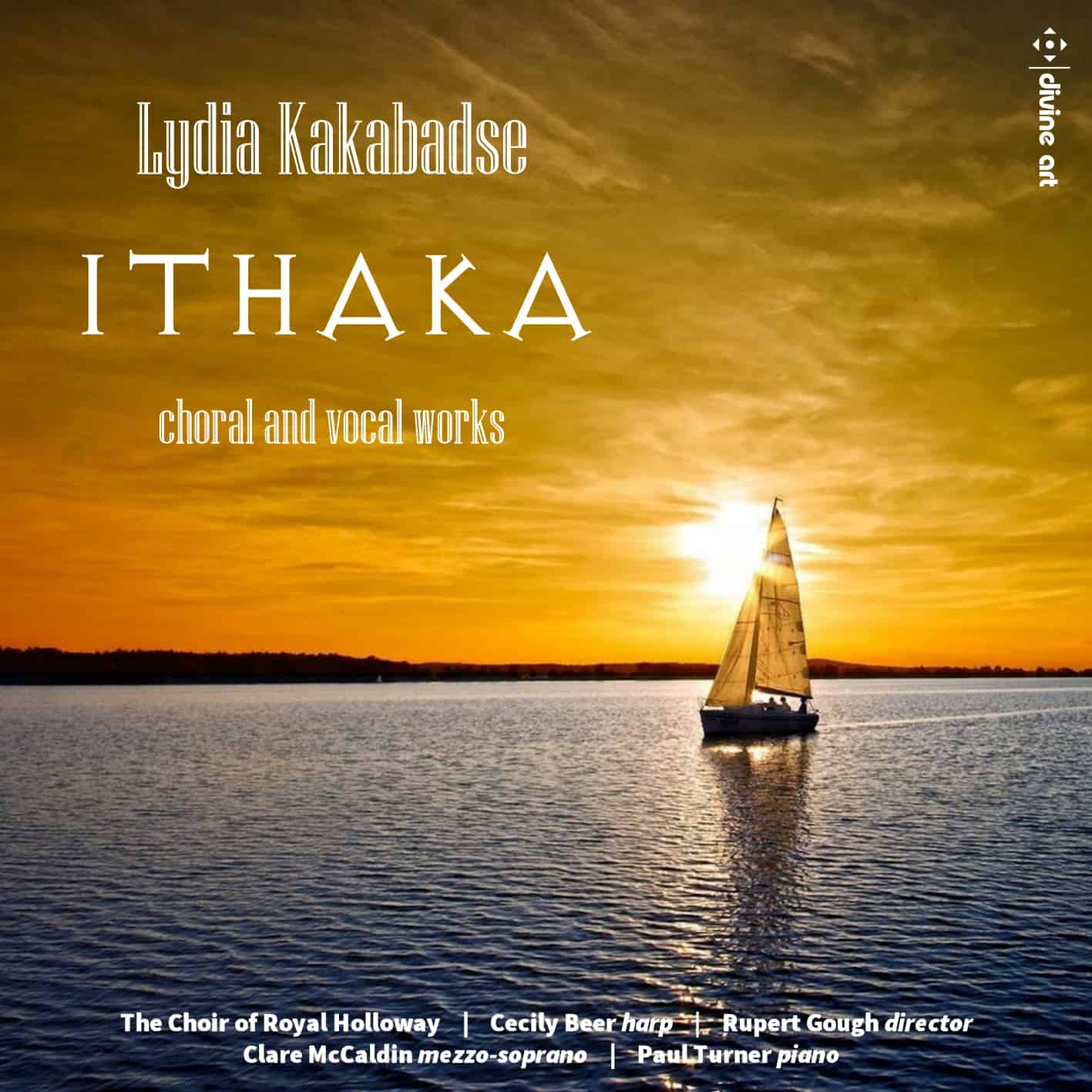
  • Ithaka: vocal and choral works by Lydia Kakabadse

    Ithaka: vocal and choral works by Lydia Kakabadse

    British composer Lydia Kakabadse (with roots in Greece, Austria, Russia and Georgia) reflects her cultural heritage in music that has western and mediterranean elements – while this is strongest in her choral music, it is heard to good effect in her chamber works, which are often written in modal intonation; her previous recorded collections have been very positively reviewed. This album is in two parts – first the stunning choral work ‘Odyssey’ – absolutely traditional in its rich harmony but carrying one or two surprises, a work commissioned by the Hellenic Institute at Royal Holloway University of London and premiered in2018; and a set of songs written in 2018 and 2019 spanning a range of styles from ballad, to arioso to folk jazz, Romantic, antiphonal and minimalistic!

    The performers are all top rate: Clare McCaldin is an outstanding mezzo-soprano with a significant recorded legacy already. Paul Turner specializes in chamber music and has accompanied eminent singers and instrumentalists. Sara Trickey is well known as a fine violinist and Cecily Beer is in demand as both singer and harpist. The Choir of Royal Holloway is considered to be one of the finest mixed-voice collegiate choirs in Britain.

    Odyssey: Choir of Royal Holloway, Cecily Beer (harp), directed by Rupert Gough
    I Remember: Choir of Royal Holloway, Sara Trickey (violin), Cecily Beer (harp), directed by Rupert Gough
    Other songs: Clare McCaldin (mezzo-soprano), Paul Turner (piano)