Catalogue Connection: 25190

  • Fanfare reviews Diana Boyle’s Bach

    British pianist Diana Boyle, a pupil of Artur Balsam who is now domiciled in Portugal, offers performances of Bach of the most remarkable concentration, following up on her previous discs of The Art of Fugue and the second book of The Well-Tempered Clavier.

    The Overture in the French Style, which here occupies a whole disc to itself with a playing time of some 37 minutes, was published in 1735 as part of Clavier-Ubung II (which also included the Italian Concerto). There are 13 movements, of which the first alone takes up nearly a quarter of an hour (the remaining sections are far shorter), with an emotionally wide-ranging exploration of Bach’s techniques. In keeping with the gravitas of the opening movement (itself entitled “Ouverture”), the Courante is serious and intimate. Boyle throughout gives the impression of care¬fully sculpting the music from a most interior place: Nowhere is this clearer than in Passepied I. Throughout, accents are perfectly judged, and a sure sense of rhythm forms the backbone of these fine readings; yet, in the Sarabande, Boyle finds perfectly a sense of the eternal, of a place beyond the mundane. The Gigue has a gloriously sedate way to it here, the concluding “Echo” a remarkable way of bringing back the music to its starting point of profound peace.

    It’s telling that the Sarabande should be the whispered, still heart of Boyle’s reading, as it is that movement that again forms a pivot for the First French Suite. Here, Boyle finds a blend of peace and fantasy in the Allemande, while the first Menuet prolongs the tranquility of that Sarabande. If anything, she is more interior than Perahia on his recent DG account (no bad thing); she holds her head up against Andrszewski, too. Boyle’s concluding Gigue is stately, almost in the manner of a French Overture, whereas Perahia is grand but provides an identifiable Gigue energy. Perahia’s DG recording is cleaner, more clinical than Boyle’s on Divine Art; both work well, and in fact both seem perfectly chosen for the individual pianist’s approaches.

    The group of Sinfonias begins with the Eb-Major, BWV 791, which has a quiet intensity that actually makes it perfectly suitable to follow on after the French Suite. Indeed, there is an inner glow around these performances of nine of the Sinfonias that elevates them. The limpidity of the D-Minor, BWV 790, is stunning; the E-Minor, BWV 793, is another of those moments of profundity, with the major mode of the ensuing E-Major (BWV 792) coming as a ray of light. Boyle opts to close with the F-Minor, BWV 795, its sense of delicious fragmentation (it is almost a skeleton of a piece) being perfect for Boyle’s approach.

    Performed on a Grotrian-Steinweg piano, specially transported from Portugal to Potton Hall, this 2018 recording is superbly realized. It’s a pity that the French Suite is listed as “No. 12” on the disc back cover, but that typo hardly detracts from the excellence of the interpretations themselves.
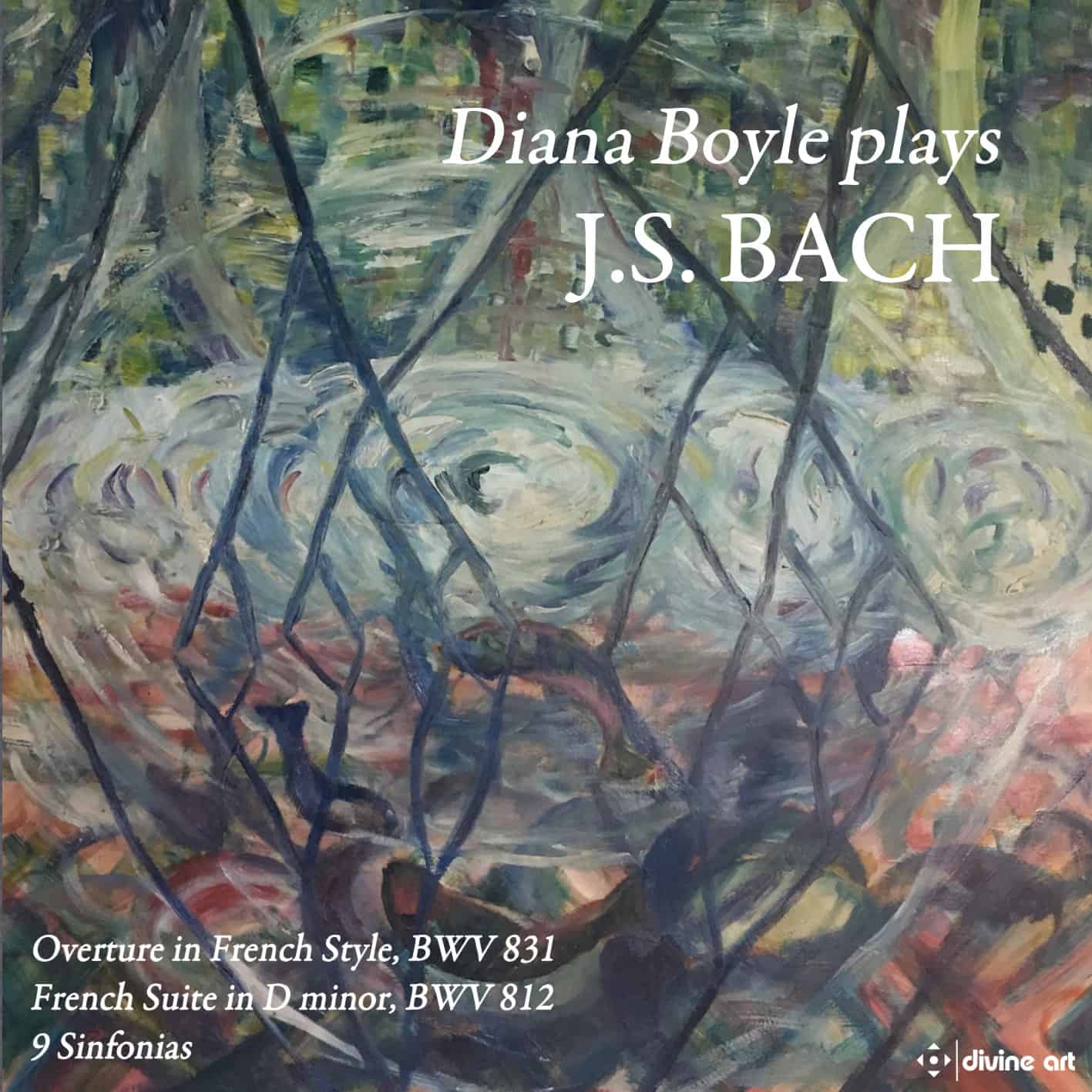
  • The Chronicle Review – Diana Boyle plays J S Bach

    This album of gentle piano music has a definite meditative quality to it. This is probably because of how Boyle prepares for one of her (reportedly infrequent) recordings, which involves going away to the top of a hill and thinking for years. The sleeve notes say she has been doing this for 25 years; she thinks about the music she is playing “with concentration and in privacy”, and moved from London to a quiet hilltop in the south of Portugal, “where the quality of light, astonishing sunsets and silence” give her time to think in peace. She also produced this album and makes all editorial decisions and score-marking, according to the sleeve notes, so after the thinking is done, she knows exactly what it is she wants to do. The end result is something akin to Glen Gould’s Goldberg Variations, where the silence is as important as the notes.

    The piano was only invented during Bach’s lifetime, so he played the clavichord and harpsichord, preferring the former for its more delicate and subtle sound, and the changes in dynamic and tone it could provide. Boyle has gone for the delicacy, and the music is calm throughout. The Overture in the French Style was the last to be composed, published as ClavierÜbung II in 1735. The work consists of an introductory piece, followed by a sequence of shorter dance movements. If you wanted a criticism, you could say the dance aspect was lost in Boyle’s zen-like rendition, although we don’t know the original piece to compare.

    Elsewhere are the “inventions”, short pieces Bach wrote for one of his sons, Wilhelm Friedmann Bach, presented here as a selection of nine (of 15) sinfonias, intended as teaching material for “lovers of the keyboard, especially those who are keen to learn”. Keen to learn more, we can only assume he meant, as they’re not simple. The titles and dates of the pieces are irrelevant, as it’s the overall sound that’s important.

    The music of Bach played by a top pianist who has spent years thinking about how to play — if you want calm and measured music, there’s not much could beat this.

  • Diana Boyle plays J S Bach – MusicWeb review

    The first CD of this two-disc album presents a complete performance of the ‘Overture in the French Style’, BWV 831, also known as the French Overture. This was published during 1735 in the second part of Clavier-Übung II alongside the Italian Concerto. At well over half and hour this is the longest keyboard suite written by Bach. Much of the duration is taken up with the long opening movement, the ‘overture’ itself. After this comes a variety of dance movements before concluding with a ‘dainty’ ‘Echo’. Other movements include two ‘charming’ Passepieds and two ‘lively’ Bourrées.

    This is the first time that I have sat down and listened to this wonderful work from end to end. And I was impressed. Diana Boyle captures the magic of all these appealing shorter movements, as well as successfully presenting the demanding ‘overture.’ I guess that she plays these ‘dances’ slower than other interpreters (e.g. András Schiff, 31:47), however I enjoyed every bar.

    I cannot quite recall when I first heard a recording of these landmark keyboard Suites: it may well have been George Malcolm’s version for harpsichord. I discovered the wayward (but genius) Glenn Gould version issued in the early 1970s. More recent experience has led me to enjoy and savour the Hyperion edition with the vivacious, but always poised, playing by Angela Hewitt. And not forgetting András Schiff on Decca. I guess that is my favourite version.

    The so-called French Suites were probably written for Bach’s wife Anna Magdalena Bach. The first five appear in her music-book begun in 1722 (Clavier-Büchlein vor Anna Magdalena Bach). Interestingly, Friedrich Wilhelm Marpurg was the first person to apply the title to these six suites in 1762. They are more international than the title suggests. The opening ‘allemande’ is German, the ‘courante’ is Italian, the ‘Sarabande’ is Spanish and the ‘gigue’, probably English. The ‘menuets I & II’ are French. Diana Boyle takes the entire Suite at a very relaxed pace, certainly compared to Angela Hewitt and András Schiff.

    Most piano students have struggled to play Bach’s Inventions at some point in their career. It is well-known that the two-part inventions are ‘easier’ than the three-part Sinfonias (or Inventions). I think there is only one of the latter that I can tackle, whereas I can battle (badly) my way through several of the former. I never know whether these ‘Inventions’ ought to be performed from beginning to end in a recital, taking note of the key scheme of ascending keys with eight major and seven minor in each group. Here, Diana Boyle has selected nine of the 17 sinfonias and plays them in order of increasing tempo. Beginning slowly the group works up to Sinfonia no.12. The final example, no.9 is once again slow. Typically, Boyle plays these pieces slower than, say, Gould. But they are well-performed and reveal much of their delight and charisma.

    The liner notes by ‘D.E.’ are helpful and explain Diana Boyle’s approach to J.S. Bach. The recording of the music is excellent and allows the listener to hear the interaction of all the contrapuntal parts and the articulation of the ornaments.
    I enjoyed Diana Boyle’s interpretation of this work. There is a coolness about her interpretation that allows the music to speak without hindrance of any sort. Neither does she destroy the flow of the music with excessive ornamentation.

    I think it all comes down to her musical aesthetic which declares that Bach’s ‘music is for the inner spirit, for our deepest meditation.’ On the other hand, there is a danger here that the ‘dance’ elements of these works may get lost in a soft-focus haze.

  • Diana Boyle plays Bach

    Diana Boyle plays Bach

    Diana Boyle is a fine pianist who records little but prepares each recording with years of thought, consideration and meditation on the music. Her interpretations are individual and thought-provoking, often delicate, not always conforming to the norm which pianists of lesser talent will follow, but looking to breathe new life and spirit into classic masterpieces. Her previous Divine Art albums have been very popular and highly praised.

    Like all of Diana Boyle’s work these new recordings are very carefully prepared and well crafted performances which do not fear to display real feeling and depth, not at all like the all too common ‘mechanical’ performances of Baroque music. The works themselves are not all among Bach’s best known, but all display his total mastery of the art of composition.