Catalogue Connection: 25192

  • The Seven Heavens | fanfare

    James Whitbourn is a British composer (b. 1963) who writes in a fairly conservative tonal language, but whose music nonetheless sounds fresh because of a genuine melodic gift and an imaginative ear for choral and orchestral color. The Seven Heavens is the major work on this disc, taking up nearly half of the total duration. It is a musical portrait of C. S. Lewis, the British writer, scholar, and lay theologian (1898–1963). The Belfast Philharmonic (Belfast being the city of Lewis’s birth) commissioned this work from Whitbourn in 2014. In its original version the work was scored for chorus and very large orchestra. Whitbourn then received a commission from Eric A. Johnson and the organization he leads, Cor Cantiamo, to revise the score for chamber orchestra in order to facilitate more performances. Whitbourn chose to rewrite it for chorus and an ensemble of seven instruments: flute, clarinet, bassoon, horn, piano, violin, and cello. His sense of color is such that a listener not looking at the score would probably guess that a larger group of instruments is employed.

    The Seven Heavens follows the work of Michael Ward, C. S. Lewis scholar and author of Planet Narnia: The Seven Heavens in the Imagination of C. S. Lewis. Whitbourn has incorporated lines from The Hymns of Orpheus translated from the ancient Greek by Thomas Taylor in 1792, plus some Shakespeare, Shelley, C. S. Lewis, and other sources. A narrative written by Michael Ward is meant to be read by the listener in conjunction with the performance. All of this is clarified in the helpful booklet notes by the composer and the inclusion of the narratives behind each of the movements as well as the sung texts.

    The seven “heavens” are actually heavenly bodies, the Moon, Mars, Mercury, Jupiter, Venus, Saturn, and the Sun. A composer dealing with this material, particularly a British composer, is almost setting himself up for unfavorable comparison with Gustav Holst’s The Planets, whatever the inspiration and settings. However, by avoiding the splashy colors and ripe late-Romantic theatricality of Holst’s work, Whitbourn has earned the right to be judged solely by his own accomplishment, which is considerable. This work is beautiful and thoroughly engaging, and it can be enjoyed on many levels. The composer mentions in his notes some of the hidden references and layers in the music (e.g., the ship’s horn on the Belfast Lough in “The Moon,” the bustle of a shipyard in “Mars,” and so on). I found more and more details on relistening, which is what one expects from good music.

    The seven short works that fill out the disc are also imaginative and attractive. In some cases Whitbourn has rescored them for the same forces used in The Seven Heavens. Again the composer’s program notes are helpful guides in providing context for each work. Ada, a musical portrait of Ada Lovelace, the daughter of Lord Byron, sets a part of Childe Harold’s Pilgrimage, which was also the inspiration for Berlioz’sHarold in Italy. Byron left England when Ada was four months old and never saw her again. I hear a longing and bittersweet quality in the music. The Voices Stilled is a deeply moving setting of the standard Agnus Dei liturgical text and was commissioned to honor those who have been killed in war. The music’s haunting quality does not let us forget the grim reality behind the commission, which came from the Shipley Arts Festival.

    The two Canticles that conclude the disc were composed in 2011 in response to a commission from the Millennium Youth Choir at the Royal School of Church Music, who wanted a new setting of the Evening Canticles from the 1662 Book of Common Prayer. The gospel text refers to revelations given to Mary and Simeon, to whom the two poems are attributed. Both were devout Jews, and Whitbourn created two pieces with a decided Jewish shape to their melodies, though the music is original.

    Cor Cantiamo is a professional 24-voice choral ensemble founded by Eric A. Johnson, Director of Choral Activities at Northern Illinois University in Dekalb, Illinois. The performances could hardly be improved upon. Diction is clear, the choral sound is very well blended, and the music-making is both musically and dramatically satisfying. The recording was made at Boutell Memorial Concert Hall, Northern Illinois University, which has produced sound that is spacious and rich but never muddy. One annoyance that I cannot resist mentioning: Nowhere is credit or identification given for the instrumental performers. This, I imagine, will be an issue only for those performers and their egos, not for the listener ***. In sum, this release is one of the most enjoyable collections of new choral music that I have encountered in quite some time.

    *** this was an unfortunate error in the print. The performers are listed on the CD page here
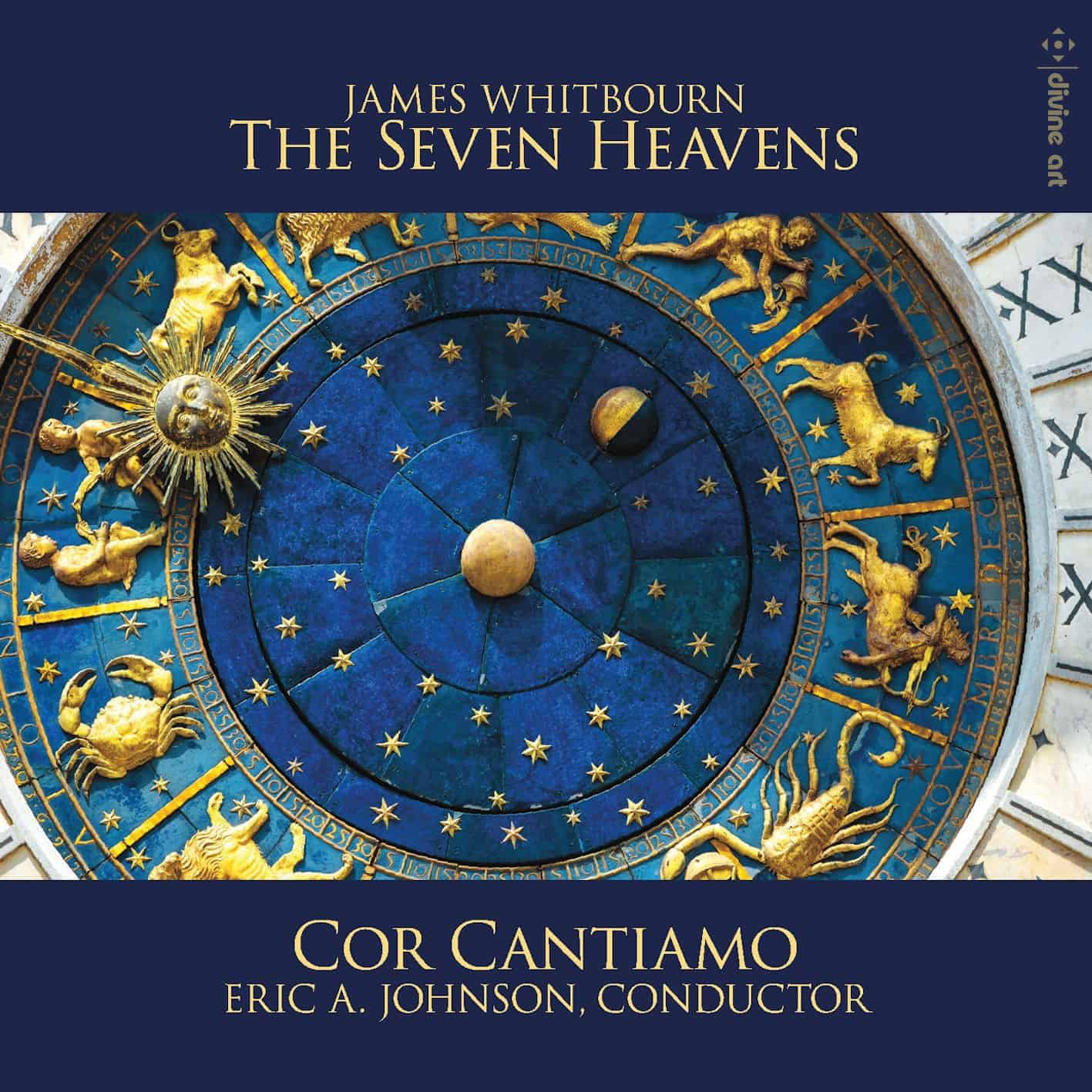
  • The Seven Heavens: Crescendo review

    Writer, historian, scholar of religions, professor at Oxford and Cambridge, it was Clive Staples Lewis (1898-1963) who inspired The Seven Heavens: this cantata establishes correspondences between the personal trajectory of the British man of letters and seven stars which founded the week in ancient mythology: Moon, Mars, Mercury, Jupiter, Venus, Saturn, Sun. The moments of its existence were divided by the academic Michael Ward into themes referring to these divinities and their iconic character (like Gustav Holst in his Planets). This provides a series of biographical sequences, the text of which must be read (or known) by the listener, behind the songs. When we know that Lewis, a great medievalist, was interested in cosmology which permeated some of his fictions (Chronicles of Narnia), we can guess the network of intersecting meanings that fueled the music of James Whitbourn.

    We also think of Rachmaninoff’s Bells, whose structure leads us from the cradle to the grave. The Seven Heavens was first conceived for a large orchestra, honoring a commission from the Belfast Philharmonic (the birthplace of Lewis) to close the 2014-2015 season, then adapted for a small instrumental force accompanying the choir, at the request of Eric Johnson. The first performance of this chamber version took place in November 2016 at Northern Illinois University by the ensemble Cor Cantiamo we hear here. The lyrics come from the Orphic Hymns, Shakespeare, Thomas Lodge, Shelley… Sound allusions (sirens of ships in Belfast Lough call in The Moon, Magdalen College clock is heard in Mars, and other places Lewis frequented…) also run through the overall score, which is constructed according to the cycle of fifths. From one piece to another, the language surprises with its variety, even if it remains suggestive, accessible, consonant, generous. James Whitbourn knows how to communicate. We will not detail here this subtle work of writing, explained in the booklet. However, let’s mention a few steps and effects.

    Piano, triangle, solo violin moisten the tender evocation of the young years. Emotion grips Mars as well, though this anguished episode is otherwise streaked with rumors of war (recalling the author serving as a lieutenant in the Somerset Light Infantry). Mercury, the ferryman, the messenger, illustrates the encounter with J.R.R. Tolkien who influenced the conversion to Christianity, at a time when Lewis abandoned poetry for prose and an academic career. The Jovian star, with which Lewis readily associated himself, radiates a debonair joie de vivre: the libretto does not mention it, but we can detect the canon melody of the medieval round Sumer is icumen in, within a flowery and springtime spirit. Emaciated as much as enamored, Venus delves into the union with New York writer Joy Davidman, who died prematurely of cancer (this relationship was the subject of the 1993 film Shadowlands, starring Anthony Hopkins and Debra Winger). The next installment, Saturn, introduced in dark deep voices, prolongs this mourning, and depicts Lewis’s own decline, whose epitaph bears a phrase from King Lear: “Men must endure their going hence”. But this portrait in music does not stop at this fateful vision and triumph over a hope of resurrection, following the aspirations that Lewis had developed in his Letters to Malcolm. This radiant apotheosis quotes the motto of the University of Oxford (Dominus illuminatio mea) and concludes with a reminder of the ritornello associated with Jupiter.

    The program continues with other recent creations. Ada (2015) is a portrait of Ada Lovelace (daughter of Lord Byron) commissioned by one of her descendants, the Fifth Earl of Lytton. The mathematician owned a Stradivarius, which is why the violin dominates instrumentation. James Whitbourn used her first name as a melodic imprint (A-D-A in English terminology) which he inserts thirty-six times, one for each year of the young woman’s life. The text is borrowed from his famous father’s Childe Harold’s Pilgrimage.

    Eternal Rest was originally written for orchestra on the occasion of the Queen Mother Elizabeth’s funeral (2002), then reduced to a refined antiphon with organ to the lyrics of the Requiem. We hear here a third version, specially written for this recording, colored by a panel of instruments. The two Canticles for Mary and Simeon were commissioned by the RSCM Millenium Youth Choir for their services at York Minster. The composer immersed himself in the history and meaning of these biblical figures, which he situates in their Judaic perspective with a harmonic, prosodic and melodic outline clearly derived from Jewish music. Viola and organ reinforce the lament. Magnificent !

    You may already be familiar with Annelies (from the Diary of Anne Frank), one of James Whitbourn’s most performed works, cataloged in the repertoire of leading UK university choral ensembles. His discography has a few CDs. This one, remarkably interpreted, brings together pages representative of his homogeneous, communicative and direct style. This uninhibited eloquence needs no other advocate than his warm, spontaneous, fervent art, which speaks to the heart and will conquer you as such.

  • Whitbourn: The Seven Heavens – ARG review

    I have admired James Whitbourn, I have admired Cor Cantiamo, and I really admire how they’ve have come together in this program. The Seven Heavens depicts the life of CS Lewis through medieval imagery of the planets; an evocative picture of the Christian writer who was a medievalist at heart. The ancient Hymns of Orpheus in English translation supply most of the libretto. Bits of Shelley, Shakespeare, and the Bible contribute the rest. The work was commissioned by the Belfast Phil¬harmonic Choir for a concert shared with the Ulster Orchestra in their 2014-15 season. Seven Heavens is heard here in the chamber version Whitbourn crafted after that premiere. What makes his music work so well is that the planetary theme and the classical poetry come together to inspire vivid descriptions of the writer’s life. Lewis’s uncomfortable conversion to Christianity can be heard in the rumbling and clanging of Mars. In Mercury, he finds his authentic voice as a writer. (“Give graceful speech and me memory’s increase.”) Lewis thought Jupiter was “the best planet” (he was born under its sign), and the music reminds us that jovial and Jupiter share the same etymological root. Venus is a bittersweet affair recalling the tenderness of love and the aching sadness Lewis felt when his wife died of cancer so soon into their marriage. Saturn is suitably dark and funereal, but light dawns in final interlude with the arrival of the “venerable sun”. I was moved by both the score and the emotional depth of the poetry. “Men must endure their going hence”, writes Shakespeare in Lear. It’s in the libretto, it’s on Lewis’s gravestone, and it’s all over this music.

    I liked the other works as well. ‘Ada’ is another biographical portrait; this time of Ada Lovelance, Lord Byron’s only legitimate child. She was, by all accounts, a smart, formidable woman and she inspires some smart, formidable music that’s rendered with tenderness by obbligato violin and the choir. Most moving of all is ‘Eternal Rest’, composed in affectionate tribute to Elizabeth the Queen Mother when she passed away in 2002. The composer’s personable notes and the inclusion of texts clinch the deal on an interesting and rewarding release.

  • The Seven Heavens – Choir & Organ review

    The title work was commissioned to celebrate the 140th anniversary of the Belfast Philharmonic Choir, and traces the life and thinking of Belfast-born C.S. Lewis using the imagery of the medieval planets; the original orchestral scoring has been reduced to chamber ensemble for this recording by Illinois-based professional chamber choir Cor Cantiamo. The Seven Heavens is a well-crafted and accessible work with an interesting backstory, and this engaging performance proves that it travels well.

    The shorter works on the disc include an attractive grace written for college feasts at St Stephen’s House, Oxford; a reworking using an English text from the Requiem Mass of an elegiac orchestral piece written for the funeral of Queen Elizabeth the Queen Mother; and a set of Evening Canticles that includes characteristically Jewish musical elements in tribute to the shared heritage of Mary and Simeon.

  • James Whitbourn Seven Heavens – Chronicle Review

    Trying to condense a review of this into a few words is like trying fit a bear into a handbag: it will eventually go in, but a lot will be missing.

    This is a big programme of music to take in, the works themselves ambitious, with a big sound and big ideas, and a number of performers, though not as many as it was originally written for.

    It’s all approachable, the sound somewhere between old, classical Anglican style and something more modern, though it’s pretty traditional; nothing too modern to frighten the horses, or the vicar anyway.

    Mr Whitbourn (his CV is too impressive just to call him Whitbourn as per our normal style) has worked for television so is used writing music that needs to be both quickly absorbed and emotional or even inspiring.

    The sleeve notes (which are free to download) explain all but the title piece is a musical portrait of CS Lewis portrayed in the imagery of the mediaeval planets. It was initially written for a big setting and occasion — Ulster Hall and the 140th anniversary of the Belfast Philharmonic choir — but was downscaled for the Cor Cantiamo on this performance to a chamber ensemble, seven instruments.

    The planets include the moon with its “diffusing silver light”, “unconquered, boisterous” Mars, Mercury the “celestial messenger, of various skill” (the latter tied in with Lewis’s Christian conversion at the encouragement of JRR Tolkien, who back then was just an academic and not an entire universe).

    After the grandeur, Mr Whitbourn gives us some light relief with Ada, she being Ada Lovelace, the only legitimate child of the poet Lord Byron and the first computer programmer. Ada is recalled as a “the little bird” in a rising motif that uses sequences of musical pitches derived from the letters of her birth name, the sequence played 36 times, one for each year of her life. The music is a little sad: Lord Byron buggered off when Ada was only four months old but, at her request, she was buried next to her father.

    Elsewhere, The Voices Stilled is a moving and powerful setting of the Agnus Dei from the Missa de profundis, commissioned for the Shipley Arts Festival and dedicated to those who lost their lives in war. Eternal Rest was commissioned by the BBC to be used in its broadcast coverage of the funeral of the queen mother. This is both sombre and broadcast-friendly; in the right conditions it will either calm or raise the hairs on the listener’s neck. It’s good played loud. It’s possibly the most traditionally “churchy” piece of music on here, for obvious reasons.

    The title piece aside, we liked best the final pieces on the CD, The Canticles of Mary and Simeon. Asked to write to a new setting of the 1662 Book of Common Prayer evening canticles, the composer looked at the bible: both characters were devout Jews, so he combines an Anglican feel with Jewish melody on a viola, which adds a pleasingly ancient feel to the rather powerful music. This is countered by the organ, which balances the Eastern with a very English/Western sound. The album will please singers, as well as those who love the sound of a good choir. It also sounds (and saying this, we have zero expertise to base the comment on) as if it could be performed in a local town hall by a decent amateur choir.

  • BMS review of The Seven Heavens by James Whitbourn

    The present CD provides the listener with a useful overview of James Whitbourn’s choral output – music that has gained steadily in popularity on both sides of the Atlantic. The Observer newspaper for example describes the composer as ‘a truly original communicator in modern British choral music’.

    The choral cantata ‘The Seven Heavens’ takes up a significant part of this interesting disc and is full of interest.

    It comprises a musical portrait of the Irish born writer C.S. Lewis – many-faceted figure – academic, author and Christian Mystic.

    Originally written for chorus and large orchestra the present work has been transformed into a version for chorus and chamber ensemble. It consists of seven movements entitled The Moon, Mars, Mercury, Jupiter, Venus, Saturn concluding with The Sun.

    The musical language is approachable throughout with a number of striking moments in evidence. It is scarcely surprising, that given the subject matter, there are references to the music of Holst but it is to Whitbourn’s credit that ‘The Seven Heavens’ manages to maintain its individuality throughout.

    ‘Venus’ provides a further poignant moment where there is some beautifully sustained writing for voices and instruments, reminding the listener of Lewis’s tragically short marriage. ‘The Sun’ draws various elements of the cantata together making a satisfying conclusion.

    The second half of the CD is made up of seven choral pieces that further underline Whitbourn’s eclectic interests. ‘Ada’ is another musical portrait – this time that of the mathematician Ada Lovelace, the poet Byron’s only legitimate daughter and a key figure in the development of computer science. The composer’s programme notes clearly outline the structure of the piece as well as the thinking behind the instrumentation.

    There follow six further pieces that exemplify the composer’s wide musical range. Mostly written as commissions for student choirs, these eminently practical works demonstrate a thoroughly accessible musical style.

    A setting of the Anglican evening canticles brings the CD to a conclusion. Both the Magnificat and Nunc Dimittis are in imbued with a strong Hebrew flavour (more than a hint of Ernest Bloch) and make an intriguing end to the programme.

    The quality of this disc is further enhanced by first rate performances and recording. Credit should go to the excellent chamber choir Cor Cantiamo. Clearly the conductor Eric A. Johnson knows what he is about – this disc is characterised by music making of a particularly high order.

  • Seven Heavens Review in New Classics

    James Whitbourn is an internationally-renowned composer recognised by The Observer as ‘a truly original communicator in modern British choral music’. Currently Senior Research Fellow at St. Stephen’s House, Oxford and a member of the Faculty of Music in the University of Oxford, his career began at the BBC, where he has worked as composer, conductor, producer and presenter. His compositional output is admired for its direct connection with performers and audiences worldwide and for its ability to ‘expand the experience of classical music beyond the edges of the traditional map of classical styles’ (Tom Manoff, NPR). He was commissioned to compose the music to mark several national and international events, including music for the broadcast of the funeral of Queen Elizabeth the Queen Mother and music for the national commemoration of 9/11 at Westminster Abbey.

    His beautiful and restrained choral works have been performed in prestigious venues around the world and been heard on many acclaimed recordings, with three Grammy nominations including Best Choral Performance for Annelies, which set words from The Diary of Anne Frank. The major work on this new CD release is a world premiere recording of Whitbourn’s The Seven Heavens, a musical biography of C.S. Lewis. This suite in seven movements for choir and chamber ensemble was commissioned by the accomplished Cor Cantiamo, an acclaimed professional ensemble which is the current Choir in Residence at Northern Illinois University, USA. As well as the inspiring title work, the album also includes seven pieces for choir, all brilliantly performed by Cor Cantiamo.

    Highlights include the beautiful Ada, timeless Video Caelos Apertos and soulful Canticle of Simeon.

  • Music Web review: James Whitbourn’s Seven Heavens

    The major work on this CD is The Seven Heavens, composed and revised between 2014 and 2016. The basic concept of this piece is ‘a musical portrait of C. S. Lewis portrayed in the imagery of the mediaeval planets’. Few readers of these pages will be unaware of the important contribution of Lewis to theology, medieval literature and children’s books. Most of us have read at least some of the Narnia Chronicles. Others will have been helped by his practical and compassionate ‘apologetic’ approach to the intricacies of theological matters.

    The liner notes give full details of the work’s progress. This includes an introductory text to each movement written by the C. S. Lewis scholar Dr Michael Ward. This places Lewis’s life in chronological episodes. Each of them relates to the attributes associated with one of the medieval planets (The Moon, Mars, Mercury, Jupiter, Venus, Saturn and the Sun), or the ‘Seven Heavens’. The sung texts are derived largely from the Orphic Hymns (The Hymns of Orpheus), translated into English by Thomas Taylor (1792). Also featured are extracts from William Shakespeare, Joseph Addison, the Psalmist, Thomas Lodge, St John, Percy Bysshe Shelley and C. S. Lewis himself.

    Musically, this eclectic score sounds like a synthesis of everything I have ever heard from the western choral tradition – old and new. That is no bad thing. It makes for an approachable work, enjoyable and satisfying from first note to the last. There is much beauty in these pages. The listener will be inspired and moved.

    The Seven Heavens was originally written for a massive orchestra with the organ of the Ulster Hall in Belfast, where the work was premiered during the 2014/2015 season as part of the 140th anniversary of the Belfast Philharmonic Choir. A reduction for choir and chamber orchestra was made two years later. It is this version that is heard on this disc.

    I wonder if Dr Ward’s texts could have been spoken before each section. There certainly seems to be a little extra room on this CD.

    I found Ada a little insipid. The choir is accompanied by violin and harp: I wonder if this was necessary. The piece is a tribute to Lord Byron’s only legitimate child, Ada Lovelace, with the text taken from Byron’s long poem Childe Harold’s Pilgrimage. I guess that few people read these long narrative poems today, but this extract is both tender and melancholy. The music was written in 2015 in response to a request from one of Ada’s descendants. Unsurprisingly, Whitbourn has used the notes A-D-A as a major constructive motif in this piece.

    Video caelos apertos was specially commissioned to mark a visit from the Medina High School, Ohio to St Stephen’s House, Oxford in 2014. The title reflects St Stephen’s words as quoted in the Acts of the Apostles, shortly before his martyrdom: ‘I see the heavens opened’. The anthem begins with a plainchant melody, before expanding into music which reflects a text from Revelation: ‘You are worthy, O Lord our God, to receive glory and honour and power’. The liner notes state that the composer has used ‘mensural devices beloved of medieval composers’. In this context, I am not sure what is meant. I guess the definition implies that the ‘symbols’ give the exact value of the notes and the rests, as opposed to plainsong which has no measurable pulse. But without seeing the score…

    I am not sure about the eclectic, if not eccentric, nature of The Voices Stilled. Ostensibly a setting of the Agnus Dei, the music incorporates the viola which at one point echoes the Last Post. I guess it was appropriate for its original inception as a memorial piece for the commencement of the Great War. The choral music is ravishing, but the ‘band’ is an intrusion.

    Eternal Rest
    was originally an orchestral number written for broadcast during Queen Elizabeth, the Queen Mother’s funeral in 2002. Fifteen years later Whitbourn recomposed the work for choir and organ. It sets these words: ‘Eternal rest grant unto them, O Lord. And light perpetual shine upon them.’ This beautiful setting is, for me, the highlight of this CD. A perfect fusion of text, voices and organ. It is a work that is fully in the tradition of Anglican Church Music.

    Gratias agimus tibi is a setting of the college grace of St Stephen’s College Oxford. This is now sung at all college high days and holy days. Scored for choir without accompaniment, it is an effective and inspiring little piece. The timeless nature of this setting reflects both the medieval (Gothic) revival structure of the college (1876) and a more contemporary aesthetic.

    The two final pieces are effectively a setting of the Anglican Mag[nificat] and Nunc Dim[ittis]. To highlight the Jewish heritage of the text, Whitbourn has introduced some sinuous melodies played on the viola: I am not convinced that this works. The organ part, on the other hand, is demanding and totally effective.

    The liner notes give a detailed account of each work, including texts and translations. There are the usual biographies of the composer and performers. Further details on James Whitbourn can be found in his excellent website. I was unable to find who played the violin, the viola or the organ. The performance by Cor Cantiamo is superb in every way.

  • James Whitbourn: The Seven Heavens and other choral works

    James Whitbourn: The Seven Heavens and other choral works

    The major work here is the suite The Seven Heavens, for choir and chamber ensemble; also we have seven other marvellous choral pieces.. All are brilliantly performed by Cor Cantiamo, the accomplished and acclaimed professional ensemble which is the current Choir in Residence at Northern Illinois University, USA, under its founder and conductor Eric A Johnson. Since its inaugural concert with Morten Lauridsen in 2010, Cor Cantiamo has developed a mission to work with contemporary composers resulting in many commissions and recordings.

    James Whitbourn is a Grammy-nominated composer and ‘a truly original communicator in modern British choral music’ (The Observer). His works are admired for their direct communication to performers and audiences. This is the seventh album devoted entirely to his choral music. His eclectic inspirations include C.S. Lewis (The Seven Heavens), Anne Frank (the very popular Annelies), notable individuals, NASA space missions and liturgical texts. In all, his music is altogether delightful.

    Instrumentalists for each work:
    The Seven Heavens:Mathias Tacke, violin; Jesse Ya-chen Lee, cello; Evan Fojtik, flute; Devin Starr, clarinet;
    Gwyn Downy, bassoon; Kelly Langenberg, French horn; William Goldenberg, piano
    Ada: Mathias Tacke, violin; Faye Seeman, harp
    The Voices Stilled: Mathias Tacke and Casey McGrath, violins; Donghee Han, viola; Jesse Ya-Chen Lee, cello; Evan Fojtik, flute
    Eternal Rest: Mathias Tacke and Casey McGrath, violins; Donghee Han, viola; Jesse Ya-Chen Lee, cello;
    Henry Robbins, double bass; Kyle Flens, timpani
    Canticle of Mary/Canticle of Simeon: Donghee Han, viola; Dan Mattix, organ
    (other works are for unaccompanied choir).