Catalogue Connection: 25193

  • Transformations: Musicweb review

    The notes tell us that the title Transformations is not just a reference to each of the three works included on this recording contain musical transformations of themes, but also that it is the first recording made on the Norman and Beard organ at Cheltenham College Chapel since its latest extensive restoration by Harrison and Harrison in 2017. Whatever the reason behind the title, the result is an excellent recital of organ music which includes the premiere recording of Jonathan Dove’s The Dancing Pipes.

    The recital opens with the Sonata Eroica by the Belgian composer, Joseph Jongen. Born in Liège, where César Franck was also born, Jongen is perhaps best known for his Symphonie Concertante of 1926, a monumental work that is regarded as one of the finest symphonies composed for organ and orchestra. I must say that while I like the Symphonie, I do prefer this sonata, although in reality a sonata it isn’t; it can be best described as a continuous set of variations, which are quite symphonic in stature. This is now my third recording of this work and it is by far the slowest, with John Scott Whiteley whipping through the piece in 15:46 on his Priory disc (PRCD 731), sounding to me a tad too fast; Christian Schmitt on his CPO recording (777 593-2) does it in a more stately 17:14; whereas here we have to wait for another two minutes for the piece to finish. This, however, does not detract from the music, as Alexander Ffinch manages to drive the tension of the piece well, while exploiting the full dynamic range of the Cheltenham College instrument.

    This is followed by what soon became my favourite piece on this disc, Jonathan Dove’s The Dancing Pipes. Originally composed for Thomas Trotter in 2014, for the celebration of 250th anniversary of the Snetzler organ in St. Laurence’s Church in Ludlow in Shropshire, this is only Dove’s second work for the solo organ and shows a great understanding of the capabilities of the organ. I imagine that he will go on to compose further pieces for the instrument. Strongly rhythmic and energetic, it fairly skips along and is based upon “a little dancing figure” which occurred to the composer. However the music is affected by other forces that Dove introduces, it is that little dancing motif which, not transformed, just adapted a little, remains dominant throughout. It sounds really good on the Cheltenham College instrument in the acoustic of the Chapel and Ffinch gives a powerful premiere performance which I will return to often.

    The final work on the disc is my least favourite, as I have never been a great fan of Liszt, That said, I do have another recording of this work, albeit part of the Brilliant Classics set 500 Years of Organ Music (95310/38), with Hans-Jürgen Kaiser at the organ of Schwerin Cathedra It is also available as a single disc (93789). I remember being not too impressed when reviewing that box set, but here in Ffinch’s performance it sounds better, perhaps because it isn’t so ponderous; it is, after all, nearly five minutes quicker overall than the Kaiser, and boy does it need it. It is based on a chorale sung by the Anabaptists in Meyerbeer’s five-act opera La prophète, and Liszt seemingly brings out the full range of emotions from the opera. The result is, therefore, a piece which runs the emotional gamut, with many twists and turns, something which Ffinch pulls off with aplomb. This is a recording of the Liszt that I would listen to again, which, having compared the recordings, I would not say about the Kaiser.

    Ffinch certainly puts the rebuilt Cheltenham College Chapel organ through its paces, the result being an interesting collection of pieces, exhilaratingly played. I particularly enjoyed his performance of the Jongen, and the Dove is wonderful; even the Liszt isn’t that bad under his hands. The organ is captured at its best by the recording, and the notes are also very good. This is an exciting and welcome addition to my collection, the Dove in particular being a real find.
  • Transformations – review from Church Music Quarterly

    This is an important recording in many ways. It is the first recording of Cheltenham’s Norman and Beard instrument since its latest 2017 Harrison & Harrison restoration.

    The CD contains three major works, one from each of the 19th, 20th and 21st centuries – superbly played and recorded. First up is Jongen’s Sonata eroica of 1930, little known to non-organists but here receiving a persuasive performance that might endear it to those hearing it for the first time. The heroic introduction knocks one back (thanks to instrument and player, and to the dynamic range of the recording) before a series of very varied variations, a fugue and a triumphant conclusion.

    Jonathan Dove’s The Dancing Pipes was written in 2014 for St Laurence, Ludlow and the 2w50th anniversary of an organ that still has most of a 1764 Snetzler at its heart, The music dances, the pipes dance, and the organist’s hands and feet dance as what the composer describes as ‘a little dancing figure’ is put through all sorts of transformations and contrapuntal inventions. The CD concludes with Liszt’s mighty Fantasia and Fugue on ‘Ad nos, ad salutarem undam’, played with attention to detail and opportunities for ‘orchestral’ colour changes.

  • American Record Guide review – Transformations

    A program of oft-recorded pieces save for the Jonathan Dove. The title refers to the use of one theme or motive as the basis for each piece: Jongen devised a series of variations on a modal melody in the style of a Belgian folk song; Liszt borrowed a theme from Giacomo Meyerbeer’s opera Le Prophet [sic], subjecting it to his technique of thematic transformation; Dove chose a dance-like motif which explores the colors of the organ while growing in intensity and momentum.

    The Jongen is well played but doesn’t quite rise to the level of Murray, while the Liszt manages to hang together, though it is somewhat plodding and lacking in forward momentum in many places.

    Ffinch plays on a robust 3-manual, 45 rank, 1892 Hill, Norman and Beard (renovated in 2017) in the Cheltenham College Chapel (England). Notes on the music, performer, and organ.

  • Gramophone review – ‘Transformations’

    Alexander Ffinch has chosen to show off the newly restored organ of Cheltenham College Chapel with three heavyweight works, each of which traces the transformation of a musical idea.

    Jongen’s Sonata eroïca takes a haunting little theme and runs it through a series of variations which ebb and flow like the waves of some mighty ocean. The organ impresses with its vast dynamic range, and Ffinch impresses with his easy manipulation of the instrument. Neither are noteworthy for their subtlety, the organ revealing a somewhat uneven inner balance which muddies the water in some of the quieter variations, while Ffinch surfs over the heroic introduction with a wildness that does not stand up to too close scrutiny. But there is no shortage here of big dramatic moments which obscure a slightly superficial feel to the performance.

    Jonathan Dove’s The Dancing Pipes was written in 2014 for the organ of Ludlow parish church, not far up the road, as it were, from Cheltenham. The piece is shot through with what Dove himself describes as ‘a little dancing figure’. As it continues to repeat itself, this figure triggers a variety of musical scenarios which concentrate mostly on the more delicate sounds of the organ. Ffinch’s sure-footed rhythmic sense ensures that the inner vitality of the piece shines through, and while its 10-minute length is probably more than sufficient to put the musical material through as many hoops as it can stand, both organ and player maintain a pleasing lightness of touch which gives it all a sprightly lift.

    Heaviest of the heavyweights, Liszt’s Fantasia and Fugue on a theme form Meyerbeer’s Le prophète will need no introduction; it is one of the major staples of the repertory. Here both the 2017 Harrison and Harrison rebuild of an original 1896 Norman and Beard instrument and Alexander Ffinch seem to be thoroughly in their element. This is a richly detailed, powerfully driven and suitably extrovert performance which brings the piece dramatically to life and provides a suitably spectacular climax to a very fine recording.

  • The Organ review of Transformations

    This is one of the finest recordings of an organ I have heard for some time. The splendid 1897 Norman & Beard instrument, as rebuilt and extended by Harrison & Harrison in 1976 (since when, a 32-foot ‘Double Ophicleide’ stop has been added), is caught with a truthfulness that is most impressive, the microphone placing in the Chapel being absolutely perfect in terms of capturing the natural ambiance of the building, the wide dynamic range without a hint of overload, as well as – most importantly – the clarity and brilliance of Alexander ffinch’s playing.

    The chosen programme sets off the instrument admirably: beginning with a quite outstanding account of Joseph Jongen’s marvellous Sonata Eroica – a work that deserves to be far better-known than it is, outside of the organ world – ffinch offers a recent (2014) work by Jonathan Dove. The Dancing Pipes is, as so often with this composer, a study in colouration and minimalistic patterns rather than being an organic piece of genuine creative momentum; it receives a wholly sympathetic account here.

    Liszt’s great ‘Ad nos’ fantasia and fugue returns us to the core repertoire in a performance of considerable musical insight and technical address. All three highly contrasted works suit this fine instrument admirably, and ffinch’s interpretative insight is splendid – genuine performances from a manifestly gifted musician and technically accomplished master. David Gammie’s accompanying booklet notes are excellent. This disc is very strongly recommended. (5 stars awarded)

  • The Chronicle (Congleton) reviews Transformations

    This CD sees Ffinch play Cheltenham College Chapel’s organ; he is college organist so he knows it well. The opener is Joseph Jongen’s Sonata Eroica. This was commissioned by Belgium Radio in 1930 for the inaugural concert at the art-deco concert hall and arts centre at the Palais des Beaux-Arts in Brussels.

    We like Belgium, the home of Rene Magritte, Mr Sax and Tintin’s Georges Remi; they always seem a bit mad. This piece opens formally and imposingly but two and a half minutes in, pedals back — the sleeve notes say it is a set of symphonic variations based on an Ardennes folksong, so the opening loudness was perhaps meant to shake up that opening night’s audience after their glasses of Mandarine Napoleon. You’d be struggling to say “Ardennes folksong” but it’s not formal organ music either. There’s something pleasingly ethereal about it, the music for fairies scampering about in a wood in a children’s ballet, particularly around the eight minute mark, after which it gets more dramatic. Say the sleeve notes: “One of the great masterpieces of late-romantic organ literature.”

    Jonathan Dove’s The Dancing Pipes is next. This was commissioned by St Lawrence’s Church in Ludlow, and dedicated to organist Thomas Trotter. It was written to celebrate the 250th anniversary of the church’s Snetzler organ. We imagine Mr T is a popular man and a lively character as “dancing” is the key word in the title, and the piece sparkles. The sleeve notes say the work was inspired by “a little dancing figure” that occurred to Dove as he tried to compose a more hefty work, and instead went with his muse. Dove is known for his work with children and community choirs, which means this is an accessible piece.

    Franz Liszt’s “monumental” organ Fantasia and Fugue on the chorale follow, and at 32 minutes is just over half the playing time. This was part of Lizst’s “revolutionary milestones in the history of music, revealing new horizons of form, technique and imagination,” say the sleeve notes. It is orchestral and theatrical in sound, and played tightly. Rather like the Dove it is accessible with little of the formal and off-putting sound an organ can have. The sound is constantly changing. The sleeve notes include extensive organ specs at the back for organ buffs.

  • MusicWeb of ‘Transformations’ organ recital

    The first of three major works on this CD is Joseph Jongen’s imposing Sonata Eroica. This piece was commissioned by Belgium Radio in 1930 for the inaugural concert at the art-deco concert hall and arts centre at the Palais des Beaux-Arts in Brussels. The work was played on the newly installed instrument built by Josef Stevens of Duffel, near Malines. The Sonata is dedicated to Joseph Bonnet, the former organist at St Eustache’s Church in Paris. The liner notes explain that this is not a ‘sonata’ in any traditional sense, but a set of ‘symphonic’ variations based on an Ardennes folksong. This tune first appears after a loud and demanding introduction. The piece concludes with a ‘tightly-wrought neo-classical fugue’ and a wonderful peroration, sounding like all the bells of Brussels ringing peals of joy and triumph.
    Listeners will detect several influences in this music including Claude Debussy, fellow Belgian César Franck and most important of all, Franz Liszt. Yet, I believe that Joseph Jongen has created a marvellous synthesis that is never pastiche. Alexander Ffinch gives a vibrant performance of Jongen’s Sonata. There is a fine balance between the romantically charged slow middle section, the commanding introduction and the overpowering conclusion. The contrast between these three ‘sections’ is perfectly made.

    I have not heard Jonathan Dove’s The Dancing Pipes before reviewing this CD. The piece was commissioned by St Lawrence’s Church in Ludlow, Shropshire and was dedicated to organist Thomas Trotter. It commemorated the 250th anniversary of the installation of the church’s Snetzler organ. The Dancing Pipes is characterised by an ever-changing sense of rhythmic drive propelled by varying metres that certainly satisfies the ‘Dancing’ part of the title. Dove has written that the work was derived from a ‘little dancing figure’ that dominates the piece and is largely resistant to ‘the challenges of various counterpoints that tried to knock it off balance.’ Naturally, the little melody survives, but not before ‘the organ pipes themselves wanted to dance.’ It is a superb piece that is, I suppose, a toccata of sorts: it is an ideal conclusion to a recital or a recessional for seeing the worshipers off the premises at the end of Matins. It is also a splendid concert-piece. The overall stylistic impression of this music is ‘minimalist’, at least in the sense that it reminds me of Philip Glass. It is played with excitement and a sense of drama and attention to registration which provides colour to this compulsive piece. This is The Dancing Pipes’ ‘world premiere recording’: I doubt that it will be the last.

    The corpus of Franz Liszt’s organ music is currently dominated by two major pieces that have stood the test of time: The Prelude and Fugue on BACH (1855) and the present Fantasia and Fugue on the chorale ‘Ad nos, ad salutarem undam’. Both remain in the repertoire of recitalists. ‘Ad Nos’ is a long work, lasting over half an hour. Despite its title, it is divided into three sections: Fantasy, Adagio and Fugue. Liszt began composing the work in 1842 and finally completed it in 1850. He considered it ‘as one of [his] least bad productions.’ The piece is based on a chorale sung by Anabaptists in German-composer Giacomo Meyerbeer’s five-act opera La Prophète (1849). What Liszt has done is to create a ‘compendium’ of organ playing ‘devices.’ The success of this work depends on the recitalist’s ability to manage the instrument in presenting ‘a kaleidoscopic range of moods and colours.’ There are three underlying compositional techniques here: organ, piano and orchestral. This fact alone, demands considerable challenges to the registration and playing technique. For me, Ffinch’s performance achieves this well, but in a typically restrained manner. I note the work’s often improvisatory and rhapsodic character and understand that this feature can be the work’s glory and perhaps its downfall. There is always a danger of the music drifting into ‘empty waffle’ Ffinch avoids this and presents a convincing and satisfying account of a work regarded by many as being one of the masterpieces of nineteenth-century organ music.

    The three-manual organ was originally installed at the Cheltenham College Chapel in 1897 by Norman and Beard. The organ case was designed by the chapel architect Henry Prothero. Over the past 120 years the instrument was been rebuilt on one occasion (1930) and restored in 1976. This work was carried out by Harrison and Harrison. Finally, in 2017 the organ was dismantled and fully restored at the organ builder’s Durham workshops.

    Alexander Ffinch is currently the organist at Cheltenham College Chapel, responsible for the day to day worship at the Chapel as well as accompanying choirs and giving recitals. He was appointed in 2004.

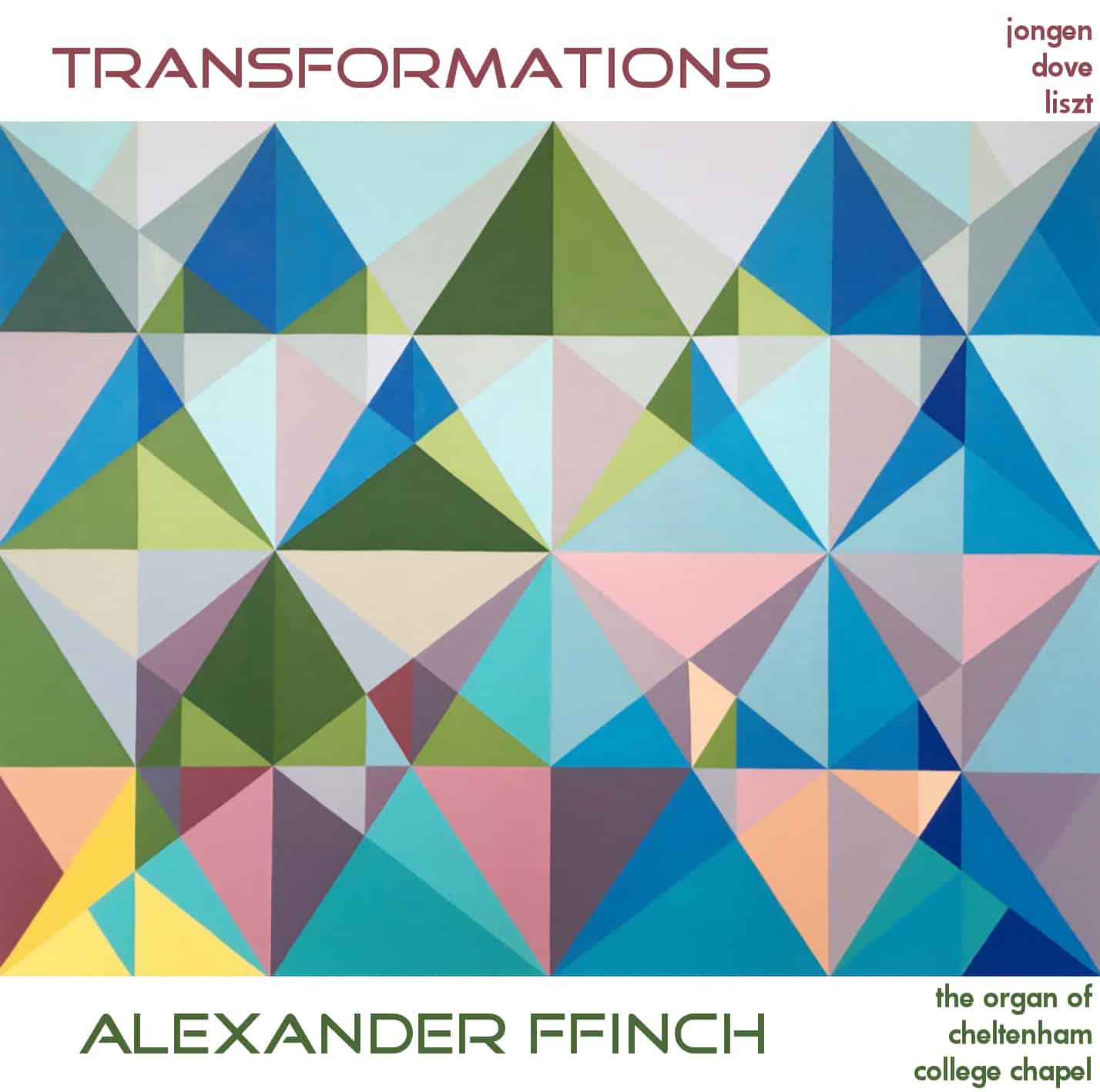
    David Gammie provides excellent details of the music and composers in the liner notes, along with the all-important full specification of the instrument. Despite the eye-boggling ‘Cosmati’ pattern on the CD cover, there are three good photographs of the organ: console, pipe-rack and a general view of the chapel. Other pictures feature all three composers, the organist Alexander Ffinch and an etching by Charles Bour (1814-1881) of the cover of the piano reduction score of Meyerbeer’s Le Prophète.

    This is an enormously satisfying CD presenting three war-horses that are either standards in organists’ repertoire (Liszt and Jongen) or ought to be (Dove). It is a well-produced disc that rewards the listener attention. The playing overall is ideal, and the sound quality is well-balanced.

  • Choir & Organ review of ‘Transformations’

    Alexander Ffinch puts Cheltenham College Chapel’s organ through its paces in fine style in this first recording since the 1897 Norman & Beard instrument was given a major overhaul by Harrison & Harrison in 2017. Its symphonic heft is vividly felt in the variegated, muscular poetry of Jongen’s Sonata eroica, its broad colour palette and dynamic range lit up by Liszt’s Fantasia & Fugue on the Chorale ‘Ad nos, ad salutarem undam’. Ffinch traverses its constant transformations of tone and temperament with the agility of an Olympic slalom skier, finding zen-like stillness in the translucent textures of its middle movement and thunderous directness in its stirring finale. There’s vital advocacy, too, for Jonathan Dove’s rhythmically buoyant, delightfully animated The Dancing Pipes in its first recording.
    (FIVE STARS)

  • Transformations – music for organ

    Transformations – music for organ

    Three major organ works: one from Liszt, one of the masters of high Romanticism and bubbling virtuosity; the powerful Heroic Sonata of Jongen and the first commercial recording of the delicately figured piece ‘The Dancing Pipes’ by Jonathan Dove, one of today’s most appreciated composers. This superb program is titled ‘Transformations’ as each piece contains musical transformations of themes; it also reflects the transformation of the fine Harrison & Harrison organ at Cheltenham College Chapel – this is its first recording since a full restoration in 2017.

    Alexander Ffinch studied at the Royal College of Music and was organ scholar at Keble College Oxford. He gave over 100 recitals as resident organist at Lancaster Town Hall and continues to undertake a busy concert and broadcasting schedule (sadly his planned August 2019 debut at Notre Dame Paris is ‘on hold’). Alexander was appointed College Organist at Cheltenham in 2004 since when he has played daily in the Chapel as well as giving regular recitals; he oversaw the 2017 restoration and manages the work of both students and visiting recitalists.