Catalogue Connection: 25197

  • Schubert String Quartets | Fanfare review

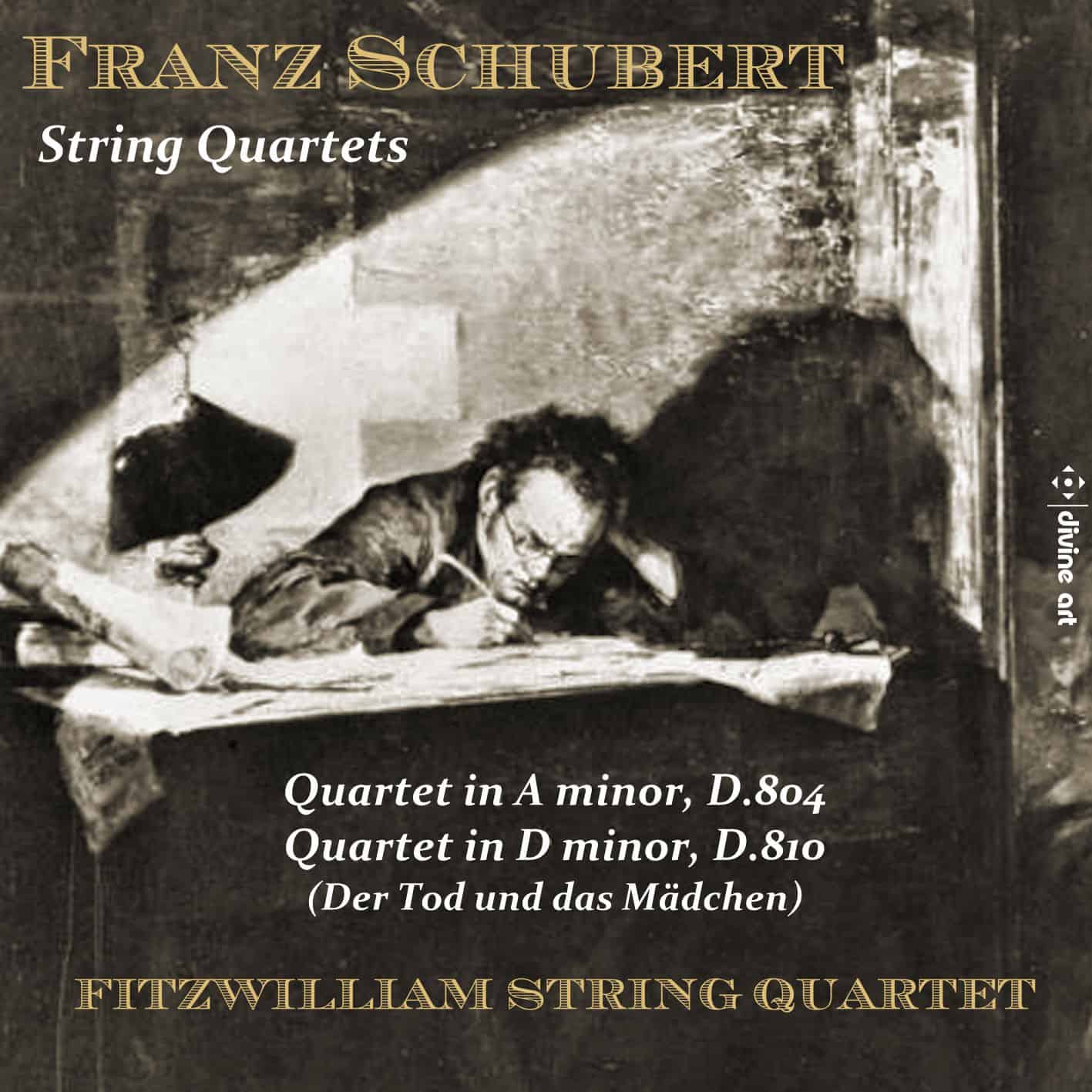
    Despite the familiarity of Schubert’s “Rosamunde” and “Death and the Maiden” Quartets, there’s room for new discoveries, as abundantly proved by this thought-provoking release. The veteran Fitzwilliam Quartet had been out of sight and out of mind in my listening for a long time. Now they almost erupt into view, so striking and original is the music-making on this disc. Everything about the two scores has been rethought to the smallest detail, as described at length in the well-written, cogent program notes by violist Alan George. There’s too much to summarize here, but I can give the most salient points, which when taken en masse produce a very different sounding performance.

    Heard in person the Fitzwilliams play with a big tone and a forceful presentation, phrasing broadly rather than in minute detail. That’s the baseline in these two Schubert quartets as well, but I was surprised by the unusual sonority being produced, until I read that the group was using gut strings. There is some degree of added mellowness to the overall sound, but what is perhaps more notable is that the violin’s E-string is softer, less prominent and bright, which affects the balance one is used to with a wire string.

    If you prefer brilliance of sound to mellowness, it takes a little adaptation listening to the Fitzwilliam’s Schubert. Personally, I enjoyed the atypical sonority combined with interpretations that exude emotional warmth. Following historical precedent, vibrato has been excluded except for rare expressive effects. This adds to the pungency of the sound. Most HIP string quartets adopt a Baroque model for tempos and accents, but the Fitzwilliam pored over the best research into Schubert’s notation, which turned out to be more dramatic, contrasted, and sharply accented than modern practice, and certainly HIP routine, comprehended. The notes have a lot to say about accenting and dynamics in particular, pointing out that Schubert’s notation went to an extreme that was unprecedented except for Beethoven.

    Many more points are covered, all of them intriguing and interesting, but the upshot is a forceful, highly expressive style, filled with variety and color, that also employs HIP understanding in the most precise sense, as applied to Schubert specifically. Not only are we faced with a surprising sound world, but the interpretations are so musical that I’d have to reach back to the Busch, Budapest, and Alban Berg Quartets for comparison.

    It took over four decades, we are told, before the Fitzwilliam played these two staples of the quartet repertoire, their principal focus being on less familiar music. To provide a bit of background, the group was founded in 1968 by four undergraduates at Cambridge University (Fitzwilliam is the name of one of the University’s 31 colleges). More than 50 years later, one founding member remains, violist Alan George. First violin Lucy Russell is next senor, with 32 years in her position. After study at the Royal Academy of Music, the original group got their big break when Decca signed them to record a complete cycle of the Shostakovich quartets. On a visit to England Shostakovich had heard them play at York University, and he was impressed enough to entrust the Fitzwilliams with the Western premieres of his last three quartets. Almost serendipitously and existing in youthful obscurity, they became the first ensemble in the world to play and record all 15 Shostakovich quartets. (The complete cycle received the very first Gramophone Award for chamber music in 1977.)

    Famous as they were for their dedication to Shostakovich—Quartet No. 8 was on the first public program they played outside Cambridge in 1969—it’s fair to say that on this side of the Atlantic the Fitzwilliam Quartet fell out of sight in other repertoire. But I like their Schubert far more than their Shostakovich, actually. Every movement has been rethought for tempo, phrasing, and sound. The quoted “Rosamunde” and “Death and the Maiden” themes in the Andantes are taken fairly quickly. Schubert didn’t take up using the metronome, but he happened to give a metronome marking for the song version of “Death and the Maiden,” which is adopted here. Particularly unusual is the folk-dance treatment of the finale of Quartet No. 13 and the accenting of the tarantella finale of No. 14. That’s not to minimize how mature and satisfying these performances are as a whole. However improbable it might seem when I compare them to the Busch and Budapest Quartets, online sampling will allow you to judge for yourself.

    A final thought: In his program notes George brings up some intriguing autobiographical issues about Schubert. He makes the point that creative genius doesn’t depend on the life a composer happens to be living. Both of these quartet masterpieces were composed in February/March 1824. Schubert was 27 and had been diagnosed with syphilis two years before. In a letter to a close friend, Leopold Kupelwieser, dated March 15, 1824, he was in a gloomy mood, quoting a line of Goethe’s that appears in the Lied Gretchen am Spinnrade: “My peace is gone, my heart is heavy; never, never again will I find rest.”

    If we commit the fallacy of mistaking the personality for the artist, the two string quartets from that same month should be equally gloomy affairs, which they certainly aren’t. Schubert would live with his dreadful diagnosis for another four and a half years. Much joyful music emerged during that period. The noted musicologist Jack Westrup commented that the first three movements of the “Rosamunde” Quartet are perhaps the most songful of any Schubert quartet. Speaking to the temptation to equate life with art, Alan George reminds us that “such speculations can be treacherous: remember that ‘Gretchen am Spinnrade’ was composed by a lad of seventeen, whereas the gloriously sunny B-flat trio appeared right after Winterreise itself, when [Schubert’s] demise was all too near at hand.”

    We should celebrate the difference between the artist and his life, not scrape the bottom of the barrel looking for the roots of misery, discord, and disease. If disease and distress determined the output of a genius, literally every note of late Beethoven wouldn’t exist. His physical and mental travails were horrendous, and we know much more about them than we do about the relatively obscure Schubert. Many other examples could be put forward, which baffles those of us who are not geniuses. But the point is beyond dispute. 
  • Schubert Quartets review

    The Fitzwilliams are irremediably associated with Shostakovich, recognized on the international scene after having recorded the complete string quartets of the Russian composer (Decca). What a surprise to find them today at Schubert, moreover on period instruments and gut strings! In a discography that sails on the summits, how does this new version of the “Rosamunde” and “Death and the Maiden” Quartets stand out? As against the daring and risk-taking of the Artis (Sony), to the controlled momentum of the Berg (Warner), the British Quartet opposes a harsh and contrasting romanticism: this wide dynamic palette echoes a Schubert who wanted, with these two works, to “clear the flight towards the great symphony”.

    The performers here make the illumination play, swinging between mystery, worry and melancholy. Despite a little acidity in the high register, the texture captivates, suggests individualities and unfolds beautiful lines. Too fluid? The slightly incisive articulation flattens the edges and conceals the inner voices. A few awkwardly adjusted transitions finally weaken this reading, despite its poignant character and its sense of narration.

  • CMD review: Schubert String Quartets

    Schubert’s musical world is perhaps one of the most distinctly Romantic of any of his nineteenth-century contemporaries; to peruse one of his scores is to be set upon some of the most impassioned and key-dominated work, built with a simplicity of harmony which so often evokes the spirit of Caspar David Friedrich’s famous Wanderer, which can speak of a heartfelt mix of joy and melancholia. It could be said that he was plagued by Beethoven’s shadow, and famously (although only purportedly) asked how anyone could achieve real musical greatness after the former’s death in 1827. Their musical difference stems often from Schubert’s love of chamber music, and his quest for a sound that spoke more evidently of the pastoral and yearning (although often cliché-ridden) poetry of Müller, Heine and Rellstab (all writing under the shadow of Schiller), which can be seen in some of the works of Schumann and others after him.

    All of this seems to have been realised by the players of the Fitzwilliam Quartet, in this new recording of two of his most well-known string quartets. Yet the effect is not as impressive, as wholesome, as can be gained from the works they perform here; there is not the overall variety needed to interpret these works. Schubert, not just in his string works, can seem repetitive, the same figures, emotional standpoints given multiple times, and his ability to flow between sections not as ornate or unseemly as Beethoven’s, often employing the simple chord progressions to change sections. There is most certainly a range of tones and expressions in this recording, and an impressive mix of the different instruments to create a polyphony in the more tempestuous sections, yet a monotonousness is sometimes found that is unwanted in trying to get the music away from its bare manuscript and into the emotional arena that Schubert was so enveloped in, and to keep the music constantly changing in effects.

    The first quartet in this collection is the Quartet in A minor, D 804 from 1824. The first movement has a deep, intensely morose feel which is evident from the very start in the falling A minor triad in the first violin and the searching accompaniment in the second.

    The key shifts quickly between the minor and major, as the overall tone does equally swiftly between moods of lyricism and contemplation and the ‘angry abruptness and severity’, as violist Alan George describes it in his informative but often inanely written notes. (I am reviewing the music here, but the quality of writing of the programme notes is important, especially when there is an evident wish of the Quartet to provide context for their interpretations, and the style of these notes is at points meretriciously weak.) That tendency for musical severity and surprising changes into musically violent emotion is a theme of this first movement, and the need for maturity in approaching the different points in the music is often missing, leaving the effect to be diminished when repeated many times. The lack of variation hinders the opportunity to give a new perspective on Schubert’s score, which, although bearing the hallmarks of the troubled mindset he was in at the time of composition, does have the need for a more measured approach, in order to make the at times repetitive music still seem vivacious enough by the end of the long first movement.

    The second movement, it is true, allows more easily for the more measured and accumulative music-making which the most expressive overall effect demands. The key of C major allows more for a simpler and more evocative yearning, or perhaps simply a constant search for meaning, resolution, which is fulfilled by the contrast of the same kind of at times dense, entrenched chords, and then sparse and flowing music, led by the admirably expressive Lucy Russell as the leader, who maintains her simple melody under the semi-quaver runs of the second violinist Marcus Barcham Stevens. This music is markedly less troubled and vertiginous, although the cellist Sally Pendlebury does use her Giovanni Regeri instrument, of circa 1700, and the gut strings used by all players to enhance this effect and keep the threatening undertones pronounced.

    The third movement begins with low murmurings on the cello which seem to be foreboding premonitions, before Schubert launches into another ascending melody that switches between the same keys of C major and A minor. The trio that follows starts in a relaxed A major before variations lead it to a conciliatory imperfect cadence in E major.

    The last movement possesses a much more jaunty and folk-song nature to it, using the effect of semi-quaver turns to their full effect, along with an ingenious and characteristic ability to create musical panoplies built around the same melody, seeming to grow upon each other at each point in the music.

    The Quartet in D minor, D 810, is often cited as one of the most extraordinary works not just of Schubert’s incredibly broad oeuvre, but of the string quartet repertoire and Romantic music as a whole. The nickname Der Tod und das Mädchen has caught on more than the Rosamunde title ever has for the A minor. Well, it’s a better name, and one that speaks clearly of the masterful grasp of key, structure and motif that is never in such abundance in the previous work. If there was a slightly nihilist backstory to the above Quartet, then the D minor is the irate, almost Beethoven-esque pinnacle of Schubert’s chamber works; deeper than The Trout, more exploratory and varied, than many of his songs, especially the often trudging music that makes up much of Die Winterreise. Of course, there is the immediate context of Schubert’s life; he had recently been severely and was now acutely aware that death was near, that the illness that had been chasing for so long was now close to catching him, and at the height of his powers.

    It would be a desultory cliché to say that this music ‘has it all’, but there is such a broad mixture of technical prowess in this work; the compulsive motif of the open D minor chord, the moments of desolation, ecstasy, passionate yearning, and the unsure, deeply Romantic scenes, such as the chord right at the beginning, which seems a simple tonic G minor chord, but with a simple, persistent F in the viola; calm uncertainty, calling to mind the tale of Turner dabbing a miniscule point of bright orange to his sea landscape, transforming the effect. Schubert’s reliance on chord structures is still here, but the originality and brilliance more evident than ever before, the stream of consciousness that must have created much of his work at such a fast pace more vivid and altogether more energetic.

    The almost hymn-like, hypnotic beginning of the second movement, Andante con moto, is carried off here with a delicacy of tone by the players, with the space for more building-up of the music. This sense again could have been increased by more of an overall assurity of cohesive structure, although much of the individual playing is often of the highest and most evocative calibre.

    There is an intensity and central sense of direction which moves it forwards through different melodies, mixed with a variety of techniques and ideas: high violin melodies and idiosyncratic, ornate details, arpeggiated cello pizzicatos, making each section of the long movement unique while also maintaining a sense of the overall structure and forward momentum.

    The short, more volatile Scherzo in a sprightly A major, leading into the final movement, which starts with a boisterous D minor melody, again returning to the tonic and dominant of the key for the most direct expression, although the dominant emotion here is more triumphant, although still possessing a vulnerability which masks the potential for darker undertones, finally covered over by the urgency of the stark ending in the tonic, on the most impassioned perfect cadence.

    Playing on period instruments is always welcome, and often necessary, in order for musicians to render the most complete sound which can interpret the composer’s original experiences and intentions properly. Yet what was missing from the playing in this collection was the immersion and passion needed to interpret Schubert’s score to another peak, to see the different peaks and troughs that can be interpreted differently in the score, although the different expressions and sections are seemingly simplistic at times. This CD holds within some extremely heart-rending, joyous and emotionally infused music, played by some wonderful individual players. The overall sounds required more forethought and mobilisation to achieve the most engrossing effect that Schubert’s music can.

  • Schubert quartets – Chronicle Review

    Rock bands attempt authenticity by doing unplugged or acoustic sessions; classical players do it by going back to basics. For this recording of Schubert’s famous quartets, the Fitzwilliam String Quartet used gut strings, and quizzed experts about playing techniques of the time the works were composed (1824).

    Lucy Russell’s Ferdinando Gagliano violin from 1789 is the youngest of the instruments by far, so they’re contemporary. BBC Music Magazine said the two pieces on here are “Schubert’s two most accessible quartets”. The String Quartet No 13 in A minor (the “Rosamunde Quartet”) was written by Franz Schubert between February and March 1824. It’s socalled because it’s based on the story of Rosamunde: queen in waiting brought up incognito as a shepherdess, then the governor who killed her parents tries to stop her, marry her, then poison her, but dies by his own poison, and Rosamunde gets to be queen. That old tale. The Quartet in D minor, (“Death and the Maiden”) “arguably the most famous of all string quartets” say the sleeve notes, takes its name from the setting of a poem of the same name by Matthias Claudius that Schubert wrote in 1817. The theme of the song forms the basis of the second movement of the quartet; the theme is a death knell that accompanies the song about the terror and comfort of death.

    You can listen to Rosamunde as background music and Death to some extent but both are far edgier than you’d expect for classical music, the music raw and exciting. Performer Alan George (viola 1740), writing in the sleeve notes, says the Fitzwilliam String Quartet had never played Death before, “the policy … that audiences can hear this, and other well-known pieces whenever they want to” but the players were “surprised — even shocked” at the ferocity of much of the first movement, and the “wild tempestuousness” of the finale.

    For the listener it’s striking music; on the whole it’s not morbid though it is sombre in places. The recording (St Martin’s Church, East Woodhay, Hampshire, July 2018) gives the piece a live feel and you often feel as if this is a live show, in as much as you sense the passion and commitment of the players in what is presumably very technical music. There must be many recordings of these two pieces. We don’t know if this is the best but it is very good. Two famous and much loved pieces played well and with gusto.

  • Schubert String Quartets: Classical Explorer review

    The Fitzwilliam String Quartet was named after the Cambridge University college where the original members were students at the time of founding, October 1968; one member of that line-up remains today, violist Alan George. The group is perhaps most famous for its recording of the complete Shostakovich String Quartets; and for its 50th anniversary recording (on Linn Records) it chose to re-record that composer’s last three quartets (Nos. 13-15: purchase link below).

    The Fitzwilliams’ repertoire is broad, however. A recent release on Métier presented music by Liz Johnson (born 1964) reminded us of their credentials in the contemporary field; while, looking backwards down the timeline, we find them performing Schubert String Quartets on gut strings with this coupling of the Schubert A minor Quartet, D804, and the famous “Death and the Maiden” Quartet, D810. The C minor and G major Quartets will follow on, one hopes within the scheduled timescale of 2020 (COVID has inevitably affected scheduling for just about everybody).

    The A minor String Quartet, D804 is sometimes known as “Rosamunde”; its second movement uses a well-known theme (you will know it!) from Schubert’s incidental music to that play. These performances by the FSQ are on period instruments with gut strings; those used to the more upholstered modern sound may need to adjust expectations, but go with it. This is stunning playing!

    The D Minor Quartet, D810, is known as “Death and the Maiden” on account of another example of Schubert self-referencing: the song, Der Tod und das Mädchen, D 531. With the use of gut strings, we really feel the rawness of the Quartet’s opening. The slow movement is ravishing, a thing of real beauty. Sally Pendlebury’s cello (a Giovanni Rogeri, c. 1700, Brescia) is so powerful, focused and assertive it has to be heard to be believed. To complete the instrumentarium: first violin Lucy Russell on a 1789 gagliano from Naples; Marcus Barcham Stevens on second violin plays on a Luigi Piattellini, 1774, from Florence; and Alan George on viola, an instrument attributed to Guarneri workshop, 1740/41, Cremona.

    When I was a lad (a long time ago) I learnt huge amounts from LP sleeve essays. It’s lovely to see the tradition of eloquent, informative essays back, with the FSQ’s violist Alan George in superb form writing on both the music itself and the challenges of performing it on period instruments. Plus, as a bonus, one of our greatest Schubert scholars, Professor Brian Newbould, offers some thoughts on Schubert’s use of counterpoint in these works.

    The “Explorer” spirit is high here; the insatiable curiosity of the players, their use of carefully-chosen instruments, their consideration of Schubert’s wide dynamics, of tempo and so on mean we hear these works anew, like newly-restored paintings.

  • Schubert String Quartets – The Strad review

    Significant research has gone into this recording of Schubert’s two most songful quartets from an ensemble celebrating 50 years, the Fitzwilliam Quartet. The booklet itself is rich in its charting of the ensemble’s journey to reconcile matters of markings, sound production, tempi and not least equipment (they settled on their own Italian instruments strung with Viennese gut). It even includes an afterword from Professor Brian Newbould, who graciously admits that there is not much left to say following Alan George’s absorbing eight-page essay.

    The performances are best taken in the spirit of the ensemble’s own journey of discovery. Internal balance and intonation can waver and this song-driven music’s architectural exposure of Lucy Russell’s first violin suggests that the organic strings, new bow holds and sparing use of vibrato are being caught fresh rather than settled.

    But the grainier and (counter-intuitively) heavier sound sets off the counterpoint in D804 well, the performance possessing more roughness and readiness than sureness of touch. The same qualities give ‘Death and the Maiden’ the all-important feeling of an inevitable slide into despair despite a full-on fight. This is the first time the ensemble has tackled the piece, which has its pluses and minuses. The variations are unusually searching, suggesting not only the eagerness of a first immersion in their world but also that it’s the movement they spent the most time on. It also carries them through to a fearless, raw Scherzo and Presto in which few of the constraints of before are apparent and real emotional tension sets in. A close but clear in-the-round recording puts listeners right in the middle.

  • BBC Music review: Schubert Quartets

    ‘Do you know any happy music?’ Schubert is supposed to have responded to a friend who complained that his works were too gloomy. Certainly it’s hard to think of a more melancholy piece that the A minor Rosamunde String Quartet; and the Death and the Maiden Quartet goes so far as to have all four movements in minor keys – a surfeit of sombreness that won’t even be found in Tchaikovsky’s Pathetique Symphony, let alone any work by such predecessors or near contemporaries of Schubert as Haydn, Mozart or Beethoven.

    The Fitzwilliam Quartet players capture the mood of Schubert’s pieces very well, and are particularly successful in Death and the Maiden, where their tempo for the famous slow movement is well judged, with its major-mode fourth variation admirably free of sentimentality. In the following variation almost all performances by other string quartets reserve the crescendo from pp to ff for the start of the second half, but the Fitzwilliam players observe Schubert’s dynamic marking indicating an increase in volume each time the first section is heard. It’s a pity, though, that their account of the tarantella-like finale is rather lacking in energy. The same is true of the last movement in the Rosamunde Quartet, which sounds more like an easy-going Allegretto than an Allegro.

  • Schubert Quartets: Pizzicato review

    The Fitzwilliam String Quartet has recorded two heavyweights from the quartets of Franz Schubert on its 50th anniversary. The ensemble, playing on historical instruments, has undertaken two works in minor keys, the one in A minor known as the Rosamunde Quartet, as well as the D minor quartet with the nickname The Death and the Maiden.

    The many years of experience in making music together produce a flawless result, based on instinctive understanding and full trust between musicians, even if, for example, the cellist has only been with the group for a few years. The presentation is characterized by fine lines and lively structure. However, the presentation of the quartets shows more the sunny side of life and less the abysmal dark sides, which can also be extracted from these works.

  • Schubert String Quartets – Whole Note review

    The Fitzwilliam String Quartet continues the celebration of its 50th anniversary with another outstanding CD following the Shostakovich Three Last Quartets reviewed here last month. This time it’s Franz Schubert String Quartets – those in A Minor D804 (often called the “Rosamunde”) and the monumental D Minor D810 “Death and the Maiden” – performed on period instruments with Viennese gut strings (Divine Art dda 25197).

    Violist Alan George’s outstanding booklet notes once again add immensely to our understanding of these almost symphonic works and the performance questions they raise – questions superbly answered by the FSQ. Vibrato – if used at all – functions as an expressive device, emphasising accents, increasing intensity and employed as decoration or ornamentation. Similarly, historically informed use of the bow, the treatment of the abundant dynamic markings and the approach to choice of tempo were all subjects with which the ensemble took great pains. The resulting performances consequently have a feeling of authenticity that is quite remarkable and perfectly exploits the emotional range of these visionary works.

    In spite of knowing and coaching the Death and the Maiden quartet for many years, the Fitzwilliam only added it to their own repertoire eight years ago, although it sounds as if they’ve been performing it all their lives; the wild finale, says Alan George, “still leaves us all physically and emotionally shaking.”

  • New Classics review: Schubert String Quartets

    Franz Schubert died in 1828, aged only thirty-one, but in his short life he wrote some 600 Lieder, nine symphonies, liturgical music, operas, some incidental music and a large body of chamber and solo piano music. He was never able to secure adequate permanent employment, and for most of his career he relied on the support of friends and family. Interest in his work increased dramatically after his death when composers such as Liszt, Schumann and Mendelssohn championed his music and he has become one of the best-loved of all classical music composers.

    Two of Schubert’s great mature string quartets, which look forward to the heights of the Romantic period, are superbly performed here by the excellent Fitzwilliam String Quartet on period instruments with gut strings. The superb Quartet in D minor, ‘Death and the Maiden’, is almost universally loved. The work was composed in 1824, after the composer suffered a serious illness and realized that he was dying. It’s named for the poignant theme of the second movement, which Schubert took from a song he wrote in 1817 of the same title, in which Death urges a frightened maiden to trust him. The dramatic A minor quartet, with its melancholy first movement, was completed shortly before and is sometimes referred to as the ‘Rosamunde’ because of its strong thematic links to Schubert’s incidental music to that play.

    Both Quartets are given compelling, authentic performances by The Fitzwilliam Quartet, which has just celebrated its 50th anniversary. The ensemble is one of the Britain’s finest quartets, equally at home in the classics, playing period instruments, or in the modern and contemporary repertoire, having had personal links with Shostakovich who called the Fitzwilliams ‘the preferred performers of my quartets’.

  • Schubert: String Quartets

    Schubert: String Quartets

    Of these two great classical quartets which look forward so much to the heights of the Romantic period, one (“Death and the Maiden”) is almost universally loved. The almost contemporary A minor quartet is sometimes referred to as the ‘Rosamunde’ because of its strong thematic links to Schubert’s incidental music to that play. Both are here played on period instruments, with gut strings, in what is an authentic and thoroughly top-class performance by one of our foremost string ensembles.

    The Fitzwilliam Quartet has just celebrated its 50th anniversary. Acknowledged as one of the finest British quartets of our age they are equally at home in the classics, playing period instruments, or in the modern and contemporary repertoire, having had personal links with Shostakovich who called the Fitzwilliams “the preferred performers of my quartets”.

    Note on Pitch:
    It is well known that a standard international pitch (A=440) was not established until well in to the 20th century; for this recording of music from 1824 we consulted historical tables of pitches for specific years in different countries, and established that if we were performing these works in London or Vienna in the 1820s the pitch might have been A=433 – as recommended by Sir George Smart for the London Philharmonic. – FSQ