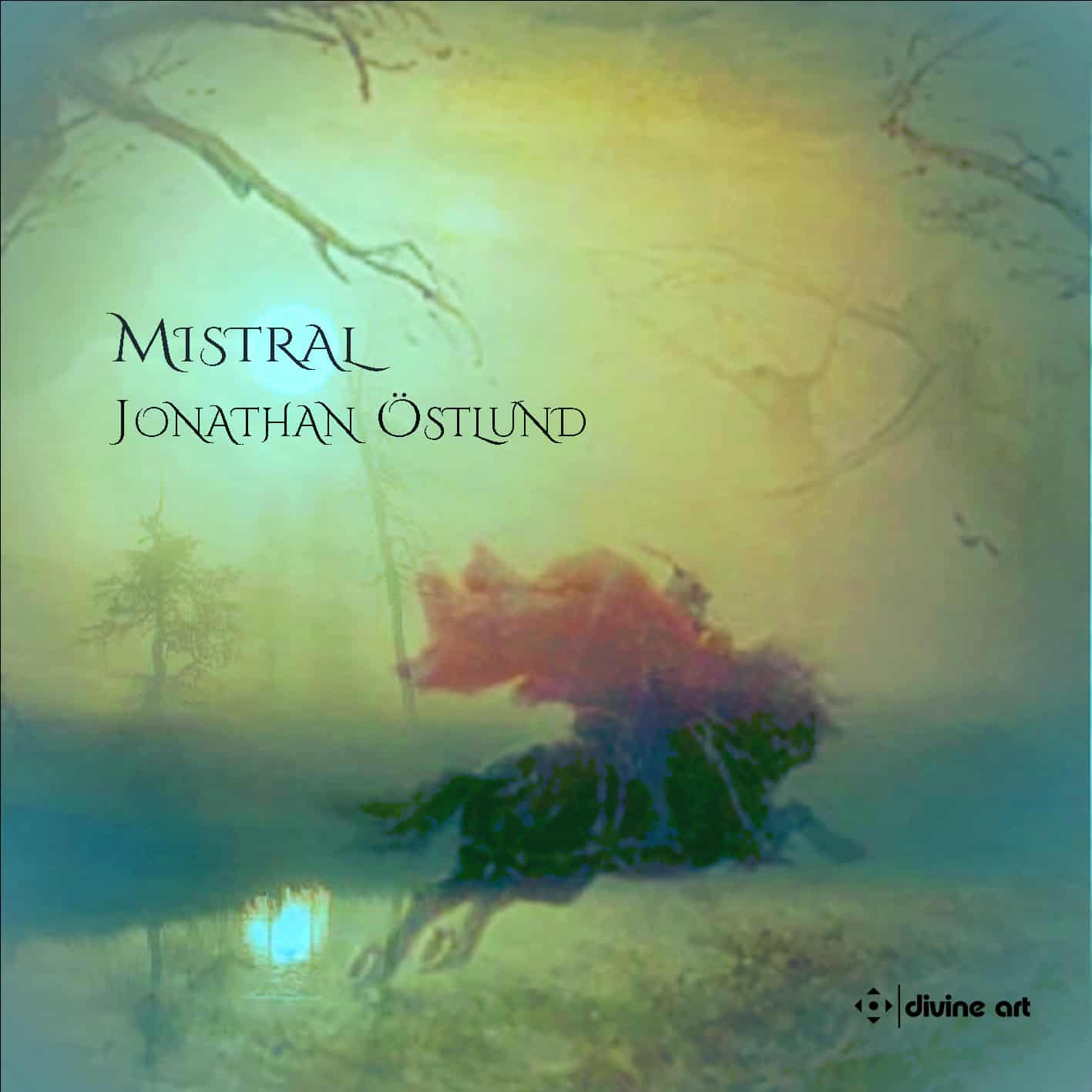
In one year, two new albums have been introduced with the music of the contemporary Swedish composer Jonathan Östlund: 2019’s double CD Voyages and 2020’s Mistral elevate him to the status of the 21st century’s Debussy.
I have already written about Östlund in connection with the first album for the British-American label Divine Art Records, which was released under the name Lunaris in 2016 (here). Both new titles contain vocal works, solo instruments (including organ), chamber and orchestral works.
The brand new album Mistral (Divine Art DDA 25199) brings orchestral works to the fore to a greater extent than the previous recording, in addition to chamber compositions. And again there are top players, some of whom have already participated in the previous double album.
First in the program is the expressive Concerto for Violin and Symphony Orchestra (16:09) in three movements; the solo part is performed by Russian violinist Natalia Kovalevskaya, playing with the Moscow Bow Tie Orchestra; which is recruited from members of the Russian National Orchestra), and the conductor is the founder of the ensemble Vlad Podgoretsky. The first movement literally burns with passionate violins in dramatically tense and immersive phrases; orchestral pulsations intensify in a clash between folkloric motifs with post-romanticism and neoclassical expressionism. The slow central movement transforms all this into flowing material that flows like the magma of time. In the final part, an uncompromising monolithic sound, full of stormy emotion, bursts out.
The following song Aquarelle (7:55), performed by the Swedish Bergslagen Chamber Philharmonic Ensemble, is inspired by Debussy; its minimalism and references to Japanese music are bright and lyrical. The orchestral delicacy here, though quite short, is undoubtedly Morpheus Metamorphoses (6:23), the disturbing stream full of brass and wood is saturated with jazz elements, and a festive march rushes towards lyricism, then drama; it evokes the music of Shostakovich. This is followed by Paganini Fantasia, a brilliant variation on ‘Capriccio No. 24’, masterfully grasped by British-Swiss violinist Andreas Laake. In the two-part suite The Forgotten Garden (14:19), the composer was inspired by the verse of the Swedish poet Erik Axel Karlfeldt, recipient of the only posthumous Nobel Prize in literature (1931). Here atonal whips are fascinating from the beginning. In the first movement everything is dramatically and densely woven, rolling on a minimalist undercurrent. The second movement is lyrical, song-like, yet disturbed by the dramatic elements of enhanced tonality. Uncovering a lost memory? A secret? In any case, this is an extremely suggestive music in a stunning interpretation by the Verisimo Ensemble – Rachael Elizabeth Cohen (flute), Christine Elizabeth Hoerning (clarinet), Felix Foster (horn), Sydney Link (viola), Thomas Beard (cello), and Olivier Hebert-Bouchard (piano).
Nataly Grines and Evgheny Brakhman interpret the two movements of Légendes de La Mer for two grand pianos (12:57) with a breathtaking, immersive, moving, arching, ragged, sensuous and sensitive Lisztian turmoil. Then the charming impressionist flute of Myriam Hidber-Dickinson is heard in Saga (2:53). The diverse pieces in the collection culminate (in the strict sense of the word) with a sumptuous, emotionally charged performance of Nocturnia – Ethereal Night’s Ascendance (10:13), a composition for mixed chorus and orchestra, where the winds dominate in the grandeur of the distinct motif, which is refined above all by the strings, and the prominent brass. The dynamic phrases contain mystery, excited expectations, even fear, but then there is an eruption, a rebellion, and eventually an all-encompassing hope and faith wins. The piece climaxes with a triumphant choral section by a large mixed choir, singing verses by the Swedish poet, philosopher and liberal of the 19th century Eric Gustav Geijer.