English composer Robin Stevens earned composition degrees in his early 20s and then was struck by illness; it was nearly two decades before he could continue his compositional schooling, starting his PhD in Manchester University in 2007. Though crucial creative years were spent in other ways, a family bequest has allowed for his catalog to begin to be recorded. I must mention here that I feel tenderhearted towards the last line of his biography, as it certainly conjures up a vivid image of Mr Stevens and his (naturally) English sense of humor: “[He] enjoys current affairs, holds loquacious dinner parties, thrives on stimulating conversation, is a keen cyclist, preaches occasionally, and is currently trying to break the 23-minute barrier on his local Park Run.” The String Quintet in C minor gives you goosebumps before the one-minute mark is even reached, and Quartet 1 makes it its job to turn dissonance into its own harmonic language. Quartet 2, with movement titles like ‘God-Seeker’ and ’Arguer’ make me wonder if the listener is being taken on an autobiographical journey in these four movements that hit the soul in a powerful way. It is a pity that Stevens lost such a large chunk of his composing career, and I’m glad that these pieces are now brought into the public eye and ear.
Catalogue Connection: 25203
-
Robin Stevens String Quintet & Quartets | Fanfare
There is an enormous stylistic range between the pieces on this disc. The String Quintet is an early work, written when the Welsh composer Robin Stevens (b. 1958) was in his early 20s. Adding an extra player to the standard string quartet, it is a so-called cello quintet like Schubert’s late Quintet in C rather than a viola quintet like Mozart’s. Stevens revised it in 2018 for this recording, but the work retains its fairly conservative language. Stevens comments that revisiting the score revealed many unconscious references to early 20th-century music, including near-quotes. It reminded him of the possibly apocryphal words of an American tourist who, “on seeing Hamlet for the first time remarked, ‘Gee, I didn’t realize it was so full of quotations!’”
In terms of his overall development, Stevens finds the fingerprints of his later style in the Quintet: “Beethovenian motivic development; rhapsodic, modal lyricism; bold, dramatic gestures; tangy harmonies; intricate counterpoint; and unashamedly direct, open-hearted expression.” Besides Beethoven I would add that Stevens must have known Schubert’s Quintet, if nothing else for the colors possible from an ensemble with two cellos. The third movement of his score, Adagio non troppo, is particularly lovely, with a central fugue that is very skillfully written. The second movement Scherzo and the finale incorporate some jazzy elements and a good deal of dramatic thrust. Any listener who is comfortable with the music of Bartók, Prokofiev, or Stravinsky is likely to find this quintet appealing.
From the beginning of String Quartet No. 1, composed in 2008, we are in a very different sound world. Stevens had suffered a debilitating illness that he does not name (an online bio refers to it as post-viral fatigue), and between 1991 and 2007 he was only able to write a few “experimental miniatures.” Regaining his full health in 2007, he began composing in what he calls a “contemporary classical idiom.” Some of the lyricism evident in the Quintet is still on display here, but it is heard in the context of a much denser style and a much more dissonant harmonic language. This work is in a single half-hour movement, and the overall impression left behind is one of severity, and relatively unrelieved severity at that.
The Second String Quartet, composed in 2011, is in three movements and an Epilogue but at 15 minutes is less than half the length of the First. Its title, “Three Portraits,” refers to personality characteristics that Stevens is depicting, not specific people. The three are “Impulsive One,” “God-Seeker,” and “Arguer.” There is a much greater variety of mood and color here than in the First Quartet. Stevens writes that we “could regard the three characters … as different members of the same family: distinctive individuals, yes, but with an overarching family resemblance, expressed in musical terms by subtle thematic bonds between the three portraits.”
I found this work more gratifying than the First Quartet. The character types are depicted clearly in the music with wit and affection. There is a playfulness to the “Impulsive One,” and quick mood changes abound. The “God-Seeker” is the movement with the strongest sense of melody. A lovely brief chorale is heard and then treated in variation form. Delicate, even ethereal, textures dominate. A very loud pizzicato chord takes us directly into the third movement, “Arguer.” Very strong dance-like rhythms interplay—the four instruments each appear to want to go in their own direction. A hushed ending leads into the brief Epilogue, a touching movement that brings peace and reconciliation to the fore.
The outstanding performances are by the Behn Quartet (an ensemble consisting of players from England, the Netherlands, Portugal, and New Zealand), which is in residence at the Royal Birmingham Conservatoire. They are clearly committed to the music; nothing here has the feeling of note-reading. They (and cellist Botbol in the Quintet) have absorbed Stevens’s style and believe in it. I can recommend this release to adventurous listeners interested in chamber music being composed today. For myself, I found much to enjoy in the Quintet and Second Quartet, but the austerity of the First Quartet was something to which I could not relate. Excellent notes from the composer comprise the accompanying booklet, and the recorded sound is very well balanced and clean.
-
Stevens Quartets: Whole Note review
Another British composer whose name and music seem new to me is represented on Robin Stevens String Quartets & String Quintet, with the Behn Quartet and cellist Timothée Botbol).
For Stevens (b.1958), the String Quintet in C Minor from 1980-81 was his first major composition, revised in 2018 for this recording. It features lush melodic writing with a truly lovely slow movement. As the composer notes, “unconscious references to, and near-quotes from, 20th-century music abound.”
In his early 30s Stevens was stricken with post-viral fatigue, a debilitating illness that kept him out of work for 17 years and limited his compositional activity to experimental miniatures. On regaining full health in 2007 he began a PhD in Composition, producing a major work in each of his six post-graduate years. The single-movement String Quartet No.1 uses “a handful of ideas, which are subjected to contrapuntal development of considerable complexity” in a work of “unremittingly dissonant harmonic language.” The String Quartet No.2, “Three Portraits” has three continuous sections – Impulsive One, God-Seeker and Arguer – followed by a brief Epilogue. A bequest has enabled Stevens to begin recording his considerable catalogue of works; if future performances are of the same high quality as these then his music will certainly be well served.
-
Robin Stevens Quartets – BMS review
The first two Quartets and the String Quintet by Robin Stevens (b. 1958) are performed with energy and clarity by the all-woman Behn Quartet, joined by Swiss cellist Timothée Botbol as additional cellist for the Quintet.
They are named after Aphra Behn, a seventeenth-century writer and feminist activist, and one of the first Englishwomen to earn a living from her writing.
The String Quintet comes first on the CD. It was composed between 1980 and 81 but revised in 2018. The First Quartet was composed in 2008, the second in 2011. All three works are remarkably different but there are certain elements that unify them.
The Quintet lies well within the bounds of tonal English music. It opens with an attractive pastoral melody on cello suggesting folk roots. This tune, and its melodic and harmonic basis, runs through the first movement, although the development section gives a hint of what was to come in the two Quartets.
Its atmosphere is present too in the other movements such as the dance-like Scherzo. This is an unusual movement in that the Trio section is not entirely separate from the scherzo.
The third slow movement has a lyrical feel while the Finale has muscular melodic music. It is more modernist and receives an incisive and precise performance from the players.
The First Quartet is not entirely atonal but lies on the outer reaches of tonality. The performers use less vibrato in their performance. Although it is listed as being in a single movement, there are many contrasting sections, some shorter, some longer, with pauses between them.
Some are scherzo-like, others slower and more lyrical. There are strong contrasts in string texture as well as harmonic against contrapuntal writing.
The Second Quartet is half as long. It has four movements including an eighty-nine second Epilogue. This is the only work with extra-musical inspiration. ‘Impulsive One’ is hard-driven. It opens with a violent ‘scratchy’ chord. ‘God-Seeker’ is slower with ethereal passages. ‘Arguer’ is energetic and dance-like with crucial use of pizzicato.
The CD takes us on a fascinating ride across this composer’s life and musical development.
-
MusicWeb review Robin Stevens String Quartets and Quintet
I recently reviewed a CD of Robin Stevens’s music for wind ensemble. I noted that his compositions were a subtle and effective fusion of traditional musical language and a more modernist voice. It is good to have the opportunity to listen to three important chamber works for string ensemble, written over a 30-year period. I am beholden to the composer for the liner notes, which helped develop my thoughts.
The earliest work on this CD is the two-cello String Quintet, written in 1980-1981. This was Stevens’s first major composition. The work was revised some 37 years later in preparation for this recording. An almost pastoral introduction leads into the main Allegro molto moderato, effectively written in the good old-fashioned sonata form. The progress of this music ranges far and wide from the introduction. There is excitement, but typically this is quite relaxed music that concludes with some fetching recollections of the opening theme. The scherzo is vibrant and jazzy in its effect, although the trio section is more reserved. This movement leads quietly into the adagio which cleverly juxtaposes music that is bluesy, sometimes deeply moving, and an anything-but-academic fugue based on a motif derived from the movement’s opening idea. It is an impressive structure. The finale once again uses the modified sonata form to present contrasting themes designed to bring this remarkable and absorbing Quintet to a conclusion. Interestingly, the composer writes that this early score made numerous references to early 20th century music, but also included several fingerprints that were to characterise his mature style. It is not necessary to hunt them down.
The lengthy String Quartet No. 1 was written after Stevens recovered from a long illness. It is stylistically more advanced than the early Quintet. The composer writes that he sought coherence by using a limited number of musical ideas. These have been subject to complex contrapuntal development. The harmonic language is deliberately acerbic, with considerable use of dissonant intervals rather than concords. The progress of the quartet is dominated by slow and fast sections succeeding each other. Lyrical music does abound in this work but tends to be confined to individual instruments rather than complete segments of the work. In the rapid portions, instruments often play diverse dynamics and signatures to the remainder of the ensemble. This leads to a sense of dislocation and alienation. In the Quartet’s coda, the musical texture seems to be simplified, with a welcome, if surprising, unison section. The work ends dramatically.. It is a work to be relished, despite its modernist aesthetic.
The final essay on this CD is the String Quartet No. 2 subtitled ‘Three Portraits’. The ethos of this work is effectively three character studies followed by a short epilogue. These three traits are Impulsive One, God-Seeker and Arguer. They are imagined as belonging to a family group. Once again, I think that Stevens has sought to create a work that is inspired by unity in diversity. This means that each movement is quite definitely individual in its aspect but is tied together by familial bonds. These qualities are well represented in each movement. The rapid impulsive music balances hyperactivity with moments of silence: mood changes are unexpected and dramatic. Dance music and abrasive harmonic structures are capriciously juxtaposed. God-Seeker, on the other hand, is slower and more meditative. The music is based by a chorale heard at the start. This is worked out as a set of variations. The Arguer movement is dominated by dance music rather than naked aggression. Contrapuntal devices are used extensively here. The Epilogue draws all three characters together. This is, after all, one big, if not always happy family. The God-Seeker seems to have the final word in these thoughtful bars.
Robin Stevens was born in Wales in 1958. He studied at Dartington College, the Royal Northern College of Music and finally at Manchester and Birmingham Universities. At the end of his education, he was appointed Musical Director and Pastoral Worker at St Paul’s Church, York. For three years he was Head of Music at a comprehensive school on the West Riding of Yorkshire. Sadly, he suffered a debilitating illness which meant that he could not work full-time for many years. Restored to health, Stevens prepared for his PhD in Composition at Manchester University. It consisted of several large-scale musical works composed in a contemporary idiom.
The Behn Quartet (with Timothée Botbol on cello in the Quintet) play these exceptionally interesting chamber works creatively and satisfyingly. I cannot fault the excellent, clear sound quality of this disc. The liner notes, as I noted, are most helpful and ought to be read. There are the usual biographies of the composer and performers. The pulsating sleeve art, The Turbulents by Iain Andrews, is a unique take on much of the music on this CD.
This is a splendid recording, enjoyable from the first note to last. The music is well-written, often profound and always interesting. Robin Stevens’s style is characterised by “Beethovenian motivic development; rhapsodic, modal lyricism; bold, dramatic gestures; tangy harmonies; intricate counterpoint; and unashamedly direct, open-hearted expression”. It is a fascinating and essential mix.
-
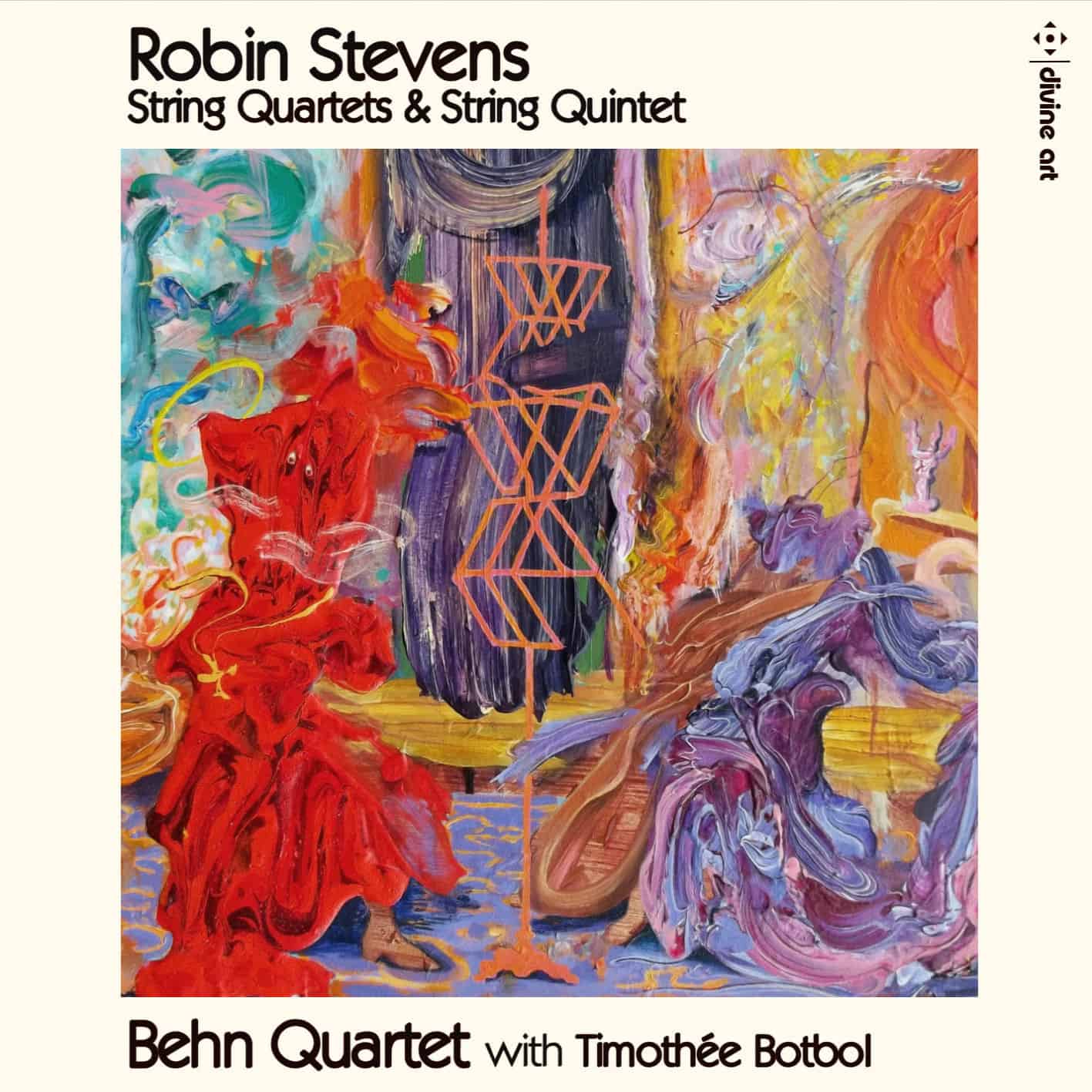
Robin Stevens: String Quartets and String Quintet
The British composer Robin Stevens is a great talent waiting to be discovered by the global music community. His varied, stimulating and expressive work arises from many influences – from the music of the Romantic era, to mathematics, his faith, and the influence of his main teacher in undergraduate days, John Joubert, and he is now producing substantial works for varied instrumental groupings, which are modernist and original, but yet immediately accessible.
This album contains the premiere recording of the String Quintet, an early work from his student days, rich in allusions to early 20th century works, but already containing many of the elements of his later work: tangy harmonies, intricate counterpoint, modal lyricism and often almost neo-Romantic expression. Above all the works are a reflection of the composer and his perceptions of the word and the people around him, yet at the same time universal in their appeal.
The two quartets are very different. The first was written in 2008 after the composer had recovered from a 17-year debilitating illness and while his style was developing considerably as he undertook his Doctorate. Its single movement is rich in variety, using a small few thematic ideas in constantly evolving forms. The second, from 2011, is a study of three character types (not necessarily real individuals) which are each distinctive but clearly related.