Catalogue Connection: 25204

  • Froberger: Fantasias & Canzonas. H&F review

    Terence Charlston’s latest recording was inspired by an interesting new instrument, as were his fairly recent ‘Mersenne’s Clavichord’ and ‘The Harmonious Thuringian’, which used a copy of a small harpsichord in the Eisanach Bachhaus. For the Froberger recording the inspiration was Andreas Hermert’s 2009 reconstruction of the original state of a much-altered 17th century German clavichord. Charlston writes that when he first saw and played this instrument he ‘was immediately smitten’; he felt that it was the ideal instrument for Froberger, especially the contrapuntal music.

    This CD is the first recording on clavichord of the complete fantasias and canzonas. All but one of the pieces (a two-part fantasia) are four-part fugues from Froberger’s Libro Secondo of 1649; a presentation copy, the music beautifully written out by Froberger, with fanciful calligraphic decorations by the court scribe. The recording aims to reproduce, as far as possible, what the performer hears, including some quiet action noise. The clear and transparent sound of this clavichord focuses our attention on the interplay of the musical lines. The canzonas are in general more lively than the fantasias, but in all these pieces there is a great variety of mood and structure, and inventive transformations and variations of the themes. Charlston is a very fine clavichordist, sensitive to the nuances of the music and the character of the clavichord; it sings in the fantasias, and it sings and dances in the canzonas. Some ornamentation is added, and the structure of each piece is made clear. Charlston;s depp understanding of the music is manifest, and in all respects this is an extremely fine recording, strongly recommended.  The 20-page CD booklet is full of useful information and insights.

  • Froberger on Clavichord: Consort review

    Terence Charlston is surely one of England’s most modest virtuosi, whose reputation among his fellow musicians is extremely high. Over the last few years he has explored, and offered us recordings of, less familiar repertoire, performing on a range of copies of old instruments, two being clavichords of early design. Terence admits to having been drawn increasingly towards the clavichord, pointing out that it offers subtleties of expression unique among keyboard instruments. This, together with the difficulty involved in playing it well, led it, like the lute in seventeenth-century France, to be considered among the greatest of all instruments. I am reminded of another fine player from a different age: between the two World Wars, Violet Gordon Woodhouse also moved from harpsichord performance to a preference for the clavichord, finally using it almost exclusively for early repertoire.

    Charlston’s recording of early – some very early – French music, using a clavichord built by Peter Bavington, to a design based on an illustration from a French treatise by Mersenne dating from the first half of the seventeenth century, was highly praised. Bavington’s clavichord, which had an unusually deep case and several separate bridges, produced an extremely satisfying sound, akin to that of a lute. Considering the date and provenance of that model, it may be at first surprising that the same clavichord did not appear again on this new CD. The historical match, and its soulful and often beautiful sound would arguably have suited the music of Froberger (1616-67) very well, but the repertoire is in fact very different. This CD contains exclusively contrapuntal music from Froberger’s second book of 1649. These pieces, unlike his works inspired by contact with French musicians during a stay in Paris, owe more to his time studying with Frescobaldi in Rome, not long before that master’s death in 1643.

    Charlston therefore employs a very different clavichord for this CD. The German maker Andreas Hermert has taken an original unplayable instrument in the Berlin collection and reconstructed it to its original design, omitting later changes (including the fitting of extra treble frets to allow easier articulation). The ‘copy’ is a very handsome instrument, which the maker believes to be from the late seventeenth century – but with ‘features of older building traditions’. The most telling of these may be two triangular cut-offs within the rectangular case, at each rear corner. Possibly a coincidence, and certainly adding elegance, these result in a marked similarity to the plan of the Mersenne clavichord mentioned above.

    Apart from this, though, the new instrument (the original is thought to be south-German) is radically different: the case is very shallow; there is a single bridge, which has a possibly unique severe ‘hook’ to the bass end (assuming this is not a whim of the maker). For a fretted clavichord, the case is unusually extended to the right of the keys, reminiscent of less severely fretted instruments by Hubert, around a century later. This allows for particularly long bass strings and a larger than normal soundboard.

    The compass is chromatic C to c”’, minus bottom C sharp, although I suspect the tuning was revised to give a short octave from C/E, since some points within the recorded repertoire are unplayable on a chromatic bass. Taking these factors into account, I wonder whether, although the pitch of the copy is a = 466, the instrument might date from as late as the early eighteenth century. In the Germanic countries, as the Museum of Musical Instruments of Leipzig university dramatically illustrates, this type of clavichord was very popular for at least a hundred years, disappearing only shortly before 1800.

    Musically, the contrast between the two clavichords is dramatic. The clarity and variety of tone from the different areas of the compass and, as Charlston points out, the unusual dynamic flexibility, are undeniable. His own response was that the instrument cried out for the performance of Froberger. This is an instrument well worth hearing, and these qualities are all exploited by the player – at times almost to excess, if one has any pre-conceived ideas about how contrapuntal pieces should sound. But for those who enjoy the effect of contrapuntal lines overlapping and weaving a sonorous texture, the lack of sustain sound from this clavichord will be a problem.

    Players can see (or imagine) the score, so that a note which has physically ‘died’ can still be heard in the head. For those who are simply listeners, the effect of hearing, for the most part, only the start of a note, can be frustrating. The treble of the instrument (as is normal) is particularly short-lived. In brief, this is an instrument which is difficult to play, and which requires effort too, on the part of the listener, except when the music is heard in small quantities which, with this restricted repertoire, is surely appropriate.

    For anyone attracted to this CD, the towering figure of Jacob Froberger needs no introduction. Froberger designed his three books to contain balanced sets of every type of keyboard music popular in his day, and the booklet provides an informative introduction to his life and work. More useful to the student and even the seasoned professional is an essay on the music selected. This is deep and well-researched, concerned with sources, compositional techniques and styles; it includes a detailed commentary on each piece. Especially for those who play this music (and I can vouch for how enjoyable and satisfying this is), these scholarly insights can enhance understanding, and reveal not only the depth of scholarship possessed by Charlston himself, but what extra unnoticed pleasures this music has to offer.

    Some of the Fantasias, which are played first, in order, display an entertaining feature shared with composers such as Orlando Gibbons, of beginning with grave, slow music which accelerates to an exciting conclusion through a reduction in note-values. The canzonas which follow are livelier pieces which incorporate toccata-like free material; they anticipate the praeludia of Buxtehude, and the early toccatas of J. S. Bach. In general, I found the canzonas more satisfying: they employ, on the whole, a livelier pace and shorter note values than the fantasias, and the decay of the instrument’s sound seemed to match more naturally the space which the brain was expecting each note to occupy. 

    Playing counterpoint on a clavichord is much more difficult than on a harpsichord. On a fretted instrument it is harder again, as only some suspensions are possible. This obliges players to avoid legato: any emphasis of a line or gesture that employs legato is impossible. A good player can, nevertheless, achieve a clean, disciplined presentation of contrapuntal textures. I vividly remember the late Christopher Kite performing Bach’s Well-tempered Clavier on a fretted clavichord. The technical achievement was remarkable but, inevitably, the effect was more academic than emotionally rewarding.

    In this case, Charlston’s approach is seldom neutral. He is an expressive player, keen to communicate more than the intellectual satisfaction of neat counterpoint. He is therefore ready to exploit the dynamic capacity of this little instrument by, for example, diminuendos at cadences, subtle accents, and even an instinctive dynamic reinforcement of fugal entries, akin to that which today’s audience has come to expect from pianists playing Bach, but seldom from early keyboard specialists playing seventeenth-century counterpoint. It is, as Terence Charlston observes, possible with the clavichord, to hear this music in new and refreshing ways.
  • Froberger on Clavichord | Fanfare

    The keyboard works of Johann Jakob Froberger are no strangers to the world of Baroque music. Like his Italian counterpart, Girolamo Frescobaldi, he enjoyed a reputation for enhancing the keyboard literature of his time. Most of his works have been recorded on the harpsichord, and the toccatas and partitas, with their importance in the development of German organ music, on that particular instrument. Here, keyboardist Terence Charlston has chosen to record the set of fantasias and canzonas on a clavichord. As one might note, this is an extremely intimate instrument, meant largely for in-home performances, as it has the resonance of library silence. That is not to say that the instrument is not versatile, but it was generally used by composers up through the Classical period as a means of trying out their works or performances where the chambers were quite small.

    Since these have been recorded quite frequently before, little needs to be said about the music itself. The fantasias are finely crafted pieces, with only the first, based upon a hexachord scale, lasting for a length of time. Charlston has chosen this instrument as a means of demonstrating that Froberger’s works are eminently adaptable to this more controlled private instrument. In a sense, he has succeeded, though throughout the action that often elicits a more sonorous rendition is reduced to a more cautious approach. The notes are played as if the music minces right along, and this is primarily the result of the instrument itself. Charlston notes that it “creates a new and very different aural experience,” which could apply not just to Froberger, but any other keyboard composition of this period. I recall early attempts to perform Emmanuel Bach’s fantasias on the clavichord, and these were rather less successful without some extreme microphone enhancements of the duller sound of the instrument. The same can be said for this disc.

    On one hand this is good to have, as the clavichord was an important household instrument of the time, and certainly Froberger’s music would have been performed on it as the occasions presented. Likewise, Charlton’s execution of these works is quite deft, if a bit on the cautious side. For most, however, unless you want to hear these often complex works on a soft, non-resonant instrument as a documentary performance, this disc probably won’t be appealing.

  • Froberger Fantasias and Canzonas review

    Froberger may have come to be less neglected than he once was, with Thurst­on Dart’s 1961 recording (also on clavi­chord) and the recent quatercentenary in 2016 being significant fillips, but it is a contention of this recording project that this revival has often taken place rather unevenly and incompletely. The toccatas and suites, and above all the occasional pieces (the laments, the tombeau, the programmatic works) with their clear emotional pointers, have all been widely programmed and recorded:, but the contrapuntal works, roughly equal in number to the others and certainly given equal prominence in the autograph manuscripts, have been largely avoided. It is as if many performers want to mix the cocktails and pour out the spirits, but are wary of decanting the fine wine that comes in between.

    Six of the eight fantasias and all six of the canzonas were gathered by Froberger himself in his sumptuous Libro Secondo of 1649 (the Libro Primo was lost, so this is some of the earliest music we have by Froberger), where they are presented after the six toccatas and before the six suites — to stand as the heart of the matter. Superficially similar examples of their respective conventional forms (one reason for their relative neglect?), they embody in fact a diverse range of treat­ment — perhaps, with the later ricercars and capriccios, the fullest and profoundest compendium of keyboard counterpoint before J.S. Bach.

    Terence Charlston has chosen for this recording a most unusual clavichord, reconstructed by Andreas Hermert as a posited earlier state of an anonymous fretted clavichord surviving in the Berlin Musical Instrument Museum (MIM2160). Its sound and capabilities are remarkably well-suited to Froberger’s textures, and fully capable of doing justice to both intricacy and a continuing sense of line, across a spectrum of tempi limited here only by the exclusion of extremes. It can sing and it can dance; its colours can match the wide range of affect within these pieces, and any worry that a disc like this might become monotonous is repeatedly dispelled by the trio Froberger-Hermert-Charlston.

    The playing is exemplary in its avoid­ance of anything either doctrinaire or gratuitous. Each piece is taken on its own terms, grounded in deep and patient understanding of its characteristics. Some are presented almost literally, with little added ornamentation, while in others embellishment is given freer rein, but never so as to impose anything alien. The execution of written-out ornaments frequently stays very close to the notation, as if to trust that Froberger knew what he was writing — not always the impression that performers give. (Perhaps Froberger’s famous reluctance to share his manu­scripts with other musicians stemmed less from a belief that they wouldn’t know how to vary and embellish his music, but that they would do so too much.)

    One of the most delightful features of this recording is the treatment of the ends of the canzonas. Here Froberger frequently allows the boughs of his polyphony to blossom into something like the stylus phantasticus of the toccatas. It is possible here for a player to be seduced by the sense of freedom into losing contact with what has gone before, and a particular challenge of presenting all of these pieces side by side must be that any personal formulae or mannerisms would become starkly apparent. Terence Charlston deftly and gracefully adds just what is needed, presenting what Froberger gave us with just enough spontaneity to make the experience a constantly refreshing one. This is very fine playing, beautifully recorded in the Royal College of Music Studios, and anyone who knows that music is a matter neither of the head nor of the heart alone deserves to listen to it.

  • Froberger Fantasias and Canzonas | The Whole Note

    So rarely does it happen that performer, composer, instrument and instrument maker(!) equitably join in artistic synthesis. This new record, featuring period instrument specialist Terence Charlston, is a fine specimen of expertise and craftsmanship, with each of the above components keenly harmonized.

    Today, there remain aspects of Johann Jacob Froberger’s art that are unknown to the public at large. The Middle Baroque composer’s contrapuntal works, in particular, are relegated to small circles of listeners and scholars – neglected, despite their ingenuity. Charlston understands this all too well. He looks not only to the impressive compendium, the Libro Secondo (an autograph manuscript dating from 1649), but to a fitting choice of instrument: a copy of a South German clavichord, the MIM 2160, as reconstructed by contemporary keyboard maker, Andreas Hermert.

    Charlston has chosen this instrument for its timbral possibilities and expressive range, even citing a lute-like tonal profile. Infamous for pianissimo playing, the clavichord in general has long been commended for its intimate, (even private) character, lyrical and sensitive in its response to the player’s touch. Bemusingly, it even boasts vibrato, of a kind.

    But not a single note of this disc ever sounds too private or too furtive. In the hands of Charlston, his clavichord soars and expands before our very ears. Through this incantation of counterpoint, in turns both exotic and familiar, Charlston reveals a depth of humanity on par with the great polyphonic achievements of J.S. Bach.

  • American Record Guide review: Froberger on Clavichord

    There are 8 fantasias and 6 canzonas from Froberger’s 1649 book. The first Fantasia, Ut Re Mi Fa Sol La (the rising scale), was pub­lished by Athanasius Kircher in his gigantic Musurgia Universalis, 1650, presenting it as an expert composition.

    Charlston’s delivery is mostly calm and undemonstrative, letting listeners find our own ways through these contrapuntal pieces. It’s persuasive, emphasizing the noble dignity and intellectual rigor of the compositions. Charlston is a terrific clavichordist. His con­trol of this difficult instrument is as good here as it was in his CD from a few years ago (“Mersenne’s Clavichord”).

    Only two pieces are available in a compet­ing recording on clavichord by Johannes Bogner Fantasia 4 on Sol La Re, and Canzona 6. Bogner played both of these pieces much faster than Charlston, and with more volatility of expression—making them sound more passionate. Both these comple­mentary interpretations work well. Charles­ton’s tuning is meantone, and Bogner’s is less extreme in its inequality.

    Bob van Asperen played all of these piec­es on organ in Volume 5 of his complete set of Froberger’s music. I’m not fond of his registrations or the intonation of that organ. Richard Egarr on Globe (36 years ago) switched between an organ and two harpsichords to bring out different characters of these pieces. Other performers mostly skip over these pieces, typically selecting only a few of them in mixed programs in favor of the Suites and Toccatas. So, getting all of these together on a single CD is most welcome, and this is the only way to hear them all recorded on clavichord.

  • Froberger Fantasias and Canzonas Early Music Review

    I had not heard Froberger played on a clavichord before and wondered how it might work, but in the capable hands of Terence Charlston this recording is a resounding success. While one might miss the variety of registrations possible on the organ, letting the player build up the texture in successive sections, the clavichord compensates by allowing for subtle dynamic differences and providing the ability to hear individual voices clearly.

    Charlston plays on a copy of a South German fretted clavichord from c. 1700, in its putative original configuration, by Andreas Hermert; this is reasonably close to the time of the composition of the music and provides Charlston with what he thinks is the ideal clavichord for the job. The instrument is well recorded, with just a small amount of instrument noise to give it a ‘live’ feel. He concentrates on the fantasias and canzonas from Froberger’s 1649 manuscript, which bridge the gap nicely between the ricercars and canzonas of Frescobaldi and the contrapuntal music of Bach. Both genres are sectional, showing off Froberger’s remarkable ability to create extended pieces out of minimal material, varying the metre while keeping a steady tactus, something Charlston brings out very successfully. He uses subtle ornamentation to keep the sound going, including the vibrato-like Bebung which also changes the pitch slightly. He exploits the unequal semitones of his mean-tone temperament in a number of pieces with chromatic subjects. Sleeve notes are very informative.

    Charlston’s joy in bringing this music to life shines through and I can strongly recommend this recording.

  • Froberger Fantasias and Canzonas – Chronicle Review

    This is a programme for people who like early music, authentic sounds — and clavichords, of course. The clavichord seems to be a cross between a harp and piano; Wikipedia says Elizabeth of York, queen of Henry VII, bought one in 1502. The instrument was popular from the 16th century to the 18th century, particularly in German speaking lands, Scandinavia, and the Iberian Peninsula. It had fallen out of use by 1850. Charlston writes in the sleeve notes that he discovered the clavichord used in this recording, a reconstruction of a south German clavichord now in the Berlin Musical Instrument Museum, by chance. It was made by Andreas Hermert in 2009. Charlston writes: “I was immediately smitten by its remarkable sound, fine decoration, tiny but very responsive keys and action, and its overall clarity and excellent musical response.”

    Its maker loaned it to him and he spent a year experimenting with repertoire and playing techniques. Of Froberger’s work, Charlston writes: “A recording on clavichord was clearly needed but until recently I had not come across an instrument which I felt was equal to the task.” He explains that a clavichord has a small sound and isn’t really a concert instrument, more for practice, but the player can control the dynamic of each note by varying the force and speed of their touch and alter the sounding string after its initiation by changing the pressure on the key. The player can even raise the pitch. If this all gets you excited, read no further because we have little to say about the actual playing. The instrument is small and delicate in sound. Unlike other instruments the notes don’t seem to hold so it’s either crisp or shortlived depending on your feeling about these things. This means, we presume, that the player has to be fairly dexterous to keep the notes coming, as any silences are going to be abrupt and obvious. There are six fantasias and six canzonas and the CD lasts about an hour. As befits an enthusiast who loves what he’s doing, Charlston explains the music in full and even Herr Hermert gets a page or two to explain what he does. This is a quiet backwater of classical music, but one in which all those who wash up there have a thoroughly good time.

  • Froberger Fantasias and Canzonas – Gapplegate review

    After a near lifetime of intensive listening I nonetheless have known next to nothing of Johann Jacob Froberger (1616-1667). Until now. A new CD gives us a lot of music, his Complete Fantasias and Canzonas (Divine Art dda25204). Terence Charlston brings nicely to us this abundant program from the aural point of view of a specially constructed period clavichord that gives out with a most distinctive tone. If it sounds more like a sewing machine than a harp that means one should try to open to its special sound and meet it halfway, so to speak. There is a tender fragility to the music as played on such an instrument–not so grand as it is modest, human, matter-of-fact and in-itself. And special to the time period concerned.

    Vivaldi was born in 1678, Handel and Bach in 1685, Rameau in 1683. We general consumers of classical music tend to know later Baroque masters more than earlier ones. This in part explains why Froberger (born in 1616) is not exactly a household name. True too is that the music we hear on this album does not proclaim itself as bold expression as much as the music of later Baroque masters did. Instead there is workmanship of a fine-hewed sort, of a quality that is best experienced cumulatively rather than climactically. And it is true in this that the music must be listened to with repetitive persistence, all the better to be able to gauge it more fully.

    This is very contrapuntal and one might characterize the music as tightly knit and phrased in a longer, wider sense more than going for a pinpointed thematic brilliance. It thrives in how all works together in the long term, with the themes more like a long meandering river than the spectacular thematic highlights we might sometimes expect from a Bach or Handel. It is not that the themes are without distinction, but they are geared to make the overall contrapuntal matrix the main thrust. For that the music is masterful, lucid in its heightening of the “structures of the long run” (to borrow a phrase from anthropologist Marshall Sahlins).

    In the end this is a carefully detailed reading of some gems from 1649, music that maintains high levels of contrapuntal brilliance as it gives an uncompromising vision of intimate chamber soundings some thirty years before the births of Handel and Bach. It is music any thorough explorer of Early Music should be happy to immerse self in. Good one! Take a listen.

  • New Classics review – Froberger

    German Baroque composer, keyboard virtuoso and organist Johann Jakob Froberger was born in 1616 in Stuttgart, where his father was court Kapellmeister. His family later moved to Vienna and Jacob later studied in Rome with Athanasius Kircher before travelling to Paris, where he became acquainted with composers such as Couperin and Gaultier. Froberger himself became one of the most famous composers of the era, even though only two of his many compositions were published during his lifetime.

    He is often credited as being the creator of the Baroque dance suite and he was among the first composers to focus equally on both harpsichord/clavichord and organ, blending Italian and French genres and techniques with quintessentially ‘German’ style music. He paved the way for J S Bach’s elaborate contributions to the genre and influenced almost every major composer in Europe, including Pachelbel, Buxtehude, Handel and Beethoven. His keyboard works are often played on harpsichord and some, like the suites, were specifically written for that instrument.

    On this new album is the first recording all 14 of his Canzonas and Fantasias, played on clavichord by Terence Charlston. These are amongst his most beautifully crafted yet most neglected works and survive together with toccatas and partitas in a meticulously written autograph manuscript, the Libro Secondo, dated 19 September 1649. The instrument used here is a reconstruction of a South German clavichord in the Berlin Musical Instrument Museum and it is ideal for the strongly contrapuntal music of J J Froberger. The clavichord is a small quiet instrument but does have a wide dynamic range and even variable vibrato, so is an extremely difficult instrument to master. Fortunately, Terence Charlston is one of the UK’s foremost exponents of early keyboard music as a soloist on organ, clavichord and harpsichord, and an international reputation as one of the leaders of this area of music.

    This is a welcome exploration of the work of a composer who has been called the Chopin of the seventeenth century – a ‘romantic’ composer even before the term had been invented.

  • Radio 3 Record Review Froberger

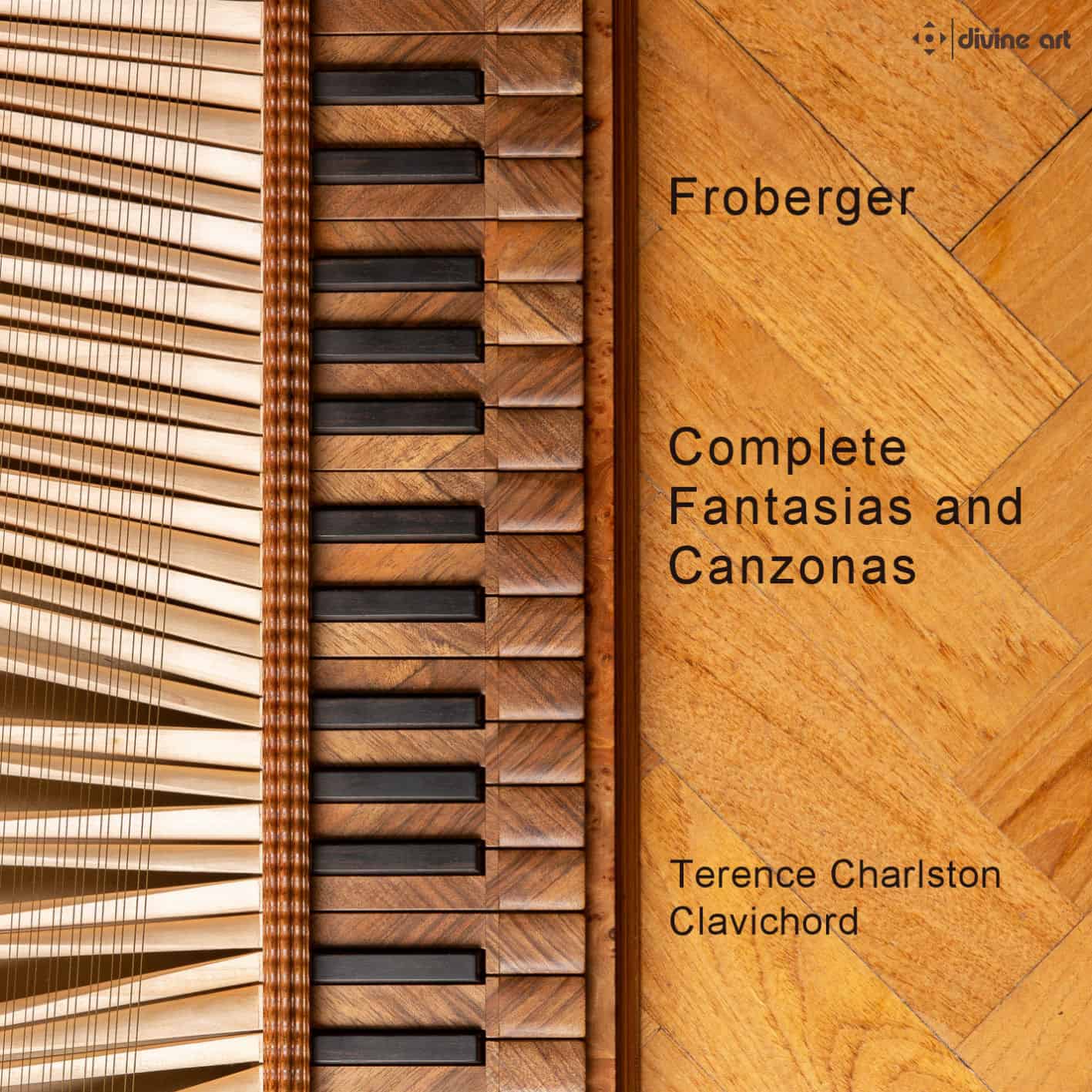
    The perfect way to hear Froberger’s outstanding keyboard music in new and refreshing ways. A deliciously intimate experience. Such a beautifully made and decorated keyboard instrument – I was seduced by the [CD] cover.

  • Froberger: Complete Fantasias and Canzonas

    Froberger: Complete Fantasias and Canzonas

    Johann Jacob FROBERGER (1616-1667)
    Froberger’s fantasias and canzonas are amongst his most beautifully crafted yet most neglected works. They survive together with toccatas and partitas in a meticulously written autograph manuscript, the Libro Secondo, dated 19 September 1649. This is the first recording of all 14 works on the clavichord. Froberger was a most important figure in the early baroque period, helping to develop the style of the ‘dance suite’ so well known from the later hands of Bach, Handel and so many more.

    The instrument used here is a reconstruction (2009, Andreas Hermet) of a South German clavichord which is in the Berlin Musical Instrument Museum. It is an ideal vehicle for the strongly contrapuntal music of Froberger. The clavichord is a small quiet instrument but does have a wide dynamic range and even variable vibrato – an extremely difficult instrument to master.

    Terence Charlston is one of the UK’s foremost exponents of early keyboard music both as a soloist on organ, clavichord and harpsichord, and as a chamber musician, having been a member of both the London Baroque and Florilegium. He has initiated many new editions and recordings of early music and has developed an international reputation as one of the leaders of this area of music.