Catalogue Connection: 25206

  • 20th Century Polish chamber music DDA 25206 – Musical Opinion

    This collection of chamber music provides snapshots of Polish music at thirty-year intervals from the turn of the last century to after World War II. Szymanowski (1882-1937) was Poland’s first major composer since Chopin. In his maturity he won many international awards and in recent years has been rightly recognised by prominent conductors as a major figure in twentieth century music. In 2007 the Polish government proclaimed ‘The Year of Karol Szymanowski’ to mark his anniversaries.  But this Violin and Piano Sonata is an early work from 1904 with little suggestion of the gorgeous extravagance of the later symphonies and concertos. All the same, it is a substantial three-movement piece with a Brahmsian continuity and it was popular in its day.  Unfortunately the recorded balance favours the piano.

    Andrzej Panufnik regarded his Piano Trio (1934) as his first serious composition. It came from his years at the Warsaw Conservatoire, a happy time of his life so different from the wartime and post-war horrors to come. The Trio, along with other manuscripts, was destroyed during the war and had to be recomposed later. The fascinating story of Panufnik’s background is in his book Composing Myself (1987), with an enlarged edition forthcoming. The Trio’s opening poco adagio has a great variety of texture with the instruments pairing up in unexpected ways. There are dissonant piano chords in a modernist atmosphere that avoids being derivative, and the second movement is a lyrical continuity followed by a light-hearted Presto that feels like a scherzo. Grazyna Bacewicz (1909-’69) was a professional violinist, also a pianist, and she wrote short stories and novels. As a composer she studied in Paris with Boulanger, the violin with Flesch, and achieved international composition awards in the 1950s and 60s. her large output includes seven violin concertos, seven string quartets and this is her fourth violin and piano sonata (1949). Unlike Panufnik, she stayed in Poland and her style is not too far out for the Stalinist regime, although she branched out in the 1960s along with many younger composers. Her violin and piano sonata is in four balanced movements. The andante has moments of intensity and the finale draws on folk influences. These are convincing performances mostly well recorded. [four and half stars]
  • 20th Century Polish Chamber Music: Fanfare review

    This is a superbly performed recital of chamber music from a stylistically conservative but highly original trio of Polish composers. 20th Century Polish Chamber Music opens with a youthful violin sonata by Karol Szymanowski (1882-1937), considered the greatest Polish composer after Chopin (and certainly the best known of these three). He is probably best known for his atmospheric Myths, for violin and piano, which is far more inward looking and ethereal than this exuberant sonata, which was written when the composer was just 20. The three-movement work from 1904 can best be described as Brahmsian; unabashedly emotional and sweeping in its impact, but without ever veering into sentimentality.

    Andrzej Panufnik’s early Piano Trio barely survived World War II, during which endless piles of musical scores were destroyed in air raids, fires, and in this case, the 1944 Warsaw Uprising. Panufnik (1914-1991) was able to recreate it from memory in 1945, and treated the work, which had been one of his earliest public successes in 1936, as a long-lost child that had been rediscovered. He continued to tinker with it, including for the 1977 revision that is heard here. It is a stellar work, bursting with youthful energy and high lyricism. The Largo is especially effective; compact yet deeply expressive. That characterization can be applied to the whole work, which clocks in at about fifteen minutes. This superb music deserves to enter the standard repertoire of piano trio music.

    Of the three Polish composers featured on this recital, Grazyna Bacewicz (1909-1969) is prob­ably the least well known, but her story is, for me, the most interesting. She was a complete musi­cian, in the Mozartian sense. She played piano and violin professionally as a young woman, often playing both instruments on the same program. She gave up public piano performance at age 20 but continued to play the violin until 1953. She also began composing at an early age, performing her own music by the age of 15. This violin sonata, premiered in 1949, fits in nicely with the companion music on this disc; it is firmly tonal, arguably neo-Romantic, but distinctive in voice and emotional spirit. I have also heard some of the solo piano music of Bacewicz (in live recital) and similarly found it to be both gripping and beautiful to behold.

    Chosen by Peter Burwasser of Fanfare in his 2021 Want List (top 5 albums of the year)

  • 2oth C. Polish Chamber Music: ARG review

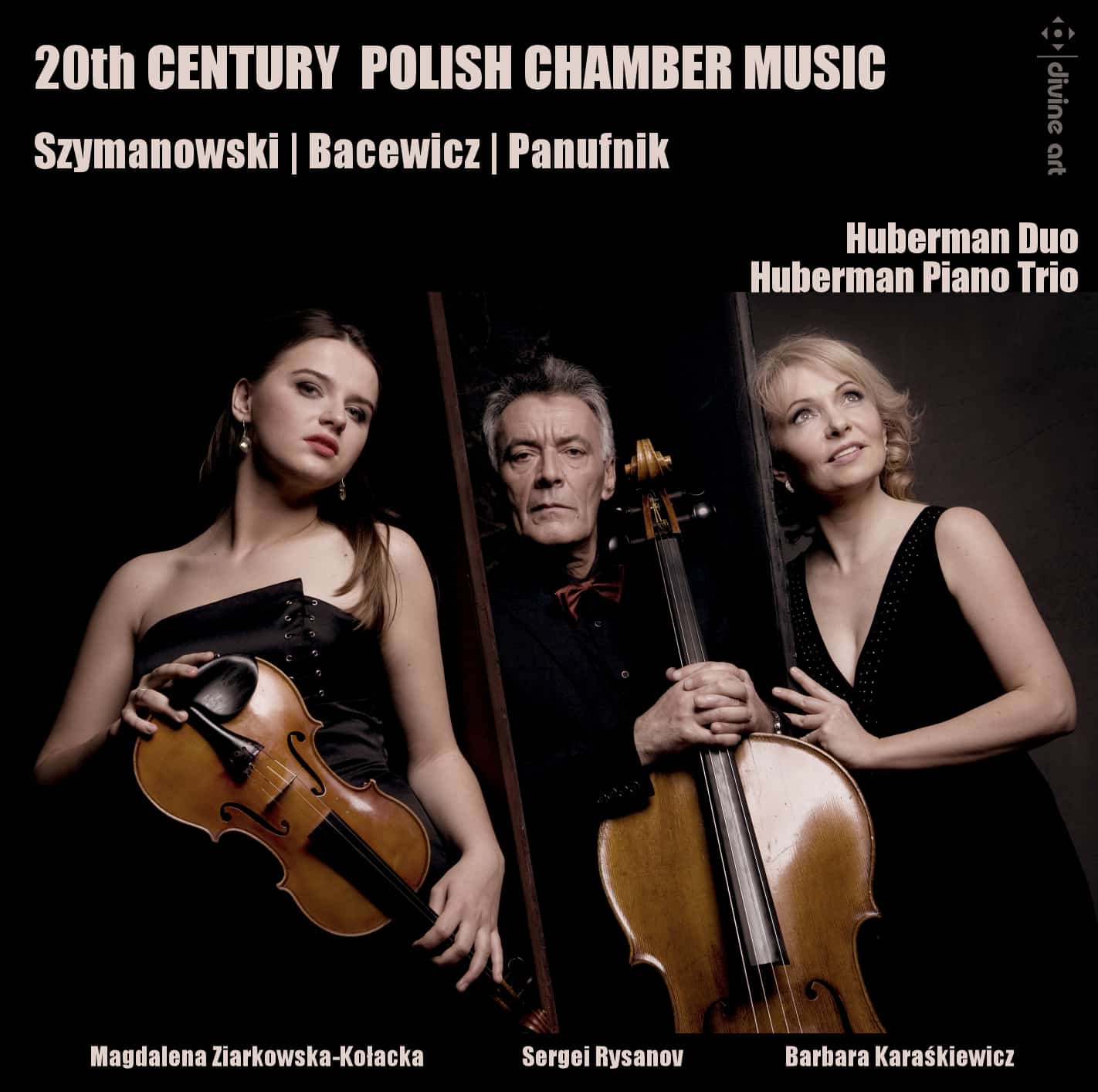
    The Huberman Trio is named after one of Poland’s greatest violinists, Bronislaw Huber­man (1882-1947). Violinist Magdalena Ziarkowska-Kolacka and pianist Barbara Karaskiewicz are joined by cellist Sergei Rysanov. Ziarkowska-Kolacka studied music at the Paderewski Academy of Music in Poznan and is deputy concertmaster of the Leopoldinum Orchestra in Wroclaw. She is writing her doctoral dissertation on Bronislaw Huberman. Karaskiewicz studied at the Karol Szymanows­ki Academy of Music in Katowice and the Fryderyk Chopin University of Music in Warsaw. Rysanov attended music conservatories in Baku and Moscow and is principal cellist of the Czestochowa Philharmonic. All three musicians are excellent and do full justice to the music.

    The best-known work here is Szymanows­ki’s (1882-1937) late-symbolist masterpiece, the Violin Sonata from 1904. This is one of the very best performances of it that I have heard, rivalling the accounts by David Oistrakh, Tasmin Little (Nov/Dec 2017), and Chee-Yun Kim (Sept/Oct 2020) and with better sound than the Oistrakh or Kim.

    Andrzej Panufnik (1914-91) and Grazyna Bacewicz (1909-69) were from the next gener­ation of Polish composers. Panufnik’s trio is late romantic with slightly modern harmonies scattered here and there. It is his Opus 1 and he wrote it when he was 20. Sometimes it has a slight air of foreboding and touches of the kind of sardonic humor that are common in the music of Soviet composers like Prokofieff and Shostakovich. The composer would later have to endure the same kind of bureaucratic oppression that his Soviet counterparts were subjected to.

    Bacewicz wrote her Violin Sonata 4 in 1949. It is in a similar late-romantic vein as Panufnik’s Trio with the same 20th Century Slavic sardonicism. It is remarkable how this style became popular when the authorities would probably have preferred a more opti­mistic, naive mood. Both the Trio and Sonata 4 are very fine works, but many may prefer the sunny optimism of Szymanowski’s Sonata, which was written before the skies of Europe had been clouded by two horrible wars and several oppressive regimes.

    Rysanov’s cello was made in Brescia around 1650 by Giouita Rodiani. Good sound.

  • Polish Chamber Music | Ruch Muzyczny

    I was delighted with Szymanowski’s sonata, not easy to convey, usually overloaded with performance effects. In the interpretation of Magdalena Ziarkowska-Kołacka and Barbara Karaśkiewicz, it emanates understanding and rhetorical depth. You can feel that Huberman Duo knows perfectly well how to present its material in performance, and knows, what this music tells about, without disclosing its literalness. It is a great art. In Panufnik’s Trio op. 1, Sergey Rysanov perfectly complements and supports both artists. The Huberman Piano Trio gives the impression of a well-coordinated band, and this piece determines the value of the entire album.

  • Polish Chamber Music | MusicWeb review

    Here, we are treated to three outstanding and, in the UK anyway, little-known performers tackling three fine works by their own countrymen, and a real opportunity to hear these pieces played to the highest standard; just the thing to allow you to ‘get your teeth’ into this somewhat rare repertoire.

    The only work, however, for all three is Panufnik’s Opus 1 his Piano Trio. In his autobiography ‘Composing Myself’ (Methuen, London 1987) he describes the work as “my first serious achievement”. The original score, first performed in 1936, was destroyed in the terrible Warsaw bombardment but he reconstructed it in 1945 and again, when living quietly in Twickenham, where I was pleased to meet him, in 1977; this is the version we hear. There are three movements but what especially struck me is the jazz influence. It was, surprisingly you might think, his discovery of jazz which enabled and inspired him to return to a musical training after he had been dismissed as “unmusical” when he was twelve! From the very first chord of the added 11th (I think that’s what I heard) and even on hearing the samba rhythms, it seems that jazz has been distilled into the whole work even including the short, elegiac Largo. There is some good work here for the cellist Sergei Rysanov. The dancing presto however seems to point to the composer of the future and the combination of the major and minor third within a chord, also heard in Jazz and Blues, becomes a Panufnik fingerprint.

    At the time that Panufnik was a student in Warsaw, Karol Szymanowski was a major influence on Polish musical life, although their compositional styles are so contrasting. Szymanowski’s Violin Sonata in D minor is an early work and is in a full-blooded Romantic style. In fact, the composer came really to resent its success and refused to play it years after, promising to write a second sonata but never living long enough to do so. Anyway, this one falls into three quite classical movements. The first, being the longest, is in sonata form but with a rather wayward recapitulation. The second is a real gem; it falls into three sections with the outer ones tugging on the heartstrings but with a middle section which is oddly spikey and pizzicato. The turbulent finale, marked ‘Allegro molto, quasi presto’, is again in an adapted sonata design and offers much virtuosity. Now, this proved to be my first encounter with this fine work so I cannot make any comparisons, but it seems to me that Violinist Magdalena Ziarkowska-Kolacka and pianist Barbara Karaskiewicz totally inhabit the piece and are aided by a brilliant recording.

    Grażyna Bacewicz was, as noted in Witold Paprocki’s ideal booklet essay, a fine performer both on the piano and violin from as early as seven. It is not surprising, then, that she composed five violin sonatas. This Sonata No 4 is considered the best of them. It falls into four movements and there is always a hint of the neo-classical style she cultivated in the 1930’s as in the First String Quartet, and of the folkloric style which came quite naturally to her and which the Polish authorities required in the years immediately following the Second World War, and which resulted in her receiving several state awards. One can detect modality and dance-like rhythms in the first and fourth movements mixed in with more complex harmonies and compound rhythms. In addition, it is very much a bravura piece and has some quite hair-raising passages for both performers. The third movement Scherzo described as “puppet-style”, is informed by both of these aspects, but the Andante second movement is expressive and at times, quite impassioned. The performance is magnificent and it is difficult to believe that it could be bettered.

    I have mentioned the booklet essay which is accompanied by black and white portrait photos of the composers and colour ones of the performers alongside the usual rather dull biographical information. The recordings have a close but rich and velvety quality. This is well worth investing in.

  • Polish Chamber Music: Infodad review

    Listeners can hear a new Divine Art recording featuring chamber works by three prominent Polish composers, performed by two or all three members of the Huberman Piano Trio. The best-known composer here is Karol Szymanowski (1882-1937), represented by his D Minor Sonata for Violin and Piano of 1904 – a work as youthful in its way as Mozart’s violin concertos are in theirs. The Szymanowski way in this earliest of his chamber compositions is clearly in the process of abandoning Romanticism and almost escaping traditional tonality. Cast in the traditional three movements (the second combining slow-movement and Scherzo elements), the sonata is front-weighted, the opening Allegro moderato full of violin expressiveness that never quite allows lyricism to enter the sound world. However, in the Andantino tranquillo e dolce, which begins in much the same mood in which the first movement concludes, there is a certain amount of genuine tranquility and perhaps even sweetness – although the chromaticism gives the material an edge, as do the pizzicato passages that are well-contrasted in this recording with the legato ones. The finale has some characteristics of perpetuum mobile and a variety of nervous-sounding tremolo effects that highlight the violin’s thorough dominance of the material – the piano is distinctly subsidiary in this sonata, although it often helps ground the violin, allowing it to produce flights of fancy.

    Three decades separate this sonata from the 1934 Piano Trio, Op. 1 by Andrzrej Panufnik (1914-1991), but this trio too is a work of its composer’s youth. Panufnik revised the work in 1977, and the Huberman Piano Trio uses that version, but the compositional explorations of a young man still come through clearly. The trio takes some of the elements of Szymanowski’s approach a good deal further, lying easily within what had by the 1930s become standard forms of modernism. But it actually seems more comfortable with old-style Romanticism than Szymanowski does in his sonata, as if the clear break from that tradition is now so firmly ensconced in music that it is acceptable to return to it to produce a certain number of effects. Panufnik’s trio is also strongly influenced by jazz, which throughout the 1920s and into the 1930s was such a significant element of classical composition. The piano riffs in the Presto finale, for example, show the jazz influence quite clearly, as does the trio’s overall rhythmic fluidity, which sometimes makes the music sound improvisational even though there is nothing aleatoric in it. The flourish at the work’s very end seems entirely in character for the piece as a whole.

    Also on this well-played CD is the highly interesting Sonata No. 4 for Violin and Piano by Grażyna Bacewīcz (1909-1969). This is a four-movement work from 1949 that incorporates mid-20th-century notions of tonality, rhythm, and instrumental contrast, but does so in a context that, like that of Panufnik’s trio, is not averse to looking back at the Romantic era. That is especially evident in the second movement, an Andante ma non troppo that sounds both emotional and expansive in this recording and that is then very nicely contrasted with the Scherzo: Molto vivo that follows. That movement is almost Mendelssohnian in its lightness and scurrying, although scarcely so in its harmonic palette. The finale of this sonata balances the first movement effectively – this is the only work on the CD that does not have a dominant opening movement – and the concluding movement’s Con passione marking is taken seriously here, lending the finish a degree of intensity that would not be out of place in Romanticism, even though the actual sound of the material is very much of its time.

    Whether interested in Polish music, 20th-century chamber pieces or simply in very fine small-ensemble playing, listeners will find much to enjoy here, including a presentation in which violin, cello and piano are all handled with a very high level of skill and a great deal of involvement in the music.

  • Music web: Polish Chamber Music

    It is usual to regard Szymanowski’s musical aesthetic as progressing from a highly romantic style redolent of Brahms and Reger, through impressionism and expressionism with nods to Debussy and Schoenberg, finally arriving at a style that synthesised modernism with Polish national folkloric material. Christopher Palmer in his 1983 BBC Music Guide to Karol Szymanowski described the Sonata in D minor for violin and piano op. 9 as ‘dull and conventional’ in both form and instrumentation. I cannot accept that this sonata is dull: I can concede a certain conventionality. To be fair to Palmer, the Sonata is written in a traditional late-Romantic style complete with three standard movements. We need to accept that this is an apprentice work, but one that shows considerable promise despite some ‘dim and uninspiring’ critical reactions at the time.

    An interesting formal conceit is that all the themes in this work are to some extent related. The first movement is written in sonata form. The two subjects provide a wide emotional contrast, and the opportunity for some thought-provoking dialogue and commentary. For me, a highlight is the beautiful Andante tranquillo e dolce which includes a remarkable pizzicato section as part of a vibrant scherzando passage. The exciting and strong final movement Allegro molto, quasi presto brings the work to a powerful and optimistic conclusion. The balance of the violin and piano was designed to allow both players to display their virtuosity.The Sonata was completed in 1904, when the composer was only 21 years old. It had to wait until 1909 for its premiere performance in Warsaw by Arthur Rubinstein and the violinist Pawel Kochański. This work was dedicated to Bronisław Gromadzki, an amateur violinist and the composer’s school friend.

    Andrzej Panufnik’s Trio was composed in 1934, whilst he was studying at the Warsaw Conservatoire. Sadly, the score was destroyed during the Warsaw Uprising. Panufnik was able to reconstruct it from memory during 1944 and then further revised it in 1954.According to the liner notes, some additional alterations were made in 1977. The composer awarded an ‘honorary’ opus number 1 to this Trio: he did not use this nomenclature for his music, so this piece clearly represents something significant in his achievement.

    The sound world of the Trio looks back toward Ravel and Debussy, with little suggesting an engagement with modernism. This well-crafted work exudes confidence, emotional feeling, and intellectual design. A largely tonal work, it is constantly pushing at the boundaries.The three movements are a sonata allegro, a ternary song form and a rondo. There is a bluesy feeling about the slow movement, and a kind of neo-classical dancing imbues the finale. There can be little better entry level to Panufnik’s music.

    For me, the most important work on this CD is the Sonata No. 4 for violin and piano (1949) by Grażyna Bacewicz. Musically, she was a polymath. Not only a distinguished composer, but also an accomplished pianist and a concert violinist, she carved a major place for herself in 20th century Polish music. In the 1950s she gave up playing the violin to concentrate on composition and teaching.

    Stylistically, Bacewicz was a neo-classicist: she was happy to make use of tried and tested musical forms and structures. This does not mean that she eschewed other modes of expression. In fact, there is a heft of neoromanticism in many pages of this Sonata, and nods to Polish folk music here and there. The work has been well described by the composer Stefan Kisielewski as ‘contemporary Brahms’. I think that this analogy does not mean that the work was derivative, but that it held the same significance for 20th century violin music as Brahms’s Sonatas did for the 19th century. The Sonata No.4 was dedicated to Bacewicz’s brother, Kiejstut. It won First Prize at the 1951 Warsaw Festival of Polish Music.

    The liner notes by Witold Paprocki, in Polish and translated into English by the pianist on this recording, provide detailed information on the works, their composers, and the musical context.The usual artists’ details are given. The booklet is illustrated with several photographs of the composers and the musicians.

    The performance of these three works impressed me. I did not know any of them, so it was a great opportunity for me to discover three noteworthy and well-written pieces. This worthy packaging of three vital Polish chamber works will surely entertain and move the listener.

  • Polish Chamber Music review

    The Huberman Duo (and Trio) are named after the great, and still vastly underrated, Polish-Jewish violinist Bronisław Huberman, whose work I reviewed on a reissue CD in July of this year, but alas, violinist Magdalena Ziarkowska-Kolacka’s playing bears no resemblance to his. Which isn’t to say that she isn’t good—she is, and very good, in fact—but she uses a consistent light vibrato and a sweeping legato that are worlds apart from Huberman’s edgy style of playing and constant vacillation between straight tone and vibrato. Just saying.

    Nonetheless, she and pianist Barbara Karaśkiewicz really tear into the early Szymanowski Violin Sonata with passion and sweep. At this stage of his career, Szymanowski had not yet found the more harmonically modern style that would make him both famous and infamous (musicians loved his music, but he died broke); it is, rather, in a late-Romantic vein which owes much more to Schumann and Brahms than it does to Scriabin and Stravinsky, whose music informed his own work later on. The second, livelier theme in the second-movement “Scherzando” is particularly interesting. The lively third-movement “Allegro molto quasi presto” sounds the most like the Szymanowski we know from the mazurkas. The last section features some fancy fast tremolo playing in the violin part and just a hint of the Szymanowski harmonies to come.

    Normally I’m not crazy about the music of Andrej Panufnik, but I really enjoyed this piano trio. Written in 1934, when he was only 19 years old, it is an extremely interesting work, sort of a combination of Polish and Stravinskian rhythms with Debussy-like harmony. Here, Panufnik alternates between sweeping lyricism and fast, angular passages, but does so in a way that makes musical sense and develops logically. And suddenly, in the midst of the first-movement “Poco adagio,” Panufnik suddenly introduces a lively dance rhythm with bitonal harmony which relieves the mood of the piece. The liner notes indicate that, around the time he wrote this piece, he was also drawn to American jazz, but to be honest there is no jazz influence in this work.

    Interestingly, although the cello is present in the first movement, it doesn’t really seem to play that big of a role in the music. It isn’t until the second movement that you really notice it, but even here it only plays occasionally. Sergei Rysanov is a good cellist but, to my ears, not possessed of a particularly rich or interesting tone. This movement goes right into the “Presto” without a break, and here Panufnik is particularly inventive, playing with the 6/8 scherzo rhythm in various permutations, even shifting away to a regular 4/4 after the opening theme statement. And the entire movement is playful and shows great imagination. Well done!

    I can’t say for certain that Bacewicz’ Violin Sonata No. 4 is the best-known work on this program, since her music is still not played half as often in the West as it should be, but I do have two other performances of it, by violinists Piotr Plawner and Annabelle Berthomé-Reynolds in sets of her complete violin sonatas. This performance is also a good one, leaning more in the direction of a legato flow but still bringing out all the salient details of the score. It still irks me that she is so marginalized in England and America but, then again, so are Szymanowski and Weinberg (though the latter composer is finally picking up in performances).

    A very fine and enjoyable CD, then. If you don’t have the Szymanowski and Panufnik pieces in your collection, this is clearly a disc you will want.

  • 20th Century Polish Chamber Music

    20th Century Polish Chamber Music

    Three works by Polish composers of great stature: the music of Karol Szymanowski is now very well known; he was responsible for the first real flowering of Polish music after Chopin, developing from the Romantic to expressionism to modernism. His Op. 9 violin sonata is his earliest chamber composition, written when he was 22 and found immediate success with audiences, if not all of the critics at the time.

    The Piano Trio of Andrzej Panufnik, who later became a British citizen, is also an early work and as his Op. 1 (he did not give opus numbers to any other composition) symbolises the beginning of his great career. Elements of modernism, Romanticism and jazz inspire this superb piece. It is heard here in the composer’s revised version from 1977.

    For Grażyna Bacewicz, chamber music played a very important role alongside concert works; she summed up the 200 year era from Chopin to Rachmaninoff as a great virtuoso composer and performer – on both violin and piano. The fourth piano sonata is generally considered her greatest – described by one critic as ‘contemporary Brahms’.

    The members of the Huberman Trio, based in Czestochowa, Poland, are all first class musicians with successful solo and orchestral careers:
    Magadalena Ziarkowska-Kołacka (violin);
    Sergei Rysanov (cello); Barbara Karaśkiewicz (piano)

    Chosen by Peter Burwasser of Fanfare in his 2021 Want List (top 5 albums of the year)