Catalogue Connection: 25207

  • The 3-Piano Project – Fanfare review

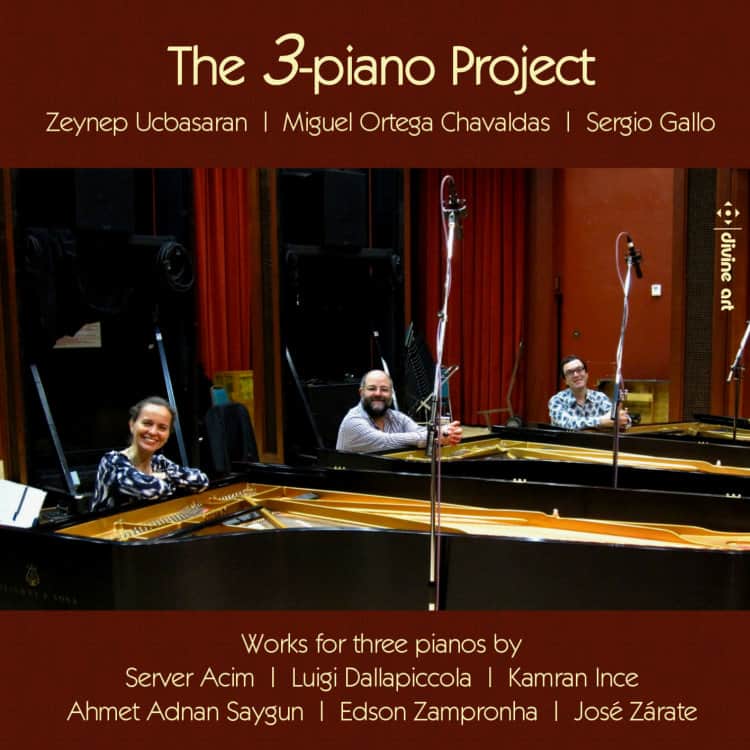
    This international project began when Zeynep Ucbasaran, Miguel Ortega Chavaldas, and Sergio Gallo—pianists who first met as students at Budapest’s Franz Liszt Academy—decided to make the first recording of Ahmet Adnan Saygun’s 1986 Poem for three pianos. To fill out the disc, they decided to commission four new three-piano works (three by composers who share the birth- countries of the pianists and one by a Turkish-American currently living in Istanbul) and to close out with a precursor in the medium, Luigi Dallapiccola’s 1935 Music for Three Pianos. The resulting recital offers a varied collection of largely unfamiliar contemporary voices. All of the newly com­missioned works except the Ince, in fact, are by composers making their debut appearances in the Fanfare Archive.

    At the center of the recital, appropriately, sits the Saygun. Saygun studied with d’lndy and later worked with Bartok in collecting folk materials in Turkey—but even though this is a late work, it’s the French influence that’s strongest. It’s a masterful post-impressionist, harmonically dreamy piece that relies largely on the shimmering play of color and textures, and on the back-and-forth-and-forth interplay that the three keyboards allow. There are flashes of ominousness, a moment where it seems ready to break into song, and distant recollections of march rhythms—but on the whole, it remains a reticent mood piece that evokes more than it expresses directly.

    The four new pieces, all composed in 2010, are quite different—both from the Saygun and from each other. The disc begins with Server Acim’s Idea Cells (Fikir Hiicreleri). The title might summon up expectations of some forbidding post-serial work. In fact, it seems a lot closer in spirit to Bartok (especially in some of the more rhythmically vital sections) than to Boulez; and although it shifts its vision fairly often, it’s got a consistent immediacy that keeps you engaged. It’s followed by Brazilian composer Edson Zampronha’s S’io esca vivo (If I Escape Alive), which takes motivic inspiration from a madrigal by Orlando di Lasso—an even more kaleidoscopic work that interleaves gestures redolent of Minimalism, neo-Renaissance, tolling bells, bird song, again with a mesmerizing effect.

    Jose Zarate’s Petit nocturne noir, cryptically “dedicated to the children of a different world,” is ostensibly more avant-garde, since, according to the notes, it’s written without bar lines and includes some aleatoric passages; but it’s a fundamentally intimate and unchallenging work, sparse in texture and unaggressive in mien. True, the notes point to a passage near the end where the pianos are “play­ing in unison and gradually becoming faster and louder,” but even this passage is hardly as dramatic as that description suggests. For drama, you need to turn to Kamran Ince’s Requiem for Mehmut, written in memory of composer Mehmet Aktug—a dissonant, bass-centered outpouring, relying on dark color and textural density more than rhythm or melody. It’s a desolate piece steeped in anger, and despite its obvious commitment (it’s easily the most emotional piece on the disc), I found it the least effective in the collection.

    Dallapiccola’s work makes a fitting conclusion. Composed before the composer turned to serialism, it’s in three movements—a chipper Neoclassical opening that might well have been penned by Milhaud, a pained poco adagio, and a brighter, more assertive last moment that doesn’t quite erase the grief. The performances seem confident, and the decade-old sound (these recordings have been wait­ing since 2010 for release) gives no cause for complaint, although the anonymous program notes are far skimpier than the material deserves. All in all, recommended for explorers.
  • The 3-Piano Project: ARG review

    Ucbasaran and Gallo, piano duo from the pre­vious review [of dda 25208, “Liszt to Milhaud”], are here joined by an old friend, Chavaldas for a most unusual program. Together they were preparing to make the world premiere recording of Ahmet Adnan Saygun’s Poem when the 3-piano project grew into reality. It is an interesting collection of music composed in Brazil, Spain, Italy, and Turkey.

    This is music that, except Brazil, works its way around the Mediterranean. Though Dallapiccola was noted for his 12-tone writing, this early (1935) work is firmly rooted in tonali­ty, as are the others here. With influences ranging from Orlando di Lasso and Turkish folk music to the extraverted and popular qualities of American music, this will entice you with unheard pieces, performed excep­tionally well with dedication and conviction. The booklet essay is quite detailed and the recorded sound first class.

  • 3-piano project | Infodad review

    Miguel Ortega Chavaldas, Zeynep Ucbasaran and Sergio Gallo offer a recital whose audience will likely be somewhat limited by the nature of the repertoire – but certainly not by the very high quality of the playing. This CD bears the title “The 3-Piano Project,” and that designation helps explain the unusual material it offers: neither the works nor their composers (from Turkey, Brazil, Spain and Italy) will likely be well-known to most listeners.

    The attraction here involves listening to a little-used instrumental combination, since “ensembles” of pianos are something of a rarity: with the exception of the 5 Browns, there are no well-known groups specializing in multiple-piano offerings. The paucity of three-piano compositions is of course part of the reason for this; and while several of the works on this CD are interesting enough, at least in part, none is sufficiently compelling to make it likely that three-piano groups will spring up as regular concert or recital features. The best-known composer here is Luigi Dallapiccola (1904-1975), whose fame rests on his serial compositions but who was doing some aural exploration even before he wholeheartedly embraced the Second Viennese School. Musica per tre pianoforti, also called Inni (“Hymn”), is one of Dallapiccola’s earlier pieces, dating to 1935, and it shows considerable command of writing for the piano. The first movement is comparatively straightforward, but the second, with its deep, grumbling opening, shows what can be accomplished in the three-piano vein, and the third, which opens with a single line and gradually layers on greater and greater sonic complexity, is a fascinating blend of lightness and chordal strength.

    The other major piece on this disc is Poem by Ahmet Adnan Saygun (1907-1991), which here receives its world première recording. It is a pleasant enough work, well-constructed and attentive to the interactions among the three pianists, and it manages a degree of lyricism despite its use of sometimes-acerbic 20th-century compositional techniques. But it has a hesitant quality about it, as if not quite sure how poetic it wants to be, and it does not sustain especially well over its 15-minute length.

    The remaining four works here are shorter and less ambitious. Fikir Hücreleri by Server Acim (1961-2019) stops and starts at irregular intervals and does indeed seem to be a series of “Idea Cells” rather than anything developed in any significant way. S’io esca vivo by Edson Zampronha (born 1963) is scalar and repetitive, its dissonances used to no particular purpose. Petit Nocturne Noir by José Zárate (born 1972) is suitably moody and dark, slow-paced and repeatedly fading to silence, the reasons for its need for three pianos being less than apparent. Requiem for Mehmet by Kamran Ince (born 1960) is, in contrast, big-boned and strongly scored, dramatically portentous from the start and quite determined to use the full sonic capabilities of the three instruments. Unfortunately, it never really goes anywhere: it keeps hinting that it will, that it is building up to something, but all that happens, eventually, is a kind of dissolution. The attraction of this disc lies in its concept (three pianos) and the quality of the performances (excellent), but much less so in the music itself. Except for Dallapiccola’s work, nothing here is gripping enough or sufficiently intriguing in its use of the pianos to make a listener wish for a great deal more three-piano material of the same kind.

    [this review was linked to another on publication so the first sentence has been edited to make it flow correctly]

  • The 3-piano Project: New Classics review

    This features contemporary music for three pianos by composers from Turkey, Brazil, Spain and Italy. Exploring modern techniques, the music is predominantly tonal, remarkably light and clear-textured, though never facile or shallow. The composers use three keyboards to explore richer melodic lines and counterpoints while avoiding the temptation to create overwhelming walls of sound. The piece by Luigi Dallapiccola (Musica per tre pianoforti) in particular is open-textured and quite traditional, predating his adoption of serialism. The album also includes the world premiere recording of Poem, a major work completed in 1986 by Ahmet Adnan Saygun, ‘The grand old man of Turkish music.’

  • The 3-Piano Project

    The 3-Piano Project

    While music for two pianos is encountered frequently, larger groups of pianos are rare, so this is an excellent opportunity to explore new and recent music for three pianos by composers from Turkey, Brazil, Spain and Italy. While exploring modern techniques the music is predominantly tonal, and remarkably light and clear-textured much of the time, though never facile or shallow. The composers have used the three keyboards to explore richer melodic lines and counterpoints while avoiding the temptation to create overwhelming walls of sound. The piece by Dallapicolla in particular is open-textured and quite traditional, predating his adoption of serialism. The album includes the world premiere recording of Saygun’s major work ‘Poem’.

    The three pianists are also international – Ucbasaran and Gallo now both live and teach in the USA and Chavaldas works in Spain. They met when students at the Franz Liszt Academy of Music in Budapest, Hungary. They all have highly praised recordings and concert appearances to their credit and came together for this special album of unique works.