Catalogue Connection: 25208

  • Liszt to Milhaud – Music Notes review

    Oh that Franz Liszt! He composed the two Lenau Faust Episodes for orchestra, including the well-known Mephisto Waltz, and then turned around and pilfered himself by turning them into two tour de force pieces for a demonically gifted keyboardist (himself of course) that only he could tackle thanks to allegedly having made a pact with Satan, no less. Or so many thought, for long after the Abbé passed on to a better life down below or elsewhere, many a piano star of Liszt’s time and many thereafter hesitatingly added these fearfully finger-breaking pieces to their concert arsenals.

    How fortunate it is to have the duo of Turkish pianist Zeynep Ucbasaran and the Italian pianist Sergio Gallo joining their formidable technical and musical prowess without the need of having to make any infernal pacts in this divine music 2016 release  (**sic – actually September 2020).

    Together Ms. Ucbasaran and Signor Gallo, greatly aided by recording engineer Barbara Hirsch render an orchestra unnecessary in this album of mostly originally-orchestral pieces. Here you will hear a lively rendition of three Antonín Dvořák’s Slavonic Dances: the lively Furiants nos. 1 and 8, and the laid-back Dumka no. 2. The listener will find further delights in selections from Gounod’s Faust (the other one), Godard’s lovely lullaby from Jocelyn, the Overture to Bizet’s Carmen, and Darius Milhaud’s zany Brazilian-inflected depiction of a bull up on a roof Le Boeuf sur le toit.

    Were it not for the enterprise of these two superb interpreters of music of all kinds and the support of the good folks at divine music, much of this music – lighter fare and salon ditties in this instance – would be inaccessible in piano-duo format, just as in the 19th century a trip to the concert hall in the big city was out of reach, were it not for the home piano – often four hands – that made a happy and economical substitute for tickets to hear Liszt in person .
  • Liszt to Milhaud: Fanfare review

    Once past the eerie Night Procession (the first of Liszt’s Two Scenes), this is a generally upbeat collection of four-hand music—mostly transcriptions, largely dance-inspired, entirely delightful. Technique is secure (listen to the trills and tremolos in the Liszt), articulation is varied and imagina­tive, long-range dynamics are handled expertly, and the rhythms have a strong momentum without any trace of overdrive. More important, Ucbasaran and Gallo neatly capture, without exaggeration, the varying spirit of the collection, showing themselves equally at home in the sentiment of the Godard (gorgeously rendered), the peaceful purity of the opening of the “Pange Lingua” passage in Night Procession, the wholesome swing of the B section of the first of the Dvorak dances, the lift of the Gounod Waltz (heard in an arrangement far less intricate than Liszt’s more familiar version for two hands), and the wackiness of the Milhaud, which deftly kicks the recital to a close.

    One editorial point: the Carmen “Overture” consists of the Prelude (without the repeat), stop­ping just short of the arrival of the fate motif, minimizing the emotional weight of the original. In a way, this fits the overall tone of the CD, but it may take you aback. The album implies that the ar­rangement, extremely straightforward, is Bizet’s own, although I’ve not been able to track it down.

    Notes are fine, sound is good. All in all, there’s little profundity here and little that will change your understanding of the composers represented. But for those times when you’re seeking low-key pleasures, this will fill your needs, especially since the program as a whole has been cannily orga­nized to avoid any sense of redundancy.

  • Liszt to Milhaud: ARG review

    Piano duets, 4 hands at one piano, have attracted great composers since Mozart and Beethoven. Schubert brought the genre to another level with a vast quantity of great music. As the romantic era progressed, it fell to Liszt, Brahms, and Dvorak to add significant works to the repertoire. All along, there were tons of lesser composers writing original music and transcribing vast amounts of orchestral repertoire for piano duet. French composers enlarged the repertoire towards the end of the 1800s and into the early 1900s. By the mid 1900s and the proliferation of record­ed music, the arrangements that were almost required to disseminate the music to a wider audience began to fade, although there are great arrangements of some Gershwin, Cop­land and Shostakovich for duet. The 2-piano idiom took over at that point for concert music by notable composers.

    Here we get a well designed, enjoyable program that touches on most of what was mentioned above. Ucbasaran and Gallo have been an active duo for 15 years and have an affinity for this repertoire. Their ensemble and balance are spot-on, as is Divine Art’s record­ed piano sound. They begin with Liszt’s duet arrangements of two of his early tone poems: Der Nachtliche Zug and Der Tanz in der Dorfschenke. While these titles may not be well known and the first is not often heard, the sec­ond also had a solo piano arrangement done by Liszt where the title became Mephisto Waltz. That has been a staple of many a virtu­oso’s repertoire for well over 150 years. The dif­ferences between the solo version familiar to all and this duet version are not great, but are noticeable and interesting.

    Three of Dvorak’s Slavonic Dances follow. They are influenced by the quality and popu­larity of the Brahms Hungarian Dances. The remainder of the program is by French com­posers, both original music and orchestral arrangements. Milhaud’s Boeuf sur le Toit is the big final work here and one of his best known. It was inspired by Brazilian popular music (compare with Gershwin’s Cuban Over­ture, arranged by the composer for piano duet). It became both a ballet and the name of a trendy Paris nightclub where the group of composers known as Les Six often gathered. I will return to this often.

  • Liszt to Milhaud | Infodad review

    Sometimes the sheer quality of music-making makes a disc worth having even if the repertoire is on the light side and scarcely unfamiliar. Zeynep Ucbasaran and Sergio Gallo are such a wonderful piano-four-hands team that their new Divine Art offering of music by Liszt and Milhaud, with a few shorter works thrown in to fill out the disc, is a genuine pleasure. This is true even though the CD is rather oddly arranged: it has a distinct Faustian focus, but with material scattered somewhat arbitrarily.

    The two comparatively substantial Liszt works are heard first; then the three short ones by Dvořák; then the arrangement of O nuit d’amour from Gounod’s Faust; then the pleasant little Berceuse by Godard (1849-1895), that composer’s best-known work; then the Bizet; then Gounod’s Faust again, the opera’s famous waltz this time; and finally the delightfully jazzy Milhaud work, a piece more on the scale of Liszt’s. Ucbasaran and Gallo seem very much at home in the piano-four-hands material here, playing everything sure-handedly (so to speak) and complementing each other in exactly the right way to make these versions of the works as effective as possible, even if none comes across quite as well as in their more-familiar orchestral guise. The Liszt pieces are standouts: Der nächtliche Zug is far less familiar than Der Tanz un der Dorfschenke, better known as Mephisto Waltz No. 1, but both are excellently illustrative of their material (drawn from a Faust verse drama, not from Goethe’s version) and played very impressively.

    The more-lyrical short pieces also come across quite well: Slavonic Dance No. 2, Godard’s Berceuse, and the Gounod waltz. Where the performances pale a bit is in the brighter and more-upbeat or more-intense material: Slavonic Dances Nos. 1 and 8 could use more verve, the Carmen overture has less exoticism and menace than it can possess, and Milhaud’s often-silly foray into distinctly jazz-inflected composition really needs more insouciance and faster pacing than it gets here. The absence of familiar orchestral touches is also felt especially acutely in the Bizet and Milhaud works, in which the instrumentation is responsible for a considerable amount of the effect and effectiveness of the music.

    Ucbasaran and Gallo make a formidable piano-four-hands team, and the quality of their playing will be enough to endear this recording to pianists and to listeners who enjoy hearing the piano played with considerable aplomb, if not always with abandon.

  • Liszt to Milhaud: Chronicle Review

    This is one for those of you who like Last Night of the Proms, not to sing along to the traditional/ jingoistic lyrics (delete as applicable) but because you like to turn the stereogram up loud and listen to cracking tunes to which you can hum along. The sleeve notes explain that before the invention of the radio, the only way to hear music was to play it yourself or to listen to other people. In the mid-19th century, composers arranged their symphonies, operas and string quartets for two people to play together while sitting at one piano — it was a good earner for composers, who sold the sheet music. This produced a large market for music for piano four-hands, the aim of which was to entertain the players and their audience. This album is an updated version of that: it’s just there to be played. Some of you will know some of the tunes, some of you all. The four-handed playing gives it the energy that a 50% reduction in hands to a lone collection of digits would struggle to do. There’s also not a single challenging second. We confess to not being familiar with the slower opening pieces, Liszt’s Two Scenes from Lenau’s Faust, but recognition kicked in with Dvorák’s Slavonic Dances, and the first rousing humalong with an energetic version of Charles Gounod’s Love Duet from Faust — the Waltz from Faust also appears — and Benjamin Godard’s Berceuse from Jocelyn. Darius Milhaud’s Le Boeuf Sur le Toit closes proceedings in carnival style. At just over an hour the CD doesn’t outstay its welcome, either.

  • Liszt to Milhaud – New Classics review

    The Divine Art label has long been associated with music for piano duo – whether at two pianos or one – through the brilliant work of Goldstone & Clemmow and more recently Piano-à-Deux. The label now features a new duo, Sergio Gallo and Zeynep Ucbasaran, with this selection of popular and well-loved miniatures and transcriptions, bookended by major works from Liszt and Milhaud. The pianists met as students at the Franz Liszt Academy in Budapest. Zeynep Ucbarasan is from Turkey but moved to the USA for her postgraduate studies and now lives in California. Her previous recordings and concert appearances have drawn widespread praise. Sergio Gallo is a Steinway artist who specialises in music of the Romantic period. He has made several acclaimed recordings and won many awards. He is currently is professor of Piano Performance at the Georgia State University in Atlanta. Composers on this delightful album include Antonin Dvorák (three Slavonic Dances), Benjamin Godard (the Berceuse from Jocelyn), Charles Gounod (the Love Duet and Waltz from Faust), Darius Milhaud (Le boeuf sur le toit), Franz Liszt (Two Scenes from Lenau’s Faust) and Georges Bizet (the Overture Carmen). These sparkling performances of well known pieces form a light counterpoint to Gallo and Ucbasaran’s new 3-PIANO PROJECT (Divine Art DDA 25207) with Spanish pianist Miguel Ángel Ortega Chavaldas.

  • Liszt to Milhaud: MusicWeb Review

    This is an album to simply enjoy. There is nothing demanding or challenging in this hour-plus selection of (largely) well-known music. As in all selections of music, some pieces will appeal to a greater or lesser extent to each listener.

    The recital begins with Two Scenes from Lenau’s Faust by Franz Liszt. I find the first piece, the 11-minute-long ‘Der nächtliche Zug’ (The Night Procession), insipid and longwinded, which is a pity, as there are some enchanting moments in the progress of this piece. The second number is infinitely more satisfying. Hiding in it as ‘The Dance in the Village Inn’ is the ‘Mephisto Waltz’ No.1. This well-known number is played here with flair and panache.

    Any selection from Anton Dvořák’s two sets of Slavonic Dances op.46 and op.72 (1878, 1886) is always a pleasure to hear. What many listeners forget, is that they were originally composed for four-hand piano. Both sets were later orchestrated by Dvořák at the behest of his publisher. The three Dances played here are taken from ‘Set One’ op.46. The first, No.1 is a rapid and fiery Bohemian dance, the ‘Furiant’. This is followed by No.2, which is a melancholic and thoughtful ‘Dumka’. In conclusion, is another ‘Furiant’ (No.8), this time inspired by itinerant Hungarian fiddlers.

    Benjamin Godard is now recalled only for his opera Jocelyn. For every listener who has persevered with the entire production, thousands will recall the beautiful ‘Berceuse’: “Oh! ne t’éveille pas encore” (Oh! Do not wake up yet) but better known as ‘Angels Guard Thee’. It is a delicious lullaby that transcends age. This short piece is given a magical performance. Incidentally, the opera was premiered in Brussels on 25 February 1888.

    This ravishing number is followed by the Overture to the world’s most popular opera, Georges Bizet’s Carmen. (Readers may disagree with this statement, but I am sure I am not too far from the truth!) And yes, I have seen the cigarette factory in Seville where she worked. The enthusiastic tourist is liable to forget that this beguiling lady and Don José are fictional characters…The Overture works well as a piano duet. The ‘Bullfighters’ music and the ‘Toreador’s Song’ coupled with a short dramatic phrase associated with Carmen’s fate provide a sparking and vibrant short work. It is played here with panache and total lack of condescension for what are two of the most popular tunes in the opera.

    Charles Gounod made his name with his five-act opera Faust, premiered in Paris on 19 March 1859. The story is too well-known to rehearse here. Zeynep Ucbasaran and Sergio Gallo give two ‘potboilers’ from the opera. First up, is the ‘Love Duet’ (“O nuit d’amour”) sung when Faust and Marguerite fall in love and pledge their troth. The second transcription is ‘Waltz from Faust’. This is a moment of ‘respite’ from the drama of the legend. Villagers dance and sing the waltz. It is breezy and joyful. However, in the middle section the music is just a touch more serious.

    For me, the highlight of this CD is the buoyant and spicy recital of Darius Milhaud’s Le Boeuf sur le toit, op. 58, composed shortly after the end of the First Word War. This was originally written for a surrealist ballet devised by the eccentric Jean Cocteau. It was conceived for two-pianos and was subsequently orchestrated by Milhaud. The entire work is based on more than 30 mainly Brazilian popular music, folk tunes, and dance rhythms, quoted at greater or lesser length. The main ‘theme’ is a Tango which recurs several times. Sometimes tunes are played simultaneously and in different keys. Milhaud once declared that the original score was inspired by witnessing the carnival in Rio de Janeiro. It is played here with imagination, humour, and a sense of the unreal – a great finish to an interesting and largely enjoyable ‘journey.’

    Little need be added about the helpful liner notes and the exceptional and vibrant recording. I have noted the superb playing by Zeynep Ucbasaran and Sergio Gallo throughout my review. I hope that this CD is a success and I look forward to reviewing further recitals from this talented pair.

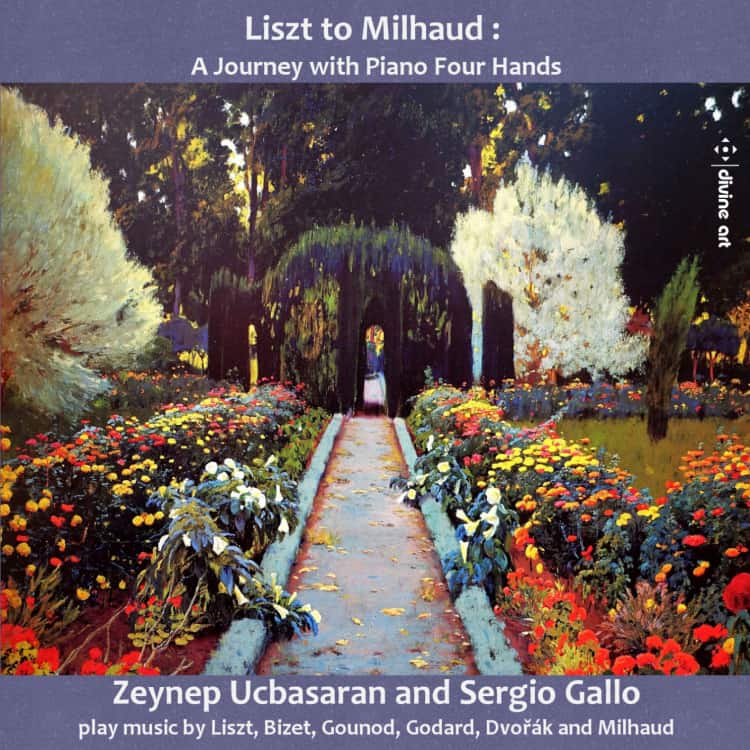
  • Liszt to Milhaud – A Journey with Piano Four Hands

    Liszt to Milhaud – A Journey with Piano Four Hands

    The Divine Art label has long been associated with music for piano duo – whether at two pianos or one – through the sterling and brilliant work of Goldstone and Clemmow and more recently Piano-à-Deux. The label is delighted to welcome a new duo with this program which contains several very popular and well-loved miniatures and transcriptions, bookended by major works from Liszt and Milhaud. They need no introduction save to say that from the dances, to the jazz-inflected pieces, each work is a joy to hear.

    These are sparkling performances of well known pieces and form a light counterpoint to the artists’ new 3-piano album of contemporary works. The pianists met when both students at the Franz Liszt Academy in Budapest. Zeynep Ucbarasan is from Turkey but moved to the USA for her postgraduate studies and now lives in California. Her previous recordings and concert appearances have drawn unalloyed praise. Sergio Gallo is a Steinway artist who specialises in music of the Romantic period. He has made several acclaimed recordings for Eroica and is currently recording for Naxos and Quartz. He has won many awards and currently is professor of Piano Performance at the Georgia State University in Atlanta.