Catalogue Connection: 25209

  • La Mer Bleue – Fanfare review

    Ensembles that include contemporary music specialist Roderick Chadwick in their ranks have been reviewed often in Fanfare. But this CD—titled La mer bleue—is his first solo recital to show up on these pages. And an impressive debut it is, one that plays to his considerable strengths, both technical and interpretive.

    Pride of place goes to his performance of the three pieces that make up the First Book of Messiaen’s Catalogue d’oiseaux. As a whole, this two-and-a-half hour work incorporates the calls and describes the flights of over 70 different species. But the word “catalog” in the title is mislead­ing: This is not a musical equivalent to the Peterson’s Guides that introduces the birds one by one. True, each of the 13 pieces in the full set settles on a particular French province. But while each is titled after what the composer called “the bird most typical of the region,” he’s written music in which “this typical bird is not alone: It is surrounded by its habitat neighbors” and, more significant, by “the surrounding landscape” (thus, for instance, in the first piece we get the “acrobatic flight of the chocards above the abyss”).

    Beyond that, we get “the changing hours of day and night in this landscape, its colors, temper­ature, and the magic of its perfumes.” And, at a greater level of abstraction, the music reveals what Raymond Tuttle aptly called “Messiaen’s obsessive exploration of not just birdsong, but the wildness of Nature and God”. It’s often described as an extremely difficult piece for listeners not al­ready steeped in Messiaen—but ever since I first met it through Yvonne Loriod’s touchstone Vega recording (the work was dedicated to her), I’ve found it irresistible. There are few works in the reper­toire that have such a distinctive sound world—although unfortunately for most listeners, there are few works that benefit so much from having a score to follow, since the programmatic details, clearly spelled out on the page, are not easy for non-ornithologists to catch. Still, Messiaen’s music is so rich that even if you can’t distinguish the birds, the overall effect is dazzling.

    My guess is that several reviews of Chadwick’s Catalogue will include some variation of the phrase “he wrote the book on it”—because, literally, he did: His Olivier Messiaen’s Catalogue d’oiseaux: From Conception to Performance was published by Cambridge University Press in 2017. His co-author, Peter Hill, had himself already recorded the work to tremendous acclaim—and now Chadwick follows suit. It’s an impressive performance, notable both for the paradoxically easy pre­cision with which he charts out the most rapid-fire lines (try the duets of the Thekla lark) and for the sheer beauty of the less dynamic passages (say, the glorious ascension of the eagle in “Le chocard des Alpes” or the chorale-like passages that separate the cries of the garden warblers in “Le loriot” or, most striking of all, the evocative purity of the “blue sea” passages in “Le merle bleu”). Could Chadwick’s dynamic range sometimes be even wider? Are there a few spots where his line momen­tarily loses focus? Sure. But the only serious complaint about his Messiaen is that he has only given us a small portion of the complete work.

    The Szymanowski is similarly impressive, Chadwick once again handling the cascades of notes with aplomb. This is a wide-ranging, post-Scriabinesque work that requires precision and succulence, ecstasy and introspection in equal measure. Chadwick doesn’t have the richest tone—but he’s got sharp architectural insight (absolutely necessary with a composer who can seem to ramble), building inexorably and offering a real sense of arrival at the climaxes. He’s also got a keen sense of the shift­ing character (or characters) of the music, patiently laying out the uneasy lassitude at the beginning of the Adagio with the same acuity with which he catches the dance undertow of the Assai vivace.

    As for Ondine: David Gorton, a Birtwistle student, is best known for his avant-garde explorations of microtonality and extended instrumental techniques, sometimes involving electronics or radically reconsidered instruments (like the Howarth-Redgate oboe). Ondine is a relatively straightforward piece—although it’s surely meant to push its audience. About as static as the Messiaen is hyperkinetic, it focuses largely on sustained clouds of music with momentary Pointillistic sparkles, offering little clear direction in the traditional sense. Without a score or alter­native performances, I can’t judge this reading—but given Chadwick’s expertise and his association with the composer, there’s little reason to doubt its quality.

    One curiosity of the disc: there are brief interludes after the second and third Messiaen pieces, and a postlude after the Szymanowski, all played by violinists Peter Sheppard Skaerved and Shir Victoria Levy. No composer is listed—they might well be improvisations. In any case, they add little to the recital.

    The notes are fine, although they tell us much less about the Gorton than about its companions, even though it’s the least familiar piece here. The sound is excellent. All in all, an impressive release.
  • La Mer Bleue: Quarterly Review

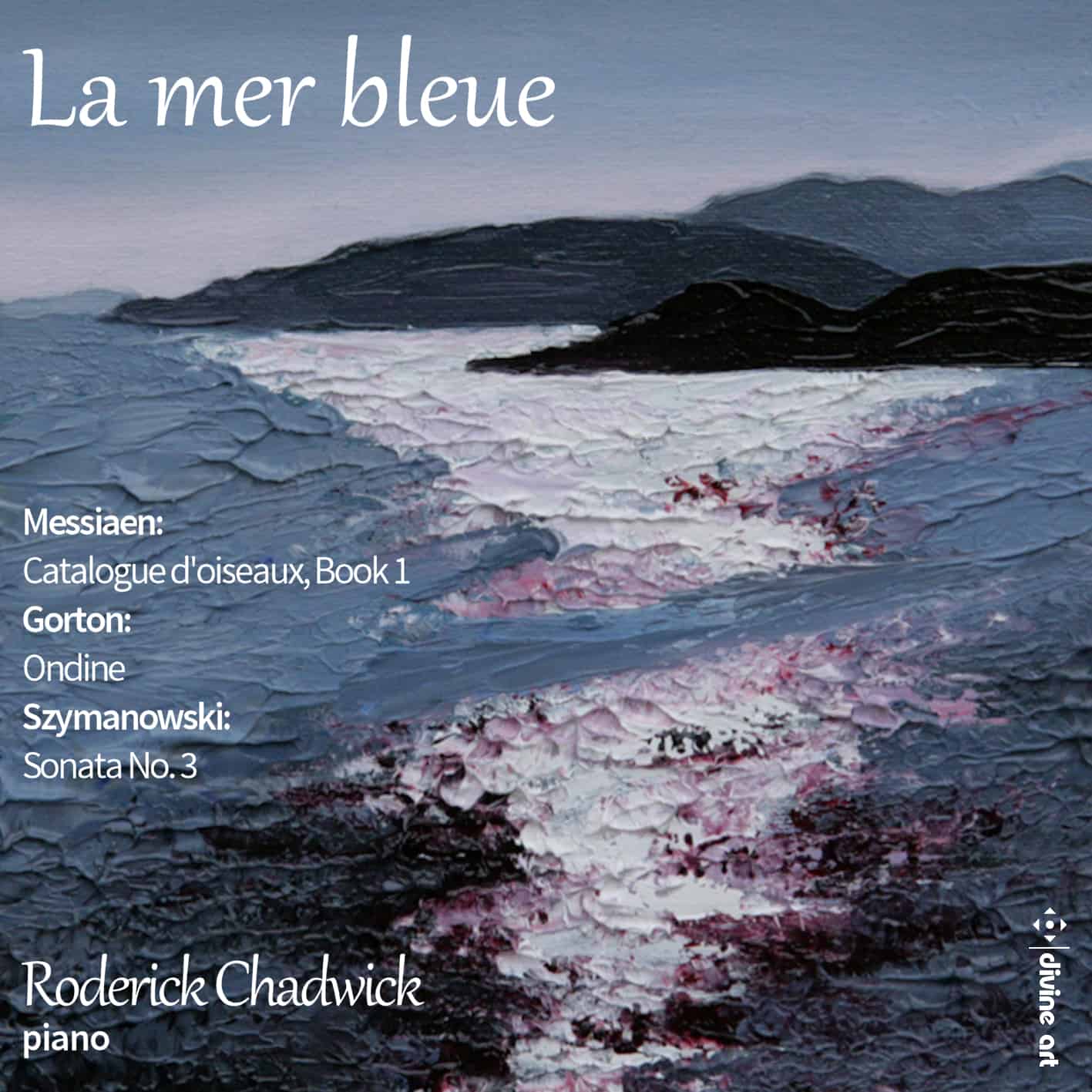
    To the Divine Art label and a hugely attractive CD, entitled ‘La Mer bleue’, with a dazzling impressionist seascape cover, offering the music of Olivier Messiaen, English modernist David Gorton – his ear-catching, expressive Ondine, and Szymanowski, his Sonata No.3, an example of 20th-century lush romanticism, performed by the pianist Roderick Chadwick.

    Messiaen – creator of the boundary-stretching, tonality-challenging, almost futuristic Turangalila Symphony – was obsessed by birdsong; and the CD offers devotees of 20th-century music the chance to detach themselves from the ordinary world by switching their ‘play’ button to the first book of Catalogue d’oiseaux. Messiaen is hard to categorise. His oeuvre is informed by his intense Catholicism and his preoccupation with the mysteries of time and the universe, as in Turangalila. Roderick Chadwick takes us, step by step, through a ‘Catalogue’ like no other. He is the perfect interpreter of this magical and unique sound world.

  • La mer bleue – ARG review

    The three works in this unusual program, two from the 20th Century, one from the 21st, would appear to have little in common; but there is a subtle unity. The juxtaposition between clangorous bird song and lyrical moments in Messiaen’s Catalogue d’oiseaux Book I is startling, especially in the probing performance here by pianist Roderick Chad­wick.

    David Gorton’s Ondine from 2004 fits nice­ly with the program. Female water spirits are evoked here, not birds, but the “liquid trickle’ of their laughter, registered by shimmering trills and other figurations, has a Messiaen-like ambiance. Chadwick ripples and splashes his way through the piece with precision and color.

    Szymanowski’s much earlier Sonata 3, full of variety and invention, has rich polyphony but also hazy, shimmering moments and sud­den juxtapositions between angularity and sensuality that anticipate the later works on the program. Rounding out the program are brief interludes and postludes played by violinists Peter Sheppard Skaerved and Shir Victoria Levy – an eccentric but colorful touch.

  • La mer bleue | Chronicle review

    This technical and slightly self-involved album revolves around Catalogue d’Oiseaux (“Catalogue of birds”), a work for piano solo by Olivier Messiaen. The full work is 13 pieces, devoted to birds and dedicated to his second wife Yvonne Loriod. The CD takes in the first three, the Alpine chough (chocard des Alpes), The Eurasian golden oriole (loriot d’Europe) — there must be some punnery there between loriot and the future Mrs Messiaen, Ms Loriod — and the blue rock thrush, aka merle bleu and possibly an equally punning reason for the album title.

    It’s erratic and angular; the birds each represent a French province so we assume the music is meant to capture something of the essence of each area. However, while technically impressive it’s a little too jarring to create an atmosphere, as the listener is always too aware of the instrument, though it does mellow towards the end. The sleeve notes give a full explanation (and can be downloaded from the Divine Art website).

    English composer David Gorton follows, fitting in nicely with the Messiaen, but his piece, Ondine, being less intrusive and more atmospheric. Ondine is a water spirit and the music captures the sound of water splashing spiritedly. Karol Szymanowski closes the programme and it’s a smoother ending, and although the piano never lets the listener relax. Szymanowski works in what we thought was perhaps a jazz air but the sleeve notes say was a result of his visits to Persia. Either way the starker piano is gradually replaced by a richer and fuller sound. An interesting and substantial album, maybe better aimed at people who like the technical side of the piano as opposed to a nice tune.

  • La mer bleue | Infodad review

    Roderick Chadwick takes listeners on a journey to and beyond Messiaen’s Catalogue d’oiseaux, Book 1, which he plays with considerable panache, by doing more than simply offering Messiaen’s effectively coloristic tone painting representing the alpine chough, golden oriole and blue rock thrush. The pianism itself is impressive enough: the juxtaposition of the piano’s higher and lower registers and its intermittent stop-and-start sections (lapsing into silence and extreme quietude) in the first movement; the repeated, repetitive outbursts and use of the piano’s very highest notes in the second; the chordal dissonance of the third and the way it leads eventually to the quietest of endings. But Chadwick is not content to provide a first-rate piano performance: he also includes two-minute two-violin interludes after the second and third Messiaen movements, resulting in a presentation that is not exactly true to Messiaen’s intentions but that widens his sonic palette to create a kind of chamber-music expansion of material originally intended for solo piano. And this is not the only exploratory element on the disc. After the Messiaen production comes Ondine by David Gorton (born 1978), an eight-minute profile of the water spirit that here gets its world première recording. The piece has the expected “dripping” sounds from the piano at its opening, but instead of drops becoming a torrent, as might be expected, Gorton’s work remains mostly quiet and gentle throughout, as if portraying tracks of rain sliding down a window. The piece is atmospheric, although not especially memorable, and nicely complements the sound (although not the intended impressionistic portrayals) of Messiaen’s bird-focused one. Interestingly, the final work on the CD, Szymanowski’s Piano Sonata No. 3, begins with much the same sound offered by Gorton and, to some extent, by Messiaen – although Szymanowski’s piece is not overtly impressionistic. The mood soon changes, in any case, as the sonata becomes more wide-ranging and sweeps into more-intense territory as its first movement progresses. It is a four-movement work in which the movements run into each other seamlessly, and Chadwick plays it in such as a way as to highlight the distinctions among the various sections within each movement – of which there are many. The harmonic language here is no surprise for its time (1917), but sounds quite modern – even when compared with that of Gorton – because of the way Szymanowski makes use of the differing parts of the keyboard. His willingness to explore slower and more-chordal passages in the second movement contrasts effectively with his interest in very short, even abrupt material in the one-minute-long third movement, and comes through clearly here. And the finale, a fugue (a form Szymanowski also used in his previous piano sonata), has a surprisingly lightweight theme and a willingness to take this hyper-serious form less than hyper-seriously. Chadwick plays the sonata with strength and understanding, although following its conclusion with yet another two-violin piece – a minute-long “Postlude” – is a rather curious thing to do. The CD comes across as an interesting intellectual exercise with some very high-quality playing, even though the connections among the pieces are only surface-level and the music itself seems unlikely to attract a substantial audience, being more for connoisseurs of piano works of a particular type and approach.

  • La mer bleue | New Classics review

    This album is built around the composer Olivier Messiaen, birdsong and impressionism. Messiaen’s Catalogue d’oiseaux (‘Catalogue of birds’), composed for piano solo, is devoted to birds and dedicated to his second wife Yvonne Loriod, who premiered the 13 pieces in Paris in 1959. Each piece is written in honour of a French province and bears the title of the bird-type of the chosen region. Book 1, played here by the excellent Roderick Chadwick, features Le Chocard des Alpes, Le Loriot and Le Merle Bleu (with violin interludes from Peter Sheppard Skærved and Shir Victoria Levy). These delightful pieces represent a journey towards sunlight, colour and company, from mountain to coastline, together with feathered songsters (song thrush, larks, golden oriole and garden warbler).

    The album also includes a world premiere recording of Ondine, an accessible piece by English composer David Gorton, best known for his uncompromising modernity, as well as one of Karol Szymanowski’s greatest works, his Piano Sonata No. 3. This is imbued with passion, longing, and in the words of Sorabji, ‘an elevated ecstasy of expression’.

    Roderick Chadwick, described by the Sunday Times as ‘possessor of devastating musicality and technique’, has performed widely in Europe, the United States and Asia. As both soloist and collaborator, he has championed some of the most challenging works for piano and is a particular expert on Messiaen. In 2018, he co-authored and published a book on the Catalogue d’oiseaux.

  • La mer bleue – Musicweb

    The title’s pun is quite clever; building on the wordplay between the third number, ‘Le Merle bleu’, of Olivier Messiaen’s Catalogue d’oiseaux, Book 1, and Friedrich Nietzsche’s statement (quoted at the head of the liner notes) that ‘Music needs to be Mediterraneanized’ (blue seas), it defines the sun-drenched mood of much of this music.  It includes two of my favourite 20th century piano works and introduces me to a worthy ‘new’ piece celebrating the water nymph or sprite, Ondine.

    The key to understanding the massive opening work, Book 1 of Olivier Messiaen’s Catalogue d’oiseaux, is to realise that the composer has not just jotted down the ‘bird-song’ of several of our feathered friends and regurgitated it, but has first taken the ‘notes’ and created a hugely pianistic reinterpretation of them. It is not an ‘exact’ transcription; often the tempo is slowed down and the notes are realised for the chromatic scale, which the birds certainly do not know.  Secondly, he has almost magically created in the progress of the music an evocation of the landscape, the light and the ‘parfums’ appropriate to the habitat. The liner notes give a great précis of Livre 1: “The first book of Olivier Messiaen’s Catalogue d’oiseaux (1958) begins with an Alpine chough’s ‘tragic solitary cry’ and ends with a Mediterranean women’s’ chorus. It is a journey towards sunlight, colour and company, from mountain to coastline, from rhythmic machinations to nostalgic added sixth harmonies…”. The performance here is ideal; Messiaen’s captivating sonorities are captured with great skill and maturity.

    I have not knowingly heard any music by David Gorton. That said, the title Ondine immediately appealed  to me as I have always had a soft spot for this lady and her artistic representations. Think of Claude Debussy’s portrayal of her in his Book II of the Préludes, or the first number in Maurice Ravel’s piano masterpiece, Gaspard de la Nuit; then there is the eponymous ballet score by Hans Werner Henze. To me, she is usually represented by ‘watery’ music. If I had listened to Gorton’s ‘take’ on Ondine with an innocent ear, I would have guessed that it was a fugitive piece by Olivier Messiaen which had passed me by. It certainly seems to nod towards ‘birdsong’ although the advertising blurb for this disc insists that it is not specifically based on this. I enjoyed this music, but it did seem to lack the tang of the sea or the splash of fountains. It is, I feel, a meditation on the water nymph’s loss of beauty and her curse of eternal wakefulness directed towards Sir Lawrence.

    Any approach to the music of Karol Szymanowski needs to take account of his three-part stylistic development. This rule of thumb may be a wee bit rough and ready, but it does generally work. His first period is usually defined as following in the footsteps of the German High Romantic composers Max Reger and Johannes Brahms.  This was followed by a more colourful musical palette nodding towards Impressionism (Debussy) and the work of Scriabin which sometimes pushed towards the atonal works of Arnold Schoenberg. His last musical phase turned towards a more traditional aesthetic informed by a deep interest in Polish folk music. The Piano Sonata falls into the second ‘period.’ Here several factors come into play, for not only do the techniques of impressionism and expressionism give this work its character, but there are influences provided by antique and oriental cultures. The liner notes give an excellent description of this Sonata: “If the Third Sonata shows Szymanowski tracing a mental journey from his grand tour back to the troubled homeland (facing a transformed future of conservatoire leadership, financial hardship and health problems), he never stops dreaming of the South.” The work was written at a time of great tragedy for the composer. During the 1917 Revolution Szymanowski’s family home in Tymoszówka (now in the Ukraine) was burnt to the ground. His two grand pianos were destroyed and dumped into a nearby lake.

    The Sonata No.3 is written in one continuous movement – like the Liszt B minor. However, it is clearly divided into four distinct sections. It can be analysed in several ways, but for me it is ‘episodic’ in nature. This Sonata requires considerable technique as well as an engaged interpretation. Roderick Chadwick has created a good synthesis in this recording balancing the “effervescent, shimmering colours of impressionism”, and the more modernist deployment of chromaticism and dissonance. Underpinning this, is the Romanticism of Franz Liszt – at least at a formal level.

    Why did Divine Art spoil this disc with the totally irrelevant two-violin ‘Interludes and Postlude’? ** That is not a criticism of their musical value as such; they are just totally unnecessary. Messiaen’s and Szymanowski’s music is perfectly able to stand on its own, without the need for a commentary. There is no indication in the liner notes as to who ‘composed’ these pieces; for all I know, they could be improvisations. Six or seven minutes are devoted to these Interludes; why could Roderick Chadwick not have boned up on another suitably ‘Mediterranean’ inspired piece? There would have then been plenty of room for another piano piece. Certainly, at 66 minutes the duration of this CD is a bit mean.

    The liner notes by the pianist are excellent. providing a detailed and contextualised description of each piece. This is hardly surprising as Chadwick is the author of an excellent study of Messiaen’s Catalogue d’oiseaux. The usual biographies of the performers are included.

    All in all, this is a superb album: three exceptional works skilfully played. Ignore the ‘fiddle accretions’ and it makes a perfect recital.

    **  We didn’t..  purely the musicians’ idea and one we actually think enhances the program.  DA

  • La Mer Bleue – Art Music Lounge review

    British pianist Roderick Chadwick has chosen here music of birdsongs by Messiaen, a piece by David Gorton based on the water nymph Ondine, and Karol Szymanowski’s Third Piano Sonata, interspersed with two independent pieces by Messiaen and ending with an original Postlude. These latter three pieces are played with two violinists.

    Chadwick takes an unusual approach to Messiaen’s music, more angular and “wide-awake” and less softly impressionistic, but this is an approach that I liked very much, as it brings out the structure in the works without sacrificing a legato feeling. It is similar to the way Joanna MacGregor plays this composer’s music. In addition to bringing out the structure better, it also brings the composer’s music more in line with contemporary works which are built around the same sort of atonal framework combined with a rhythmic pulse. His touch on the keyboard is also more delicate than MacGregor’s in this sort of music. But the one thing it does not do is to evoke a mood; thus, if this was Chadwick’s intent, it misses the mark.

    The Messiaen pieces played by the violins, however, are also crisp performances, in fact using straight tone. Straight tone in 20th century music? I have no idea if this is what Messiaen called for, but somehow I doubt it but, again, it is effective in its own way.

    Gorton’s Ondine sounds a bit like atonal Debussy, and is actually played with more atmosphere than the Messiaen pieces. It’s a fascinating work, an early piece by this composer and very interesting in the way he carefully places his notes so that they make an attractive pattern despite the atonality.

    Chadwick’s performance of the Szymanowski Piano Sonata No. 3 is absolutely superb, catching the breathless feeling and ambiguous feeling as if one were floating in a sea of atonality perfectly.

    A good album, then, well worth exploring.

  • La Mer bleue

    La Mer bleue

    This album is built around Messiaen, birdsong and impressionism. First we have book 1 of Messiaen’s Catalogue d’oiseaux, together with two newly written interludes and a postlude for two violins, transferring the song to the strings. Messiaen’s work is a journey towards sunlight, colour and company, from mountain to coastline, together with three feathered songsters.

    English composer David Gorton is best known for his uncompromising modernity but in his Ondine, he has produced a work much more accessible and although not specifically based on birdsong, it has many resonances with the Messiaen, and is an ideal partner to the earlier work; this is its first recording.

    With Szymanowski we reach the mainstream of 20th century writing, Romanticism hardening in light of the Great War and the October Revolution. This work, one of his greatest, is imbued with passion, longing, and in the words of Sorabji, ”an elevated ecstasy of expression”.

    Roderick Chadwick, as both soloist and collaborator, has performed some of the most challenging works for piano; his recent Stockhausen disc was highly praised. He is a particular expert on Messiaen and in 2018 co-authored and published a book on the Catalogue d’oiseaux.