Catalogue Connection: 25210

  • Songs for Sir John DDA 25210 – American Recorder review

    On Songs for Sir John we have the pleasure of hearing British recorder virtuoso John Turner on all 22 tracks of this CD. The compilation comprises works composed in honor of the composer, teacher and arts administrator Sir John Manduell (1928-2017), though none of his works appear here. Fortunately Manduell’s work is available, though not widely known in the U.S.

    Manduell met Turner when there was a need for a recorder teacher at the Royal Northern College of Music, of which Manduell was principal. Their long friendship yielded a number of works written for Turner.

    Manduell was a composition student of Lennox Berkeley (1903-89; Berkeley’s lineage includes studying with the renowned Nadia Boulanger in Paris, France, plus significant influence from Igor Stravinsky and Francis Poulenc). The strong lyrically modal vocabulary of British composers such as Benjamin Britten (1913-76) and Ralph Vaughan Williams (1872-1958) is quite present in Manduells works.

    The 16 pieces by 16 composers on this CD show the further blossoming of that lineage—not as a uniform approach, but in related use of melody, rhythm and timbre, and in the presence of Turner’s marvellous playing. One work, Robin Walker’s Four Nursery Rhymes, is a reissue from 2005. The others were recorded in December 2019 for this disc.

    Likely the most familiar (to Americans) among these composers are Sally Beamish (born 1956) and Berkeley. Beamish’s elegant Yeats Interlude (track 5) is for soprano and alto recorder (one player), oboe, violin and cello, and dates from 2018. It is among the eight works based on W.B. Yeats’s poetry that open the CD.

    Particularly charming are the Three Duets for two recorders (tracks 13-15) from 1938, 1924 and 1955 by Berkeley, edited by his son, composer Michael Berkeley. Laura Robinson joins Turner ably on these duets to create a wonderful duo ensemble sound.

    On the majority of works on this disc we hear soprano Lesley-Jane Rogers’s beautiful singing, in which the texts are clearly audible.

    Perhaps my personal favorite piece on Songs for Sir John is Jeremy Pike’s 2018 setting of Yeats’s poem The Cat and the Moon, for soprano, alto recorder, oboe, violin and cello.

    The recordings from 2005 and 2019 sound great on CD. That is the format I recommend, not only for the audio quality, but for the excellent commentary by the composers and performers provided in the booklet. Once again, Turner and colleagues provide a wonderful collection of music in which the recorder figures prominently. I look forward to more!
  • Songs for Sir John: Manchester review

    “My favourite CDs of 2020”
    John Turner curated this collection of new compositions in memory of Sir John Manduell, the founding principal (among many other distinctions) of the Royal Northern College of Music. The initial brief, I guess, was to write a setting of something by Yeats, a favourite poet of Sir John, and to employ one or more of recorder, oboe, violin, viola and cello as well as the voice; and in the event some of the contributors modified it to admit of instrumental-only contributions, a setting of Joyce, a new combination of Three Duets for two recorders (by Lennox Berkeley, collated by Michael Berkeley) and Four Nursery Rhymes by Thomas Pitfield, set for narrator, recorder and piano by Robin Walker. My favourites are Sonnet, a lovely, Purcellian-ground-like setting of ‘When you are old and grey …’ by Elis Pehkonen, Sally Beamish’s Yeats Interlude (seven-and-a-half minutes of interesting motifs, fascinatingly developed), David Matthews’ clearly articulated and contrasting Two Yeats Songs (‘Lullaby’ and ‘Sweet Dancer’), Kevin Malone’s melodic and thoughtful Zuzu’s Petals, Gary Carpenter’s mellow harmonies in This Great Purple Butterfly, and the concise and charming setting of The Cat and the Moon by Jeremy Pike.

  • Songs for Sir John – BMS review

    This collection of compositions by 15 living composers is perfectly described in an introduction by Paul Hindmarsh of the Royal Northern College of Music as a ‘Garland of tributes to Sir John Manduell (1928 – 2017).

    Born in Johannesburg, Manduell went on to study at the University of Strasbourg, Jesus College Cambridge, and with Lennox Berkeley at the Royal Academy of Music. A founding principal of The Royal Northern College of Music from 1973 to 1996, he was a producer of music for the BBC and Programme Director of the Cheltenham Festival from 1969 – 1994.

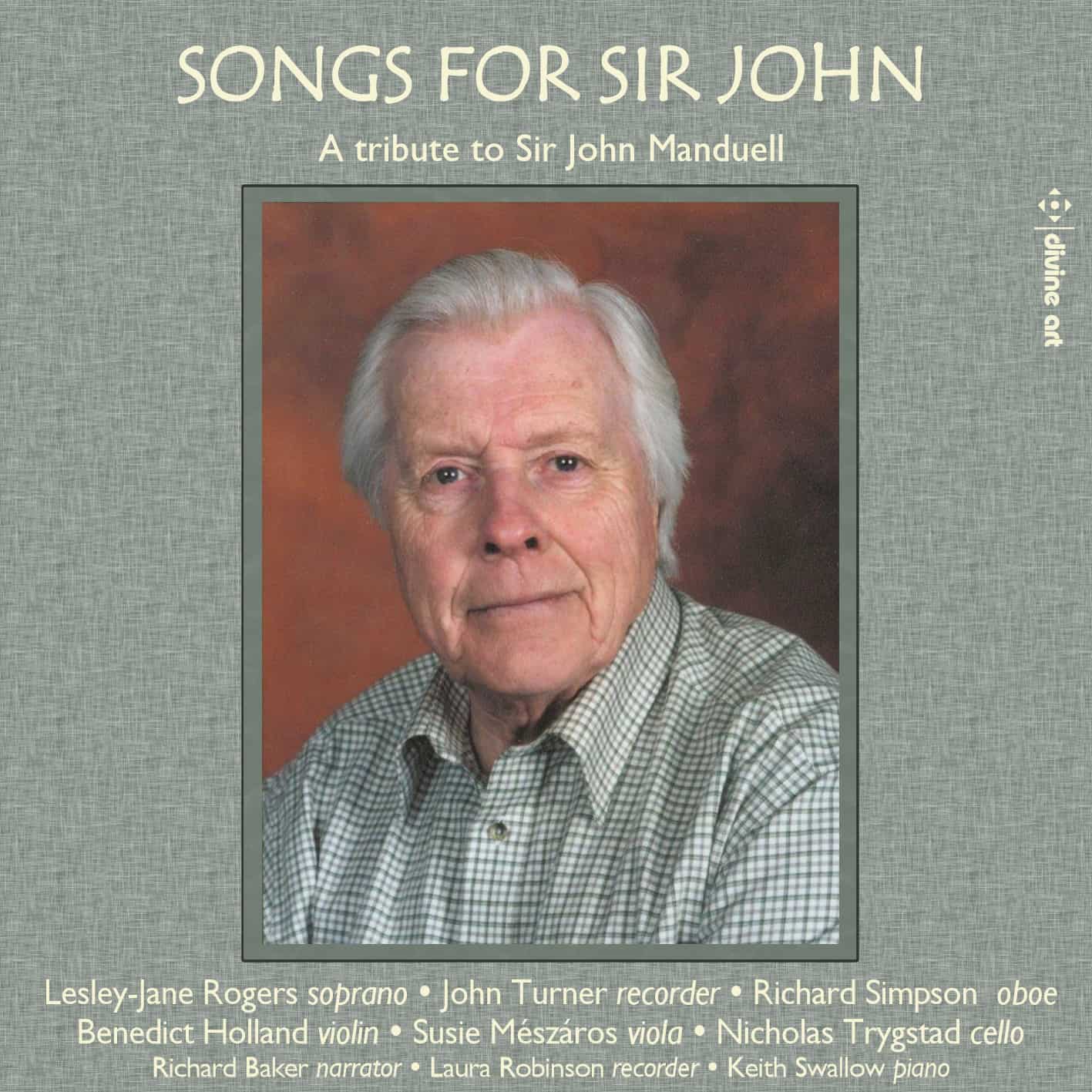
    A composer in his own right, he was a passionate supporter of other composers and performers. His photograph on the CD radiates encouragement, a word repeated so often by so many of the contributors.    

    Three movements for two recorders by Lennox Berkeley, assembled by his eldest son Michael Berkeley, are included. At least four of the other contributors were, like Manduell, pupils of Berkeley. Most are English and have connections with the Royal Northern College of Music. One, David Horne, is a Scot. Kevin Malone is originally from the USA while Naji Hakim, composer of a colourful final piece on the CD, is a Frenchman of Lebanese ancestry.

    Most of the song arrangements, sung with sparkling clarity by Lesley-Jane Rogers, are settings of poems by W. B. Yeats, Manduell’s favourite poet, although one is by James Joyce. Richard Baker accompanied by Keith Swallow on piano and John Turner on recorder narrates four fun poems from a children’s anthology with music to tickle the imagination by Robin Walker.

    Sally Beamish contributes an extensive instrumental interlude based on ‘The Wild Swans at Coole’, incandescently cinematic in its descriptive power. 

    The instrumental ensembles add much colour or atmosphere. They vary amazingly too. One has a touch of early music, another with folk music at its centre, for instance Jeremy Pike’s graphic The Cat and the Moon while David Matthews offers advanced romantic charm. 

    Zuzu’s Petals by the American composer Kevin Malone, relates to a scene from the Jimmy Stewart movie, It’s A Wonderful Life. It tells us that yes, Manduell’s was indeed A Wonderful Life. 

  • Infodad review: Songs for Sir John

    The winds heard on a new Divine Art recording of music by no fewer than 16 composers are used in the service of a particular concept: a tribute in chamber music to Sir John Manduell (1928-2017), a well-known producer, teacher, and artistic director in Great Britain, and a composer as well. Manduell is virtually unknown in the United States in any of his roles, in all of which he functioned in the United Kingdom, and while he is famed within the music profession in Europe, he is not exactly a household name outside the music field, even there. So the CD called Songs for Sir John, although certainly well-meaning and assembled in exemplary fashion, reaches out to a very limited audience indeed.

    The composers themselves are scarcely household names: Robin Stevens (born 1958), Elis Pehkonen (born 1942), Martin Bussey (born 1958), Geoffrey Poole (born 1949), Sally Beamish (born 1956), Michael Ball (born 1946), David Home (born 1970), David Matthews (born 1943), Kevin Malone (born 1958), Gary Carpenter (born 1951), Peter Dickinson (born 1934), Lennox Berkeley (1903-1989), Robin Walker (born 1953), Jeremy Pike (born 1955), Nicholas Marshall (born 1942), and Naji Hakim (born 1955). To the extent that the disc has a theme – and a level of interest beyond that of tribute – it lies in the use by many of the composers of the poetry of William Butler Yeats (1865-1939),whose works were chosen because Yeats was Manduell’s favorite poet.

    The various Yeats settings use instruments in different ways and different combinations: Stevens and Pehkonen, for example, combine soprano with recorder, oboe, violin and cello; Bussey omits the oboe; Beamish contributes an instrumental Yeats Interlude for recorder, oboe, violin and cello; Dickinson turns to a contemporary of Yeats, James Joyce, for a work for soprano, recorder, violin and cello; Berkeley, who of course was not alive at Manduell’s death, is represented by Three Duets for Two Recorders, which are attractive and very short pieces; Walker sets Four Nursery Rhymes, which are certainly not by Yeats, for narrator, recorder and piano.

    The comparatively limited instrumental complement is employed skillfully by all the composers, and both the singing and the playing are very fine, although the works that stand out most clearly are the ones not using Yeats’ poetry – simply because they offer verbal coloration of a different kind. The composers’ writing for winds as well as strings is quite good throughout the disc, and even though this is scarcely a CD that will have wide appeal, it is one that offers a considerable number of well-thought-through settings that provide listeners who have a taste for modern British chamber music with the chance to hear quite a few interesting examples of it.

  • Songs for Sir John Sunday Times

    This memorial to Sir John Manduell, for years the head of the Royal Northern College of Music, is conceived as a sequence of settings of his favourite poet, Yeats. Recorders, oboe, violin, viola, cello and piano are used, sometimes without Rogers, and with Richard Baker as narrator in Robin Walker’s Four Nursery Rhymes. Among the 16 items are vivid brief inventions by Poole, Sally Beamish, David Horne, David Matthews and Peter Dickinson.

  • Songs for Sir John – MusicWeb review

    This imaginative and inspiring new album from Divine Art has all the hallmarks of ‘Manchester Impresario’ John Turner in its concept, ethos, and stunning performance. The idea is to present a tribute to the late Sir John Manduell with a diverse set of 16 works from 16 composers of different generations. Interestingly, many hail from the North Country, by birth or inclination. A thread of continuity is provided by W.B. Yeats, who provides the texts and inspiration for several these pieces. Not only are there numerous settings of songs, but also some works for chamber ensemble. All feature the recorder; most include the oboe, violin, and cello.

    A few notes about Sir John Manduell may be of interest to those who have not yet come across his achievement. He was born in Johannesburg in 1928; however, his family returned to the United Kingdom some ten years later. Manduell read Modern Languages at Jesus College Cambridge. He won a Performing Rights Society Scholarship for post-graduate studies at the Royal Academy of Music: his composition tutors at this time were William Alwyn and Lennox Berkeley. Manduell’s career was to embrace a wide variety of musical activities, which must necessarily have limited the amount of time spent on composing. Amongst his many appointments were: BBC producer in London, the Head of Music for the Midlands and East Anglia (BBC), the first Director of Music at the University of Lancaster and, in 1971, the first principal of the RNCM. He remained in that post until 1996. Other important offices included the first chairman of the European Opera Centre, programme director of the Cheltenham Festival for 25 years and service on the British Arts Council. From a compositional point of view, Manduell’s catalogue is tantalisingly small. He wrote in several genres, including chamber works and song. He died in October 2017.

    Readers will be delighted that I am not going to discuss all sixteen contributions in order. I want to select what was, for me, highlights of this album. That said, an omission of any work from my review does not imply my displeasure or indifference to it.

    I enjoyed the ‘miniature’ instrumental ‘tone poems.’ First is Sally Beamish’s Yeats Interlude, for recorder, oboe, violin, and cello. This piece was inspired by the great poem ‘Wild Swans at Coole’. She has transferred the ‘inflections’ of the spoken text to instrumental colour. It is successful and truly captures the mood of Yeats’s words, reflecting a search for lasting beauty in a fast-changing world. I am not quite sure what ‘Zuzu’s Petals’ have to do with Yeats. This rather abstract piece by Kevin Malone is again scored for recorder, oboe, violin, and cello. It is haunting music that reflects Frank Capra’s evocative film A Wonderful Life. Despite the initially introverted nature of this music, there is a fundamental optimism that shines through as it progresses. The ‘Three Duets’ for two recorders by Lennox Berkeley was one of several works that he wrote for these instruments. The present collection includes two recently rediscovered pieces and a ‘Minuet’ which dates from 1924. The opening ‘moderato ‘was composed around 1938 and the final ‘allegro’ was completed in 1955. The work was edited by Michael Berkeley with ‘the expert guidance of John Turner.’ It is a charming addition to both the recorder repertoire and Lennox Berkeley’s catalogue.

    If we turn to the songs, Lesley-Jane Rogers contributes many delightful performances, none more so than in Geoffrey Poole’s ‘Reflection’ and Peter Dickinson’s ‘String in Earth and Air.’ The latter dates from 1955 when Dickinson was Organ Scholar at Queen’s College, Cambridge. It was originally for voice and piano. Irish Lit. fans will know that the poem set is by James Joyce and not Yeats. Geoffrey Poole’s ‘The Old Men Admiring Themselves in the Water’ (from Yeats’s In the Seven Woods) is an innovative setting of this melancholy poem where the poet divines his future in the water’s past. Another enchanting number is Nicolas Marshall’s ‘Into the Twilight’. The composer writes that this ‘is a valedictory poem in which Yeats compares age and the toils of life (‘out-worn heart in a time out-worn’) to the rejuvenating beauty of nature. Both words and music fuse here to perfection. I enjoyed David Horne’s ‘Those Images’, for soprano, recorder, oboe, violin and cello; it is a clever balance of a sometimes declamatory, often lyrical, vocal line with some innovative instrumental commentary.

    For me, the highlight of this CD is the Four Nursery Rhymes composed by Robin Walker. The texts of ‘The Shipwrecked Sailor’, ‘Lilly Pickle’, ‘Staring Moon’, and ‘Cat and Mouse’ were taken from the book of verse Johnny Robins by Mancunian polymath and composer Thomas Pitfield. The present pieces are set for narrator, recorder, and piano. Walker has created a magical score, with lots of melodic word-painting, but the marvellous thing here is the performance. The narrator is the late, great, Old School newsreader, broadcaster, and musical aficionado Richard Baker. I need say no more.

    The liner notes are exceptional. Details of each work are written by several hands, typically by the individual composers. The texts for all the songs and narrations are provided. Handily, they are placed in order in each separate programme note. There are tributes to Sir John provided by Michael Berkeley, Bryan Fox, Lesley-Jane Rogers, and John Turner. Performer résumés are included as well as a photograph of each.

    This is an album to savour. Do not rush through the entire recital. Try to take a few tracks or a single work at a time. There is nothing here that is overtly challenging, but much that is beautiful, with each piece demanding our full attention.

  • Songs for Sir John – A tribute to Sir John Manduell

    Songs for Sir John – A tribute to Sir John Manduell

    Sir John Manduell was a pivotal figure in British music – as composer, teacher, BBC producer, first principal of the Northern Royal College of Music and founder of the European Opera Centre. Beloved and revered by musicians, yet someone whose name is shamefully little known outside the music profession.

    This album in tribute presents works by 16 composers from more than one generation, centred around settings of W.B. Yeats and principally songs with oboe, recorder, violin and cello. The music is varied, rich and wonderfully set to the texts, and yet the textures are always transparent and clear; there is nothing inherently ‘difficult’ for the listener. The performers are among the cream of the Music world of Northern England, and also, in the Robin Walker Nursery Rhymes (the only work not specially recorded for the album), feature the iconic veteran BBC presenter Richard Baker. Many of these artists have starred in several other Divine Art and Metier albums – click their names above for details.

    Even without the Manduell connection this is a wonderfully constructed program of new chamber music. In the track list below, the non-vocal works are marked *.