Catalogue Connection: 25211

  • Piano Trios with Trio de l’Ile – Fanfare review

    Quebec-based Trio de L’Île, a superb young trio for piano, violin, and cello, here presents a highly compelling program of two relatively obscure mid-20th-century works with Armenian roots, plus a substantial work by Astor Piazzolla. The Piazzolla work, completed in 1960, is larger in scale than the ubiquitous short pieces that are often heard as encores in any number of formats. These are actually four distinct nuevo tangos masquerading as a four-movement work, in this piano trio arrangement of the original scoring of violin, piano, electric guitar, double bass, and bandoneon. The variety of tempos and melodic content of the tangos allows the grouping to work well as an apparently unified work.

    Gayane Chebotaryan’s single-movement Piano Trio is heart on sleeve Romantic, in the manner of Rachmaninoff, but utterly honest and bursting with passion. Chebotaryan also infuses her music with Armenian folk traditions. This 1945 work was written early in her career, which was centered in Moscow, where she lived until her death in 1998. Arno Babadjanian was, roughly, her contemporary, and also Moscow-based. His trio is in a traditional three-movement format and is also, stylistically, a throwback. He had a gift for big-boned, rather melodramatic writing, much in the tradition of the most famous Armenian composer, Khachaturian. The Andante, in particular, is quite a romp, and Trio de L’Île brings it off with great panache, although I was surprised at the pace of the music given the tempo indication. While none of this music is especially challenging in any intellectual sense, it is all very well written and an easy pleasure to hear, especially given the exuberant and virtuosic performances.
  • Trio de l’Ile: MyScena review

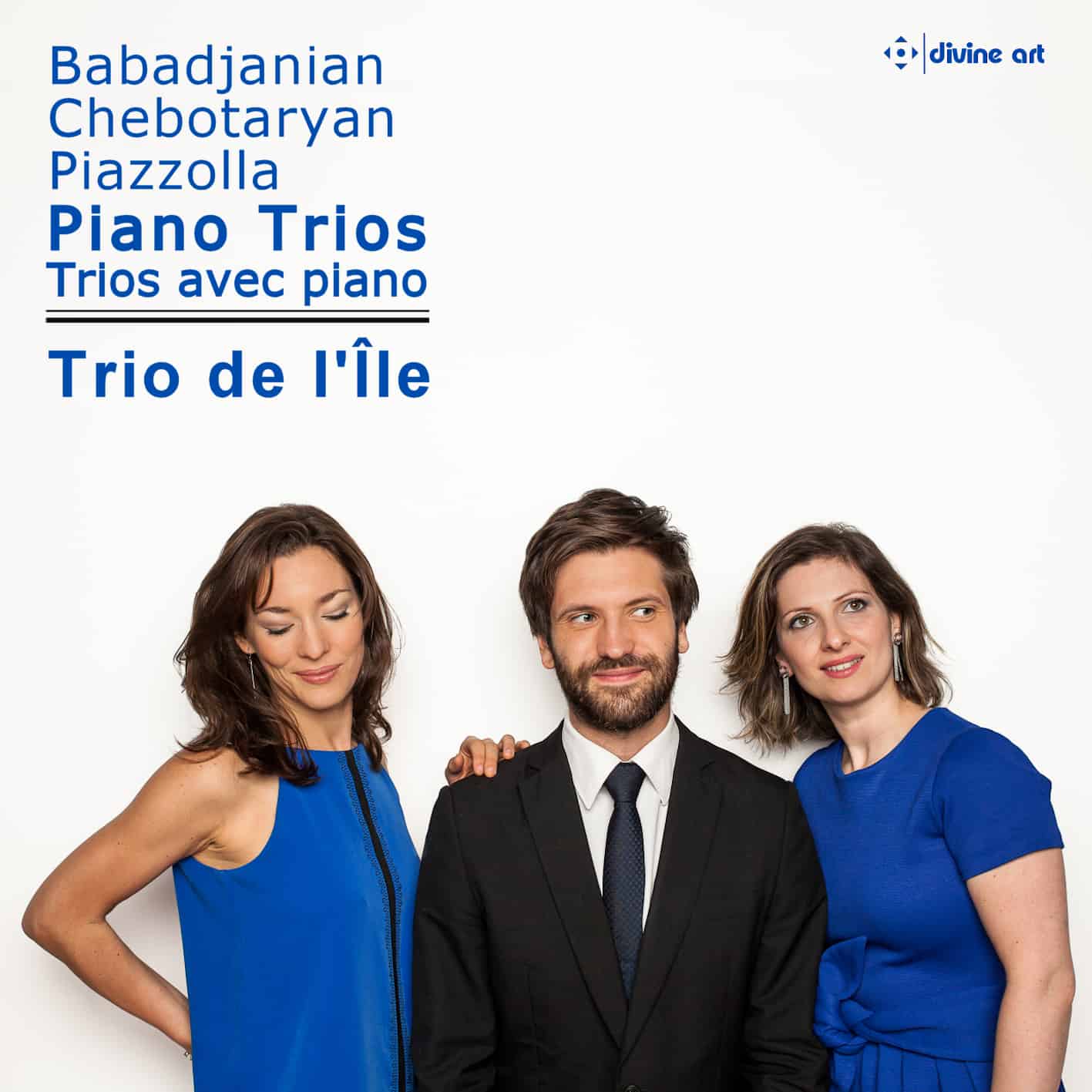
    I was already familiar with the Trio de l’Île from live performances and aware of the level of cooperation they achieve on stage. Now the players are on disc with this first album released by Divine Art. Comprising violinist Uliana Drugova, cellist Dominique Beauséjour-Ostiguy and pianist Patil Harboyan, the group presents piano trios by 20th century composers, but not figures we would call modern or contemporary. In two Armenian composers, Gayané Chebotaryan (1918-1998) and Arno Babadjanian (1921-1983), the influence of Russian romantic music is clearly felt. To these the program adds Astor Piazzolla (1921-1992) and his well-known Cuatro estaciones porteñas.

    There is a beautiful cohesion between all these works. Whether in the Piano Trio of Chebotaryan, the Trio for piano, violin and cello of Babadjanian or the cycle of Piazzolla, we find a common intensity, a passion that inspires them all. The music is also full of bouncy, dancing energy, and not only because of the tango rhythms that characterize Piazzolla’s music. Through their musicality and synergy, the musicians give the necessary momentum and impetus to these trios, most of which are novelties. Excitement guaranteed!

  • Piano Trios – BBC Music review

    Rich Romanticism combined with touches of folk, hints of orientalism and, in Piazzolla’s Estaciones Porteñas, the sharp heels and smokiness of tango. This is terrific stuff, excellently played.

  • Trio de l’Île: ARG review

    This is the fourth time that the trio by Arno Babadjanian, a 20th Century Armenian com­poser, has come my way. It is a brooding, romantic work, with a strong Rachmaninoff influence coloring the Armenian melodies, and I’m always happy to see a new recording. The Trio Aeternus’s coarse reading is out of the running. I still have the other two I’ve reviewed, so I put them all in the CD changer and had a good old-fashioned shootout.

    The MSR sonics are dark, accenting the brooding; the violinist has recurring intona­tion problems—really the only flaw. The Potch Trio has a brighter sound, sometimes with a glare from the violin; the piano isn’t the most resonant. Their performance is good, but it now sounds careful.

    The Trio de l’Ile has more fluid phrasing and the most drama though not the most mys­tery. The violinist struggles a little with intona­tion, too, but is much better than the Trio Solis’s violinist. There is a part in I that must be wicked, as it tends to snare everyone to some extent. The sonics are clear; I would prefer more plush acoustics for this ardent, glowing piece, but its other good qualities elevate it over Potch and Solis. The finale is particularly vigorous. Our Editor praised the Gelius Trio for its sweet sound; it is mellower than the recording at hand, but the excessive reverbera­tion puts too much oil on the stormy waters.

    The short, one-movement trio by Gayane Chebotaryan (1945) is closer to Khachaturian and has an even stronger folk influence. The pizzicato accompaniment to the piano melody at the opening is clever, and the diminuendo from the slow central section to the dancing coda is magical. If you’re a sucker for Armen­ian tunes (as I am) you’ll enjoy this charming, beautiful piece. At the risk of beating a dead horse, I will point out that the miking at this session captured a lot more reverberation, almost making the cello indistinct. Piazzolla’s Cuatro Estaciones Porteñas were scored for violin, piano, electric guitar, double bass, and bandoneon; Jose Bragato, a member of Piazzolla’s Octeto Buenos Aires, made this effective arrangement. At first it seemed a strange disc-mate, but the slow, sen­timental part of ‘Primavera Portena’ reveals that it has more in common than expected with the Armenian pieces. The musicians play it with plenty of affection and expressive beau­ty.

  • Trio de l’Île: Chronicle review

    This is the debut album from Quebec-based Trio de l’Île, a young ensemble comprising Uliana Drugova (violin), Dominique Beauséjour-Ostiguy (cello) and Patil Harboyan (piano) and features a mix of Argentinian and Armenian music from three composers, two of whom were new to us. Gayané Chebotaryan (1918- 1998) was influenced by a life-long fascination for the polyphony of Armenian music. Arno Babadjanian (1921-1983) is considered to be one of the most important Soviet Armenian composers, his style influenced by Armenian folk music, classical music, and Soviet and American popular music. His trio for piano, violin and cello in F sharp minor is called “a hidden gem of 20th century chamber music” in the sleeve notes. Astor Piazzolla (1921-1992) defied the traditional view of the tango and transformed the genre, inventing nuevo tango, and was the only one we’d come across.

    Enough biography. We must confess we listened to this several times before reading the sleeve notes, and Armenia never sprang to mind. On the other hand, Piazzolla’s piece, Las Cuatro Estaciones Porteñas (1960) was obviously influenced by (and in turn influenced) the tango and suggested (in a pleasant way) the mood for the album, the kind of genteel and polite music you’d get in a posh European tearoom should you have called in for a brew in about 1928. Chebotaryan’s Piano Trio opens, the shortest work at 8:24 and it’s initially powerful and ominous, the violin reminiscent of the funeral march; it livens up. “Melodious and melancholic” the sleeve notes call it. Babadjanian’s hidden gem follows and is gentler; the opening section is rather lovely, though too high on the violin to be drippy and bland. The second movement is much livelier, the piano and strings working together aggressively; in places it’s even jolly. Piazzolla’s piece is his take on the Four Seasons, and it also opens in a lively fashion. The piece is presented in the same order as Vivaldi’s music (spring onwards) but Wikipedia reports that he wrote them in the order summer, winter, spring, autumn and various people have tinkered with this sequence ever since. Tango nuevo incorporates jazz, and Piazzolla added new instruments including sax and electric guitar, clearly absent from this piano trio, and without knowing it you’d be pushed to say this was tango, more modern classical music with some tango-y moments. It’s an interesting if melancholic album, and if you like music that evokes an era and atmosphere, it’s well worth a listen

  • Trio de L’Île : MusicWeb review

    A MUSICWEB  DISC OF THE MONTH JANUARY 2021

    The Divine Art label is being very kind to the piano trio aficionado. In recent years, it has issued two recordings from the Australian Trio Anima Mundi containing a number of first recordings by British and Commonwealth composers. Here the Canadian ensemble Trio de L’Île gives us three works with some presence in the catalogue – the Piazzolla has more than 20, the Babadjanian more than a dozen – but which can only benefit by more exposure. The composers are near-contemporaries and each work has considerable folk music and/or dance influences.

    Gayané Chebotaryan is described as an Armenian composer, even though she was born in what is now Russia. Her single movement trio is the least known here, with influences from Armenian folk music which her mentor Khachaturian would have appreciated. In just over eight minutes, you are taken on quite an emotional journey. It is not a work I am particularly familiar with, having met it for the first time during the course of my Piano Trio Survey, remarking then that it was enjoyable. My sense of it here is that it is more than just that.

    Babadjanian wrote his trio eight years after his fellow Armenian, and they have a great deal in common, though Babadjanian’s is a normal size and in the usual three movements. It has a meltingly beautiful slow movement, flanked by energetic folk dance-inspired allegros. It was the discovery of my survey of the piano trio repertoire, and this is the second new recording of it I have reviewed in the last six months. I hope this means that the considerable merits of this work are now being taken more seriously. The previous recording, on Toccata Classics, was not a total success, falling well short of my preferred version by the Amici Ensemble on Atma Classique. I can now say that it falls even further behind what is now my top recommendation. Trio de L’Île give a simply outstanding performance here, capturing the passion and energy in a way that puts even the Amicis in the shade.

    Piazzolla’s Las cuatro estaciones porteñas (Four Seasons) is one of his most popular works, arranged for numerous different instrumental combinations, that for piano trio being one of the most common. It was made by José Bragato, who was the cellist in Piazzolla’s own octet, so it is absolutely authentic, and one of my favourite pieces of music. My favourite version is … no, make that “was” … by an ensemble led by Jan Vogler on Sony, but is now that by Trio de L’Île. Again, the passion and energy in their performance is thrilling, and they have also given the music a rawness that I now realise, having listened to Piazzolla’s own recordings, is essential and missing from many other recordings, even the good ones, where a smooth Romantic sheen is applied. I have never heard the Autumn movement sound so intense – cellist Dominique Beauséjour-Ostiguy’s playing here is exceptional. Across the four movements, I lost track of the number of times that a shiver went down my spine – simply rapturous.

    Trio de L’Île is comprised of three Canadian-based musicians – pianist Patil Harboyan, violinist Uliana Drugova and Beauséjour-Ostiguy. Remarkably, this is their debut recording as a trio; Harboyan does have a recording from 2014 of Armenian cello and piano music. She is described as Canadian-based Armenian, so I expect that the choice of the Babadjanian and Chebotaryan owes a considerable amount to her. Readers of my reviews will know that I intensely dislike strident hard-edged violin – Uliana Drugova gives a demonstration of how to do it properly, even at the loudest and fastest points.

    I have only one reservation: at under 55 minutes, there was surely space for another work of a similar nature, perhaps some more Piazzolla. I recall commenting in another review of a recording I didn’t enjoy that the short running time was actually an advantage because I didn’t have to listen to any more. Here it is quite the opposite – I craved another 20 minutes in the company of Trio de L’Île. This is my first review of the year, and it seems I have a Recording of the Year already in place.

  • Piano Trios review from PanM360

    The Trio de l’Île is made up of three excellent Montreal musicians: Uliana Drugova on violin, Dominique Beauséjour-Ostiguy on cello and Patil Harboyan on piano. This 20th century piano trio album is their very first and at the same time testifies to a high level of musicality. Having seen them in concert, I can confirm that the intensity felt when listening to the three works on the program is completely in line with what we can see on stage: passionate performers, high-level musicians, instrumentalists in full control of their means and individuals listening to each other. The result is an opulent overall sound, vibrant with emotion and color.

    The program is very accessible. Two consonant trios inspired by Armenian national folklore set the tone with fiery lines and visceral energy that transport both performers and listener alike. Babadjanian is known a little in 20th century scholarly music, but Chebotaryan is a discovery. Piazzolla’s magnificent Seasons are now a mainstay of the repertoire and are expressed here with searing verve of heat, even for winter!

    Well done for this superb first recording and a big thank you to the organizations that support this ensemble, particularly the City of Laval (hence the name of the ensemble), which could not have found better ambassadors!

  • Piano Trios: Only Strings review

    Pianist Patil Harboyan is a scholar of Armenian music. Due in part to her urging, Trio de l’Île incorporates the work of two Armenian composers on this lovely disc, including that of St Petersburg Conservatory-trained Gayané Chebotaryan (d. 1998). Her one-movement Trio (1945) combines elements of Armenian folk music and the Russian classical tradition. To my ears, its lyricism suggests Dvorak and Mendelssohn, and its rolling forward motion movement Chopin.

    Soviet-Armenian composer Arno Babadjanian (d. 1983) composed his trio in F sharp minor in 1952. As in the Chebotaryan, we taste bittersweet strains of folk music, along with hints of Shostakovich and Borodin, Debussy and Ravel.

    Many credit Argentine composer Astor Piazzolla (d. 1992) with creating the “Nuevo Tango,” a fusion of tango, popular song, and traditional classical forms. He composed his popular Las Cuatro Estaciones Porteñas for quintet; it since has been rearranged for several combinations of instruments. The challenge for the trio here is to suggest the timbres of violin, piano, electric guitar, double bass and bandeon. I appreciate their success, and the perfect intonation of violin and cello, the joyful glissandi, the execution of intense dynamic changes, and of Piazzola’s humorous sound-painting of weather patterns.

    This recording bodes well for the Trio and represents yet another first-rate release from Divine Art.

  • Trio de l’Ile: Piano Trios |Infodad review

    What is intriguing about the Piazzolla performance by Trio de l’Île on a new Divine Art CD is not the repertoire – the players offer, yes, Las cuatro estaciones porteñas – but the arrangement of the Piazzolla material, and the ways in which it contrasts with the other two pieces on the disc, which will almost certainly be wholly unknown to most audiences. The Piazzolla has an especially strong flavor of the concert hall in this arrangement and in this trio’s performance: the dance rhythms are certainly there and are emphasized as appropriate, but much of the emphasis is on tonal warmth and the sort of “conversational” balance that sounds so good in classical chamber music.

    The musical flow rather than its rhythmic changes gets the emphasis here, and the progression through the year is highlighted by placing the seasons in the same order in which Vivaldi offered them. Thus, the arrangement, by J. Bragato, is not at all true to Piazzolla’s intentions – and the work itself is incorrectly stated on the package to date to 1960. But if the Trio de l’Île performance is looked at as a rethinking and reinterpretation of Piazzolla’s music and a pleasant aural journey, it is quite successful on those terms. And coupling the Argentinian material, however much it may be modified, with two works by Armenian composers, is an interesting decision.

    The 1952 Trio for piano, violin and cello by Arno Babadjanian (1921-1983) is the same length as the Piazzolla work (albeit in three movements) and has considerable expressiveness: the first movement dwells on the strings’ lower ranges to fine effect; the second features a particularly beautiful melody first heard very high on the violin and then winningly disposed among the three instruments; and the finale sweeps away the emotional heft of the earlier movements with panache in a burst of rhythmically attractive thematic material that sounds folklike even though it is not drawn directly from Armenia’s folk music.

    Also on the disc is the 1945 Piano Trio by Gayané Chebotaryan (1918-1998), a short work (eight-and-a-half minutes) that is folk-inspired. Its string pizzicati and dancelike piano elements, plus some strongly emotive violin lines, convey its mood effectively, and its character comes through very well indeed in this performance. Although the disc will not be anyone’s first choice for the Piazzolla material, which is inauthentic despite its fine sound, the CD presents a good opportunity for listeners to explore 20th-century piano trios from Armenia and to think about ways in which their expressiveness fits, or does not fit, with Argentinian material from the same time period.

  • Babadjanian, Chebotaryan & Piazzolla: Piano Trios

    Babadjanian, Chebotaryan & Piazzolla: Piano Trios

    2021 MusicWeb International Recording of the Year

    This is the debut album from Quebec-based Trio de l’Île, a young ensemble of exceptional talent, comprising Uliana Drugova (violin), Dominique Beauséjour-Ostiguy (cello) and Patil Harboyan (piano). The group was founded in 2015, and the three members have all enjoyed success in their careers to date, as performers and teachers.

    The Piano Trio in F sharp minor (1952) by Armenian composer Arno Babadjanian (1921-1983) is widely considered one of the greatest masterpieces of the genre; the Andante a particularly beautiful and much-loved melody.. The work is joined by another Armenian piece, the trio (1945) by Gayané Chebotaryan (1918-1998), which has stronger inspiration from the Armenian folk inflections familiar in the music of Khachaturian as well as the Russian classical tradition.

    As a contrast we have the ‘Four Seasons of Buenos Aires’ from 1960 by Argentinian legend Astor Piazzolla, the composer who revolutionized the tango, turning it from a steamy dance into a true art form. Lively, exotic and highly rhythmic, these pieces embody the Latin spirit totally. The arrangement for piano trio is by cellist José Bragato, a member of Piazzolla’s own Octet.