Catalogue Connection: 25213

  • Fanfare review: 1847 – List in Istanbul

    Eighteen forty-seven marked the end of a period of almost a decade in which Franz Liszt toured throughout Europe, giving virtuoso piano recitals for ecstatic audiences. The following year, Liszt began his conducting duties at the court of Weimar. On July 7, 1847, Liszt arrived in Istanbul, Turkey. Before departing Istanbul on July 13, Liszt performed a series of concerts, including two recitals for Sultan Abdul-Medjid. In October 2011, as part of the celebrations for Liszt’s 200th birthday, pianist Zeynep Ucbasaran played a recital of pieces Liszt performed during his week in Istanbul. Ucbasaran performance was broadcast live by the European Broadcasting Union, in collaboration with Turkish Radio and Television. Ucbasaran also performed this repertoire in concerts at the Budapest Liszt Museum, and Béla Bartók Music Hall in Miskole. Those concerts form the basis for a CD from Divine Art: 1847: Liszt in Istanbul. A small caveat about the featured repertoire: While concert programs re­flect that Liszt performed a Chopin Mazurka, and selections from the Hungarian pianist/composer’s own Magyar Dalok (Hungarian National Melodies), the specific works from those categories are not identified. Ucbasaran chose the pieces from among those Liszt might have performed.

    Liszt was 35, and at the height of his blazing virtuoso prowess when he played his Istanbul recitals. The repertoire Liszt selected showcased the remarkable technical and interpretive prowess that drove audiences into a frenzy. Ucbasaran proves herself more than equal to the task. She has a sterling technique that surmounts all the challenges posed by Liszt’s technicolor keyboard writing. But she is also an artist who fully embraces the true magic of the featured Liszt virtuoso pieces. The recital includes Liszt’s adaptations of operas: Donizetti’s Lucia di Lammermoor, as well as Bellini’s I puritani and Norma. In addition, there is Liszt’s brilliant transcription of Schubert’s harrowing song setting of Goethe’s Erlkönig. In all these pieces there is to be sure a surfeit of opportunity for tech­nical display. But throughout, Liszt is always respectful not only of the original composer’s melody, but of its expressive/dramatic potential. A first-rate Liszt pianist not only dispatches the technical fireworks with panache, but also demonstrates an understanding of and sympathy with the plight of the characters in the original operas and song. That is what Ucbasaran does to the finest effect. Throughout, she phrases Liszt’s adaptations of the vocal lines with the utmost sensitivity: with a beauty of tone and flexibility of phrasing that would be the envy of the finest bel canto singer. The Grande Paraphrase de la Marche de Giuseppe Donizetti is a brilliant adaptation of music by Gaetano Donizetti’s older brother, who served in the Ottoman Empire. Liszt created his para­phrase, originally composed by Donizetti for the Sultan Abdul-Medjid, the month prior to his arrival in Istanbul. Liszt performed the work for the Sultan in the second of his palace concerts for the Sultan. The work has all the pomp and fireworks you might expect, and Ucbasaran has a grand time playing it. Weber’s Invitation to the Dance has the requisite sparkle and snap as well. Both the Chopin Mazurka, op. 33/4, and Hungarian National Melodies are of a far more intimate and reflec­tive nature. Ucbasaran plays both with the utmost sensitivity, often lingering over passages, and to lovely effect. The recording places the listener in quite close proximity to the pianist. Some may pre­fer an acoustic that more approximates a seat a bit further back in the recital hall. Given the reper­toire and Ucbasaran’s thrilling performances of it, I found the experience totally satisfying, and ex­hilarating. The disc includes lovely notes by Omer Egecioglu. In the old days, my friends and I might have called this a “party record,” and meant that in the most complimentary terms. It’s great fun from beginning to end. Liszt himself was both a brilliant and profound musician, and a first-rate entertain­er Ucbasaran celebrates all those elements, and to magical effect. Enthusiastically recommended.
  • Liszt in Istanbul: ARG review

    1847 was the year Liszt headed for Istanbul (then Constantinople) for a series of concerts. The selections here were played at the recitals. Ucbasaran’s performance was broadcast by the European Broadcasting Union to all of Europe, with the collaboration of the Turkish Radio and Television on Liszt’s 200th birthday in October 2011. And they were performed in a recital series by the pianist in the Liszt Muse­um in Budapest and the Bela Bartok Hall in Miskule, Hungary.

    The program includes Reminiscences from Lucia by Donizetti and from Bellini’s Norma, as well as pieces from I Puritani. The Rondo brilliant is based on Weber’s Invitation to the Dance. There is Liszt’s treatment of Schubert’s ‘ Erlkonig’ and a suite of Hungarian Melodies. Chopin’s Mazurka in B minor, Op. 33:4 is the only work on the program played in its original form.

    Turkish pianist Ucbasaran is not afraid to let the music rip forth in thorough Lisztian style. There is little attempt to hold the display aspects of these compositions in check, as some have tried to do. All of this music is intended to impress people and does so with­out any shame. Liszt was too fine a musician to overdo things, and the embellishments fit perfectly in the style.

    The biggest work is the Norma Reminis­cences, and never losing sight of Bellini’s music, one can imagine Turkish audiences being thrilled on hearing these themes for the first time. Things have changed over time and we can now hear these operas as their com­posers intended. Do you want to listen to the melodies no matter how imaginatively dis­pensed in arrangements? If so, enjoy to your heart’s content.

    The Steinway D sounds wonderful, and the notes are informative.

  • Liszt in Istanbul: BBC Music Brief Note

    Ucbasaran pays tribute to Liszt’s visit to her home country with a programme of pieces he performed during his visit. The playing is tidy and well phrased, if a little ‘sensible’

  • Liszt in Istanbul: MusicWeb review

    The disc presents music that Liszt played (or may have played) during a two-week visit in Turkey in 1847, towards the end of his final tour. He was completing an eight-year virtuoso career lasting from 1839 to 1847. Liszt arrived in Istanbul (then typically called Constantinople) on 7 June 1847, aboard the Austrian steamboat Conte Kolowrat. He gave several public recitals and two command performances for the Sultan of Turkey, Abdul-Medjid Khan. It is important to realise that at that time the Ottoman Empire was keen to Westernize their domain. The Sultan had received a Western education, spoke fluent French and played the piano. He was also an admirer of Italian opera, so it was appropriate that Liszt played three operatic paraphrases during his recital at the Çırağan Palace. It has been documented that Abdul-Medjid listened “with growing interest, mingled with astonishment and admiration”. Other concerts were given at the Russian Embassy and the Franchini Hall. An exact chronology of the recitals is not known, neither are full details of the music played.

    Amazingly, the Erard piano company shipped an instrument from Paris for use during Liszt’s recitals. It was sold afterwards for a considerable price to a certain M. Baltagi, who wanted it as a present for his fiancée. Franz Liszt left the city on 13 July.

    Liszt wrote the Grande Paraphrase de la Marche de Giuseppe Donizetti for Abdul-Medjid, and dedicated to him. It is based on a march by Giuseppe Donizetti, the older brother of the more famous Gaetano. Giuseppe had founded the court orchestra Mizikay-i Hümayun. Liszt’s reworking of the tune is big, gutsy and – to be honest – quite over the top. I love it! It deserves to be better known. It is no wonder that the Sultan approved.

    Réminiscences de Lucia di Lammermoor de Donizetti, always popular, are based on the final sextet of Act II of Gaetano Donizetti’s opera. Starting quietly, the piece deploys arpeggios, cadenzas, trills, tremolos, scales in thirds and complex runs, developing into a dazzling display of technical wizardry.

    Carl Maria von Weber’s Aufforderung zum Tanze (Invitation to the Dance) is the first concert waltz (as opposed to music written for dancers in waltz time). It has retained its popularity for over 200 years. Written as a rondo, it has become a model for countless other compositions. The liner notes remind us that the music “recounts aspects of the meeting, dance, and finally the farewell of a young couple at a ball”. Despite its fame, it never sounds hackneyed. It is given a remarkable performance here. We do not know if Liszt souped it up when he performed it in Istanbul.

    Liszt played one of Frédéric Chopin’s Mazurkas during his tour, but it is not known which one. Zeynep Ucbasaran has chosen Mazurka in B minor, op. 33 No. 4, composed in 1838. This lovely example is formulated as a little rondo.

    The Introduction et Polonaise de l’opera I Puritani de Bellini is full of the joy and happiness that reflects the moment when Elvira obtained consent from her father to wed Arturo. This piece is derived from the longer Réminiscences des Puritains. It makes an ideal encore.

    Liszt’s re-imagining of the eldritch Erlkönig by Schubert is one of great war-horses of romantic piano music. Just looking at the “unplayable” sheet music is scary. The liner notes are correct in stating that this transcription “shows the musical heights the solo piano is capable of reaching”.

    Once again, it is not possible to know which of Liszt’s Magyar dalok (Hungarian Melodies) were played during this tour. He wrote eleven examples of these folk-tunes. Zeynep Ucbasaran has chosen three numbers from the first volume. To be honest, I find them a little dull and lugubrious.

    The final work on this disc, the Réminiscences de Norma de Bellini,Grande Fantaisie, was written in 1841. Leslie Howard has defined it as having the “ability to capture the essence of the operatic drama in a new structure”. The music explores seven themes from the opera. It creates a remarkable synthesis between the emotional impact of Bellini’s masterpiece and all the creative potential of the Romantic piano. It is a long work, but the interest never wavers. Sacheverell Sitwell once declared it to be “a perfect example of Liszt’s method”. Zeynep Ucbasaran gives it a splendid performance.

    It is important to note that the recording was made in 2012. The music was originally broadcast live by the European Broadcasting Union (EBU) to all of Europe, with the collaboration of Turkish Radio and Television (TRT). It was part of the Franz Liszt 200th birthday celebrations during October 2011. The same material was also performed “to great acclaim” in Hungary, in the Liszt Museum in Budapest and the Béla Bartók Hall in Miskolc.

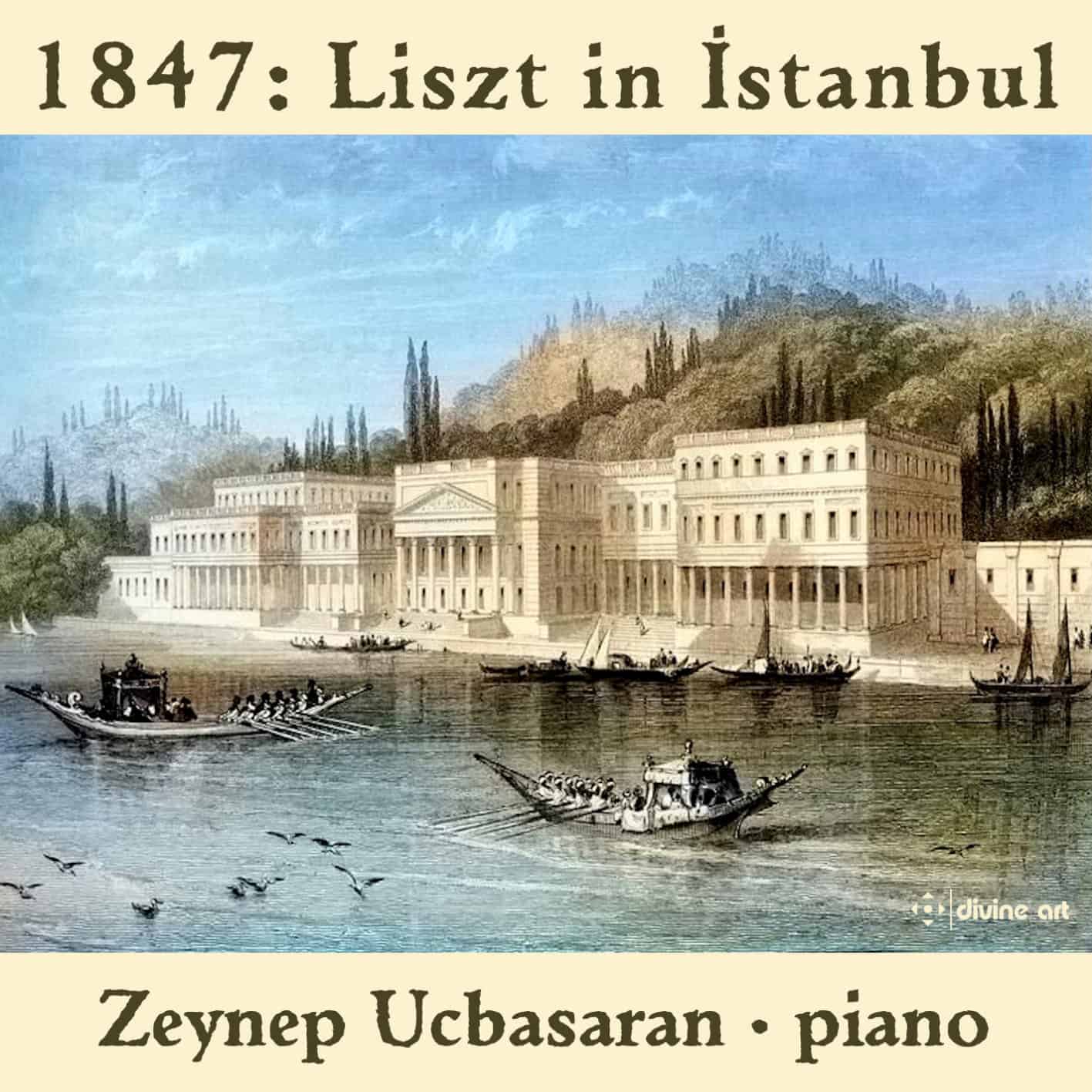
    The liner notes are excellent. The main text is helpfully divided into two parts. The first sets the scene and provides the context, the second discusses the music. There are several historical illustrations, including a concert programme, a sheet music cover, and the certificate of the medal with diamonds (Nişan-ı İftihar, Order of Glory) given to Liszt by Sultan Abdul-Medjid. The CD cover features the old Çırağan Palace in Beşiktaş, in the first half of 19th century, and the back cover shows the Grande Rue de Pera (İstiklal Avenue), Constantinople taken in the late 19th century. There is a short biography of the Turkish pianist.

    I enjoyed this CD, and I found the concept appealing. It seems a great idea to try to recreate a historical recital or concert. Liszt performed in many places, and gave a multitude of concerts. He is known to have toured Spain, Portugal, Germany, Austria, France, England, Poland, Rumania, Russia. and Turkey, amongst other countries. Programmes and adverts of these concerts exist but it is often the case that there are no exact titles. For example, as noted above, one flyer lists “A Chopin Mazurka”: there are 58 to choose from.

    I hope that Zeynep Ucbasaran will continue her exploration of Liszt and his concerts. I look forward to reviewing her subsequent recitals.

  • Liszt in Istanbul: New Classics review

    In 1847 Franz Liszt visited Istanbul (then Constantinople) and performed several recitals on an Erard piano specially shipped for him to play. As early as 1838 he wrote to a friend that ‘I have a desire and strong decision to go to Istanbul, although I would need signed letters of introductions for cities like Izmir, Istanbul and Athens from Prince Metternich.’ With the help of his poet friend Alphonse de Lamartine, Liszt’s visit was finally scheduled for 1847. He spent a month there and gave several concerts including two in the Sultan’s palace.

    He was fêted and praised highly; at that time the city was a hub of Western culture and a frequent destination of Italian and French opera companies, so Liszt’s operatic transcriptions found a receptive audience. This new CD features Turkish-American pianist Zeynep Ucbasaran playing a selection of works from Liszt’s program which were broadcast throughout Europe in 2011 and performed live to great acclaim. This recital celebrates not only great music but also what was Liszt’s final year as a virtuoso performer.

    Zeynep Ucbasaran began music studies in Istanbul at the age of four, then in Hungary and Germany before moving to the USA to obtain her degrees in Piano Performance. She has won multiple awards and performed in many parts of the world. She naturally has an affinity with the musical culture and heritage of her native Turkey. Highlights include Liszt’s Grande Paraphrase de la Marche de Giuseppe Donizetti and Réminiscences de Lucia di Lammermoor, the Introduction and Polonaise for Bellini’s opera I Puritani, Erlkönig (Schubert’s Erl King arranged by Liszt), Chopin’s Mazurka in B minor, and Carl Maria von Weber’s Invitation to the Dance.

    Zeynep Ucbasaran plays with great passion, exuberance and flair, bringing vividly to life one of List’s most historic performances.

  • Liszt in Istanbul – Music Notes review

    Noël Coward’s famous one-liner “Never underestimate the potency of cheap music” comes to mind when listening to Liszt’s stirring 1847 Grand Paraphrase of a March of Donizetti composed by the Italian for His Majesty Sultan Abdul-Medjid Khan and refashioned by him into a more-is-more study in musical grandiosity bordering on the humorous. 

    That, the Réminiscences de Lucia Di Lammermoor de Donizetti, which takes the Chi mi frena in tal momento sextet and turns it into a deranged study in musical grandstanding, and just about every other piece in the terrific CD 1847 Liszt in Istanbul helps to re-establish Liszt’s non-credentials as a guiltless pilferer of other composer’s music as much as a shameless showman of mid-19th century salon music.

    Liszt takes Carl Maria von Weber’s Invitation to the Dance and re-labels it Rondo Brilliant in Db major. He takes three Big Moments from Norma and a soprano aria from I Puritani (Son vergin vezzosa) and refashions them into vehicles for his larger than life pianistic skills, even if at the expense of sacrificing Bellini’s seamless Bel Canto melodies by over-embellishing them into musical mush.

    Elsewhere the Hungarian Abbé-composer  delivers a pretty decent facsimile of a Chopin Mazurka and of Schubert’s Lied The Earl King, but neither begins to compare to the real thing.

    None of this is to say that Liszt was only a shameless copier always out to foray into other’s music and take what he could. His three vibrant Magyar Dalok (Hungarian Melodies) bring out the best in him, successfully tapping into his Central European roots. And by way of redemption, overall, Liszt proves here to be an entertaining salon composer. Turkish pianist Zeynep Ucbasaran is a formidable artist who elevates this music to lofty heights by virtue of her sensitive musicality and dazzling technique. Here’s hoping that divine art will bring her out again to delight us with music worthy of her technique and sensibilities.

  • 1847: Liszt in Istanbul

    1847: Liszt in Istanbul

    In 1847 Franz Liszt visited Istanbul (then Constantinople) and performed several recitals on an Erard piano specially shipped for him to play. He spent a month there and gave several concerts including two in the Sultan’s palace. He was fêted and praised highly; at that time the city was a hub of Western culture and a frequent destination of Italian and French opera companies, so Liszt’s operatic transcriptions found a receptive audience.

    Turkish-American pianist Zeynep Ucbasaran created a selection of works from Liszt’s program which were broadcast throughout Europe in 2011 and performed live to great acclaim. Now this recital is committed to a recording which celebrates not only great music but also what was Liszt’s final year as a virtuoso performer.

    Zeynep Ucbasaran began music studies in Istanbul at the age of four, then in Hungary and Germany before moving to the USA to obtain her degrees in Piano Performance. She has won multiple awards and performed in many parts of the world. She naturally has an affinity with the musical culture and heritage of her native Turkey.