Catalogue Connection: 25215

  • Metamorphoses – Fanfare review

    NOTE: this review also appeared in American Record Guide.

    Alfonso Soldano (b. 1986) plays his own piano solo arrangements of the Rachmaninoff songs and Debussy’s orchestral works. Most of the pieces here exist in one or more other arrangements for piano solo, duet, or two pianos. The shadow of Liszt looms large with song arrangements and orchestral transcriptions that require a true virtuoso technique. The songs, much like Liszt, start out as an almost exact transcriptions of the combined voice and piano parts, and then grow more complex and difficult. Short songs are occasionally extended with an additional verse, and the piano parts that are difficult to begin with are extended far beyond what would be appropriate if played with a singer. There are also key modulations and transpositions that grow out of the virtuosity. The orchestral pieces are transcriptions that follow the original in both key and length. The creative aspect here is how well Soldano builds the complex sounds and voices of a full orchestra using just two hands.

    There are 13 widely respected (and very difficult) piano solo arrangements of Rachmaninoffsongs by Earl Wild (but only four of those are also set here by Soldano). Twelve of those appeared back in 1981 and one was added later. Julia Severus’s disc has 21 songs arranged for solo piano by seven different people, including the pianist and the composer himself. Nine of those are also arranged by Soldano here. There are many others, notably Kocsis’s Vocalise, which has been recorded many times. Rachmaninoff’s songs, despite their exceptional qualities, were slow to enter the standard repertoire. My assumption for this is the Russian language and the Cyrillic alphabet. The difficulty of the piano parts challenges the best pianists. Most Western singers do not get much training in Russian, but with the resources now available, they are regularly programmed. As evidenced here, piano solo transcriptions are also regularly created and performed. Soldano’s arrangements are very good. They don’t go over the top with virtuosic flair, but retain the musical integration of voice and piano. They are more akin to Rachmaninoff’s own transcriptions of Lilacs and
    Daisies than some of Wild’s tour de force arrangements.

    One of the problems I faced here with the Rachmaninoff songs was which English translation to use. Soldano’s English titles are very close to accurate translations of the original Russian titles, but are not always the English titles we are most accustomed to seeing. The 1922 Gutheil edition, published during the composer’s life, had the original Cyrillic titles and English titles that are rarely accurate translations of the Russian. Other published versions and various recordings have a variety of similar English titles. There is no universally accepted system of transliterating the 33 letters of the Cyrillic alphabet, so there are variances if the attempt is to use the Russian title. I’ll use one of my favorites, op. 21/7 as an example. It is most often transliterated as Zdes khorosho, and translated as Here it is beautiful, or more accurately, Here it is good to be. Soldano lists it as How peaceful, and the 1922 edition uses How fair this spot. Ultimately, I used the titles as printed in this CD. There is an excellent two-piano arrangement of the Nocturnes by Ravel. Debussy himself did a piano four-hands version of the Prelude to L ‘enfant prodigue. Although not stated, I have to assume that Soldano used these published versions for two pianists as a starting point for his solo versions. His transcriptions show a good knowledge of Debussy’s orchestral scores as well. As much as I love Debussy’s piano music, the great composer’s ability with orchestral forces is also worth high admiration. In the case of the Nocturnes, for simple listening pleasure, I always choose an orchestral rendition over any piano transcription. I admire Soldano both as a pianist and a transcriber, and heard
    some musical lines a little differently. It has a good booklet essay. This great sounding recording is well-worth hearing, especially for the Rachmaninoff songs.
  • Metamorphoses – Review from Classics Today

    The Italian pianist Alfonso Soldano’s robust sonority and rock-solid technique are tailor made for Rachmaninov, as proven by an earlier Divine Art release featuring the Op. 16 Moments musicaux and the monumental Piano Sonata No. 1. Soldano’s 15 original transcriptions of Rachmaninov songs convey a similar impression. Soldano expands the songs’ textures by filling out the piano parts with lush doublings, added inner voices, swirling filigree, and declamatory gestures in the form of full-bodied chords and darting octave sequences. In other words, he serves up the originals as if they were newly discovered Rachmaninov Preludes.

    That said, Soldano’s arrangements sound thicker when compared alongside Earl Wild’s better known Rachmaninov song transcriptions. This is best revealed through two songs that the transcribers have in common. Wild’s intricate linear interweaving and agile deploying of registers throughout “In the Silence of the Secret Night” Op. 4 No. 3 and “How peaceful” Op. 21 No. 7, for example, shimmer with a mobile transparency that Soldano’s relatively conventional, conservative treatments don’t match.

    That Soldano can accommodate and keep control over all of the component parts of Debussy’s Nocturnes within the limits of ten fingers is no small feat. Indeed, his sensitive textural layering throughout Sirènes is such that you hardly miss the wordless vocalists. Similarly, Nuages’ long sustained lines lose little in translation, so to speak. With Fêtes, however, Soldano’s faithfulness to the original text sometimes causes the music’s rhythmic momentum to bog down, particularly in the central march episode. For this reason I prefer the more pliable, fluid, and pianistically oriented Vladimir Leyetchkiss solo piano transcription. The production would have benefited from a warmer and more resonant ambience than the slightly dry and boxy engineering conveys.

  • Alfonso Sldano ‘Metamorphoses’ DDA 25215 – ARG review

    Alfonso Soldano (b. 1986) plays here his own piano solo arrangements of the Rachmaninoff songs and transcriptions of Debussy’s orchestral works. Most of the pieces here exist in one or more other arrangements for piano solo, duet, or 2 pianos. The shadow of Liszt looms large over both the song arrangements and orchestral transcriptions, all of which require a true virtuosic technique. The songs, much like Liszt, start out as almost exact transcriptions of the combined voice and piano parts, and then grow more complex and difficult. Short songs are sometimes extended with an additional verse, and the piano parts that are difficult to begin with are extended far beyond what would be appropriate if played with a singer. There are also key modulations and transpositions that grow out of the virtuosity. The orchestral pieces are transcriptions that follow
    the original in both key and length. The creative aspect here is how well Soldano builds the complex sounds and voices of a full orchestra using just two hands.

    There are 13 widely respected (and very difficult) piano solo arrangements of Rachmaninoff songs by Earl Wild (Ivory 74001, July/Aug 2004), but only 4 of those are also set here by Soldano. 12 of those appeared back in 1981 and one was added later. Julia Severus’s disc (Naxos 573468, Sept/Oct 2017) has 21 songs arranged for solo piano by 7 different people, including the pianist and the composer himself. 9 of those are also arranged by Soldano here. There are many others, notably Kocsis’s ‘Vocalise’) which has been recorded many times.

    Rachmaninoff’s songs, despite their exceptional qualities, were slow to enter the standard repertoire. {Perhaps that was because of the Russian language, the Cyrillic alphabet, and often awkward translations. The difficulty of the piano parts challenges the best pianists. Most Western singers do not get much training in Russian, but with the resources now available, they are regularly programmed.

    Soldano’s arrangements are very good. They don’t go over the top with virtuosic flair, but retain the musical integration of voice and piano. They are more akin to Rachmaninoff’s own transcriptions of ‘Lilacs’ and ‘Daisies’ than some of Wild’s tour de force arrangements.

    One of the problems I faced here with the Rachmaninoff songs was which English translation to use. Soldano’s English titles are very close to accurate translations of the original Russian titles, but are not always the titles we are accustomed to seeing. The 1922 Gutheil edition had the original Cyrillic titles and English titles that are rarely an accurate translation of the Russian. Other published versions and various recordings have a variety of English titles. There is no universally accepted system of transliterating the 33 letters of the Cyrillic alphabet. I’ll use one of my favorites, Op. 21:7, as an example. It is most often transliterated as ‘Zdes khorosho’, and translated as ‘Here it is beautiful,’ or more accurately, ‘Here it is good to be.’ Soldano lists it as ‘How peaceful’, and the 1922 edition calls it’ How fair this spot)

    There is an excellent 2-piano arrangement of the Nocturnesby Ravel. Debussy himself did a piano 4-hands version of the Prelude to L’enfant Prodigue.Although not stated, I have to assume that Soldano used these published versions for two pianists as a starting point for his solo versions. His transcriptions show a good knowledge of Debussy’s orchestral scores as well. In the case of the Nocturnes,for simple listening pleasure, I always choose an orchestral rendition over any piano transcription. I respect Soldano both as a pianist and a transcriber, and heard some musical lines a little differently here. There is also an excellent booklet essay. This great-sounding recording is well worth hearing, especially for the Rachmaninoff songs.

  • Alfonso Soldano ‘Metamorphoses’ DDA 25215 – MusicWeb review

    The history of piano transcription has almost reflected the history of the piano itself. The sheer colouristic abilities of the piano and huge developments in piano technique allow for something over and above mere movement of notes from one instrument to another. As Alfonso Soldano says in his notes great pianist/composers from Liszt and Rachmaninov onwards have seen the value of recreating not just the notes of a work but also as much as possible of the idea of what lies behind those notes and their own experience of and reaction to the music. The very best transcriptions are works unto themselves; a heady and occasionally intoxicating mix of composer, performer and arranger. Closer to our time and apropos this disc are the recreations of Earl Wild (1915-2010) whose many transcriptions include thirteen of Rachmaninov’s songs, magnificently re-imagined in terms of the piano.

    Concentrating on the earlier songs and including two of the posthumous songs Soldano has chosen fifteen of Rachmaninov’s seventy-plus songs, only four of which overlap with Wild’s versions. They are not always the most familiar songs but the quality of Rachmaninov’s writing makes any of his songs welcome. The opening transcription, the early Romance op.8 no.2 is representative here and is a much more complex arrangement than that of Rachmaninov’s friend Alexander Siloti (1863-1945); like Wild Soldano is consciously creating fresh works, often moving away from Rachmaninov’s own rich accompaniment, and occasionally even the melody, while maintaining his idiomatic harmony and inner voice writing, with many mini cadenzas and flourishes added – the last breath before diving into the passionate final outburst of Do you remember the evening? Is just one instance.

    One of the most beautiful arrangements here is the relatively restrained Dusk is falling, poignantly simple when set against the climax-upon-climax overt passion of Do not believe me, friend. Another is the flowing and etude-like They replied, one of my personal favourites among the songs, with its repeated melodic motif, harmonised differently at each iteration. The success of transcription technique is clear in a song like How peaceful, more commonly known as How fair this spot, that can be given such entirely different treatments as those by Earl Wild, Vyacheslav Gryaznov, Isaak Mikhanovsky, Raymond Lewenthal and Soldano, all versions sitting on my shelves and all so effective and yet so personal (Steinway 30082 for Vyacheslav Gryaznov, Ivory Classics 74001 for Earl Wild, Naxos 8573468 for Isaak Mikhanovsky, Deutsche Grammophon 4779527 for Raymond Lewenthal). The accompaniment to the final song here, Spring torrents, is already something of an study for the pianist and Soldano, like Frederic Meinders on his amazing transcriptions disc from 1993 (Kam-CD9303) and Earl Wild before him, integrates the melody skilfully among the thundering torrents making for a very satisfying whole. These are such adept and warmly romantic transcriptions that I would wish that the sound was just a touch warmer and more open. The sound is good and there is plenty of clarity, I just want to luxuriate more in the monumental richness of Soldano’s Steinway in this big, bold and adventurous playing.

    Curiously I was less aware of this in the Debussy items so evidently it suits this soundworld better. Soldano plays first the Prélude to Debussy’s early lyric scene L’Enfant prodigue that won him the Prix de Rome in 1884. I would not have necessarily guessed Debussy listening to this blind but Soldano makes a beautiful job of this charming pastoral sunrise. The same can be said of his larger undertaking, the three Nocturnes; mostly less complex than the transcription by Gustave Samazeuilh (1877-1967) in the outer movements, especially Sirènes, but remarkably effective. I love Nuages where he manages to create that hypnotic effect of clouds rolling endlessly across the sky, capturing a lot of the same atmosphere of Debussy’s prélude La Cathédrale engloutie even if the inspiration is rather different in that instance. Fêtes is well served too and if I prefer Sandro Russo in Vladimir Leyetchkiss’ transcription (Steinway 30105) for his tauter rhythmic control this is still a very good version. The least successful for me here is Sirènes but only because I feel it is a little too languid; at 12:28 it is slower than many orchestral versions – Boulez 9:40, Stokowski 10:18, Elder 10:59 for instance. It is not a problem of sustain, which Soldano manages expertly without resorting to endless tremolandi, but rather I find that some phrases such as the vocal line at 2:05 feel a little earthbound, losing the sense of the sirens song drifting across the shifting ocean waves. I can’t fault the transcription however and as a whole this is a wonderful recital, loaded with colour, imagination and pianistic delight. Soldano has enriched the repertoire with these idiomatic transcriptions and I hope that pianists will take to these as they have taken to those of Earl Wild and others.

  • Infodad review of Metamorphoses DDA 25215

    Soldano is a strong advocate of Rachmaninoff’s piano music, but here he appears to have arranged 15 songs for piano solo simply because the music sounds pretty. It does sound pretty, and often more than that, given Rachmaninoff’s propensity for grand gestures and unashamed (even overdone) Romanticism. And Soldano makes an effort to communicate, without words, the emotions that Rachmaninoff sought to produce with words in three songs from his Op. 4, three from Op. 8, three from Op. 14, two from Op. 21, two from Op. 26, and two published posthumously.

    The arrangements are pleasantly done and the performances are well-paced and sensitive, although the songs are not given in any discernible sequence and do not relate particularly well to each other except in a very general stylistic sense. These were not intended as songs without words but as songs with words, and in the absence of verbiage, what Soldano brings forth is essentially 40 minutes of background music: everything sounds nice, nothing sounds particularly memorable, and there is really nothing in these Rachmaninoff arrangements that makes them worthy of foreground attention – they are fine for listening to while also doing other things.

    More interesting and involving on the disc are Soldano’s four arrangements of works by Debussy: the prelude from his early cantata L’Enfant Prodigue and the three well-known Nocturnes. These four pieces were always intended to communicate through instruments, not voice, and Soldano’s arrangements show his concern for using the piano to bring forth the same kinds of effects that Debussy sought through the orchestra. This works, on the whole, rather well, with the impressions of clouds and the sea, in particular, conveyed to good effect through Soldano’s sensitive presentations. The Debussy works, though, remain more communicative in their original form, their colors more delicately blended and contrasted than on the piano.  It is pleasant to hear these familiar pieces in a way that is different from the usual, and Soldano certainly shows himself to be a careful arranger as well as a caring interpreter. The works on the CD as a whole, though, are considerably less convincing than in the forms in which the composers intended them to be heard.

  • Metamorphoses: International Piano review

    Following on from his 2020 album of the First Sonata and Moments Musicaux, Italian pianist Alfonso Soldano takes his love for Rachmaninov a stage further with this recital of his own arrangements.

    Soldano’s lengthy accompanying essay tells of years of snobbish and ignorant dismissal of the art of transcription, his eye and ear on such celebrated practitioners of the genre as Liszt, Busoni and Rachmaninov himself.  Here we find transcriptions of 15 of Rachmaninov’s songs that arguably reflect the composer at his most heartfelt and indelibly Russian. In every instance Soldano’s playing is glowing and red-blooded, alternating a storming eloquence with intimacy. He also features two Debussy settings, creating a hypnotic sense of drifting in ‘Nuages’ (the first of the three Nocturnes) and recalling memories of ‘En bateau (Petite Suite) in the Prelude from L’enfant prodigue, But above all, Soldano is a pianist born for Rachmaninov, making you long to hear him in the Concertos, Preludes and Etudes-Tableaux.

    “Soldano’s playing is glowing and red-blooded, alternating a storming eloquence with intimacy. Soldano is a pianist born for Rachmaninov, making you long to hear him in the Concertos, Preludes and Etudes-Tableaux” – Bryce Morrison (International Piano)  CRITIC’S CHOICE CD

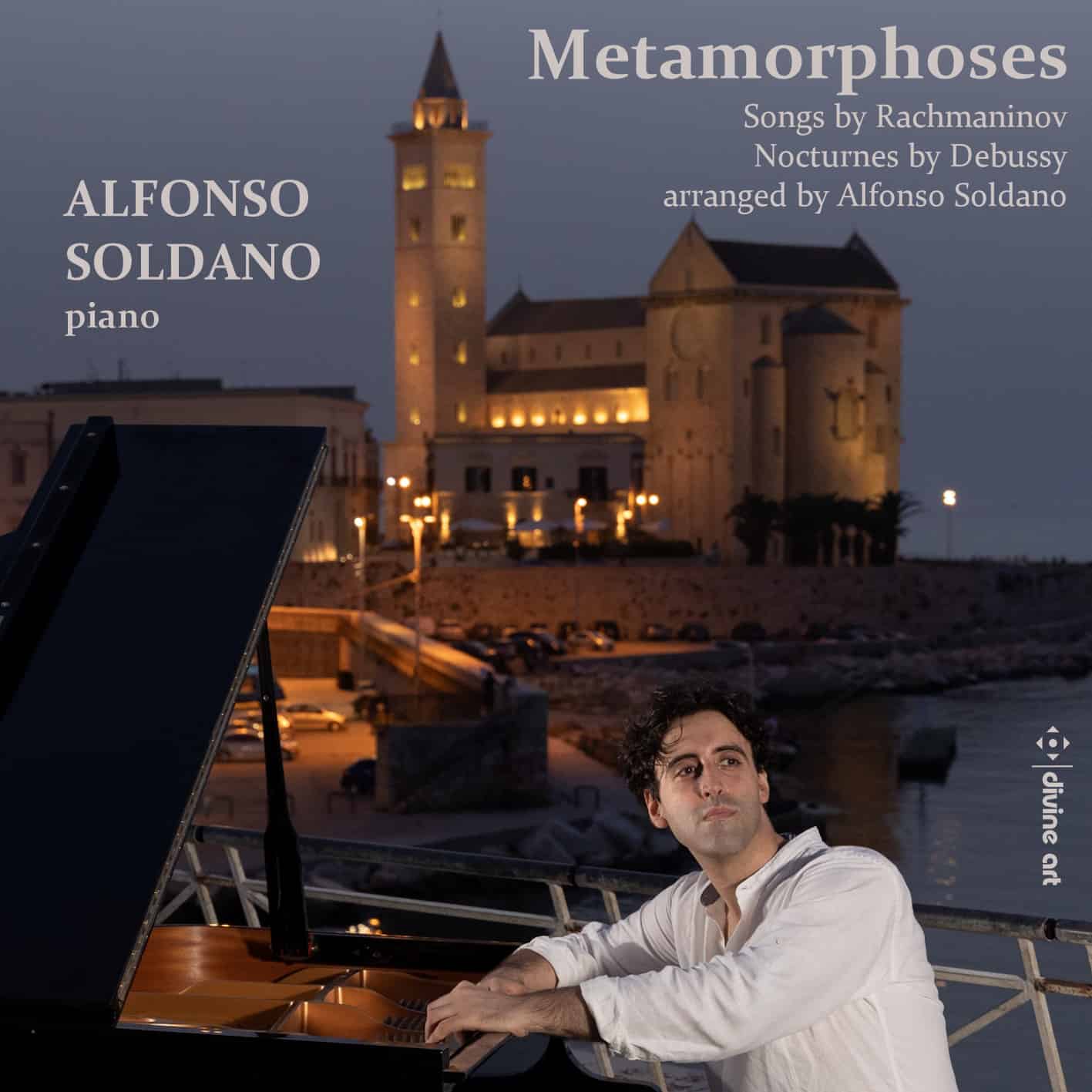
  • Metamorphoses

    Metamorphoses

    Alfonso Soldano is professor of piano performance at the Giordano Conservatory in Foggia, Italy, following similar posts at Santa Cecilia Academy in Rome and in Trani. He was a favorite student of Ciccolini and is renowned for his virtuosity. He was awarded the International Gold Medal for ‘Best Italian Artist’ in 2013 and has won many other competitions, and is also a busy writer and transcriber. His previous recordings for Divine Art, of the music of Rachmaninoff, Bortkiewicz and Castelnuovo-Tedesco, received glowing reviews. He has performed and given masterclasses all around Italy, and in Germany, Switzerland and Romania, and post-Covid is planning a wider international concert schedule, hoping to tour the USA.

    His Rachmaninoff is especially magical. He has transcribed 15 of the composer’s romantic songs for solo piano in three books of ‘Romances’ which he performs here with works by Debussy which Soldano has also transcribed. The album is a glorious, sumptuous immersion in late Romantic and Impressionist music which will appeal equally to classical experts and the wider general public. It is a collection of sheer beauty.