Catalogue Connection: 25216

  • Marius Constant orchestral works – review from Classica

    Though Turner has already been recorded by Louis de Froment (Phoenix) and the concerto 103 regards dans l’eau by Patrice Fontanarosa under the baton of the composer (Cybelia), these records are no longer available in the catalog. We will therefore enthusiastically welcome this new release. Anthony Korf reminds us in the liner notes of the Romanian childhood of Marius Constant before his eventual settling in Paris. The conductor (and creator of the Ars Nova ensemble) wanted to be the promoter of the music of his time; however the composer himself was set against the serial avant-garde, as evidenced by these three refined scores, which are in very French style: Turner shows him as a master manipulator of the timbres, the different combinations of which resonate with a painter’s palette. Following an extraordinary ever-changing soundscape, the most dissonant masses of sound gradually disintegrate, letting a flute solo suddenly pierce through the rustling grayness of the strings.

    Brevissima evokes Dutilleux’s Métaboles in the desire to merge different movements into a brief form, but Constant has a lyricism very much of his own, undoubtedly more noticeable in 103 regards dans l’eau. Never drowned out by a Riverside Symphony diligently conducted by George Rothman, Olivier Charlier’s violin illuminates this multicoloured bazaar of motifs, endlessly revived by an invisible lifeforce. (FIVE STARS AWARDED)

  • Musicweb review: Marius Constant Orchestral Works

    Marius Constant is one of those composers who, as the booklet notes for this release puts it, is “lamentably unsung”, but almost all of us will have heard at least some of his music – his authorship of the TV theme The Twilight Zone being just one of many little-known facts about this remarkable voice in 20th century music.
     
    This disc comes with a neatly made short film, ‘formatted for computer playback’, in which the Riverside Symphony’s directors talk about their discovery of the works recorded here, and also has some fascinating archival footage of the composer. Constant states that he is not an intellectual composer, but one with an intuitive approach both in terms of content and form, a point of view with which many of us might feel a close connection.

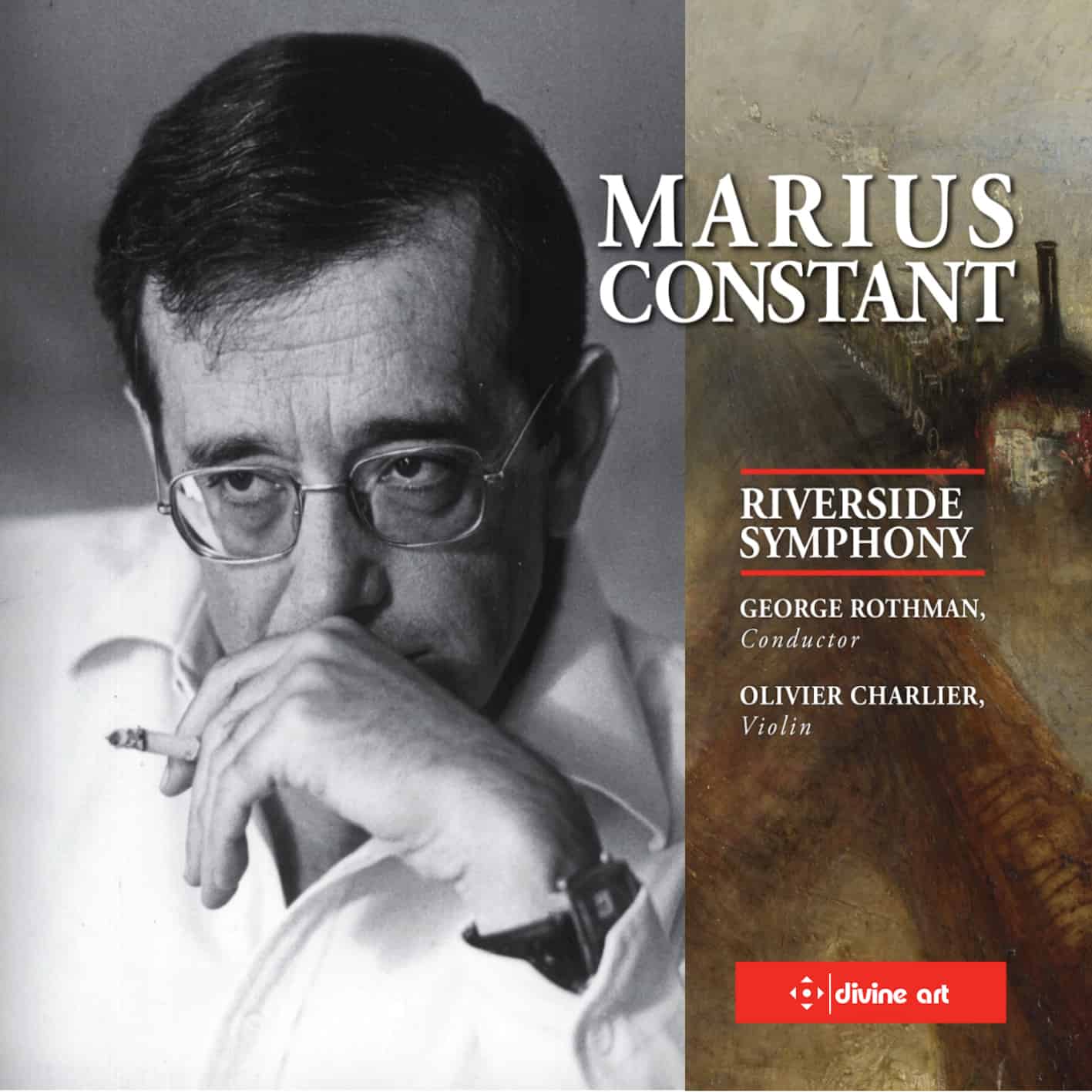
    Turner was inspired by Constant’s encounter with this English artist’s work in the Tate Gallery in London, and whose painting “Rain, Steam and Speed, The Great Western Railway 1844” fleetingly adorns the cover for this release, appearing clipped and in reverse on the booklet. The work is in three movements, the first, Rain, Steam and Speed being by no means the expected portrait of an iron juggernaut ploughing through the countryside. There is mystery and poetry here, as well as some heavy action which hints at the avant-garde trends of the 1960s, but handling them with lightness and translucence of orchestral colour. The second, Autoportret, is reflected on the back cover of the CDs gatefold package, the “unflinching, even unflattering projection of ambivalence, doubt and sorrow” of the artist’s gaze being seen as his ‘tormented’ side. This and the final movement, Windsor avoid caricature even in their most angular moments, Constant’s skill in balancing lyrical and rhythmic tensions creating its own fascinating sonic canvas.

    Constant was Romanian in origin, but like Dutilleux his orchestration always has an underlying Frenchness in its luminosity and a sense of restraint: of power held in reserve. Brevissima is a four-movement symphony “whose generative conceit is the super-compression of large form. The result is a unique homage to a grand tradition in ten riveting minutes.” There are moments of lush romantic sound here, alongside extreme contrasts of dynamics and mood. The atmosphere at times reminds me of Alban Berg in something like Wozzeck, where the drama is both underlying and constantly unfolding, full of chills and thrills and relatable human experience of one kind or another. In Constant’s own words, “the wager of Brevissima was to employ a massive sonority and sculpt it into a grand sonata form in a greatly reduced time frame; a discourse free of useless ornamentation, which… sought variety yet coherence, a narration surprising but convincing.” In this, Brevissima is supremely successful but quite dark, even with those passages of eloquent expressiveness and a slightly corny close.

    103 Regards dans l’eau or 103 Visions of Water is a violin concerto that derives its inspiration from “poetic celebrations of water” from a variety of literary and scientific sources. There are 103 titled ‘movements’ not reproduced in the booklet, the work here divided into the tracks of its main four sections, marked only by tempo indications. The dialogue between soloist and orchestra is almost entirely constant throughout the work, though it is clear from the outset that the violin is also in a dialogue with itself, a characteristic which at times rubs off into the orchestra, but by no means always. This is a violin concerto that can be heard ‘along more familiar guideposts’, but it takes on the concerto form in an almost entirely different way to classical conventions. Constant’s detail is more in the micro than in the macro, which is not to say that we get wrapped up in anything too hard to decipher, but if there are any grand candenzas or orchestral tuttis then these only last for what seems like a few bars before the waterscape changes. The final Lent section has some breathtakingly beautiful passages and sonorities.

    Superbly performed and recorded, this is a gem of a disc. The music demands time and attention, but rewards in equal measure. The excellent Riverside Symphony and its adventurous directors owe us our gratitude for bringing this rarely heard but fascinating repertoire to our attention.

  • Marius Constant Orchestral Works – Diapason review

    Opening a window to an inventive, playful and seductive style of modernity, the compositions of Marius Constant breathed a breath of poetry and freedom in the rather dry universe of the avant-garde at the turn of the 1960s. At the same time musical director of Roland Petit’s ballets, initiator of Ensemble Ars Nova (whose excellence could rival that of the Domaine Musical), and co-founder of France Musique, Constant continued to compose, to teach and to work in his other roles before rather disappearing from public view as when he left his native Romania.

    His quality is rare: the pastel colors and the sfumato of Turner (1961) which had enchanted the public of the Festival d’Aix-en-Provence in 1961 are rediscovered here with the same amazement. The evolution of its discourse, without being simplistic, is always organic, and therefore easy to grasp even in its contrasting reversals, its ruptures, its languor. If perhaps one can see a connection with the Pieces for orchestra op. 10 by Webern for the elegance of the impressions, we have a greater sense of Dutilleux’s Tout un monde lointain (1969). In short, a masterpiece which, if the programs of French orchestras were concerned with reconciling their audiences with the music of the second half of the twentieth century, would abolish prejudices – even without the absolute perfection of the Riverside Symphony.

    More massive in color as in their structure are the four movements of Brevissima (1992). This condensed symphony deserves much performance for the height of its qualities. Composed for Patrice Fontanarosa (who premiered it in 1981 and recorded it for Cybelia), the violin concerto 103 regards dans l’eau is more in tune with the modernity of its time, except that it sounds better thanks to the infallible meaning which Constant provides, for the associations of  impressions in the fusion of the parts as well as in the contrasting opposition. Omnipresent and abundant, the solo part, never overshadowed by the orchestra, is a work of extremely brilliant, ostentatious and sometimes verbose virtuosity. If the crystalline introduction and the poignant finale concentrate the interest, this thirty-minute fresco does not make you regret the ideal performance of Olivier Charlier.

    (translated from the original French)

  • Marius Constant – Fanfare review (2)

    Four concertos by Marius Constant, recorded back in 1990, show him as highly eclectic. His modernist, tonally sophisticated language incorporates diverse influences including modern jazz, classical structures and ethnic music. To give you an idea of the breadth of his musical interests, the three movements of his Saxophone Concerto are titled Raga, Tempo di cakewalk and Passacaglia. One of his concertos is for barrel organ; its second movement is a free fantasia on a theme by Beethoven. Until now, that Erato concerto disc seemed to be the last new recording fully devoted to Constant’s music. The only recent releases have been two performances of his idiomatic orchestration of Ravel’s Gaspard de la nuit.

    The composer was born in Bucharest in 1925 but spent his adult life in France where he wrote several ballet scores for Roland Petit, founded the Ars Nova Ensemble, conducted frequently, was director of dance music for the Paris Opera, and taught at the Paris Conservatoire. An individualistic composer, Constant’s career was hampered to some extent by the fact that he did not run with the Boulez crowd. The avant-garde criticized his eclecticism as superficial, to which Constant quoted the Romanian philosopher Emil Cioran: “No one achieves frivolity without a struggle.” His best-known piece of music is the theme to the 1950s sci-fi television program The Twilight Zone, which was actually assembled from musical fragments he submitted to CBS as all-purpose dramatic stings. He died in 2004; none of the obituaries mentions anything about his personal life.

    The three works on this CD span thirty years. The earliest is Turner from 1961, a suite of three tone pictures after paintings by J. M. W. Turner (often cited as the “first Impressionist”). The paintings are Rain, Steam and Speed (the painter’s masterly depiction of a speeding train from 1844), the rather ambivalent Self Portrait and the somber hunting scene Windsor. Constant, who described himself as an “instinctive” composer, is revealed as an evocative orchestral colorist in these pieces.

    From 1981 comes a substantial work for violin and orchestra: 103 Regards dans l’eau (103 Visions of Water). Although in 103 short movements (!), each inspired by a particular view of water, the work also falls into an obvious four-movement structure, albeit with the slow movements at the beginning and the end. It is, as you would imagine, very fluid, but the music grows organically and the piece does not come over as fragmentary. The violin part is virtuosic in true concerto style with many solo passages, and the orchestration subtle and colorful as in Turner. Harmonically it is tonally based but contains avant-garde devices such as clusters, and no clear tonal center: the composer most closely suggested is Constant’s friend Henri Dutilleux. I can’t say I quite have this concerto’s overall measure yet––this review was written, of necessity, in some haste––but several sections stand out as adroit post-Impressionist waterscapes.

    Brevissima, from 1992, is nothing less than a symphony, with an opening adagio leading to a symphonic allegro, a scherzo movement, a largo, and a passacaglia finale “qui culmine près d’un soleil brúlant” (to quote the movement’s title). The reason it is called Brevissima is because all this, with the requisite symphonic development of a recurring four-note motto, takes place over the course of ten minutes. Constant’s contraction of symphonic form is deftly done––the three-minute first movement even contains a gentle coda––and again the orchestral sonorities are a highlight.

    I might add that none of these works is remotely jazzy, nor do they sound like The Twilight Zone, and they are far from superficial or frivolous. Both Turner and 103 Regards dans l’eau have been recorded before, the latter with the composer conducting the Berlin SO on a Cybelia disc that is now close to impossible to find, and again in a version that uses a reduced orchestration of 12 instruments. I have not heard either of these. I requested the new disc because of my previous interest in the composer, little knowing it would be such a knockout. Conductor George Rothman and artistic director/resident composer Anthony Korf founded New York’s Riverside Symphony in 1981. They play these works stunningly, and you understand why when you see the video interview where Rothman and Korf speak about the music with reverence and enthusiasm. (The video also includes an illuminating archival interview with the aged Constant.) Violinist Olivier Charlier’s previous recordings include the Dutilleux Violin Concerto “LArbre des songes” (with Yan-Pascal Tortelier on Chandos) so Constant’s concerto suits him admirably, and he plays it with élan. The musical standards are matched by the sound quality, which is first rate, the balance revealing the many details that make this composer’s music so fascinating. Charlier’s violin is recorded quite closely but that is no problem; in fact, it is an asset. Want List material without a doubt.

  • Marius Constant – Fanfare review (1)

    Marius Constant, when he wasn’t known for writing the Twilight Zone theme song, was mostly known as a ballet conductor for Roland Petit in Paris and the occasional composer of modern works, yet his own compositions never quite made it into the mainstream of the classical repertoire. A pupil of Olivier Messiaen, Tony Aubin, Arthur Honegger, and Nadia Boulanger, Constant had a restless mind, composing such works as Haut-voltage, Contrepointe, Cyrano de Bergerac and Éloge de la folie, and won wide recognition when Leonard Bernstein premiered his 24 Préludes pour orchestre in 1958. Two years earlier, in 1956, Constant jotted down s short (40-second) piece that he liked but had no immediate use for. Three years later, he submitted it in an international contest sponsored by CBS television to find a theme song for Serling’s proposed new show. It came to define him in America, which is a shame because his other music is powerful and fascinating.

    Judging from the works on this disc, Constant’s style was one of sonic contrasts, one might almost say clashes, utilizing a sparse orchestral palette. Although his formal music, like the Twilight Zone theme, alternated quasi-tonal passages with jagged shards of melody, one would have to call him an essentially tonal composer who worked with modes and chromatics. He was not a 12-tone composer, which, the notes say, is partly the reason he did not receive international fame. I used to try following his career through the years, but in those decades before the Internet all you could really find out about him is that he was a first-rate conductor, particularly of ballet but also of opera and occasionally symphonic music. We heard that he was also a fine composer, but nothing much was recorded. The works on this disc, however, are really and truly outstanding.

    Tonal yet abstract seemed the best description of his style. One feature that impresses the listener in all three of these works is that, for Constant, the initial inspiration for a work seldom dictated form or content. Unless one were told that the opening suite of three pieces were an homage to the great British painter J.M.W. Turner, for instance, it would be the last thing that would come to mind. Constant internalized aspects of the person or thing that inspired him and wrote to his own aesthetics. Although Brevissima was written 31 years later, its style and overall structure are very similar to Turner. In this work, however, I didn’t particularly like the very end, which just came to a crashing climax and then stopped, but most of the music is superb as is the playing of the Riverside Symphony.

    By far, the most involved and involving work on the CD is the violin concerto, 103 Regards dans l’eau. Composed in 1981, it owes a bit in form and style to the violin concerto of Alban Berg, yet maintains much of Constant’s own personality, particularly in the orchestral accompaniment, which alternates between sparse (and sometimes non-existent) and powerful. My personal impression is that Constant was a composer who thought more in shapes than in colors. I “hear” spirals, trapezoids, and interlocking rectangles in his music, but in terms of timbre his basic colors are black and silver. There is light in his music but it is always a white light, either diffused or (more frequently) sharply etched against angular black shapes. The music builds and flows through the four movements which are marked in terms of tempo but nothing else. In the second movement (Agité, dotted quarter note=80), the fleet solo violin figures sound furtive and frightened, as if running for their lives until a percussion outburst slows the soloist down for the rest of its duration. Our soloist, Charlier, is a first-rate technician who fully enters the spirit of the music. Constant’s music—even the Twilight Zone theme—always sounds to me like the fabric of dreams. They are unsettling but not frightening dreams; one seems to be unable to find solid ground through most of it, but somehow you always come back down at the end. This violin concerto is no exception. After nearly a half hour of feeling weightless and unable to connect with anything tangible, the music ends on a tonic chord. It’s a soft, high tonic chord, but you still feel that there is closure.

    The 15-minute video (which plays through Adobe, not Real Player or Windows) features conductor Rothman and artistic director Anthony Korf speaking about Constant and his music, interspersed with archival footage of the composer talking and conducting. A few brief moments are also shown of one of his greatest triumphs, the Cyrano ballet that he wrote for Roland Petit. Constant explains that the reason he stayed so long with Petit was that he wanted to get to know how to write for the theater, how to balance “action and rest, tension and release.” He also makes it clear that he was not an intellectual composer but instinctive, that he eschewed traditional classical forms to make up his own. We also learn that although one hears 103 Regards dans l’eau as a violin concerto, it is in fact made up of 103 separate shards of music. Korf speculates that it may be the only piece of music to do such a thing. Of course, none of this would mean anything if the music were not so gripping and moving, but it is, as are the performances of it. This is a desert-island disc.
  • Marius Constant; review from Classics Today

    (nb this review was published in 2015 on the initial limited release of the album)

    French-Romanian composer Marius Constant (d. 2004) is best known in this country for his theme music to The Twilight Zone. This probably gave him a higher profile than he ever enjoyed in France. He is also noteworthy as a conductor, an excellent one, whose recordings for Erato of contemporary French music, Messiaen especially, remain reference versions to this day. He was not a member of the Pierre Boulez mafia, and so like his colleague Dutilleux he was neglected–relatively speaking–for much of his career. Now that the stifling effect of Boulez and his cronies seems to be passing, it may finally be possible to gain a fair assessment of French music over the course of the 20th century. If that happens, Constant’s achievement will surely rank high.

    Like Dutilleux, whose music his output sometimes resembles, Constant subscribed to no system. He is not terribly tonal, but it doesn’t much matter. His textures and harmonies are often beautiful, mysterious, and atmospheric. He is a “chord guy”, meaning that his music is best listened to moment by moment, for its ever-changing density and its degrees of light and shade. Thus, his Violin Concerto “103 Regards dan l’eau” (“103 Visions of Water”), really does consist of 103 tiny sketches, but grouped into four movements. It is wonderfully written for the soloist given the inherently songful nature of the violin and the initial, seemingly fragmentary premise; and for all that you might think otherwise it holds together very impressively.

    Brevissima is a 10-minute-long pocket symphony, a single sonata-style movement articulated in four short sections and culminating in a passacaglia finale, but Constant handles his counterpoint subtly, using it to achieve a fulfilling climax. Turner is an aptly colorful and evocative tone poem based on the English master’s paintings. There are three movements: “Rain, Steam, and Speed”, “Self-Portrait”, and “Windsor”. All of this music repays repeated listening–it may sound elusive at the start, but as soon as you penetrate its sound world you will begin to enjoy its masterful exploitation of the orchestra as well as its expressive range. It isn’t “easy” in the sense that it never uses traditional melodic signposts, but it’s not at all difficult to follow, and Constant never indulges in pointless complexity for its own sake.

    The performances here are excellent. Both Turner and the Violin Concerto have been recorded previously, but don’t bother trying to find those earlier versions. The Riverside Symphony is a Manhattan freelance orchestra of professional calibre, capable of doing superb work under music director George Rothman. They certainly do here. Rothman conducts with loving attention to details of balance and rhythm, while soloist Olivier Charlier is, as we know, an artist of international repute. What a difference this enterprising, self-produced release represents as compared to the heaps of worthless new versions of repertory warhorses coming from allegedly “major” orchestras on their own proprietary labels (think: overpriced Schumann symphonies from Rattle and Berlin). In other words, this release deserves your support and, more to the point, will reward your time and attention. The sonically excellent CD also contains a video about Constant, which I have not viewed on the principle that if the music does not speak on its own terms, it’s not worth the effort. If I can tear myself away from this marvelous music, maybe I’ll watch the video someday soon

  • Marius Constant: Infodad review

    The symphony orchestra remains the ne plus ultra for tonal color and communicative potential using the widest variety of sound worlds and combinations. As a result, composers continue to search for new ways to use symphonic forces for a large variety of expressive purposes – and to make a great number of points with, to and for listeners. Those points are not necessarily made in traditional concert halls: some very fine and classically trained composers are known primarily for their contributions to popular culture – Dimitri Tiomkin and Bernard Herrmann for films, for example, and Marius Constant (1925-2004) for a single work for television: the theme for The Twilight Zone. But there is considerably more to Constant than that: his ballets still garner occasional performances, and his symphonic works, on the basis of a new Divine Art release, are certainly worth the occasional hearing.

    The three pieces performed by the Riverside Symphony under George Rothman have very different intentions. Turner (1961), as its title is intended to indicate, is inspired by the paintings of J.M.W. Turner (1775-1851). The first movement reacts to Rain, Steam and Speed (1844) with a suitably atmospheric portrayal; the second to Self-Portrait (1799) with a focus on drama; and the third to works including Windsor Castle from the Thames (1805) and Windsor Castle from the River (c. 1807) in a style mixing the impressionistic with the suitably magisterial. Listeners unfamiliar with the specific Turner works to which Constant is reacting will hear well-proportioned music whose connections to particular topics are less than obvious.

    Brevissima (1992) is a more-interesting work: an entire four-movement symphony boiled down to a mere 10 minutes. The rather scattered-sounding Scherzo, placed second, is the most unusual movement; the concluding Passacaglia funèbre is the most intriguingly structured. The piece is, in truth, somewhat too compressed, hinting at the symphonic rather than actively seeking it. But, like Constant’s music in general, it shows a fine command of orchestral forces.

    The longest work on this disc is a four-movement violin concerto from 1981 called 103 Regards dans l’eau (“103 Poetic Celebrations of Water”), featuring violinist Olivier Charlier. Two slow movements frame two faster ones here, the violin making its primary points mainly in its top register and the work as a whole coming across as rather self-indulgent and self-consciously “modern” in sound. It is an interesting piece but not a particularly engaging one, although, again, the writing for orchestra – and for the solo instrument – is impressively self-assured. The CD offers more insight into the composer than audio recordings usually do, because it also contains video material: a discussion of the music with Rothman and archival footage of Constant, with all the video formatted for computer playback. This additional quarter-hour of material certainly broadens the scope of the almost-hour-long audio portion of the disc, although really, the music needs to speak for itself rather than through the video – and it does so, telling listeners that Constant was a skilled if perhaps not highly innovative composer who handled orchestration with considerable ability even though the underlying ideas and sounds of the works heard here are not particularly original.

  • Marius Constant Orchestral: MusicWeb Review

    Marius Constant was born in Bucharest but made his lifelong base in Paris from 1945 until his death. He studied conducting with Jean Fournet and composition with Nadia Boulanger, Olivier Messiaen and Arthur Honegger.

    His first notable orchestral work was Twenty-Four Preludes for Orchestra which was premiered by Leonard Bernstein and the French National Orchestra in 1959. George Rothman, the conductor here, studied with Bernstein. The Constant work-list includes seven operas, seven ballets and works in pretty well every other format. His most popular piece is the theme from The Twilight Zone (1959). This was not his only foray into work for the small and large screens. With ORTF forces he recorded extensively for Erato, both his own music and that of Messiaen and Varèse. Erato also produced a CD of four of the concertos (horn, organ, saxophone, trombone) under Jerome Kaltenbach. His orchestrations of the work of other composers include those of Ravel and Debussy – the latter in Pelléas et Mélisande –
    “A Symphony after the opera”.

    He was amicably associated with Henri Dutilleux. Until hearing this disc I knew very few of Constant’s works but these three orchestral pieces occupy a flighty avant-garde niche. The music muses sourly, crashes with insolence, swells with turbulence and occasionally sings out though rarely in total surrender to uncomplicated cantilena.

    Messiaen’s side-ways influence can be heard, from time to time, in Turner. Bleak, curdled, and certainly affluent in atmospheric effects, Turner is in “The Three Essays”: ‘Pluie, Vapeur et Vitesse’; ‘Autoportrait’ and ‘Windsor’. In making links to the images, I have guessed which of several ‘Windsor’ paintings the last Essay relates to. The work dates from the early 1960s. It is open to remark that Constant was gripped by the British Turner when he had a pantheon of Impressionists from France to choose from. ‘Autoportrait’, presumably Turner’s and perhaps Constant’s self-portrait, suggests the composer readily picked up and amplified jagged anger and this mood carries over into ‘Windsor’.

    There are four short movements in Brevissima (“A symphony in four movements”) from three decades after Turner. The music still crashes and heaves but the voice of Debussy is closer to the surface of the mix. It sears and moans but is concise and Constant allows himself the luxury of a wind machine in the last movement. There are also some very frank echoes of the orchestral Debussy.

    The French violinist Olivier Charlier developed his musicianship under the aegis of Henryk Szeryng, Yehudi Menuhin and Nadia Boulanger, one of Constant’s own teachers. Charlier’s recordings, many of which were made with Chandos, include concertos by Dutilleux, Lalo, Gregson, Gerard Schurmann, Mendelssohn and Saint-Saëns. Here Charlier follows in the footsteps of recordings of the concerto made by Rodrigue Milosi and by Patrice Fontanarosa under the composer; the latter on a Cybelia disc and coupled there with the Constant’s Nana Symphony. The Concerto is contemplative and at times (as in the last of the four movements) floats freely with an almost Waltonian lyricism. The recording is once again exemplary and reliably communicates the score’s tensile strength and its exploration of the extremes of dynamic.

    The disc is completed by an eleven-minute video (which I was not able to access – problems with my PC, not with the CD) about Constant. You are guided through the experience of Marius Constant’s world by George Rothman and Anthony Korf; the latter wrote the useful and extensive booklet note.

    Not for faint hearts then. Those who persist will hear lyrical impulse given treasured expression amongst the thrawn pages and thorny conflicts.

  • Marius Constant: Orchestral Works

    Marius Constant: Orchestral Works

    Marius Constant (1925-2004) was born in Romania and began formal music education at the Royal Bucharest Conservatory at the age of 11, also being enrolled in the Lycée Français: he later moved to France where he developed his remarkable career. Best known in musical circles for his ballets, and by the general public for the Twilight Zone theme, he is truly one of the 20th century’s most gifted and inspired composers, and one of the most cruelly overlooked. His orchestral works here are inspired by nature and art and encompass beauty and emotional power in a unique contemporary style.

    The Riverside Symphony was founded in 1981 and comprises many of the best of New York’s finest musicians. Acclaimed for its devoted championing of unfamiliar and new works, its annual concert series at Lincoln Center have brought much praise for their innovative programming. Olivier Charlier, soloist in 103 Regards dans l’eau, has been recognised internationally for his superlative playing; he has played with over 50 French orchestras as well as orchestras from around the world.

    This album was originally released by Riverside in 2014 but in the USA only. It includes a video with archival clips of the composer and discussions with the orchestra directors (formatted for computer playback).