Catalogue Connection: 25217

  • Robin Stevens: Cello and Piano – BMS review

    Several of the twenty numbered items on this CD reveal Robin Stevens to be a very individual and exploratory composer. This is especially true of the first of the two longer works on the CD. The Sonata Romantica for cello and piano’ does not instantly come across as a ‘romantic’ work. Referring not to this piece alone, but to many of the shorter ones, Stevens writes, ‘the cello’s melodic lines just maintain a hold on tonality in the face of dissonant, staccato piano accompaniments’. In the Sonata, the piano is mostly not an accompanying instrument at all. Both players have starring roles, equally radiantly performed by cellist Nicholas Trygstad and pianist David Jones. 

    At the beginning of the work and in its final two minutes, cello and piano are together in a more traditional format and in these last moments, the idea of ‘romantic’ certainly shines through. Elsewhere, the solo instruments indulge in conversation or even impassioned argument. The cello is a ‘singing’ instrument while the piano basically is constructed as a percussion instrument. Robin Stevens latches onto those sound ideas and develops them throughout the work. Its brilliance lies in the way that Stevens makes the instruments sound so different and yet marries them together so well throughout even the most argumentative passages.

    The second larger work on the CD could not be more different. In the five movement Balmoral Suite depicting members of the Royal Family in their Summer visits to Balmoral, the piano is a perfect accompanying instrument throughout a series of attractive traditional Scottish dance-style tunes. This is ‘easy listening music’ (whereas Sonata Romantica is not).

    There are two groups of ‘character’ pieces for cello and piano. In each, one movement stands out: Clockwork Toy and A Short Ride in a Dangerous Machine (not to be confused with the John Adams minimalist piece for full orchestra). These two pieces are amusingly pictorial in their impact.

    There are four pieces for solo cello following on the tradition of J. S. Bach and later Britten. Stevens is himself a cellist and these pieces further investigate the solo capacities of the cello.  The final piece, A Birthday Trifle, accords with the easy listening pleasure of Balmoral Suite, so this recording, depending on the pieces, could both test and delight the listener.
  • Music Web review Robin Stevens music for cello and piano DDA 25217

    The first piece, the large-scale Sonata Romantica for cello and piano, is difficult to sum up. Robin Stevens takes three pages of the booklet to explain and analyse what is happening. The blurb for this disc describes the Sonata as “a searing […] a single-movement, half-hour epic of the genre”, and that is correct. Structurally, it would seem to consist of an introduction, exposition and development, but there is no formal recapitulation. Throughout, echoes of themes are constantly heard. There are solo passages for the cello and for the piano. The composer describes this as “conversational”. It would really be what any sonata is about unless it is just a solo tune with vamped piano. There is much beauty here, yet sometimes I feel lost with the work’s progress. Is it too long? I am not sure; a score would help. I feel that successive hearings could reveal this piece to be one of the great Romantic cello sonatas in English music. But will listeners invest the time and study?

    Three Epigrams for cello and piano are very short; the longest is just over a minute long. The pieces – ForebodingGentle Lament and Clockwork Toy – are not Webern-esque in form or aesthetic. Ingeniously, they balance melodic tonality with dissonant piano accompaniment.

    Carried on a Whimsy for solo cello is a good example of Stevens’s eclecticism. This miniature plays off various compositional devices. There are microtones, lyrical moments, virtuosic passages and vivid statements. The work ends gloomily.

    Three Character Pieces for cello and piano are atonal, with just a hint of a key here and there. The titles are grander than the music: Thunder in the SoulWistful Chorale and A Short Ride in a Dangerous Machine. There is to my ear nothing wistful about the chorale: it is intense and quite disturbing. The finale is really a brash moto-perpetuo. Is it meant to echo John Adams’s Short Ride in a Dangerous Machine? I think not. There is nothing even post-minimalist about Stevens’s angular and unpredictable score.

    Talking about comparisons, there is an allusion to Elgar’s heart-breaking Sospiri for strings, harp and organ, in Robin Stevens’s take on “Sighs”. This is a study in glissandi for cello. It lacks a sense of direction and seems to be a technical exercise.

    Microtones reappear in On the Wild Side for cello and piano. This is definitely “expressionist music” (avoiding “traditional forms of beauty” to convey powerful feelings), with much scurrying of cello accompanied by brief staccato piano chords. The liner notes rightly describe this as a “cataclysmic whirlwind of a piece, which concludes with the listeners having a door firmly slammed in their faces”. This is one of the most fun numbers here.
     
    A Probing Exchange for solo cello is a highly charged miniature, full of dissonance, dashing passagework and arpeggiated chords. It is over in a flash.

    The Balmoral Suite for cello and piano is pure light music, a long way from any “ism”, originally scored for recorder and piano in response to a commission by John Turner. Stevens insists that it is a pastiche on Scottish folk music with an occasional contemporary twist thrown in for good measure. An overture, A Family Gathers, parodies several musical forms including a march. There is no need to ponder which family is intended. The second movement, Grandpa Hankers for the Past, is a portrait of Prince Charles, with a distinct nod to rococo music. There follows a graceful and quite lovely tribute to Catherine, Duchess of Cambridge. The penultimate movement, Enter Great-Grandpa is a respectful homage to the late Prince Philip. Listen for the scotch-snaps and a gentle gait of “a gentleman in extreme old age, still endeavouring to live life to the full”. The finale, Rough and Tumble in the Nursery, reflects the “younger family members” full of joie de vivre. It is always the sign of a good composer when they can turn their hand from complicated “art music” to something immediately approachable and quite simply entertaining.

    The first of four short pieces that conclude this recital is Much Ado About…? Devised for solo cello, it is the least successful on this disc. It does not appear to have an end in sight, hence the question mark. Stevens writes that it is full of “cheeky insouciance”.

    Say Yes to Life for cello and piano was written for a friend experiencing a difficult pregnancy. The composer throws all sorts of rhythmic and melodic snatches at the listener. The liner notes suggest that this vibrant work is programmatic. I suggest listening to it absolutely as a kind of toccata.

    I would never have guessed that Unfailing Stream for solo cello was “a probing, almost mystical composition […] whose continuous flow of melody depicts the Holy Spirit constantly working to inspire faith and love in the life of a Christian”. I found it quite beautiful but just a little long-winded.

    The two-minute Birthday Trifle for cello and piano commemorates Stevens’s own sixtieth. Despite the intrusion of modernist microtones, this is fun. The jazzy opening and sub-pop tunes lend delight to this little “encore”.

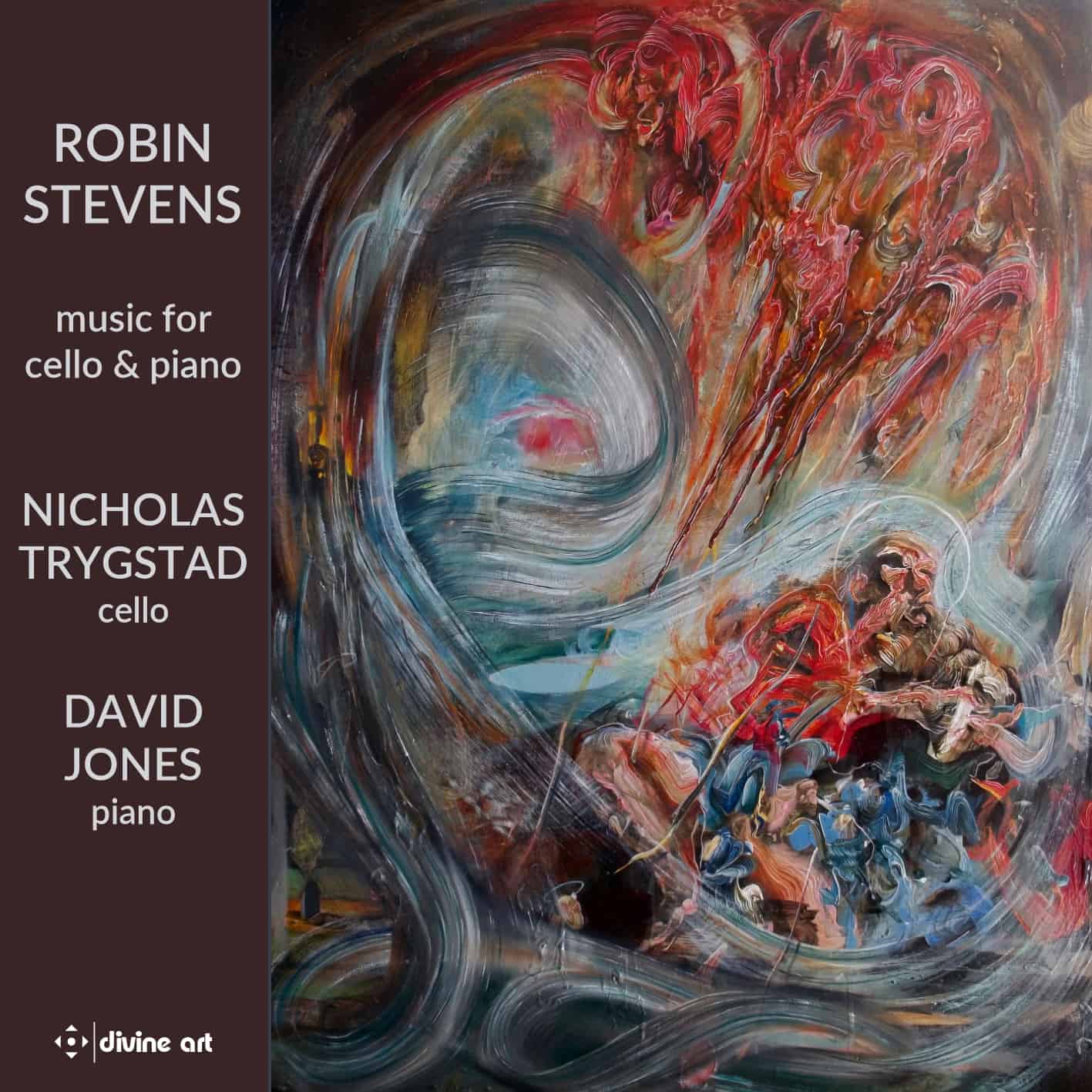
    Details of Robin Stevens’s life and work appear on his excellent webpage. In this review, I have concentrated on the music rather than the playing. All the works seem to be premiere recordings, so there is nothing to compare, but one can conclude that cellist Nicholas Trygstad and pianist David Jones are sympathetic to Stevens’s complex, technically demanding and often wide-ranging music. The recital is helped by a vibrant and clear recording. The composer’s detailed notes, brief biographies of all concerned, several photographs and Iain Andrews’s inspiring cover graphics – all this makes for an ideal booklet.

    Robin Stevens’s style is characterised by “Beethovenian motivic development; rhapsodic, modal lyricism; bold, dramatic gestures; tangy harmonies; intricate counterpoint; and unashamedly direct, open-hearted expression”. It is an absorbing and satisfying combination.

  • The Chronicle review Robin Stevens Cello and Piano DDA 25217

    Unlike the Bartók album also reviewed this week, this more modern album is not quite so instantly accessible but despite its modern and sometimes austere sound it’s a long way from being difficult.

    The PR says that Stevens writes “stimulating and expressive” work influenced by everything from the music of the Romantic era to mathematics and the eclectic nature of the composer means that something interesting is never far away. The sleeve notes are also excellent, Stevens explaining each piece in some detail, both technical and not so: “The soaring, aspirational cello melody of the opening leads into faster music of a restless, scurrying character … the unborn baby is represented by a mocking theme familiar to all children — ‘naanaa — na-naa-naa’”.

    An accomplished cellist, Stevens suffered for many years with post-viral fatigue, which he also writes about.

    Although there are shorter works for cello and piano and some moments of wit, the album opens with the 27–minute Sonata Romantica, a more serious work. Stevens explains that all the musical material of the sonata appears within the first five minutes, later developed and varied, “seeing the same landmarks from different viewing points”.

    This longer piece is followed by Three Epigrams, all clocking in around one minute, Clockwork Toy the longest and most entertaining. “Carried on a Whimsy “employs microtones to more serious expressive intent” says the composer but is generally pleasantly melancholy, and sounds more traditional, with some impressive playing.

    The frantic and slightly obsessive A Short Ride in a Dangerous Machine deserves a mention for Stevens’ comment: “The sense of risk — actual, rather than imaginary for any musicians reckless enough to attempt a performance of this extremely demanding piece — is heightened by the unpredictable and ever- changing bar-metres.”

    In many ways the album is defined by the closing piece A Birthday Trifle, written by Stevens for his own 60th birthday party, as you think that anyone who can write something this joyful deserves a listen, helping the listener get over the more challenging modern sections.

    The best (ie easiest) section is the light and easy Balmoral Suite, a commission from John Turner, who premiered the original recorder and piano version in Manchester in 2017, and is an affectionate tribute to a well-known family who spend their summer holidays in the Highlands. This five-movement piece combines Scottish folk music with occasional modern twists thrown in. Movements include Grandpa Hankers for the Past (a nod to the conservative taste of Prince Charles), and Enter Great-Grandpa, a tribute to the late Prince Philip.

    Well worth a listen if you like some modernity.

  • Robin Stevens: Music for Cello and Piano

    Robin Stevens: Music for Cello and Piano

    The British composer Robin Stevens (b. 1958) is a great talent who is being discovered by the global music community, due in part to the critical acclaim given to the two previous Divine Art albums of his music. His varied, stimulating and expressive work arises from many influences – from the music of the Romantic era, to mathematics, his faith and inspiration of his teachers, and he is now producing substantial works for varied instrumental groupings, which are modernist and original, but yet immediately accessible.

    An accomplished cellist himself, Stevens has produced a body of work for the instrument which should become part of the regular repertoire. On this album, works for cello and piano stand alongside pieces for solo cello, from the substantial 27–minute Sonata Romantica to several compositions in a lighter, tonal style full of Stevens’ wit and humour. Written between 1994 and 2020, they present a diverse range of expressionist and gently modernist sound worlds

    American cellist Nicholas Trygstad moved to England in 1998 to study at the Royal Northern College of Music. He became principal cello of Scottish Opera and from 2005 the Hallé Orchestra, and is very active in both solo recitals, chamber concerts and his teaching duties both at the RNCM in Manchester and also now with NYO Inspire.

    David Jones is Head of Accompaniment at the Royal Northern College and pianist for the Hallé Choir, and has given premiere performances of works by a number of prominent British composers. His previous recordings include three albums of music by Jeffrey Lewis, attracting the comment “not to be missed”: by Gramophone. Both Nicholas and David have appeared on previous Divine Art / Métier recordings.