Catalogue Connection: 25218

  • Fanfare review: Antiphonies (Carson Cooman organ music 14)

    This is Volume 14 in the ongoing series of discs of Carson Cooman’s organ music, performed as usual by Erik Simmons. I have reviewed about half of the total, mostly positively, and this one also goes on the plus side of the ledger. All of these pieces were composed between 2013 and 2020.

    Fantasia canonica was written for the installation of Charissa Simmons as Canon for Children and Families at the Episcopal Church cathedral in Portland, [Oregon]. (It is not said if she is any relation to Erik Simmons, though a joint commission by them mentioned elsewhere in the notes suggests that they are.) The theme of the piece is derived from conversion of letters in the dedicatee’s name to corresponding musical notes. (Fellow Fanfare critic, friend, and composer David DeBoor Canfield wrote a piece for my wedding in 2005 that derived its theme using the same technique.) The piece has an air of stately but celebratory gravitas. Two from the British Isles employs an easily recognizable pair of well-known hymn tunes, “Kingsfold” and “Hyfrydol,” as thematic bases for a prelude and postlude to a church service; the former is more contemplative, the latter rather energetic, as if to propel parishioners out of their pews. Three Autumn Sketches after a Watercolor by Maria Willscher is, as the title indicates, cast in three movements, titled “Herbststimmung” (Autumn Mood), “Herbstfarben” (Autumn Colors), and “Sonnenuntergang” (Sunset). The lovely watercolor in question is thoughtfully reproduced in the booklet. (While again there is no information provided, I presume that Maria Willscher was related to—perhaps the mother of—Cooman’s colleague and friend, Andreas Willscher, whose works I have also reviewed in these pages.) All three movements are slow-moving, meditative, and subdued; but I wish to single out Sonnenuntergang as an absolutely gorgeous, deeply moving, prayerful piece, one for which the cliched remark “I want that played at my funeral!” would be completely appropriate. This brings us to my one regret regarding this disc: The mood is rudely broken by the loud, dissonant opening chord of the next work on the program, A St. Patrick Silhouette. A different ordering of the contents of this disc to avoid such a jarring jolt would have been far more appropriate. (I suppose that’s why the “program tracks” function on a CD player exists.) The piece itself, which is divided into several distinct sections, is effective enough in suggesting the turmoil of the saint’s life, though it is not one of my favorites in Cooman’s oeuvre.

    The disc gets back on track for me with St. Michael Antiphonies, which belies its title by being a delightfully tuneful work with a lively, jumping dance theme. Desert Marigold offers an oasis of botanic stillness, as if one were watching the flower slowly unfold (or better, refold) against a gradually encroaching twilight background. Prelude del ricordo (Prelude of Remembrance), according to Cooman, “was thought of in reference to the numerous lives lost during the COVID-19 pandemic.” If that description suggests something quiet and contemplative, think again; most of the piece is dramatically assertive. To my ears, it does not suggest anger, but rather a steely determination that those lost should not be forgotten, but vividly remembered and treasured.

    The closing work, Suite circulaire, is another triptych, with movements titled “Praeludium,” “Ricercare,” and “Toccata.” Cooman states that his objective in crafting this suite was to take “a free, contemporary approach to the historical genre of ‘circulating’ (or modulating) compositions, where the basic material moves through a variety of keys before returning ‘home’ again. The goal is not simply to play a modulation ‘game,’ but rather to construct a true musical discourse where the varied keys are an essential part of the concept.” This is the other work on this disc that I find to be less than a complete success. In the first movement, a grupetto-like four-note motif is repeated far too often for its own good; if Cooman were to cut the length of the movement by about a third, he would greatly strengthen it. I have no criticisms of the other two movements; the “Ricercare” provides a quiet interlude, and the “Toccata” a predictably vigorous, even violent, virtuoso finger- and foot-busting closer. As before, Erik Simmons presents Cooman’s works in the best possible light. The instrument, at the Propsteikirche St Ludgerusin Billerbeck, Germany, was recorded remotely using the Hauptwerk system employed on several previous releases in this series. It is a modem instrument, constructed by Orgelbau Fleiter in 2014; it definitely has a modem sound palette rather than one of a German Baroque or Romantic organ, but one that is not unattractive. Anyone who has been collecting this series of discs will definitely want this one as well; it is worth the price for the Sonnenuntergang alone. Recommended.
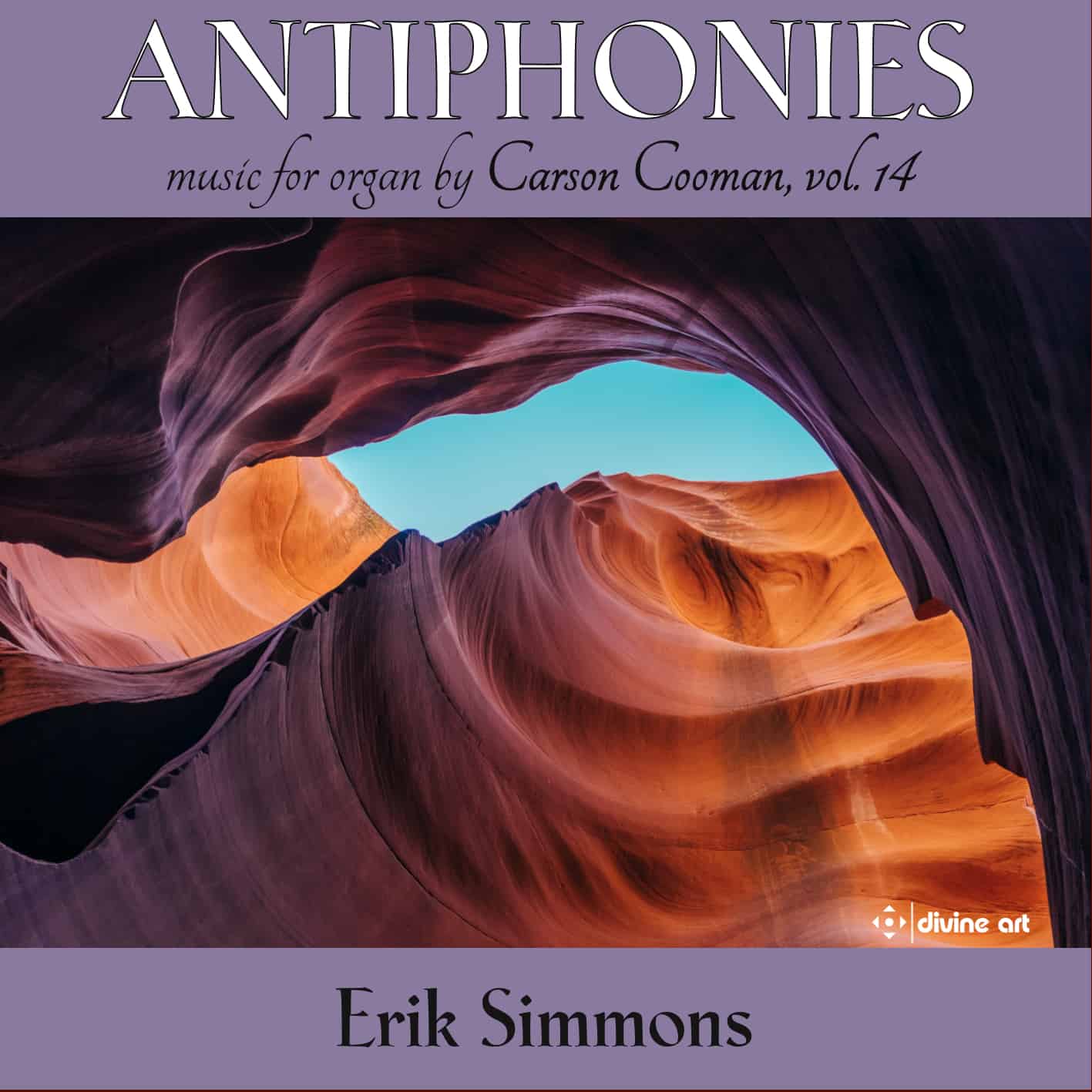
  • Carson Cooman ‘Antiphonies- from the Quarterly Review

    Two traditional tunes from the British Isles feature on a new CD from the Divine Art label, devoted to the works of American contemporary composer (and composer-in-residence at Harvard University), Carson Cooman (born 1982).

    Mr. Cooman is a composer keen to realise the potential of the internet in spreading his message, with thousands of his compositions available via the worldwide web – a recognition, perhaps, that in a not-so-far-away-future, where our way of living and working is so different, such technology might possibly become an alternative to the concert hall. The ‘2 from the British Isles’ (as they appear in the track listing) are the Welsh tune, Hyfrydol – nostalgic and full of “hiraeth”, or longing; and Kingsfold – perhaps better known as the hymn-tune, I heard the voice of Jesus say – or the great theme in Vaughan Williams’s Five Variants of Dives and Lazarus.

    Devotees of the organ will relish the rich tones of Cooman’s St. Michael Antiphonies, the St. Patrick Silhouette, and his Autumn Sketches. Here is a modern voice, rooted in the past but with hope in the future.

  • The Organ review: Antiphonies

    The amazingly productive American composer Carson Cooman has, as “Vol. 14” in his Organ Music works suggests, written much for the instrument, of which he himself is a master organist. This latest volume carries his immense output (over 1,300 opus numbers) forward, and those who have been acquiring the earlier releases in this series will need no second bidding to obtain this new release, beautifully and most convincingly recorded on the Orgelbau Fleiter instrument via the Hauptwerk system by Erik Simmons, whose dedication to the composer’s output is now well-known.

    Indeed, Cooman could hardly have encountered a finer or more sympathetic interpreter of his work than Erik Simmons, who has mastered the composer’s individual style admirably. Of the various works here, the Three Autumn Sketches make a fascinating triptych, although I found the opening work on the disc, the Fantasia canonical, perhaps more compelling. Native British organists may well be attracted to the two hymn-tune Preludes, on Kingsfold and Hyfrydol, for purely nationalistic reasons, and they will be well rewarded for doing so, but one cannot but admire the consistency of invention, the seemingly endless [stream] of genuine musical reactions to a wide variety of inspiration that Cooman’s music consistently delivers. For those who may baulk at the composer’s teeming creativity, I for one music disabuse them: Cooman’s music, and, especially for readers of this journal, his organ music, is well worth hearing – there may be much to choose from, but it invariably falls upon the ear and within the fingers of all genuine musicians, and as such occupies a special, perhaps, unique, place in contemporary music. (FIVE STARS AWARDED)

  • Antiphonies (Carson Cooman organ music): ARG review

    Carson Cooman is outrageously prolific. This program includes recent works that are Opus­es 1358, 1362, and 1365. 1358, called ‘Preludio del Ricordo) is my favorite of this group. It takes only 5 minutes, but it is the perfect organ piece, with both variety and grandeur. There are two chorale preludes on English hymn tunes (one is Hyfrydol), a suite, and a number of almost impressionist nature sketches. It’s all pleasant music, none of it mere noise, but per­haps not in the “greatest” category. I could listen to it for hours, but some of it slips into the background.

    If you like the organ, this one is very spe­cial. It was built by Fleiter in 2014 (in Billerbeck, Germany) and incorporates many French elements and Cavaille-Coll voicings. I find it much more satisfying than the many neo-baroque organs we hear (on records and in churches). Both the organ and the music are in the general “romantic” category, though a living composer like Cooman can take excur­sions beyond.

    I know: how to recommend one disc when there are 13 previous volumes? I can only say that these are some of his latest pieces (though he is not yet 40 years old!) and that they appeal to me as a lover of organ music. I have certain­ly not heard the previous 13 volumes, but we have reviewed a few of them. In fact, we have reviewed 23 discs of his music, most of it for other instruments or voices.

    As I said, outrageously prolific. But maybe the inspiration just keeps coming, and a number of gems may be found among the many pieces. I hear a few here.

  • Cooman: “Antiphonies” – Infodad review

    To get a sense of just how prolific a composer Carson Cooman is, consider that the latest release of his organ music – scarcely the only type he writes – is the 14th in a series. Erik Simmons is methodically working his way through a great deal of Cooman’s organ oeuvre, focusing in this case on sacred and secular works dating to the last decade. Although organ music is itself something of a niche preference, it clearly resonates, both literally and metaphorically, for Cooman (born 1982), who has a fine sense of the organ’s capabilities and a clear comprehension of the many styles that can be used for organ works.

    Cooman’s poise and classically inflected style show here in Fantasia canonica (2019) and Two from the British Isles (2013), the stately Prelude on “Kingsfold” and animated Postlude on “Hyfrydol.” Impressionism comes to the fore in Three Autumn Sketches after a Watercolor by Maria Willscher (2017), the first quiet and moody, the second more dissonant and featuring clever use of the instrument’s sonic capabilities, and the third chordal and crepuscular.

    Simmons fully explores the tonal and emotional colors of these pieces and, indeed, all the works on this disc, next offering the strongly emphatic A St. Patrick Silhouette (2020), then the equally strongly accented St. Michael Antiphonies (2015). After this come two entirely secular works from 2020, Desert Marigold (featuring delicate tone-painting) and Preludio del ricordo (whose boldness makes for an effective contrast). The disc concludes with a return to the classical poise of Fantasia canonica by presenting Suite circulaire (2018) – a well-built Praeludium, contemplative Ricercare, and suitably virtuosic final Toccata. Cooman moves without apparent effort between tonality and considerable dissonance, between comparatively strict adherence to old forms and fantasia-like development of newer ones. The organ used for this recording – a 2014 instrument at a church in Billerbeck, Germany – fits the music particularly well, and Simmons’ comfort with and advocacy of the material comes through consistently. Fourteen discs (so far) of contemporary organ music are, by any measure, a very considerable library – and testimony both to Cooman’s skill in creating the material and Simmons’ in performing it.

  • Antiphonies: review from Classical Music Sentinel

    As a composer, Carson Cooman (b. 1982) is so prolific and creative that I turned my attention away for only a short while, and this recording of some of his more recent organ works is already 8 volumes ahead of Volume 6 which I reviewed in November of 2017. As a matter of fact, Desert Marigold, the most recent composition on this CD is Cooman’s Op. 1365. It’s a highly serene and subdued piece which showcases a pipe organ’s softer and warmer stops, and harmonically unfolds in an organic fashion, and quietly comes to rest naturally in the home key. And even more impressive is that one would think that at this rate all of his compositions would sound the same as if coming off an assembly line, but quite the opposite, they are all distinctively different and varied in style, expression and technique.

    In contrast, the piece that follows titled Preludio del ricordo (Prelude of Remembrance) is a loud peroration utilizing the instrument to its fullest. The booklet notes written by Carson Cooman himself point out that “it was thought of in reference to the numerous lives lost during the COVID-19 pandemic.” The Three Autumn Sketches, as their title suggests, are highly evocative as well as contemplative. And if you’re the type of pipe organ enthusiast that likes to hear the instrument, as well as the organist, firing on all pistons, the Toccata from the Suite circulaire will make your day. It’s new music from composers like this, torchbearers for the instrument, adding new sustenance to its 500 year old roots, that will keep the pipe organ tradition and culture alive and thriving. All of Cooman’s music is tonal and accessible, but with plenty of unique and at times adventurous harmonic twists and turns, that raise the bar and instantly tweak your ears. Organist since the age of 10, Erik Simmons has been the musician on this ongoing project since day one, and has consistently provided excellent, expressive playing, along with an intuitive use of each and every organ’s registration options.

    The instrument you hear on this recording is the Organ of Propsteikirche St. Ludgerus, Billerbeck, Germany. It was completed in 2014 by the Orgelbau Fleiter organ firm, and boasts 72 stops across four manuals and pedal, from a 1′ Mixtur to a 32′ Contrebombarde. This recording was produced via the Hauptwerk system, which involves MIDI (Musical Instrument Digital Interface) and virtual software models of actual instruments. It would take too long to explain clearly how this works, but it is certainly worth your time to investigate it further. It’s almost like being in two places at once, or rather like playing an instrument remotely in real-time. If you have a MIDI keyboard and computer at home, you could be playing this Propsteikirche St. Ludgerus pipe organ in your own living room, by simply downloading the required software. Quite fascinating! But instead of me talking about it here are links to Hauptwerk and Sonus Paradisi, where you will find all of the useful information and technical details that would allow you to play various organs around the world if you were inclined to do so.

  • Antiphonies (Carson Cooman Organ Music vol. 14)

    Antiphonies (Carson Cooman Organ Music vol. 14)

    Carson Cooman is many things musical – organist and Composer in Residence at the Memorial Church, Harvard University; writer, critic and consultant, concert organist, and above all a highly prolific composer of music in a wide variety of genres, from orchestral to song. Recent counts show over 3000 tracks of his music available online with over 300 compositions written for him by more than 100 composers.

    His organ compositions come in many styles, from liturgical models, to substantial secular pieces such as his organ symphonies, preludes and fugues. On this album a range of works, most composed between 2013 and 2020, wonderfully realized on a fabulous instrument.

    Erik Simmons is a superb organist, making his 14th Cooman organ album for Divine Art. We hear the gorgeous voices of the organ of Propsteikirche St. Ludgerus in Billerbeck, Germany, recorded through the Hauptwerk system.