Catalogue Connection: 25227

  • Tom Hicks: Liszt & Ireland sonatas, etc (25227) – ARG review

    A fascinating collection containing not only John Ireland’s fine sonata, but also the ever-popular Liszt along with some less often encountered pieces. The theme of teacher and pupil presents the celebrated Charles Villiers Stanford along with several of his students. Liszt, of course, was not among them, but that’s OK; and the Guernsey-born young pianist is to be congratulated for his imagination in assembling such an interesting program. I’m also a pushover for the attractive art-work of Castle Cornet, Guernsey by Wendy Heaume.

    The Ireland is a most attractive work and is played with close attention to its wonderful variety of rhythms and tonal colors. The Liszt is also played for all its worth, and that is considerable. While the tendency today is to underplay the virtuosic elements of the work, as if to add to the seriousness and profundity, Hicks will have none of that. It’s as if to say “it is what it is” And his stunning technical agility refuses to be suppressed. While tracked in three sections it is played continuously.

    It is in the lovely hymn-like ‘non troppo lento’ that Ireland’s sonata reaches its height of expression. This is also the longest movement, and the one that reaches the greatest emotional depth. The third and final movement treads its serious pathway to a conclusion that may remind some of its mentor, or possibly the sonata by Frank Bridge. This performance is not lacking in any aspect, especially when compared with Eric Parkin or Mark Bebbington.

    Stanford himself is represented by two of his 24 Preludes. It is enough to give us a flavor of what the master is all about, yet make us regret that more wasn’t included. From his student Samuel Coleridge-Taylor we hear the melodic Waltz 2 from his Op.71, and there’s the searching’ Cortège’ by Rebecca Clarke.

    All of this sounds forth in full glory on the Steinway D and is well documented in David Wordsworth’s notes. My only regret is that there was still room for some more.

  • Liszt & Ireland Piano Sonatas etc (DDA 25227) review

    Tom Hicks is a US based British pianist still in his twenties who was trained in Manchester before continuing his studies in Yale with Boris Berman ad Chicago with James Giles. This is his debut disc on the Divine Art Label and shows him to have unusual priorities: Tellingly sensitive voicings, a desire to always produce warm, reserved but glowing tone at all levels and rhythmic and articulative control are leitmotifs running through every phrase played. Hicks is mindful never to over-spill technically into carelessness. Listening to his performances of the Ireland sonata (such a gloriously positive valediction after the end of World War 1) and the Liszt B minor (apparently there are currently around 200 alternative versions of this in the catalogue!) always feels safe and satisfying. One could never imagine this player to panic, lose control or focus. Dependable playing that would surely thrive under the live pressures of any international competition or broadcast, no matter how high profile.

    Priorities in this performance of the Liszt B minor Sonata are very much to produce clear and focused sounds on literally every semiquaver. Hicks certainly takes the concept of separating the three upbeat triplets from the five repeated quavers in the ‘mephisto’ motif throughout the sonata seriously- every time. Rarely have I heard a performance in which literally all the notes emerge with indisputably pristine focus. Clarity is the word! In terms of sonic significance, the biggest moments in both sonatas emerge with remarkable resonance. One could never imagine demonic angst, percussive ugliness, or thoughtless abandon to pour forth from this pianist’s finely developed digits. But Hicks is most certainly capable of reserved spell-casting too, and this is most tellingly realised in Samuel Coleridge-Taylors’ intimately charming ‘op. 71 no. 2 ‘Three-Fours’ waltz- surely the highlight of the disc in terms of communicative conviction.

    Those in search of demonic abandon, ‘safety last’ and even long seamless melodic lines in which beats and bar lines dissolve, may be rather disappointed. Hicks never allows his pulse to quicken too much. He does not allow himself to get even moderately intoxicated. But there is no shortage of alternative versions of either sonata if you are after this sort of thing! As for the programme content, there is much here to stimulate thought. Using a teacher-pupil thread to connect miniatures with two substantial sonatas produces a highly listenable, contrasted, and intriguing recital, recorded most sympathetically in Guernsey last year on a piano which may not be the newest-but which certainly exudes a quaint charm.

    I found the sound quality and occasional tuning issues with the instrument strong pluses in listening: Here is a complete antidote to the clinical perfectionism that can be presented in modern recordings where the emphasis is on cleanliness and order rather than on evoking a sense of a live event. I was reminded of one of the issues on the Divine Art Label in this respect, ‘The Scottish Romantics’ (DDA 25003) in which a piano most certainly past its best years nonetheless enhanced rather than jeopardised the nostalgic Victorian charm present in music by Sir Alexander Mackenzie, Hamish MacCunn, and John Blackwood MacEwen.

     Perhaps in hindsight it would have made more sense for the Frank Bridge sonata (or the un-recorded Mackenzie Fantasy) to have been included here instead of the Liszt, but that it not to take away from a highly stimulating and individual recorded recital that will give much pleasure and food for thought.

  • Tom Hicks – Liszt and Ireland Sonatas DDA 25227 – Musical Opinion review

    The appeal of the repertoire on this disc may be too widely-spread for it to appeal to many buyers – Liszt, Rebecca Clarke and Coleridge-Taylor would be awkward to programme in a live recital, along with short pieces by Stanford – but this selection dominated by the two magnificent if widely-differentiated Sonatas, is so consistently well-played that the ‘calling card’ nature of the programming has to fall away when the listener is confronted by playing of such consistent excellence.

    Tom Hicks has the measure of the Liszt Sonata, and whilst specialists may question this or that tempo for a certain passage, or discuss the structural comprehension of this artist, there is no doubt that Tom Hicks is a serious musician, possessor of a formidable technique and has the intellectual capacity to master a relatively wide range of repertoire, both well-known and unknown. He is supported by very fine recording quality and one hopes that this young artist will go on to enjoy the career his undoubted gifts deserve. (FIVE STARS)

  • Liszt and Ireland Sonatas (DDA 25227) Infodad review

    Tom Hicks’ new CD on the Divine Art label is 100% for, about and featuring the piano, in a recital that is somewhat uneven in the interest level of the pieces but certainly very varied in presentation. Liszt’s well-known and massive B minor sonata gets a broad, committed, intense performance here, with Hicks delving deeply into the somewhat overdone emotionalism of the piece and presenting its varied and contrasting sections with strength and solidity. The sonata tends to sprawl, and Hicks lets it do so, capturing the differing moods of its movements and sections-within-movements while still making clear that it is a unified whole.

    The contrast with John Ireland’s sonata is a fascinating one. The two works are separated by most of a century – Liszt’s dates to 1853, Ireland’s to 1918-20. But Ireland’s seriousness and expansiveness compare very well with Liszt’s, although Liszt is more gestural in his emoting and Ireland more heartfelt (his sonata is in part a response to the Great War). Ireland’s sonata makes some of its points through a level of dissonance that Liszt never employed, and Ireland’s stately central movement is in a style all his own – one that Hicks clearly finds quite congenial. The Ireland sonata is a major work that is filled with intensity and expressiveness that Hicks brings out with considerable skill – this is a very involved and knowing performance. A bit oddly, the two sonatas appear at the conclusion of the CD, following Hicks’ playing of four short encore-like pieces. Two preludes by Charles Villiers Stanford open the disc and go by pretty much in a flash – together they last barely three minutes. Next comes an attractive, small-scale slow waltz by Samuel Coleridge-Taylor, and then a serious (but also small-scale) Cortège by Rebecca Clarke, which nicely sets up the mood of the Ireland sonata that follows it. Everything is well-played and attractive, although the mixture of music is a trifle on the odd side. The fine renditions of the major works by Liszt and Ireland are very much the primary attractions here.

  • Liszt & Ireland piano sonatas etc DDA 25227 – MusicWeb review

    The liner notes explain that the theme of teacher and pupil run through the repertoire on this CD. This is true of Samuel Coleridge-Taylor, Rebecca Clarke and John Ireland, all three of whom were students of Charles Villiers Stanford at the Royal College of Music. Somewhat more tenuous is the inclusion of Franz Liszt. David Wordsworth explains that Frederic Lamond, who gave the premiere of Ireland’s Piano Sonata on 12 June 1920, was a pupil of the renowned Hungarian, but the real rationale for including Liszt’s Sonata lies with the contemporary critic Ralph Hill, who wrote that Ireland’s Piano Sonata was “one of the finest and most important since Liszt.” No doubt this is a statement that could be discussed and debated, but I have much sympathy with Hill’s contention.

    The proceedings open with two Preludes from Stanford’s op.163, completed in 1918. They may well have had an educational purpose. It was the first time that a British (Ireland was not then a republic) composer had written a cycle of 24 Preludes. Christopher Howell has noted the irony of this “cycle [coming] at a time when tonality was being abandoned entirely by certain continental European composers.”  This may well have been Stanford’s deliberate attempt at “making a plea for the tonal system, which he associated with musical sanity.” Prelude no.24 features arpeggios supporting a delightful tune, in a highly-wrought bit of Romanticism which concludes quietly. Arpeggios also feature in the Prelude No.4. Unusually written in 12/16 time, “it projects a singing melody over running semiquavers.”

    Samuel Coleridge-Taylor’s Valse Suite “Three Fours” op.71 was published in 1909. This is a pot boiler, a sequence of six waltzes that uses every cliché in the book. The present selection is Valse No.2 in A flat major. It is memorable for its charming melody and rich harmonic accompaniment. The Suite was dedicated to “Miss Myrtle Meggy,” an Australian pianist and pedagogue.

    Rebecca Clarke’s dark and lugubrious Cortège was completed around 1930, dedicated to William Busch, and revised by her in the 1970s; it is her only piano piece. This music nods to Debussian Impressionism but lacks something of the Frenchman’s luminosity.

    John Ireland once asserted that the first movement of his Piano Sonata was about “life,” the second was “more ecstatic” and, the last was “inspired by a rough autumnal day on Chanctonbury Ring & [the] old British Encampment.”  It could be argued that the second movement is not “ecstatic” but reticent and meditative. On the other hand, Ireland’s words give the listener a valid clue for understanding this music. The knack for the pianist in this compelling work is to get behind some of the mysteries that it seems to present. This includes the supernatural elements that are derived from Ireland’s reading of Arthur Machen, and the visual and spiritual impact of the prehistoric hill fort at Chanctonbury Ring in the South Downs.

    Stylistically, this sonata is in the trajectory of Brahms and Liszt, but with the “added note” harmony being Ireland’s own fingerprint. There are many moments where Impressionism is to the fore. Fellow composer E.J. Moeran noted at the time the sonata’s “complexity of harmonic texture…[and] its absolute conciseness: there is not a redundant note in it.” Colin Scott-Sutherland wrote that all the facets of Ireland’s art are present here: “…the lyrical, the dramatic, the extrovert and the melancholy – the intense self-questioning and the open, almost naïve, avowals.” It was written between 1918 and 1920 and was revised by Ireland in 1951.

    There are several recordings of Ireland’s Piano Sonata currently available. These include Alan Rowlands, two by Eric Parkin, John Lenehan, Malcolm Binns and Mark Bebbington (although I may have missed one). Certainly, Tom Hicks gives a remarkably rhapsodic account here. This is a demanding work to perform, both from a technical and interpretive perspective and he succeeds remarkably. In the slow movement he creates the numinous atmosphere the music requires. On the other hand, the first account I heard of this sonata was Eric Parkin’s and that version for me bears the palm. That said, Hicks’s account is a welcome addition to John Ireland’s discography.

    The Liszt Sonata needs little introduction but I cannot understand why Hicks has chosen it for the present CD. I would have thought that another English piano sonata would have been ideal, and not necessarily the often-recorded Frank Bridge. My mind ranges over possibilities, and thinks of examples by Harry Farjeon, Leo Livens and William Baines. Is there really a need for yet another version of the Liszt? There are more than 200 in the catalogues already, including those by the “greats” such as Martha Argerich, Daniel Barenboim, Emil Gilels, Van Cliburn and Vladimir Horowitz.

    Undoubtedly, it is given an exceptionally commanding performance, which balances the dramatic with the intimate. Technically, the Sonata uses wide ranging pianism, including intricate finger work, tumultuous octaves, part playing in the fugato sections and depth of tone in the melodic section, but most important of all is whether the pianist can project and maintain the unity of this entire structure, which is made up of a small group of themes subject to constant transformation. It has been said that there is virtually every emotion known to humankind in these pages. Tom Hicks goes a long way in satisfying this aim in a sonata that Wagner described as ‘… beyond all conception, beautiful, great, lovely, deep and noble – sublime.’

    The sound recording is perfect. The booklet notes devised by David Wordsworth give all the information required for an intelligent appreciation of this CD. Biographical details of the artist can be found at his website.

    Despite my nag about swapping the Liszt for another British piano sonata, this is an excellent and well-balanced recital that fully deploys Tom Hick’s multitudinous talents.
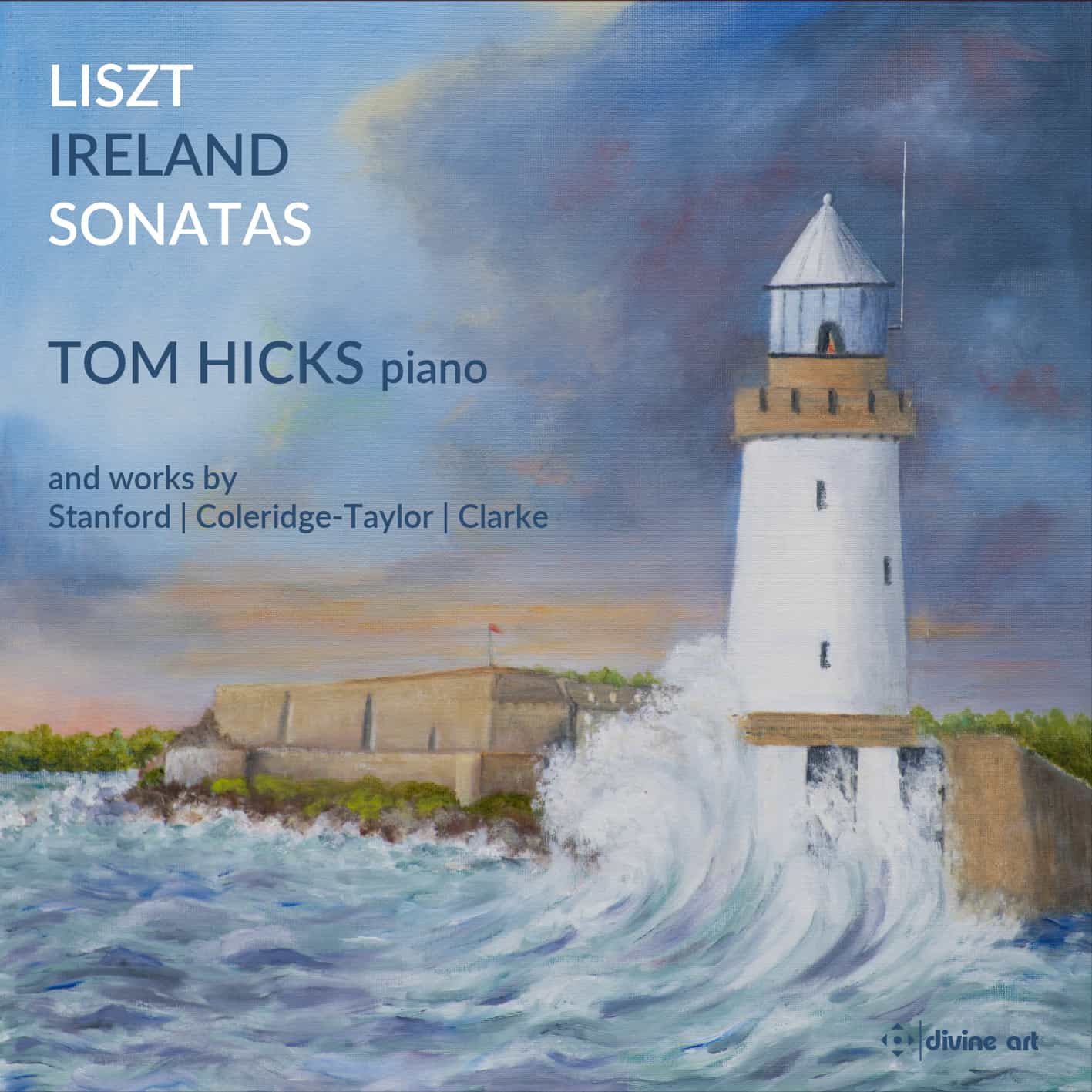
  • Tom Hicks: Liszt and Ireland Piano Sonatas

    Tom Hicks: Liszt and Ireland Piano Sonatas

    Hailed as an artist of ‘magnificent pianism’, Guernsey-born pianist Tom Hicks has been praised for his ‘gorgeously creative playing’ that ‘transports the listener to another place and time’. Hicks is a gold medallist in numerous national and international competitions and holds degrees and awards from The University of Manchester, The Royal Northern College of Music, Yale University and Northwestern University, where he now lectures. His first disc featuring John Ireland’s Sarnia, ‘Tom Hicks: Ireland and Tchaikovsky’ has been described as ‘brilliantly evocative’ by Colin Clarke in International Piano, and ‘gorgeously creative’ by Scott Noriega in Fanfare.

    In his first recording for Divine Art, Tom presents stellar performances of two major Sonatas – those of Franz Liszt and John Ireland. A generation apart, both are highpoints of the Romantic and post-Romantic era. This playing puts Hicks at the top of the tree for his bold expressiveness and vision.

    On this album Hicks prefaces the Sonatas with shorter, but equally imaginative and expressive pieces: two Preludes by Stanford, Cortège by Rebecca Clarke, and one of the charming waltzes from the ‘Three-Fours’ Suite by Samuel Coleridge-Taylor.

    Tom Hicks is also a strong supporter of contemporary composers and his new album of music by British composer Camden Reeves, inspired by the harmonies and rhythms of blues music, will be released in the late spring of 2022 (“Blue Sounds”) – Métier MSV 28604)