Catalogue Connection: 25230

  • Vision and Venture Congleton Chronicle

    We’ve written about this twice but never actually reviewed it; who cares about release dates anyway? “Visions both utopian and evasive … ventures towards and away from … forays and escapades — these are what broadly characterise the keyboard music featured on this recording,” says Beville in the sleeve notes, but it’s perhaps more escapism than escapades as, it’s a mostly relaxing collection of tunes (as one never says for classical pieces, even though they are).

    The album opens with Bach’s “Prelude and Fugue in E Major”, “inescapably wedded to his religious faith” as the sleeve says, so it’s reverential and evokes feelings of sitting in a church reflecting on the meaning of life.

    Prokofiev’s “Visions Fugitives, Op. 22” follows and it’s more of the world but equally tranquil. It’s a set of 20 short pieces of changing moods, from the relaxed “Lentamente” to the more sprightly “Allegretto tranquillo”, which is still tranquil in the way a mountain stream is. (If only the track names gave clues).

    They’re mostly short — down to 23 seconds for one — so this selection whizzes by. Mr Beethoven ends all this with his “Piano Sonata in E flat major, Op. 7”, a mighty 8:49 long and more intricate.

    Beville’s playing is excellent, fast yet delicate and agile, capturing both the whimsy of the shorter pieces and the reverence of others.

    We wrote about this before after we tested it on AI. We tried again, this time on the Google thing. It was more accurate but added some extra works that must be hidden tracks as the sleeve notes and CD contains no reference to any Scarlatti, Chopin or Liszt.

    A nice album for anyone who likes intricate tranquillity.

    Out on Divine Art, DDA 25230.

  • Visions and Ventures (DDA 25230) ARG review

    This is a fine second release from British pianist Beville that gives us a good picture of his keyboard abilities. His training was mostly in Great Britain with advanced study in Germany. He has been an active pianist for many years, as well as a prolific composer. The pieces here were recorded in 2003, 2006, and 2019, all remastered in 2022. In his booklet essay Beville says “Visions both utopian and evasive… ventures towards and away from… forays and escapades—these are what broadly characterize the keyboard music offered on  this recording.”

    I particularly enjoyed Bach’s solemn 4- voice Fugue following the busy Prelude, essentially in 3 voices. Beville’s contrapuntal clarity is a model of how to balance voices. The Prokofieff comes my way on a regular basis and gives a more gentle and varied look at his piano styles. The 20 short pieces are brilliantly conceived sketches (to use Beville’s description). They allow the pianist to cover a wide range of tempos, dynamics, and articulations, all of which are exceptional on this disc. The final work is Beethoven’s Sonata 4, the large four-movement work sometimes nicknamed The Grand. It is certainly one of the high points of Beethoven’s first compositional period and a fitting conclusion for this program. Beville investigates all of the composer’s contrasts of texture and harmony to give a very
    satisfying rendition.

    The recorded piano sound is good, and along with the pianist’s detailed booklet essay,
    it completes a quite satisfying recital.

  • Visions and Ventures DDA 25230 – Fanfare review

    In his liner notes to this collection, Visions and Ventures, British pianist Stephen Beville claims he seeks “Visions both utopian and evasive … ventures towards and away from … forays and escapades [that] broadly characterize the keyboard music featured on this recording.” Beville opens with the Prelude and Fugue in E Major from WTC II, a work that integrates a sense of piety into a strong, improvisatory prelude in binary form, whose polyphonic texture gravitates to the dominant, in seamless motion in four parts. Under Beville’s hands, the stately fugue assumes a poised nobility of line, again conveying a poignant, reverential affect akin to the spirit of the B-Minor Mass.

    Beville proceeds to the 20 pieces of Sergei Prokofiev composed c. 1914–16 under the title of Visions Fugitives, after the lines from the poet Konstantin Balmont: “In every fleeting vision I see worlds / Filled with the fickle play of rainbows.” Composition instructor Anatoly Liadov felt that the young Prokofiev had become “tainted by Modernism” in this work, written in a laconic, often witty or sarcastic mood as miniatures or character-pieces. The assemblage, not often played as a unit, reveal some common characteristics within their essential, ternary structure: disjunctive melodies that do not necessarily end emphatically; thirds and seventh chords that destabilize the harmony; chromatic melodies that abruptly shift to distant tonalities; dramatic dynamic contrasts; the use of the tritone; homophony in the bass reminiscent of a lyrical nocturne; free counterpoint. Beville identifies four as “quintessentially Prokofievian”: No. 1 (Lentemente), No. 8 (Commodo), No. 11 (Con vivacità), and No. 16 (Feroce). I would add No. 10 (Ridicolosamente) for its kinship to the op. 17 Sarcasms. Those experimental and rife with harmonic dissonances, as well as rhythmically percussive, are No. 14 (Assai moderato), No. 15 (Allegretto), No. 17 (Inquieto), No. 19 (Poetico), and No. 20 (Lento irrealmente). The tenor of the works seems coldly clinical, as in No. 2 (Andante), with its tolling figure. The pieces emerge as acutely acerbic studies in touch, compressed toccatas whose character might possess allure or uneasy intrigue, as required. A brief piece like No. 5 (Molto giocoso), lasting a mere 23 seconds, makes potent demands on Beville’s wrist articulation. The glistening sonority of No. 7 (Pittoresco “Arpa”) compels Beville to accord it special attention in his notes. Simultaneously enchanting and unnerving, these pieces reveal the mental and musical vigor of their creator.

    Beville sees what he terms “revolutionary optimism” in the 1796 “Grand Sonata” of Beethoven, a work which received a 1972 recording of extraordinary breadth from Arturo Benedetti Michelangeli (DG 2530197). This Sonata No. 4 in E flat Major already projects the “heroic” impulse we find in later works, especially in the “Eroica” Variations and “Eroica” Symphony. Always seeking to resolve a dramatic conflict, Beethoven in his first movement Allegro molto e con brio, pits the tonic against the dominant B flat Major. Beville makes splendid, often jabbing, colors in his realization, imposing a strong sense of formal outline for the sonata form. The swirl of eighth notes makes its own impression as to Beethoven’s capacity for virtuoso technique. No less apparent are the bold procedures, such as harmonic wanderings or what commentators term “circuitous routes” in the passing harmonies in Beethoven’s development section. The playing of the coda projects a robust vitality.

    The emotional heart of the work lies in its broadly expansive Largo, con gran espressione in C, as close to an operatic scene as Beethoven might compose later for Fidelio. Dramatic pathos collides with pregnant silences, only to emerge with fragments and compressed gestures in sometimes explosive dynamics, typical of Sturm und Drang sensibility. One might imagine the music to juxtapose moments of defiance against moments of religious or pious contemplation, anticipating the tension in his op. 13 “Pathétique” Sonata, where the chromaticism of Beethoven’s pain confronts the diatonicism of his will. Good spirits return with impelling force in the ensuing Allegro third movement, a humorous minuet and Trio whose discourse becomes increasingly animated, interrupted only briefly by the Minore Trio section that, again, bristles with a sense of impassioned revolt. For his last movement, Rondo: Poco allegretto e grazioso, Beethoven returns to the dynamic tension between E flat Major and B flat Major. But a potent, third motif in C Minor adds once more a sense of Beethoven’s future explorations in both sonata and symphonic expression. The last surprise lies in an excursion into E Major that eventually makes its way to the security of the tonic key. This is a stylish, adventurous recital, well balanced and technically impressive.
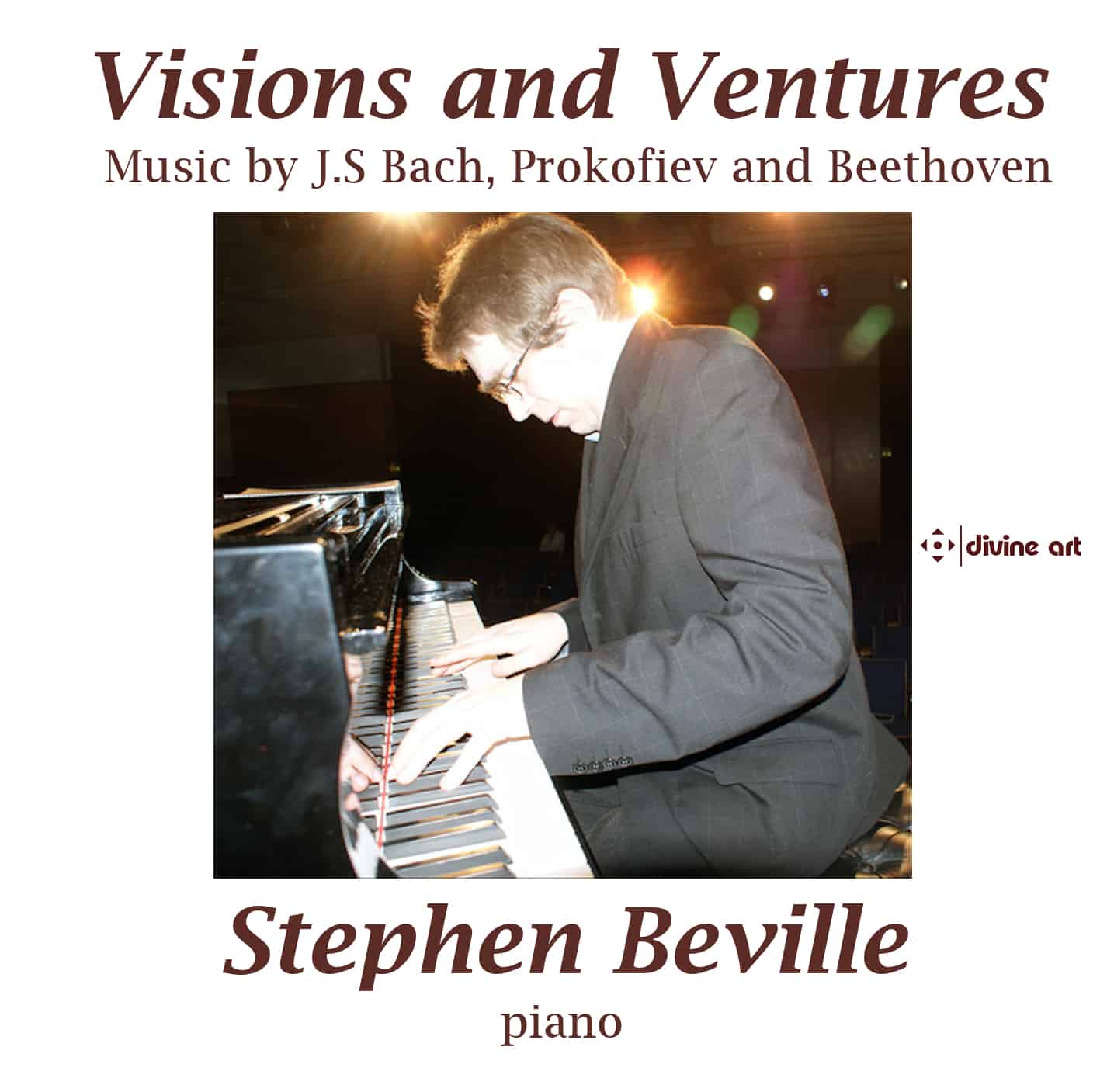
  • Visions and Ventures DDA 25230 – Infodad review

    Stephen Beville’s new Divine Art disc features works by composers whose music is rarely heard on the same program. The longest piece here is the 22-brief-movement Visions Fugitives by Prokofiev. These are micro-miniatures (half the movements last less than 60 seconds) that explore various keys, rhythms and tempos with greater delicacy than one usually associates with this composer. Movements such as the fourth, Animato, are a bit closer to the dry and wry wit of Prokofiev than are most of these little pieces, many of which have a pleasantly relaxed air about them: Pittoresco, Commodo, Allegretto tranquillo, Poetico and others. At the other extreme is the genuinely amusing Ridicolosamente, which has a purity of fun not usually heard in Prokofiev – the Feroce and Inquieto movements are less surprising. The final two movements, which Beville contrasts especially effectively, sum up the many moods of this suite very well: the penultimate Presto agitatissimo e molto accentuato is followed by the longest movement of all, Lento irrealmente.

    The tempo designations themselves show just how much Prokofiev wanted to communicate through these not-quite-trifles in terms of their mood swings. That makes the contrast between this piece and the Beethoven sonata that Beville offers all the clearer. This fourth Beethoven piano sonata, Op. 7, is quite an early work (1796) but was seen by the young composer as a grand one – in fact, Beethoven designated it Grande Sonate, and at 29 minutes it is one of the longest the composer ever wrote. One reason Beethoven labeled it as he did was that the sonata was published by itself, not as part of a set – an unusual occurrence at the time. But the significant growth in expressiveness after his first three sonatas may have had something to do with the designation as well. The first two movements are big, almost imposing, and filled with plentiful themes and virtuosity (first movement) and with poetry and drama (second). The third and fourth movements are simpler and more earthbound. The sonata as a whole is an impressive achievement, and the first such work in which Beethoven began to explore new expressive forms.

    The contrast with the miniaturization in Prokofiev’s Visions Fugitives is very pronounced indeed. Beville sets up the Prokofiev/Beethoven exploration by first offering Bach’s Prelude and Fugue in E, BWV 878, which he presents with straightforward simplicity, if perhaps rather too much reliance for emotional impact on the piano’s pedals (especially in the fugue). The Bach sits somewhat uneasily at the start of this CD, leaving it unclear where Beville is going with the whole thing – although by the disc’s end, his interest in contrast both within the Prokofiev and Beethoven and between them is clear enough.

  • Visions and Ventures

    Visions and Ventures

    Works from three different musical eras seemingly unconnected – but in the mind of Pianist Stephen Beville very linked – hence the album title – as inspired by Visions and Ventures: Bach always a visionary musically and guided by his religious faith; Beethoven venturing into Romanticism with revolutionary ideas and optimism for a better world; Prokofiev caught up in the unrest in pre-revolutionary Russia, sketching pieces to escape the political turmoil – at least in his imagination. The Visions Fugitives come from a composer in his mid-twenties, just graduated and full of musical confidence, and are typically Prokofievian while some contain radical modernist elements. The Beethoven Sonata is likewise the work of a young 26-year old. It is full of playful invention and optimism and is perhaps one his most appealing works.

    Stephen Beville was acclaimed in 2010 as ‘one of the most talented young musicians to emerge from the UK’. (Frankfurter Neue Press). His interpretations have been compared to Arrau, Rubinstein and Ax. Rock-solid technique and virtuosity while avoiding showmanship have informed his playing from student days at the Junior Royal Academy in London from age 11, tutoring from the great Peter Katin, and postgraduate studies at the Royal Northern College of Music in England and the Hochschule für Music in Karlsruhe. He has performed in many international festivals.

    As well as a firm grounding in classical and 20th century repertoire, Stephen Beville is also a busy composer, his works having been performed by several leading new-music ensembles.

    Stephen’s debut CD ‘Stephen Beville in Karlsruhe’ was given warm reception on its release:
    “Beville is a thoughtful artist, whose accounts of each of the established masterpieces here are well worth hearing.” – Robert Matthew-Walker (Musical Opinion)
    “An intelligent, controlled and searching pair of hands quite capable of imparting power as well as finesse.” – Gary Lemco (Audiophile Audition)