Catalogue Connection: 25232

  • Prokofiev: Cinderella & Romeo and Juliet Ballet Suites

    Prokofiev’s own set of piano pieces from the two ballets serve as the basis for two four-movement suites arranged for clarinet and piano in the 1950s by Branislav Fedotovitch Prorvich, a clarinettist with the Bolshoi Theatre in Moscow. lan has developed his arrangements from these originals aided by his producer and long-standing clarinet colleague Malcolm McMilllan.

    From the commencement of this epic musical journey in the Cinderella Suite, the piano sets the scene in ‘The Dancing Lesson’. The clarinet joins after a few bars with a beguiling and sardonic melody punctuated by sparkling altissimo staccato interjections. By contrast, in ‘The Winter Fairy’, the clarinet employs a dark and soulful sonority which is played here with great tonal warmth and sostenuto. Our two soloists are constantly rising to the challenges set out by the composer and offer a virtuosic duo display in ‘Grasshoppers and Dragonflies’. In the opening of Romeo and Juliet, the clarinet has to navigate the rapid-scale passages, which is accomplished here with complete ease, and then assumes the sombre tonal voice of the original tenor saxophone, with the piano re-creating the orchestral landscape.

    This recording shows the musical mastery and nuanced imagination of lan Scott’s artistry. In ‘Dance of the Girls with Lillies’, he plays with an exquisite and delicate voice as the clarinet ascends into the heavens, creating a ravishingly mesmeric effect. Both lan and pianist Jonathan Higgins exercise such control over this musical offering that it is easy to forget the gigantic technical challenges that Prokofiev had originally created. I am sure he would have approved of this re-working. This recording ends with ‘Death of Tybalt,’ where the piano creates a terrifying demonic foreboding as the clarinet joins ni conclusion to halt one’s breath!

    Ian Scot studied with Henry Morrison at the RSAMD (now the Royal Conservatoire of Scotland) in Glasgow. He continued his studies with John Denman at the University of Arizona, at the recommendation of Reginald Kel. He has been a guest principal with all the major London orchestras, and appeared as soloist with I Solisti Veneti, the Izmir State Symphony Orchestra, the BC Concert Orchestra and the Gulbenkian Orchestra on tour in the Far East. He has been principal clarinet with the Royal Ballet Sinfonia since 2000.
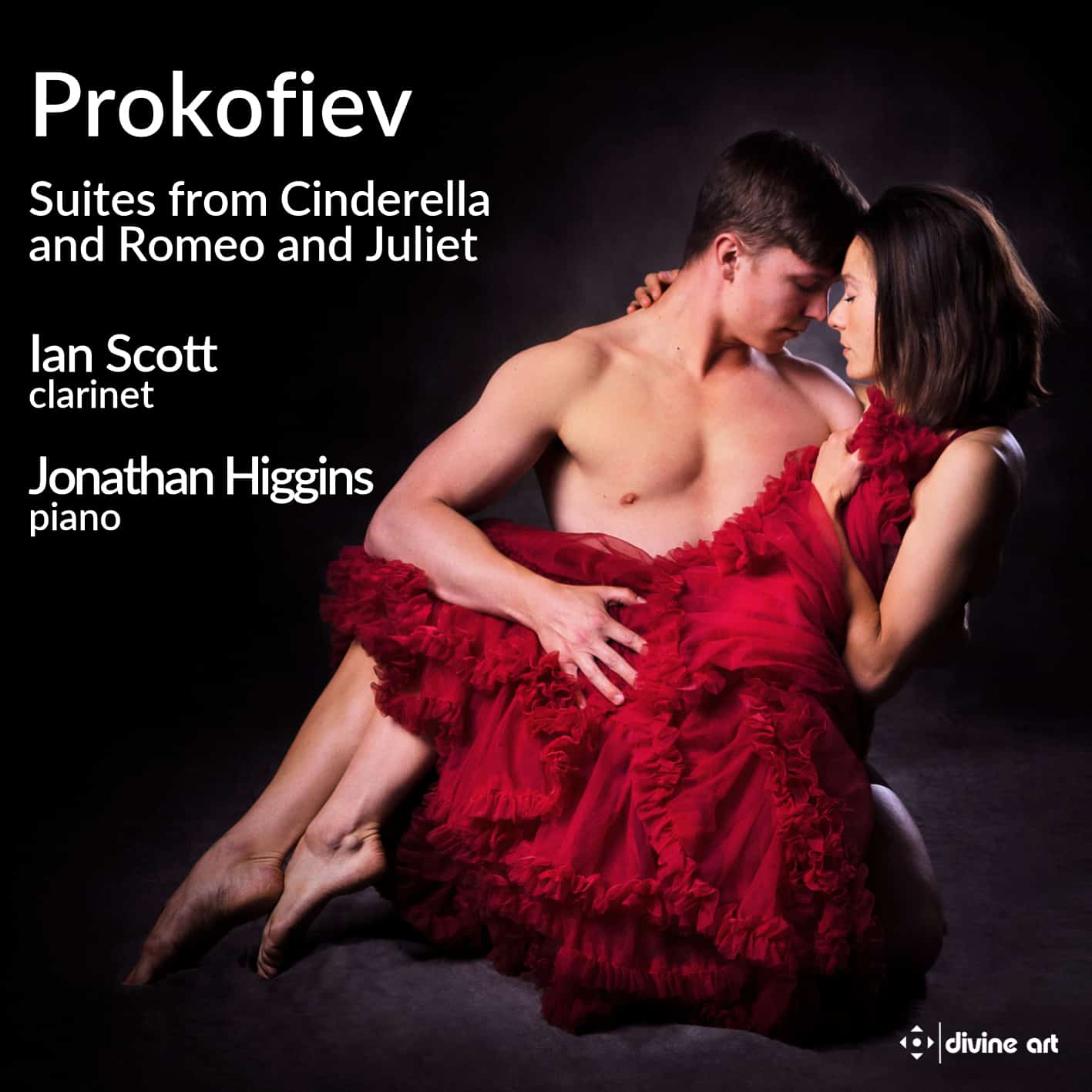
  • Prokofiev Ballet Suites DDA 25232 – review from De Klarinet

    That the appealing ballet music of Sergei Prokofiev lends itself extremely well for a transcription for clarinet and piano can be defended in several ways. Prokofiev himself made piano transcriptions of a large part of his orchestral works and in the original setting of his ballet music he made extensive use of the various characters of the clarinet. That produces one nice foundation for this version. In typical English musical collaboration clarinettist Ian Scott and pianist Jonathan Higgins play highlights from the ballet suites Cinderella (opus 87) and Romeo and Juliet (opus 64). In part, they took advantage of existing arrangements by Bronislav Prorvich, but for most of the sections, clarinetist Ian Scott and producer Malcolm McMillan wrote transcriptions for this duo vision of Prokofiev’s ballet music. In both Cinderella and Romeo and Juliet the result is something like two captains on one ship: Prorvich set his arrangements with the orchestra as the cradle adding interpretations of the clarinet parts, while Messrs. Scott/ McMillan reasoned more from the perspective of the clarinet. That’s not strange at all, since both have for years been seated side by side in an orchestra and know each other’s musical wishes and possibilities. However the difference in vision indicates a diversity in the performance. One hears the characteristic English timbre of Ian Scott’s instruments by Peter Eaton (type Elite) – a derivative of Boosey & Hawkes, but t maybe a little more veiled in sound. Scott performs in the second and third registers impeccably and with great control, while his tone in the low register is not quite so smooth.  Ian Scott’s interpretation is also remarkable in that it reveals the style of an orchestral musician, rather than a totally prominent, dominating soloist that one can often find in chamber music. This relatively short CD (50 minutes) is magnificent, if only for the always surprising twists and atmospheres which Prokofiev derives from his ballet music. It almost begs for an extrovert interpretation of clarinet and piano, but Scott, in particular, keeps quite a low profile, not becoming ‘flashy’. Perhaps the greatest energy of pianist and clarinetist in found in the Grand Waltz, where the inspiration for this transcription emerges in clearly audible fashion. Of course there is more recognisability in Romeo and Juliet. Its atmospheres and characters as present by Ian Scott and Jonathan Higgins have been exploited much more here and have translated into freer play, leaving natural space which allows for greater expression. Here too we note the ‘orchestral interpretation’ from Scott, so you don’t get the feel of extroverted chamber music playing. But the music in combination with the arrangement – because of its great impact of melody and rhythm – remains very strong, so this version will take some beating.

  • Prokofiev Ballet Suites DDA 25232 – Fanfare Review

    Ian Scott is principal clarinet of the Royal Ballet Sinfonia, and Jonathan Higgins has been principal pianist of the Birmingham Ballet for over 25 years. Both clearly have an understanding of, and appreciation for, music written for the dance.

    This delightful disc of suites from two of Sergei Prokofiev’s most successful ballet scores arranged for clarinet and piano is effective not only because of that understanding that they have, but because they both know that Prokofiev often featured the clarinet in his scores. Prokofiev also arranged music from both of these ballets for solo piano, and the arrangers used the composer’s piano reductions in their arrangements. Some of the pieces in each suite were arranged by a Bolshoi Theater clarinetist from the 1950s, Bronislav Prorvich, and others were arranged by Ian Scott and a colleague clarinetist of his, Malcolm McMillan.

    The result of their work is a pair of very effective, and charming, sets of pieces for clarinet and piano. Scott plays with rhythmic flair, sensitivity, and wit, all qualities that serve this music very well. The zest with which he and pianist Higgins play “Grasshoppers” and “Spring Fairy” from Cinderella is infectious. They also capture the darker spirit of Romeo and Juliet. “The Death of Tybalt” is rendered with exactly the right feeling of menace. Scott’s program notes are informative, and the recorded sound is well balanced. This should appeal to all clarinet lovers, but also beyond that to anyone who would enjoy hearing this music in a different but effective guise.

  • Prokofiev Ballet Suites DDA 25232 – Review from London Light Music

    Born in Ukraine, Sergei Prokofiev (1891-1953) is probably best-known by light music enthusiasts for Peter and the Wolf but these ballet suites are not far behind in popularity.

    Both prominently feature the clarinet and Ian Scott, principal clarinet of the Royal Ballet Sinfonia, had the idea of replacing the orchestra with the solo instrument and having, as he writes in his booklet notes, “the freedom to interpret the ravishing melodies”.

    In this he has been totally successful alongside accompanist Jonathan Higgins, who was principal pianist in the now Birmingham Royal Ballet for 25 years from 1995, playing a Steinway Model D. This is a thoroughly delightful disc, with none of the 20 tracks being over 5:06 overstaying their welcome, which can be enjoyed at a sitting or dipped into (Dance of the Knights is here, of course) to enjoy two marvellous musicians performing pieces by a consummate composer. There is an all-round quality to this issue in every respect, with the fine sound being engineered by Tony Faulkner at St John Evangelist Church, Oxford, in November 2021. The excellent booklet includes coloured photos and gives details of a previous release featuring Ian Scott – ‘From Russia’ (DDA 25223) – quoting a recommendation from the review on this website.

  • Prokofiev Ballet Suites DDA 25232 – Infodad review

    The underlying purpose here is to present, for the first time, the arrangements of some of these pieces for clarinet and piano by Bolshoi Theatre clarinetist Bronislav Fedotovich Prorvich. From Cinderella he arranged The Dancing Lesson, Winter Fairy, Passepied, and Adagio. From Romeo and Juliet he arranged Juliet’s Entrance, Masks, Dance of the Knights, and Mercutio. In each case, this led to a mini-suite of about 13 minutes’ duration, created in the 1950s but not previously recorded.

    Ian Scott, working with Malcolm McMillan, arranged seven additional Cinderella numbers and five more from Romeo and Juliet to produce the suites heard on this recording, on which Scott plays clarinet and Jonathan Higgins is the pianist. The purpose here is to showcase the clarinet’s capabilities in this music; to bring Prorvich’s work to light; and to present well-known works in a way they have not been heard before. All this is fine, and certainly the warmth of the clarinet fits much of this music very well indeed – although, it should be pointed out, not as well as Prokofiev’s original and very sensitive orchestral settings.

    Everything here sounds good and is played well, and the CD is an enjoyable curiosity that will be of special interest to clarinetists and to listeners who have become somewhat jaded by the original Prokofiev scores and will welcome the chance to hear portions of them in a new guise. It is hard to imagine, though, that anything here will supplant audience interest in hearing the music – whether the full ballets or excerpts from them – as Prokofiev intended.

  • Prokofiev: Cinderella & Romeo and Juliet Ballet Suites

    Prokofiev: Cinderella & Romeo and Juliet Ballet Suites

    Of the major works of Sergei Prokofiev, none (apart perhaps from Peter and the Wolf) have become so well loved by a wide audience as the ballets Cinderella and Romeo and Juliet. From the stage productions, to the orchestral suites, to the piano versions, many of these pieces are universally recognised.

    In the 1950s, four pieces from each ballet were arranged for clarinet and piano by Bronislav Prorvich, a clarinettist with the Bolshoi Theatre. Strangely, so far as we know, these sparkling arrangements have never previously been recorded. Ian Scott and his producer Malcolm McMillan have added a further 12 movements from the ballets, many of which strongly featured the clarinet in the original orchestral version. This has resulted in a lovely collection of pieces that are at once very familiar but also heard in a completely new light.

    SUPPORTED BY THE OLEG PROKOFIEV TRUST