Catalogue Connection: 25233

  • Shades of Night (DDA 25233) – Fanfare review

    This is only the latest of several night-themed piano recitals that stimulate one’s imagination. Just recently, for example, I enjoyed a Stradivarius CD by Ciro Longobardi (Nuit) in which he paired Ravel’s Gaspard de la nuit with various nocturnes by Salvatore Sciarrino. Andrew Brownell’s program is, in some ways, conservative because it begins with the “Moonlight” Sonata and ends with Clair de lune, and includes two Chopin nocturnes. That will make a lot of people happy, and Brownell plays these works very well.

    There are some surprises, though. None of them are nasty. One comes immediately, with the unusual yet very appealing sound of Brownell’s piano, which is a Blüthner Model I. Although Blüthner is regarded as one of the most prestigious manufacturers of pianos, I don’t recall seeing it often on CDs or in concert halls. (It was a favorite of Rachmaninoff.) The manufacturer’s CEO, Christian Blüthner-Haessler, praises its “dark, chocolate sound, with a sparkling treble.” It is well suited to this program, which contains a fair amount of dark, chocolate music, although some of the chocolate is bitter.

    Another surprise is the inclusion of more unusual works—notably, a movement from Hindemith’s Suite “1922” and Lowell Liebermann’s Nocturne No. 5. It would be too easy to describe the latter as a Chopin nocturne with a lot of wrong notes, partly because these wrong notes are so right in the context of the whole work. The more I hear Liebermann’s music, the more I like it, and just the inclusion of his not quite seven-minute nocturne here encourages me to seek out more of his piano music. Overall, Brownell’s program reminds us that the night can be a time of trouble and unease, as well as a time to relax and to dream happy dreams. The only questionable performances on this CD, perhaps, are the two works by Couperin, but that’s because there will be people who resist the idea of this music being played on a piano, and who will more strongly resist the idea of playing it with as much Romantic-style affect as Brownell applies here. That’s their problem.

    Brownell won prizes in several competitions (Leeds, J. S. Bach, etc.) about two decades ago. He was born in Portland, Oregon, received his doctorate at Guildhall, and now teaches at the University of Texas at Austin.

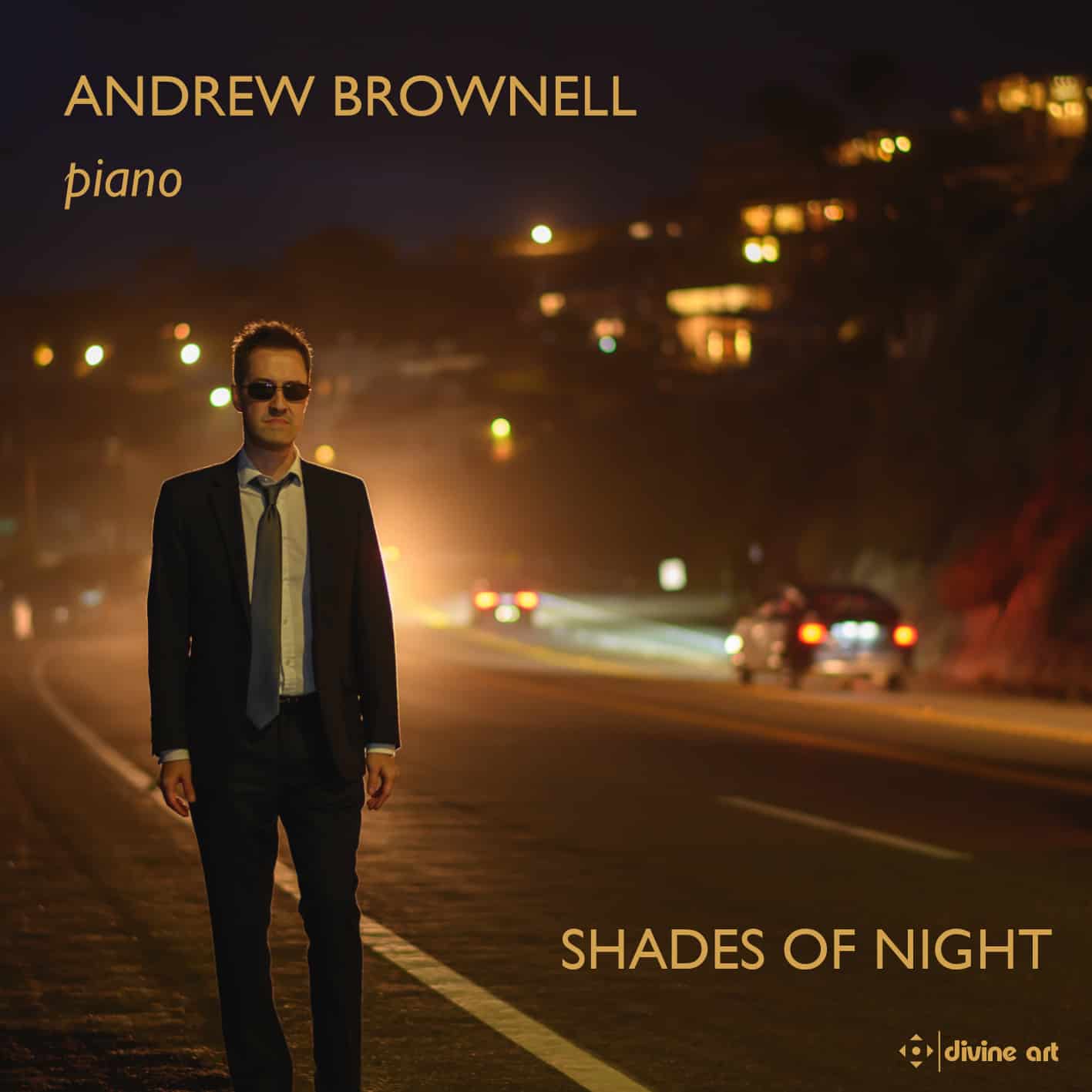
    Two mysteries remain. If this program was recorded in 2015, why is it not seeing light of day (so to speak) until now? The second mystery concerns the cover photograph, which shows the pianist wearing sunglasses at night and walking along the shoulder of an urban highway. Did he have a flat tire? Is he hitching a ride? Do a talented pianist a favor and give him a lift to the nearest 7-11. All kidding aside, this is a late-night program well suited for late-night listening. Brownell’s mastery of the material, and his ability to convey its sometimes complicated psychological content, is never in doubt. I would get this if I were you.
  • Shades of Night (DDA 25233): Fanfare review 2

    This is only the latest of several night-themed piano recitals that stimulate one’s imagination. Just recently, for example, I enjoyed a Stradivarius CD by Ciro Longobardi (Nuit) in which he paired Ravel’s Gaspard de la nuit with various nocturnes by Salvatore Sciarrino. Andrew Brownell’s program is, in some ways, conservative because it begins with the “Moonlight” Sonata and ends with Clair de lune, and includes two Chopin nocturnes. That will make a lot of people happy, and Brownell plays these works very well.

    There are some surprises, though. None of them are nasty. One comes immediately, with the unusual yet very appealing sound of Brownell’s piano, which is a Blüthner Model I. Although Blüthner is regarded as one of the most prestigious manufacturers of pianos, I don’t recall seeing it often on CDs or in concert halls. (It was a favorite of Rachmaninoff.) The manufacturer’s CEO, Christian Blüthner-Haessler, praises its “dark, chocolate sound, with a sparkling treble.” It is well suited to this program, which contains a fair amount of dark, chocolate music, although some of the chocolate is bitter.

    Another surprise is the inclusion of more unusual works—notably, a movement from Hindemith’s Suite “1922” and Lowell Liebermann’s Nocturne No. 5. It would be too easy to describe the latter as a Chopin nocturne with a lot of wrong notes, partly because these wrong notes are so right in the context of the whole work. The more I hear Liebermann’s music, the more I like it, and just the inclusion of his not quite seven-minute nocturne here encourages me to seek out more of his piano music. Overall, Brownell’s program reminds us that the night can be a time of trouble and unease, as well as a time to relax and to dream happy dreams. The only questionable performances on this CD, perhaps, are the two works by Couperin, but that’s because there will be people who resist the idea of this music being played on a piano, and who will more strongly resist the idea of playing it with as much Romantic-style affect as Brownell applies here. That’s their problem.

    Brownell won prizes in several competitions (Leeds, J. S. Bach, etc.) about two decades ago. He was born in Portland, Oregon, received his doctorate at Guildhall, and now teaches at the University of Texas at Austin.

    Two mysteries remain. If this program was recorded in 2015, why is it not seeing light of day (so to speak) until now? The second mystery concerns the cover photograph, which shows the pianist wearing sunglasses at night and walking along the shoulder of an urban highway. Did he have a flat tire? Is he hitching a ride? Do a talented pianist a favor and give him a lift to the nearest 7-11.

    All kidding aside, this is a late-night program well suited for late-night listening. Brownell’s mastery of the material, and his ability to convey its sometimes complicated psychological content, is never in doubt. I would get this if I were you.

  • Shades of Night DDA 25233 ARG review

    I am somewhat skeptical of a program titled “Shades of Night” that begins with the first movement of the Moonlight Sonata and ends with ‘Clair de Lune’. Such a program cherry picks only appropriate movements that exploit the obvious concept rather than considering complete works. Still, there are choices that stretch the imagination and avoid the “pops” elements so that this keeps an air of seriousness as a reasonable recital.

    Hindemith’s ‘Nachtstuck’ From Suite 1922, Op. 26 is a rarely heard but effective piece, as are the two Nightingale pieces from Couperin’s 14th Ordre. Two Chopin Nocturnes fit the bill quite well, but were expected from this assemblage. A wonderful surprise was the Nocturne 5 by contemporary Lowell Liebermann and Bela Bartok’s ‘The Night’s Music’ from Out of Doors. Samuel Barber’s Chopin-like Nocturne, Op. 33 was an unexpected eye-opener; and the slow movement from Brahms Sonata 3 shows the thought that went into the program.

    With all of the interest in the choice of selections it must be admitted that so much slow music might not be as easily digestible as a program based on a wider variety of tempos, but these “Shades of Night” do what was expected of them, and do it quite well. Decent notes and good sound from the Bluthner will, I suspect, draw attention for some of the more unusual fare.

  • Shades of Night DDA 25233 – London Light Music Group review

    This label has only been in existence for 30 years and during that time has collected critical acclaim for quite a number of its over 600 titles. It now brings us an eclectic anthology by Andrew Brownell, himself a recipient of praise for his pianism, that explores the themes of the night and also of passion, the latter mostly from the Romantic period (late 18th and early 19th centuries).

    Its baker’s dozen of tracks open and close with what will no doubt be familiar to a lot of readers: the Adagio from Beethoven’s “Moonlight” Sonata and Debussy’s “Clair de lune”. Then there are two Chopin Nocturnes, another by Samuel Barber, his Homage to John Field, and one by his fellow American, Lowell Liebermann (b.1961), composed in the mid-1990s. There is also the longest item, the slow movement of Brahms’ Piano Sonata No.3 (10:33), described by the pianist as, in his view, possibly the most ravishing expression of love in the piano literature.

    Other appropriate pieces come from Bartók, Couperin (2), Hindemith and Schumann. Brownell’s exceptionally good explanatory booklet notes add much to the understanding and enjoyment of what we hear.

    The album was recorded at The Singing Hall, St Paul’s Girls’ School, Hammersmith, London, on a Blüthner Model 1 Concert Grand way back in October 2015, and one cannot help wondering why it has taken so long to release. Bearing in mind the positive effect that music can have on mental health and wellbeing, and reading recently that star pianist Lang Lang considers the piano to be a “spiritual instrument”, listening to this recording could well do us all good.

  • Shades of Night: a piano recital by Andrew Brownell

    Shades of Night: a piano recital by Andrew Brownell

    Step back to a time when the night was an antithesis to the clarity of illumined day. In the especially fertile imaginations of the 19th-century Romantic composers, this was a time when the world gave itself over to mystery and magic.

    These works explore the “otherness” of night and its potential for strangeness. The album also focuses on the theme of passion, mostly from the Romantic period.

    In the especially fertile imaginations of the 19th-century Romantic composers, this was a time when, shielded from the gaze of the Almighty, the world gave itself over to mystery and magic: lovers met for forbidden trysts, revelers drank and cavorted through the small hours, and spirits walked the earth.

    In this album, Brownell hopes to transport you out of our sterile, modern understanding of night and into the stranger, more interesting reality it must have been for most of human history. Described by Musical Opinion as “potentially one of the most significant pianists of his generation”, since winning 1st Prize at the 2005 J.N. Hummel Competition (Bratislava), he has achieved widespread recognition as “one of the foremost Hummel interpreters of our time” (Hudobný Život).

    Brownell’s performances have been seen and heard on BBC radio and television, Classic FM, NPR, CBC, ORF, and RBB KulturRadio. He has been soloist with orchestras such as the Hallé, Royal Liverpool
    Philharmonic, and Calgary Philharmonic.