Catalogue Connection: 25235

  • The Fabulous Sir John DDA 25235 – Fanfare review

    This fine disc is a tribute to the late Sir John Manduell (1928-2017), founding principal of the Royal Northern College of Music in Manchester and widely acknowledged Renaissance Man. It is a sequel to Songs for Sir John, also on Divine Art.

    The Aria for Sir John by Adam Gorb (b. 1958) is beautiful; soft strings (the excellent Victoria String Quartet) create a bed of sound over which the insuppressible John Turner weaves recorder lines. It is the recorder that “sings” the aria, with strings an active conversation partner. Premiered in 2019 at the University of Manchester, the work is airy and free. It’s no surprise to learn from James V. Maiello’s review of Gorb’s First Symphony that that work is “more like a divertimento than a symphony” (Fanfare 40:4); there is a deft hand at work here.

    The Gorb acts as an introduction to music by Manduell himself. First, there comes the eight-minute Elegy for string quartet of 2005. It is dedicated to Christopher Rowland (first violin of the Fitzwilliam String Quartet and a teacher at the Royal Northern). It is a highly impressive piece, firstly for its expressivity but also for its clear, tight pitch organization and equally clear counterpoint. The various aspects combine to create a most moving piece. The string orchestra version (not heard here) was requested and premiered by Kent Nagano, whose thoughts on the piece seem prescient: “I found the work to be a masterpiece—one of Sir John’s best. A work firmly anchored in the future yet written in a way that one heard the past—one recognizes the universality of humanism.” Those words about the future ring true in the grittiness of some of the chords, almost rasping in this performance.

    The texture thins for Recitative and Aria, performed here by Benedict Holland and Kim Becker. It was written in memory of Peter Crossley-Holland (a colleague of Manduell’s at the BBC), and Manduell used the two salient letters of the dedicatee’s surname as a starting point. The mode of expression is simpler than in the Elegy, the 11/8 “Aria” dances and skips rather than confuses. This is a sterling performance; tuning (no doubt problematic in some of the writing) is superb throughout, and the recording is perfectly balanced.

    One of Manduell’s earliest works, the charming Trois Chansons de la Renaissance dates from 1956, when he was a student of Lennox Berkeley at the Royal Academy of Music in London. It’s probably no accident that Lennox’s own first published work was a setting of the same du Bellay poem that comprises the second movement. But first there comes an utterly compelling and delightful setting of some Ronsard, “Mignonne, allons voir si la rose” (texts are included, but not translations—not relevant in the case of the Alwyn, of course). The second is that du Bellay setting of “D’un vanneur de blé aux vents.” It is here that soprano Rachel Speirs comes into her own, teasingly playful, her light soprano perfect for the fragranced music, invoking late-summer haze as a thresher gets on with his work. Finally, we have “A sa dame malade,” a setting of Marot (which, like the Ronsard, begins with an invocation of “Mignonne”). There is wit in this last setting, which is about the dangers of “gastronomic self-indulgence”; perhaps I need to listen to this on repeat.

    Using treble and descant recorders, John Turner gives a compelling account of Bell Birds from Nelson, written for the 70th birthday of composer Anthony Gilbert. I confess, with all of the Manchester-centric music, I had imagined Nelson to be the place in Lancashire (in the borough of Pendle); but no, this one is in New Zealand (Gilbert was an Ozophile). The programming, like Turner’s playing, is perfect; the single line ending of Bell Birds from Nelson segues into the solo clarinet which opens Nocturne and Scherzo (for clarinet and string trio), premiered in 1968. It is Manduell’s harmonic awareness that is so striking here; the construction of the chords is managed by a super-acute ear. While the reference to Bartók Night Music for the Nocturne stands, it is slightly misleading in that Manduell’s vocabulary is absolutely distinct from Bartók’s (and, possibly a rather controversial statement, arguably preferable). The lead-in to the Scherzo is delicious, a lovely clarinet slide that is to return later (beautifully managed, as are the angularities of Manduell’s writing in the Scherzo proper). There is beauty everywhere in this piece; compositionally, certainly, but particularly also in Linda Merrick’s simply gorgeous sound and phrasing, and her complete comprehension of what Manduell wanted. The final Manduell piece is a playful work for recorder and piano, Tom s Twinkle, brief and to the point, described by the composer as a “short jeu d’esprit.” It was written in memory of the composer Thomas Pitfield (lecturer at what was then the Royal Manchester School of Music). Choosing 11/8 for Tom’s Twinkle was in itself a homage to Pitfield’s penchant for such irregular time signatures.

    Far grittier is Michael Berkeley’s A Dark Waltz for recorder and string quartet, dedicated to Manduell’s memory. It is in essence a “Valse triste,” originally for recorder and string quartet (as it is heard here); there is another version are for oboe and string quartet. It is intriguing how the waltz morphs into a shadowy processional; it’s a mini-masterpiece. Turner’s solos are compelling, as is the interaction of recorder with string quartet. Superb chamber music playing is on offer here from Turner and the Victoria String Quartet.

    It is William Blake who provides the texts for five of Alwyn’s songs from “Songs of Innocence.” It was written in 1931, and the writing is charming and deft; we hear five of the 12 songs in a realization by David Matthews, himself a noted composer. Alwyn taught Manduell composition for two years at the Royal Academy. In the fresh tenderness of these songs one can see why Manduell admired Alwyn so much. Speirs again excels, while the ear is often drawn to the gossamer textures of the Victoria String Quartet; Phil Hardman’s recording (produced by Paul Hindmarsh) allows all detail to flower. The final song, “Nurse’s Song,” is particularly effective, an invitation for children to come in from play as the sun is setting (and their reluctance to do so).

    Another Renaissance Man, Richard Stoker (1938-2021), another Lennox Berkeley pupil and friend of Manduell, offers Memento Mary Magdalene, a piece for recorder and string quartet that is an offshoot from his activities as an actor in the filming of The Da Vinci Code (2005). This is a lament for Mary Magdalene, and it is marked religioso. It is incredibly powerful, and certainly acts as an invitation to investigate more of Stoker’s music. There are only two reviews of Stoker’s music on the Fanfare Archive, and at least one of them is problematic as the disc is now so old it might be hard to find. Reviewed in Fanfare 2:3 (Jan/Feb 1979), Stoker’s three string quartets and a Miniature String Trio were played by the Strange Quartet, music which reviewer Lewis Foreman found “Bergian” (not something I hear in the Memento, particularly); Stoker’s op. 5 Sonatina for Clarinet and Piano was played by Einar Johansson and Philip Jenkins on a mixed clarinet and piano disc on Chandos (Fanfare 16:3, a piece rather dismissed by John Bauman as “hardly great music”). There is much variety on this disc, and much to be treasured. Extensive notes seal the deal.
    Recommended.
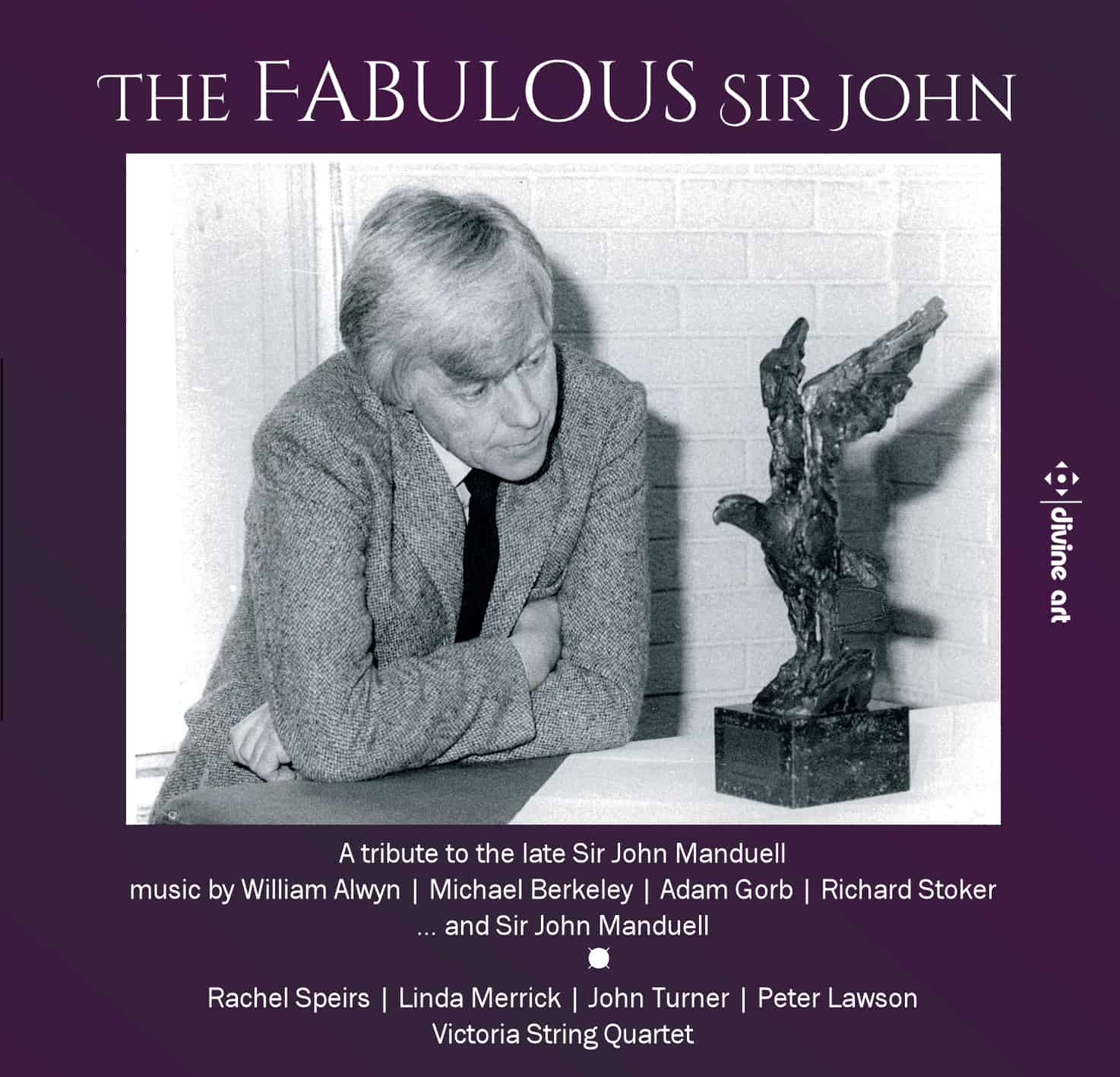
  • The Fabulous Sir John DDA 25235 – ARG review

    Sir John Manduell (1928-2017) was a British composer, BBC producer, first principal of the Royal Northern College of Music, and founder of the European Opera Centre. He was highly revered by people in the music and broadcasting professions.

    Stephanie Boyd reviewed an earlier album of works by 16 composers in tribute to Sir John. This sequel presents chamber music and songs by William Alwyn, Michael Berkeley, Adam Gorb, Richard Stoker, and Sir John himself.

    The program begins with a wordless ‘ Aria for Sir John’ for recorder and string quartet by Gorb, now the head of the Royal Northern College of Music. More than half of the pieces here are by Sir John, including the two longest ones. A short work by Berkeley, five William Blake settings by Alwyn, and Stoker’s haunting ‘Memento to Mary Magdalene’ complete the program.

    Spiers gives fine performances of the Alwyn songs and three settings of Renaissance texts by Sir John. Recorder soloist John Turner is the only repeat performer from the earlier tribute album, and he again plays beautifully in more of the program than anyone. The performers, like Sir John, are based in and around Manchester. These are strong and radiant performances. If you like newer British music, you will find this very nicely performed and expertly recorded.

    Notes are by John Turner. Texts are in English and French without translation.

  • The Fabulous Sir John DDA 25235 Anthony Gilbert review

    This is by no means the first CD of tributes to Sir John Manduell, CBE, Founding Principal of the Royal Northern College of Music, but is the sequel to Songs for Sir John (Divine Art DDA 25210, released 2020) and gives us nearly 38 minutes of his own music. All this is thanks to the equally fabulous virtuoso recorderist John Turner, who has initiated numerous recordings of music of our time, often, but by no means always, featuring his own instrument in combination with a variety of chamber ensembles – in this case the Victoria String Quartet along with soprano Rachel Speirs, clarinettist Linda Merrick, pianist Peter Lawson and of course John Turner himself.

    Perhaps as an indication of the breadth of Sir John’s involvements, all four of the other composers knew him independently of his rôle as Principal of the RNCM, and this beautifully compiled disc shows, in the way their music relates to that of Manduell’s, what a remarkable student, friend and colleague he was. Two living composers: Adam Gorb and Michael Berkeley, frame the eight tracks of Manduell’s music in a beautiful and elegant manner, each in his own striking way. 

    Adam’s Aria for Sir John seems almost to call out to the listener with a little word-like, or name-like gesture.  He tells me that it was intended as a tribute to both Johns, but John Turner added the ‘Sir’ to re-direct its intention! 

    Not being a critic or even a journalist, I don’t feel it would be right for me to evaluate, let alone highlight, any of the individual pieces on this disc – they all have their own fine, individual qualities. However, regarding Sir John’s, I shall venture a few observations since I’ve known his music for many years. It has individuality of a remarkable and personal kind.  What’s clear from what we hear on this disc is that it doesn’t fall into one stylistic category, but into a range of related styles, none of which follows a fashion. But different in style and character though each piece sounds, there are subtleties which unify them, which are most obvious in the Trois Chansons de la Renaissance. There’s a gentle humour, a special sense of timing, a harmonic language which is rather more modal than tonal within phrases but with a hint of key at cadences, and an elegant shaping of the phrases overall.

    His Elegy for string quartet is a richly-expressed tribute to the late Christopher Rowland, formerly leader of the Fitzwilliam String Quartet, who before that led the Sartori Quartet in John Manduell’s department at Lancaster University. So the first violin really stands out here!

    Recitative and Aria for duo of violin and viola – very expressive but with ‘wit’ – was written in memory of composer, writer and BBC colleague, Peter Crossley-Holland.

    Trois Chansons de la Renaissance for soprano and piano are settings of early-French poems, which Rachel Speirs and Peter Lawson perform with clarity and gentle humour.  Sir John was a great francophile, as shown in the gentle pastiche in at least one of the songs, and in the correct word-shaping in all three.

    Bell birds from Nelson for solo recorder, I’m happy to say, is a beautiful 70th-birthday tribute to myself, recapturing the song of birds Sir John heard on a visit to New Zealand.

    Nocturne and Scherzo, for clarinet and string trio, is the longest piece on this disc, lasting well over 11 minutes.  The slight ambivalence of the Nocturne, as though the dreamer is desperate to get going, is beautifully brought out by clarinettist Linda Merrick with Benedict Holland, Kim Becker and Jennifer Langridge, and the way they recapture the faint ambivalence in the Scherzo shows great understanding of Sir John’s intention, which was seemingly that the two movements are really just one.

    Tom’s Twinkle, for recorder and piano, has a humour which matches that of the title.

    To complete the frame around Sir John’s fascinating pieces, we have Michael Berkeley’s A Dark Waltz for recorder and string quartet. Michael had known Sir John for decades, so this brief tribute, containing hints of Hebrew chant (chants are a feature of much of Michael’s music), is deeply personal.  John Turner and the Quartet bring out the feeling of a prayer for peace (or Shalóm?) beautifully.

    Next, as a ‘historical’ background, there follow five Songs of Innocence for soprano and string quartet by Manduell’s first Composition teacher, William Alwyn, and a piece for recorder and string quartet by his co-student, Richard Stoker. The Alwyn songs are what could be thought of as ‘roots’, stylistically, of Sir John’s own musical ‘trees’.

    1. The Ecchoing Green (sic) – another waltz, perhaps looking back a little;
    2. Spring now looks forward, brightly and tenderly;
    3. The Divine Image has the feel of a hymn;
    4. Laughing song is jerky and jolly, and
    5. Nurse’s Song has hints of rebellion, perhaps relating to a Manduell Alwyn knew, as I feel all five of these songs do, in their different ways.

    Finally, as a gentle ‘coda’ to the whole CD, which is really a composition in its own right, we have Richard Stoker’s Memento Mary Magdalene, for recorder and string quartet, a six-minute piece of great beauty. Here, we hear not only the recorder ‘singing’, but also the viola.

    The playing and singing on the whole album are completely compelling, showing a very strong and convincing sense of engagement.  I do hope another one follows, perhaps this time featuring RNCM composers from the 1973-96 ‘Manduell’ era?

  • The Fabulous Sir John – recorder magazine review

    There are some interesting curios on The fabulous Sir John, a disc dedicated to the memory of Sir John Manduell, the founding Principal of the Royal Northern College of Music. John Turner brings his wonted elegance to the long lines of Adam Gorb’s Aria for Sir John, Michael Berkeley’s sad and angry Valse Triste and Richard Stoker’s Memento Mary Magdalene, Op. 84, three pieces for recorder and string quartet. There’s also Manduell’s own 11/8 jeu d’esprit, Tom’s Twinkle, and Bell Birds From Nelson, which uses descant and treble to capture Australian birdsong most attractively. It made me think of Van Eyck’s English Nightingale. Not perhaps music that you’d take to a desert island, but all useful additions to the repertoire.

  • The Fabulous Sir John DDA 25235 – BMS review

    For many years Sir John Manduell was best known as a music administrator of great accomplishment; now his compositions are slowly appearing, and here half a dozen are heard alongside works by his associates.

    Adam Gorb’s Aria for Sir John is a characterful tribute for recorder and string quartet, with (to my ears) a whiff of French elegance – it is instantly appealing.

    Michael Berkeley’s Dark Waltz is an elegy for a close friend; if the recorder doesn’t strike me as the obvious solo voice for a lament there’s no denying either the melodic charm or the sincerity of the piece, very much in the Valse Triste tradition.

    Alwyn’s early Songs of Innocence (1931) are tuneful strophic settings that illustrate the apparent simplicity of William Blake’s verses, without ever quite plumbing their more oblique depths: by contrast Richard Stoker’s haunting Memento Mary Magdalene might be the most immediately probing music on the disc.

     As for Sir John’s own works, his Elegy for string quartet from 2006 nags a repeated seven-note motto theme like a tongue probing a tooth to explore a world of anguish and angst. As a stand-alone movement the abrupt ending might strike you as either bafflingly unfinished or admirably curt. A Recitative and Aria for violin and viola explores a similarly austere world, traversing a knotty duologue to a yearning and rather plangent lament.

    Three French Songs from his student years are more immediately accessible: winsome, delicate and droll by turns. After two short pieces for solo recorder the Nocturne and Scherzo for clarinet and string quartet (at 11 minutes) is the longest piece on the disc. It is very much of its time (the late 60’s): at first eerily atmospheric and then rather percussively ‘in-yer-face’. To be honest, several hearings left a rather wan impression, though it’s possible that others might be more taken with its dour rigour.

    Does Sir John’s music have its own distinct personality? It is hard to say without assessing a wider sample. I shall certainly investigate his dramatic Double Concerto, also on Divine Art; for the present disc I must fall back on the infuriatingly equivocal description of well-made – even very well-made – music, well performed and presented, and leave readers to explore further.

  • The Fabulous Sir John – Musicweb review DDA 25235

    Sir John Manduell (1928-2017), composer and academic, crucially the first Principal of Manchester’s Royal Northern College of Music, is still much loved and revered. So much so that this is the second tribute disc from The Divine Art. The composers featured are very much part of the Manchester scene.

    Adam Gorb’s Aria for Sir John is a touchingly melodic little piece for recorder and string quartet.

    Next comes a sequence of pieces by Manduell himself. After an edgily haunting and reserved Elegy for string quartet there’s a trippingly complex Recitative and Aria in similar language, The Trois Chansons are for soprano and piano. Here, Manduell responds with natural melodic pliancy to the texts. These are indeed early works of his and this explains the less relentless and even straightforward melodic style. Of the three, ‘D’un vanneur de blé aux vents’ was also set, at about the same age, as Manduell by Lennox Berkeley, in 1925, Young men’s songs then – sung here by Rachel Speirs. She has lyric instincts and operatic powers in reserve and the latter are certainly engaged by ‘À sa dame malade’.

    The short Bell Birds from Nelson is for John Turner’s solo recorders (treble and descant). It was written for the 70th birthday of a composer little recalled, Anthony Gilbert. Its trills and chirps bespeak a virtuoso piece evidently well prepared.

    Nocturne and Scherzo is for clarinet and string trio and was completed as a dedication piece to Alun Hoddinott in 1967. It adheres to Manduell’s style as in the Elegy and Recitative and Aria. There’s fear afoot in the sinister Nocturne.

    In like style there’s the passingly brief and cheeky Tom’s Twinkle for recorder and piano. The title prepares you for the score’s brevity. It was written in memory of calligrapher, artist and frankly lyrical composer Tom Pitfield.

    Michael Berkeley’s A Dark Waltz for recorder and string quartet is a thoughtful piece and escapes any suggestion of the waltz having intoxication; but then it was written in memory of Sir John. It is most adroitly short and with a touching poignancy.
     
    William Alwyn’s Five Songs from ‘Songs of Innocence’ are polished little Blake settings for soprano and string quartet and comfortably join the delectable output of Geoffrey Bush and Adrian Cruft from many years later. These songs are from May 1931. David Matthews is to be thanked for making these songs a practical performing entity. Apparently, the score is hard to read. There is something of Britten in the strikingly humorous ‘bounce’ of ‘Laughing Song’. The five end with the thoughtful ‘Nurse’s Song’. All credit to Alwyn for concluding the sequence with a down beat and a shiver.

    Richard Stoker’s Memento Mary Magdalene is a lament for Mary for recorder and string quartet. Stoker deserves credit for following such an unexpected subject. The music sinks like a stiletto under the skin and is most moving. Surely, it is time for more Stoker including his operas Therèse Raquin and Johnson Preserv’d, the symphonies, concert overtures and three each string quartets and violin sonatas. Here is a most fastidious composer who yet seeks out the listener’s heart. With Manduell he was a fellow Berkeley pupil.

    The styles here range from severe to sweet but without the juiciest succulence. The notes in the CD booklet, which is neatly and legibly laid out, are all in English only and are extensive. Sung texts are there, but in the case of Sir John’s songs, are not translated into English. The booklet also includes a set of recollections of Sir John from Bryan Fox, Kent Nagano and Linda Merrick.

  • The Fabulous Sir john – Infodad review DDA 25235

    The talents of Sir John Manduell (1928-2017) included composition but went considerably beyond his creation of music: Manduell was a well-known producer, teacher, and artistic director in Great Britain. However, he is virtually unknown in the United States in any of his roles, in all of which he functioned in the United Kingdom; and while he is famed within the music profession in Europe, he is not exactly a household name outside the music field, even on that side of the pond. So a CD devoted to tributes to Manduell is by definition a limited-interest item – and two CDs of tributes would seem to be over-the-top. But that is what Divine Art is offering: The Fabulous Sir John is an add-on to a previous tribute disc called Songs for Sir John.

    In some ways, the new disc is actually a better tribute than the earlier one: the previous disc included works by 16 contemporary composers, while the new one offers works by only five – but one of them is Manduell himself, so this disc is a way for the uninitiated to hear some music written by the person who is being lauded. Nor is it a small amount of music: nearly 40 minutes of the CD’s 65 are devoted to works by Manduell, and an additional piece, the four-minute Aria for Sir John by Adam Gorb (born 1958), sets the scene for the pieces by Manduell himself. Gorb’s piece is fine – sensitive without being overly mournful – but Manduell’s own are something of a mixed bag. Elegy has some sensibilities in common with Gorb’s work; Recitative and Aria, although not a vocal work, has the right approach to justify its title, although its insistent dissonance is a bit much; Trois Chansons de la Renaissance offers three pieces that are vocal (sung by soprano Rachel Speirs), and here the settings are first-rate, keeping the words clear while providing very apt piano support (Peter Lawson is the pianist); Bell Birds from Nelson is rather obvious, if pleasant, in its use of recorder (played by John Turner); Nocturne and Scherzo, the longest Manduell work offered here, contrasts its sections suitably if not especially surprisingly; and Tom’s Twinkle is a nice little 90-second bit of fluff with, again, a recorder focus.

    After the Manduell-composed pieces on this disc, there is A Dark Waltz by Michael Berkeley (born 1948) – the piece is more crepuscular than genuinely dark-hued. Then Speirs returns, this time accompanied by the Victoria String Quartet, for 5 Songs from “Songs of Innocence” by William Alwyn (1905-1985). The words by William Blake have attracted many composers, and Alwyn’s settings are fine, although some of the vocal lines are rather overdone for poems that Blake intended to be un-ironic presentations of naïve feelings (in contrast to his Songs of Experience). The disc concludes with Memento Mary Magdalene by Richard Stoker (1938-2021), which uses recorder and string quartet to produce a quiet and thoughtful ending for this tribute disc. All the performers – also including Linda Merrick (clarinet), Benedict Holland (violin), Kim Becker (viola), and Jennifer Langridge (cello) – perform with sensitivity and a sense of suitable deference to the person whose accomplishments the CD is designed to celebrate. But none of the music, including that by Manduell himself, is so noteworthy as to command attention beyond that associated with this particular memorial project. As well-intentioned as this second Manduell tribute disc is, it remains, like the first one, an offering strictly aimed at people familiar with and appreciative of Manduell, especially ones for whom his many significant musical roles were important during his lifetime.

  • The fabulous Sir John: A tribute to Sir John Manduell

    The fabulous Sir John: A tribute to Sir John Manduell

    Sir John Manduell (1928-2017) was a pivotal figure in British music – as composer, BBC producer, first principal of the Royal Northern College of Music and founder of the European Opera Centre. Beloved and revered by musicians, yet someone whose name is shamefully little known outside the music and broadcasting professions.

    This album is a sequel to ‘Songs for Sir John’ (DDA 25210) which in tribute to Sir John presented works by 16 composers from more than one generation. On this new album we present music by Sir John himself, and by William Alwyn, Michael Berkeley, Adam Gorb and Richard Stoker, all well crafted works which will give great enjoyment as well as perhaps inspiring musicians to add them to their repertoire.

    Even without the Manduell connection this is a wonderfully constructed program of new chamber and vocal music. The performers, like Sir John, are based in and around Manchester, England, which is a dynamic ‘hotspot’ for fine musical creativity.