Scenes from the Gospels’ account of the Passion of Christ, with reflective meditations. Drawing deeply on the traditions of Baroque Passion settings as well as such works as Stainer’s ‘The Crucifixion’ and Maunder’s ‘Olivet to Calvary’, Simon Mold’s ‘Passiontide’ is a masterpiece. It’s a strikingly accessible work that explores a range of emotions with a sure feel for word-setting and an irrepressible tunefulness, while nonetheless capable of many passages of gravitas, poignancy and lingering beauty. Highlights include dramatic moments in the Garden of Gethsemane and before Pilate, a searching setting of the Reproaches for choir and soloist, the heart-rending farewell duet for Mary and Jesus and a final scene that taps into the feelings of believer and non-believer alike.
Catalogue Connection: 25238
-
Passiontide – lenten cantata by Simon Mold DDA 25238 – review by Church Music Quarterly
This substantial meditation in the style of baroque Passion settings, with hints of Stainer’s The Crucifixion and Maunder’s Olivet to Calvary, tells of the Passion of Christ. The work is in five distinct sections: The Last Supper, Gethsemane, Jesus before Pilate, The Crucifixion and the Death of Jesus.
Combining hymns (suitable for congregational singing), arias and recitatives, choral motets and organ interludes over the course of an hour and a quarter, Mold takes the performers and listeners on a moving Passiontide journey, The music is accessible and would make a lovely alternative to the aforementioned Stainer and Maunder pieces. The contribution of the vocal soloists would benefit from more finesse and at times a sense of drama. The real stars of the show are the nine singers of the Knighton Consort who gave performances of maturity and sensitivity.
-
Passiontide (DDA 25238) Fanfare review
British composer Simon Mold (b. 1957) has a history as both a treble soloist and a chorister in the Peterborough and Leicester Cathedral Choirs. Most of his compositions are vocal or choral. Passiontide is a Lenten cantata, described in a subtitle as “scenes from the Gospels’ account of the Passion of Christ, with reflective meditations.” The music is steeped in the British choral and vocal tradition as it was before Benjamin Britten. The style recalls Finzi, Holst, and even Stainer. Any given 15 minutes are attractive, but my attention began to wander after that because of the lack of variety in mood and color.
Looking back to Bach, there is undeniable potential for great drama in the events covered by Passiontide, which include the Last Supper, the trial before Pontius Pilate, and Jesus’s Crucifixion and death. In different eras, composers have found ways to communicate the drama effectively. I waited for such moments to occur here, but they never did. Mold’s music is pleasant, at times soothing, but rarely gripping.
There are five choral hymns in Passiontide, which are beautifully sung by the nine-voice Knighton Consort. The four soloists, three of them men, are variable. Baritone Stephen Cooper as Jesus sounds leathery at times, and the same is true of tenor Philip Leech. Helen Bailey, who sings the role of Mary but also serves as a soprano soloist with choir in The Reproaches and the Voice of the Cross, offers a gleaming and well-produced voice. Jeremy Leaman’s dark bass-baritone is well cast as Pilate.
The recorded sound is basically fine, except that occasionally Leech’s lighter singing is covered. The booklet contains a helpful program note by Christopher Barton.
-
Simon Mold’s ‘Passiontide’ DDA 25238 – review from Catholic Herald
Settings of the Passion story by an English composer in the English language have always been thin on the ground, probably nervous of competition with Handel’s Messiah. And despite some interesting modern examples – including a neglected epic by Jonathan Harvey called Passion and Resurrection, written for Winchester Cathedral in 1981, as well as next-generational updates on St John and St Luke by James MacMillan – the ones that people tend to know aren’t necessarily of shining calibre or spiritual substance. There are the 1970s pop jobs, Godspell and Jesus Christ Superstar, which I suppose count as Passion narratives. And there’s the sincere but stodgy Victoriana of John Stainer’s Crucifixion or JH Maunder’s Edwardian counterpart Olivet to Calvary: music loved by many an amateur choral society but, to my ears, dismal.
So a new contender can only be welcome. One recently releasedon disc – from the Divine Art label – is Passiontide by Simon Mold: an 80-minute score composed in 2010 for various performers connected with Leicester Cathedral. Mold isn’t quite a household name but he’s been active on the UK choral circuit as a singer and teacher for many years. And what he’s written here is something carefully calculated to be within the reach of amateur performers – none of it unduly challenging, and based eclectically on musical sources that range from Bach (to the point of parody) through to Vaughan Williams and Rutter.
As for the text, it’s almost entirely in English, drawn from 19th-century hymnodists, assorted psalms and a bizarre chunk of the medieval Dream of the Rood in which the wooden beams of the Cross expound on their journey from tree trunk to sacred relic. Most of the words come from a 17th-century text published as Christologia, or, A Metrical Paraphrase on the History of Our Lord and Saviour Jesus Christ by one Elisha Coles, who took it upon himself to rewrite the gospel texts in rhyming couplets.
That Coles was of Puritan stock might not commend his work to devout Catholics, and he’s a strange choice for this work, responsible for quaint archaicisms that occasionally descend to the level of pantomime. “Must I, O Father, drink this bitter cup?/Thy will be done: I’ll freely drink it up” is a bathetic case in point that doesn’t altogether dignify Christ’s agony in the garden. More positively, there’s a pleasing succinctness in the way the story unfolds, organised into five scenes – Last Supper, Gethsemane, Pilate, Crucifixion and Death – pinned together with reflective motets or hymns that serve much the same functions as Bach’s chorales and deliver a competently constructed tunefulness that will please many a chorus. Beyond that, I can only say I wish the music had more definition, strength and edge: it’s unadventurous in idiom, with not enough to captivate the heart or memory. But it has practicable uses for a parish choir. And though the recording, produced by Mold himself, hasn’t the vocal excellence expected in these days of elite professional consorts, it too has uses – as a demo disc to introduce the piece to possible performers. There will surely be some.
-
Passiontide cantata DDA 25238 – review by World
What makes this recording of Simon Mold’s 2010 “Lenten cantata for soloists, choir and organ” unique isn’t the music or the performances (both fine). It’s the seamless textual garment that Mold has woven from Scripture (three psalms, Micah 6, 1 Peter 2), Coles’ Christologia, Aquinas, and a half-dozen hymnists spanning several centuries. Then there’s “The Dream of the Rood,” wherein the cross speaks for itself.
-
Passiontide – Chronicle review
Premiered in Kent in 2009, Passiontide was conceived as an alternative to Stainer’s Crucifixion, telling the story of Holy Week in the manner of a small oratorio and including several hymns for choir and audience in a nod to the earlier composer’s well-known choral work (the preview notes say).
They go on: “Mold has compiled an eclectic libretto that combines some quirky 17th century metrical Gospel narrative with a variety of choral and solo reflections; the result is a strikingly accessible work that explores a range of emotions with a sure feel for word-setting and an irrepressible tunefulness, while nonetheless capable of many passages of gravitas, poignancy and lingering beauty.”
Accessible is right. It sounds throughout as if you’ve stumbled across a church and found a service in progress, with some fine singers admittedly, but nothing grand. The sound is reverential, gentle and respectful; and the church organ is clearly a real church organ. (The album was recorded in Mountsorrel Methodist Church, Leicestershire, which looks like it has good acoustics, and hosts organ recitals — one we found had Angela Sones, director of music at All Saints’ Church, Lichfield). It’s sincere and honest, and calming, too. The narrator is Philip Leech, tenor (Guildhall School of Music and Drama), Jesus is sung by experienced song recitalist Stephen Cooper (Southwell Minster) and the soprano soloist is Helen Bailey (Royal Academy Opera), along with bass-baritone Jeremy Leaman (Loughborough University) as Pilate.
Roxanne Gull (Christ’s College, Cambridge and Lincoln Cathedral) conducts The Knighton Consort made up of choral specialists. The organist is David Cowen (Oxford, Paris and currently organist of Leicester Cathedral).
The album is being released for Easter but anyone who likes choral music and / or church music should have a listen; it’s reverent without being overwhelming and is nicely traditional.
-
Passiontide (DDA 25238) BMS review
Passiontide by Simon Mold (b. 1957) is described both as ‘A Lenten Cantata for soloists, choir and organ’ or ‘Scenes from the Gospels’, ‘an account of the Passion of Christ, with reflective meditations’. Both the Gospel Scenes and the Reflective Meditations are fully delivered with the Meditations, Sentence, Motet, Psalm and more, carrying much of the emotional response.
The Gospel scenes include The Last Supper, The Garden of Gethsemane, The Trial by Pilate and the Crucifixion and Death of Jesus. The principal part in the delivery of these scenes goes to tenor, Philip Leech. His voice comes across as earthy and emotionally involved, which in this work I thought was right, rather than the clear-ringing tenor detachment found in some such works. There are indeed passages one recognises as traditional recitative where the organ tries to imitate harpsichord, but often the flavour of English art song takes over in both voice and organ.
The character parts are sung by singers closer to the bel canto ideal. Baritone Stephen Cooper as Jesus is particularly good, as is Jeremy Leaman’s deep voiced Pilate. Soprano Helen Bailey is excellent in a number of parts, Mary, Mother of Jesus and in one astonishing section, the Voice of the Cross itself!
The Knighton Consort has nine voices conducted by Roxanne Gull. They are brilliant in the five Hymns included in the performance, suggesting the influence of Stainer’s The Crucifixion. I particularly enjoyed the first hymn, God of unexampled grace. The CD is worth it for that piece alone. Both the music for soloists and a multiplicity of choral sections are well done.
There are many different style changes in Mold’s writing. Overall, lavish romantic English song is to the fore in many pieces alongside more traditional church choral writing. The influence of Finzi is mentioned in the booklet to which I would say, ‘Yes!’ and Britten, well no, I don’t think so. Above all, in both the composer’s eclectic choice of text and of variety of musical style, even including Bach a couple of times, this is a work worth hearing both for true believers and for those interested in English music. I certainly cannot think of anything else quite like it.
-
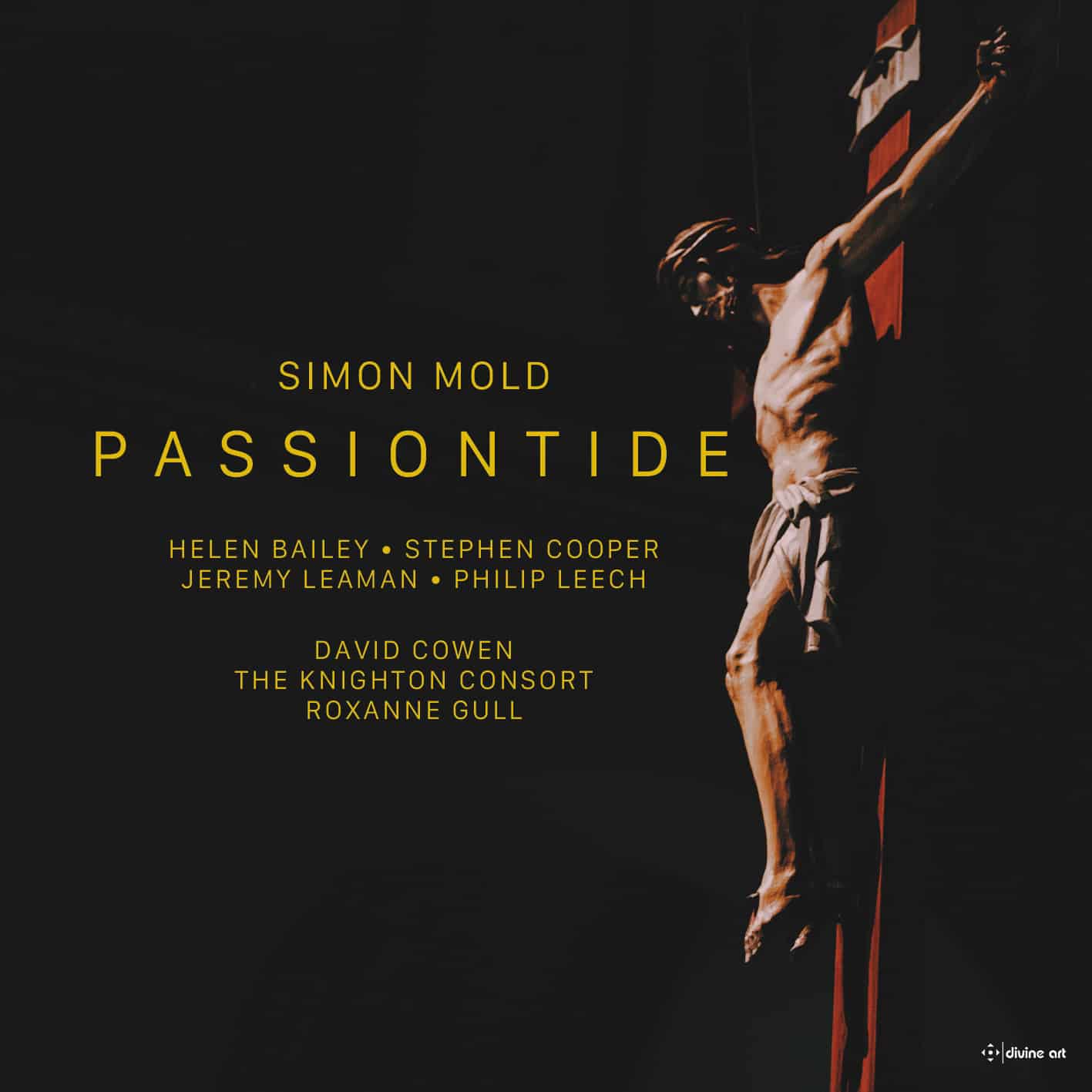
Passiontide – A Lenten Cantata
Simon Mold’s new setting is a triumph drawing deeply on the traditions of baroque Passion settings as well as such works as Stainer’s ‘The Crucifixion’ and Maunder’s ‘Olivet to Calvary’. This work is a masterpiece which, if there is any justice in the world, will be widely sung, to be appreciated by choirs, audiences and congregations.
A strikingly accessible work that explores a range of emotions with a sure feel for word-setting and an irrepressible tunefulness, while nonetheless capable of many passages of gravitas, poignancy and lingering beauty.
Highlights include dramatic moments in the Garden of Gethsemane and before Pilate, a searching setting of the Reproaches for choir and soloist, the heart-rending farewell duet for Mary and Jesus and a final scene that taps into the feelings of believer and non-believer alike.