Catalogue Connection: 25239

  • Spanish Meditations and Dances DDA 25239 – Fanfare review 2

    Arnold Schoenberg was quite clear when he said there are plenty of tunes still to be written in C Major. Composer Gregory Fritze (b. 1954) writes in an unabashedly tonal idiom, but somehow it appears fresh as a daisy. Or is that a “margarita”? For the essence of this music is rooted in Spain, a country the composer has visited a host of times, often for research. Sheppard Skærved’s own notes talk of the “sun-soaked score,” and how right he is. This is not overtly virtuoso music, so when there is an explosion of technical difficulty (as in “Tenerife Dance”), it really makes its mark, while the very next “Buñol” is gloriously expansive and lyrical.

    The fifth piece, “Madrid,” is a set of variations on a theme by Luigi Boccherini. Sheppard Skærved gives out the tune with beautiful simplicity; then suddenly the piano takes us into far more modernist territory, and we’re off on an adventure. The variations are massively diverse, and much of this is such good fun that it is easy not to listen for the artful construction and finely-honed writing for both instruments. Watch out for the gong strike near the end! As if to calm the listener’s frazzled nerves, Fritze offers a milder “Tavernes de la Valldigna” (which actually acts as something of a prolongation of the calmer end of the Variations) followed by a simply delicious “Pastoral.” The harmonies and melodies of both are clean and inviting.

    Sudden, refreshing shots of pointillism paint “Bilbao—At the Gugenheim.” One of the most interior spaces is “Llíria,” the tenth movement, followed by a “Llíria Dance,” nicely contrastive, with a deliberately heavy contrasting element. There is something remarkably calming about “L’Alcúdia”; the piano writing is perfectly Spanish. The earthy “Barcelona—Gaudi Dance” is nicely grungy—Sheppard Skærved relentless, and in a positive way—while the following “Alzira” rises to a rousing climax. The cycle ends with another pairing, “Carcaixent” and “Carcaixent Dance,” the former gently flowing, the latter fiery and feisty.

    Occasionally Fritze teases our memories, offering quotes or near-quotes embedded within his score. This is an impressive cycle of Spanish-inspired works, performed with fervent devotion by Sheppard Skærved and Chadwick.

  • Spanish Meditations and Dances DDa 25239 – Fanfare review

    Gregory Fritze (b. 1954) received a rave review from James Altena (in 34:3) and has been receiving the same from me for some years. Heretofore, however, mine have been only of the private sort, where I’ve been singing his praises as a gifted composer mentally to myself and out loud to a handful of other people individually. I’m very happy to now be able to do so in print to a much wider audience. Interestingly, I knew Greg when we were both graduate composition majors at Indiana University back in the 1970s. I admired his music even back then, but we lost touch until about a year ago, when we became reacquainted during his visit to Bloomington. That’s when my collection of his CDs began, and I’ve been hooked by his extremely well-crafted and -imagined music ever since. Indeed, he is one of the two or three best currently active wind ensemble composers (and leave it to Canfield to know the band field) as far as I’m concerned, and it is in this area and the brass one in which he is especially renowned, a natural consequence of his also having been a professional tubist for a good part of his career. (I’ll bet, though, that he doesn’t know that “tuba” in Estonian means “room”—and don’t ask me how or why I know that). As a composer, he was head of the composition department at Berklee College of Music (with around 45 professors of composition alone, it is perhaps the world’s largest music school). He is now retired, and I trust this means that he’s writing all the more music.

    Being relatively well acquainted with his music for band and brass ensembles of various make-ups. I was particularly happy to receive the present CD that features his works for violin and piano. The present set of 17 short works was written and arranged for the superb violinist Peter Sheppard Skærved. Its Spanish theme reflects composer’s numerous (about 60 in the past 30 years) trips to Spain, whether to hear performances of his music or to do research on Spanish music. This work was written in 2020-21, during the height of the COVID pandemic with its concomitant confinements how much extra music must have been written during this period!) When the restrictions were lifted. Skærved knew (from having studied the score) that he wanted very much to play—and eventually record—this work.

    From the onset of the opening Valencia, one realizes that this work presents Fritze in his most tuneful mode (his music, as far as I’ve heard, is generally quite tonal, a string quartet excepted). This is the sort of music that really would lose something if I were to try to analyze it, so I shall not attempt to do that. Rather, these are pieces that one simply sits back and luxuriates in, as I’m doing as I type these words. The titles are drawn from various cities and regions of Spain, presumably places that Fritze has visited over the years (there are no notes provided for the individual pieces in this suite). I rather doubt that he attempted to recreate the character of each city in these pieces (although [perhaps a passing dissonance in the Tenerife movement could refer to the air disaster that occurred there some years ago), but that matters not in the least. In each of these pieces, Fritze pays obeisance in some measure to the Iberian peninsula. His skill in writing idiomatic violin lines and gestures is such that it might lead the listener to believe that this was actually his instrument rather than the tuba.

    Hearing the fifth piece (Madrid) in the set causes me to wonder if Fritze might have attended my master’s composition recital. I had a woodwind quintet on the program, and at the very end of The piece I had scored an unexpected fortissimo stroke from an off-stage tam-tam (since excised from thepiece). Lo and behold, a loud tam-tam appears ex nihilo in this piece as well. Another interesting effect comes in the seventh piece, Rioja, where the violinist is instructed to tap quickly on his instrument. This is not as loud, but every bit as unexpected, as the heart-stopping earlier tam-tam stroke. Yet another surprise comes in Bilbao—at the Guggenheim, where the modernity of the piece is ratcheted up several degrees to marvelous effect. The style shifts mid-point in the piece to a sultry and bluesy atmosphere, and then again to another one, suggesting that Fritze is creating sort of a miniature Pictures at an Exhibition in this work. Most of these pieces don’t seem too technically demanding—that is, until one reaches No. 11, Liria Dance, which gives the violinist (especially) a real work-out. I bet that other violinists will discover this piece and play it as an encore.

    Peter Sheppard Skærved and pianist Roderick Chadwick make an exceptional team in bringing these works to light. Skærved’s tone, intonation, and phrasing are most admirable, and I even like the way he shifts (a violinist’s left hand not only plays notes with four different fingers, but according to The requirements of the music constantly has to change position up and down the fingerboard, and this “shifting” produces pleasing audible results if done skillfully). Chadwick, for his part, seems completely immersed in the rewarding piano part, bringing sensitivity and imagination to its execution. Between the superb music and the equally superb music-making, this CD is catapulted to the “must own” category of recordings. I cannot imagine this not making my 2023 Want List.
  • Spanish Meditations and Dances DDA 25239 – Chronicle review

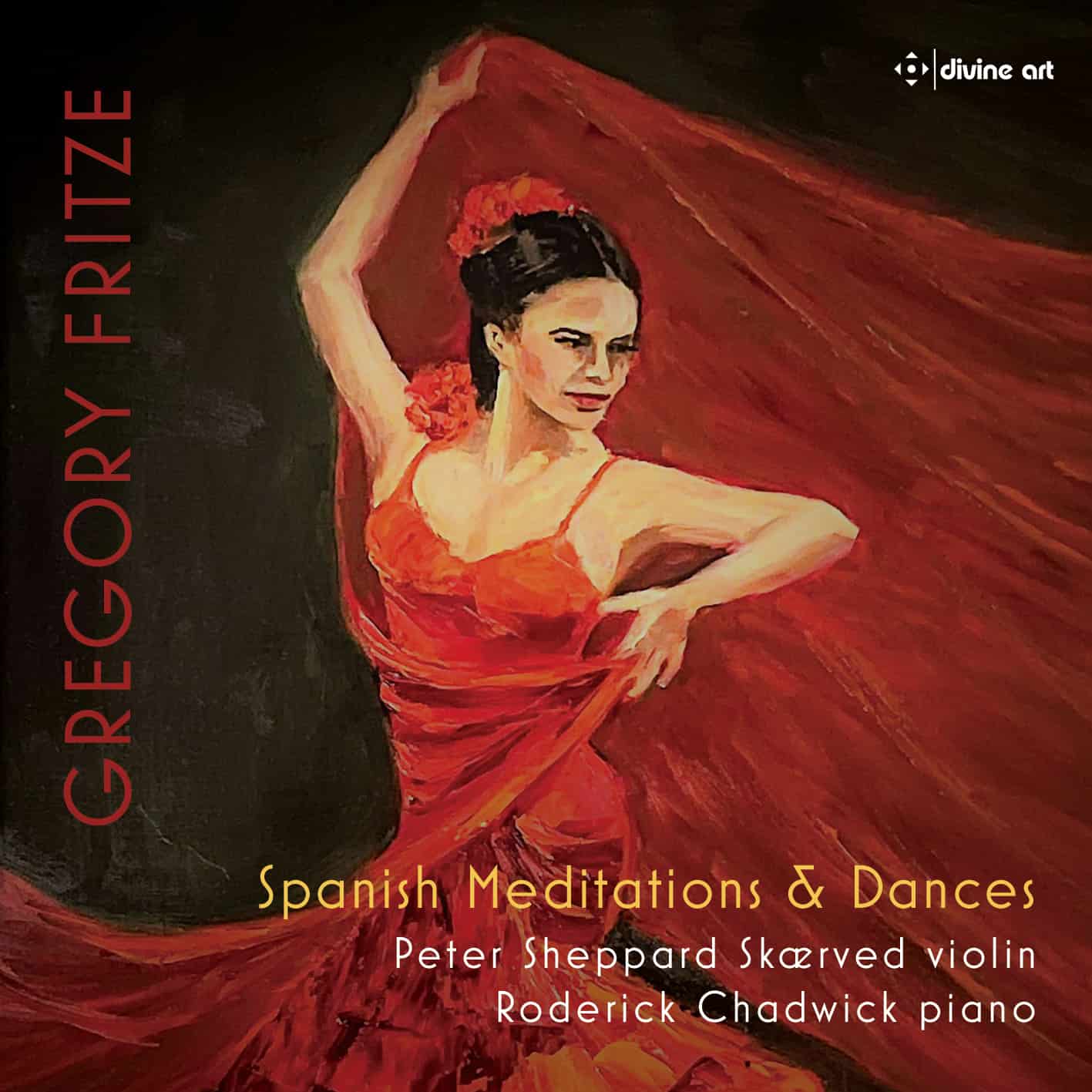
    This is a programme of 17 pieces for violin (Peter Sheppard Skærved) and piano (Roderick Chadwick) composed and arranged by American composer Gregory Fritze. It’s very easy on the ear, although Spain is at times not a country that springs to mind, flourishes aside.

    The opener is called Valencia and while it’s an atmospheric piece, the images it invokes are more English pastoral, the scene from a costume drama where they dance under an oak tree. Lovely track, though.

    Tenerife does open with a definite Latin dance feel (and a violin melody similar to Manuel, he of the Music of the Mountains, and his Rodrigo’s Guitar Concerto de Aranjuez) so is more Spanish, with some bull fighter-ish little runs on the piano. A short piano solo is evocative of Mike Oldfield or “quietest moments” Supertramp. It’s nicely mournful but is followed by the more chipper Tenerife Dance, less dance-y than the opening of Tenerife and reminiscent of the music you get in old Westerns, so more Mexican. There is a nice interplay between piano and violin, the former playing almost a pop tune and the violin responding in a leftfield fashion.

    Buñol must be a slow and mournful place if this more delicate tune represents it; there is a Spanish mournfulness in the violin but again if the album was called English Meditations, it could sound English and bucolic.

    There are 17 tracks so we’re not listing them all but Buñol is magnificent, very romantic and Spanish; Cullera is lovely and gentle and flows like water (the city is situated near the discharge of the river Júcar in the Med), while Barcelona Gaudi Dance is as lively as its name suggests (but again could pass as exotic Scottish if it was called Inverary Mackerel Dance).

    So easy on the ear and relaxed, it at times just slips by. This is nevertheless an entertaining album, with top class playing on the piano and violin.

  • Fritze: Spanish Meditations and Dances

    Fritze: Spanish Meditations and Dances

    “Spanish Meditations and Dances” is a set of 17 pieces for violin and piano composed and arranged by American composer Gregory Fritze, specially for violinist Peter Sheppard Skærved. The set includes both expressive meditations and exciting technical dances, inspired by the towns and regions of Spain. Gregory Fritze is a prize-winning composer and Fulbright Scholar, with a long history of successful performances and composition awards.

    The performance of “Spanish Meditations and Dances” features Peter Sheppard Skærved on violin and Roderick Chadwick on piano. Both musicians are critically acclaimed and have extensive concert and recording careers. The compositions showcase the violinist in both expressive and exciting technical playing and titles of the movements are from the many towns and regions of Spain that have been a great inspiration in the composer’s music over the years.

    Each movement is a stand-out piece, showcasing the exceptional talent of both the composer, Gregory Fritze, and the performers, Peter Sheppard Skærved and Roderick Chadwick. The emotive and technically masterful violin playing paired with the dynamic piano accompaniment make for a truly captivating listening experience. The album is destined to be an airplay classic.