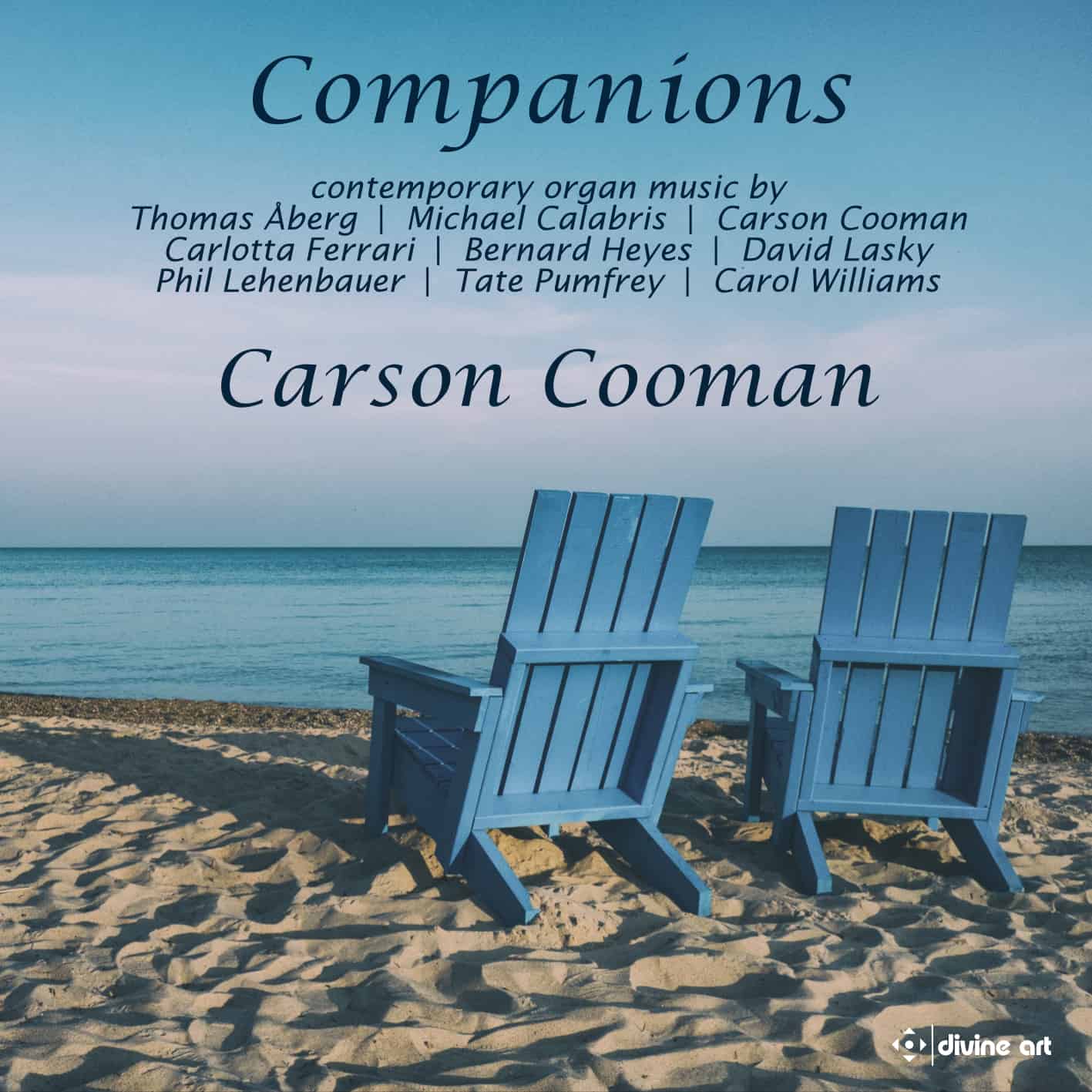
Recorded on the fine organ at the Pauluskirche, in Ulm, Germany (Thomas Gaida, 2013, after Gebrüder Link, 1910), this disc presents a carefully chosen selection of contemporary organ music, beginning with Carol Williams’ Prismatic, op. 24 (2019). British-born Williams was civic organist of San Diego, CA from 2010 to 2016. Her piece indeed depicts shafts of light—and even glistenings, I would suggest. Written for the composer’s own recital on the Midmer-Losh organ in Broadwalk Hall, Atlantic City, New Jersey, it pounds with energy as well. The use of Scriabin’s so-called “mystic chord” is also part of the equation. The final, glowing peroration is, in retrospect, perfectly planned: It emerges absolutely naturally, a testament to Cooman’s fine grasp of the piece. It also sounds fantastic; Cooman’s organ is incredibly impressive.
Cooman has recorded several pieces by Carlotta Ferrari, including two whole discs reviewed by David DeBoor Canfield in Fanfare 40:2. Her 2022 piece Companions (from which the disc derives its name) was written for Cooman in response to the religious painting The Divine Journey of Companions of Love and Home by Janet McKenzie. There’s no missing the blues element in Ferrari’s piece (it is based on a hexatonic blues scale, reflecting the prevalence of purples and blues in McKenzie’s painting).
Swedish composer Thomas Åborg’s Three Short Fantasy Pieces (1978–79) were his earliest published organ works. This is chromatic music in the sense of “colorful,” as in the first movement Åborg depicts daylight, before retreating to whispered but still colorful utterances. It is all beautifully timed (and aurally painted) by Cooman. We move from English to German for the title of the second piece, “Wartet auf …” (Waiting for …) and to a disquieted meditative space. It is deeply concerning that there are only ten pieces by Åberg in the Fanfare Archive, nine of which are recorded by Cooman. In terms of discography, Åberg’s Fantasy in A Minor seems to be his most popular work (Cooman’s is one of the recordings). The sheer sonic imagination deployed in “Wartet auf …” is remarkable. He holds out dynamically until the tinkling, bold coda (not as contradictory as it sounds—give it a listen). Finally, and offering a third language for the movement titles, “Pluie d’orage sue Saint-Louis” (Thunderstorm in Saint Louis), reflecting a storm experienced by the composer in the French/Alsatian town of the title. It is virtuoso music, delivered by a virtuoso performer in the shape of Carson Cooman.
Cooman’s own Recitative (2018) is dedicated to the German organ builder Thomas Gaida (see the details for the instrument used in this recording, given above) and was inspired by the “enormous” Flauto mirabilis stop he developed for just this particular organ. It is a fine, serious piece, and very beautiful, particularly the cadence in the final measures. Carlotta Ferrari’s The Grave of Keats (2021) is very different, full of shifting movement. Written to mark the bicentennial of the death of that famous poet, the title refers to Oscar Wilde’s poem as well as to a pilgrimage made by the composer to Keats’s grave. In a rather nice touch, Ferrari marks the opening to be played “flowing like water” to reflect (no pun intended) Keats’s tombstone inscription of “here lies one whose name was writ in water.” There is a dark shadow that lies over the piece, and indeed the ending is positively haunting.
We move to very topical matters with David Lasky’s 2022 Peace Prayer No. 1, written in response to events in the Ukraine. There is, perhaps, a sense of hope enshrined in the powerful harmonies. Another piece written for Cooman, Canadian composer Tate Pumfrey’s Sursum Corda (Lift up your hearts, from 2021), seems almost like a prolongation of Lasky’s piece. Rather more jaunty is Phil Lehenbauer’s Voluntary in F Major (2022). It is described by Cooman in his booklet notes as being composed “in the ‘American classic’ style,” and what can I say but that it certainly is. The piece certainly has a spring in its step, and it sounds as if Cooman enjoys every second. Again, the path to the close is perfectly tracked, and I love the little harmonic surprise at the end. The name of Michael Calabris (b. 1986) is new to the Fanfare Archive. Based in northeast Ohio, Calabris has composed in many genres and styles (including heavy metal). HisCanzona of 2020 breathes an air of mystery and is entirely in keeping with this program (the only metal is the organ pipes).
Finally, it’s nice to have grandeur, here in the form of Bernard Heyes’s Organ Symphony No. 15 (2007–08). At some 32 minutes, this is the longest work in the program. This was originally imagined by Heyes as his final organ symphony (he changed his mind and has subsequently written another six) and, despite his U-turn, there is a sense of “finality” about it. The movements have titles. The first is “Impressions of Australia” (from a 2007 trip). The opening theme is a rhythmic imitation of “Australia” and is an impressive edifice of a structure. The title of the second movement, “Mind Music,” takes a melody often in the composer’s head (“Mind”) and develops it harmonically. The harmonic shifts are actually really rather beautiful, especially in such a shaded account as this. “Quondam,” the third movement (of five), refers to “that once was” (or the past, in other words). There is certainly gravitas here (Cooman calls it “monolithic”), with near-cluster chords that take us close to the Gothic; later, scrunches punctuate a melodic line. Although there are five movements, in a sense the fourth is preludial to the fifth, as its title, “Before the close,” attests. The melodic material of the fourth section seems to rotate slowly around pitch axes; it is properly calming, and Cooman rightly takes all the time in the world. As to that “close” itself, the “Fantasy Finito,” as it is called, begins with a bath of sounds before an exciting toccata lets rip. Cooman’s fearless technique enables the full brightness of this music to shine. At just under ten minutes this is an extended finale (by some measure the longest movement of the symphony). Heyes’s piece is a case of not really having to know the movement titles, though; I am not sure my listening was particularly enriched by them, to be frank. Still, this is a piece to return to, and I for one would like to hear more of Heyes’s organ symphonies (recordings of which seem to be scarce). Cooman’s command, both in terms of technique and musicality, is beyond criticism throughout. A final mention must go to Christian Starke, who saw to production, engineering, editing and mastering. Recommended.