Schliessmann’s new release collects a number of works often recorded by pianists (the program includes the Chromatic Fantasy and Fugue) along with the Fantasia and Fugue in A minor (S 904) and an interesting three-movement complex made from the C-minor Fantasy and Fugue (S 906) and the Adagio in G (S 968). His tone is lovely and singing; his phrasing imaginative and probing (even in such an absolutely familiar work as the opening section of the Partita’s first movement). Some fast passagework sounds unsteady (Capriccio of the Partita, Fantasy in C minor), but at his best – in the fast movements of the Italian Concerto and the Chromatic Fantasy and Fugue – he has no rivals.
Catalogue Connection: 25751
-
Fanfare – Jerry Dubins – 25751
It should be obvious from our interview above that for all his breadth and depth of knowledge in the disciplines of music, art, literature, and philosophy in general, and his breadth and depth of learning and scholarly insight into the music of Bach in particular, Burkard Schliessmann is, at heart, an unapologetic Romantic, a state of being that finds expression in his playing of these works. This is not to say that you will hear exaggerated cadential ritards, idiosyncratic tempo adjustments, rhythmic unsteadiness, or phrasing irregularities. Schliessmann is too knowledgeable and respectful of Bach to allow any corrupting influences to taint his readings of the scores.
Where his “Romantic” approach comes in, if you wish to call it that, is in his stated belief that once you’ve made the jump to play Bach on the piano, you have to do so with full committment, to play not in the style you would on harpsichord, but to take advantage of all the possibilities offered by the concert grand. Interestingly, Schliessmann reflects my own attitude in this matter, for on more than one occasion I’ve said in reviews that the most successful performers of Bach on piano—such as Angela Hewitt, András Schiff, Murray Perahia, and Craig Sheppard—do not attempt to simulate or imitate a harpsichord sound; they embrace the instrument at their disposal for what it is and what it can do.
Listen, for example to Schliessmann’s playful offsetting of the voices in the Rondeaux movement from the C-Minor Partita, taking advantage of the piano’s ability to produce chiaroscuro effects of lighting certain notes and shading others. This movement and the following Capriccio with which the Partita ends are both some of Bach’s most wiggly, giggly music, and Schliessman’s performance of them will make you chortle.
The same may be said of his first movement of the Italian Concerto . Just listen to the twist he gives Bach’s rhythmic variant in bars 37–38 of the straight 16ths that precede it in bars 35–36. It just tickles me every time I hear it. We tend to have this image of a serious and severe Bach scowling under that white wig, but anyone who could write music like this had to have a keen sense of humor and an appreciation for the ribald joke. This is something Schliessmann understands, and it comes through in his wonderfully perceptive playing.
But not all is fun or funny in these works. There’s the beautifully lamenting second movement of the Italian Concerto , an aria in all but name, and the plaintive A-Minor fugue, to both of which Schliessman brings real depth of feeling. And then, of course, there’s the great Chromatic Fantasia and Fugue , a work which stands alone in Bach’s output, but which clearly has precedent in the so-called stylus phantasticus in the works of Frescobaldi and other earlier 17th-century keyboardists.
This is the one piece I personally prefer to hear on harpsichord. This not to diminish Schliessmann’s performance of it in any way—it’s as illuminating as everything else he does—but there’s something about the harpsichord’s jangling sounds and clomping effect of its jacks falling back from the strings—effects totally eliminated by the piano’s silent mechanism—that adds to the atmospherics and eccentricities of the thing.
Be that as it may, Schliessmann’s Chromatic Fantasia and Fugue is as audacious and bodacious as any on piano I know. A fantastic Bach recital all around, and in an SACD recording that projects the piano right into your listening space with a three-dimensional effect that spreads the keyboard in front of you from left to right and the full length of Schliessman’s Steinway concert grand from front to back. This earns the strongest of recommendations.
-
Classical CD Review – Robert Benson – 25751
Young German pianist Burkard Schliessmann obviously is a major figure on the pianistic scene. His recording of Bach’s Goldberg Variations issuued in 2008 won a prestigious critics’ award, and several other prizes as well. His limited list of recordings include videos of Chopin and Godowsky. On this fine new Schliessmann recording he offers a selection of Bach favorites playing with conviction and tonal beauty. His own personal Steinway Piano has been captured with a rich acoustic. A quality issue; surely many more will follow from this sterling young artist.
-
Southwest Radio – Reinhard Ermen – 25751
The [Chromatic] Fantasy is like a particularly discursive introductory recitative that explores all the possibilities that are then delimited by the Fugue in its formally perfect way. You are about to hear the new recording by the pianist Burkard Schliessmann. He is extremely well informed as a musician. He knows not only the aesthetic maxims of the Baroque but also the performing traditions of the 19th century, a century which for its part had to rediscover Bach for itself. Schliessmann sees himself as the heir of the virtuoso performing tradition, which he continues to develop in his own unique way. This occasionally leads to moments that listeners may find puzzling, when, for example, he shapes at least part of the melody and its accompaniment in altogether opposing ways and coordinates them with an original rubato rhetoric. The music does not simply purr along but flows over unusual cascades. Listeners need to re-orientate themselves.
The pianist’s unorthodox modelling technique is particularly noticeable in this sequence of dance movements [the Partita No. 2], each of which has a different mood and all of which are introduced by a magnificent Sinfonia. A different breath blows through the music from section to section, resulting in unusual changes of perspective. The piano doesn’t always do what we are accustomed to expect from it.
-
Audio Video Club Of Atlanta – Phil Muse – 25751
German pianist Burkard Schliessmann is a many-sided individual. The native of Aschaffenburg, Bavaria is highly intuitive in his approach to the music he plays. A graduate of the Frankfurt University of Music and Performing Arts, he is also a keen student of philosophy and photography. Further, he is a professional scuba diver and is an ambassador for the Protecting of Our Ocean Planet program of Project AWARE. He is said to experience the phenomenon of Synesthesia, allowing him to incorporate the colors of the underwater world into his musical interpretations.
“Synesthesia”? It could be. Certainly, occasional exposure to “rapture of the deep,” which produces a feeling of tranquility and mastery of the environment, can’t hurt where the music of J.S. Bach is concerned. (Scuba divers, please, I’m just kidding!) Bach united the formal, expressive and spiritual elements of keyboard music as no one had done before his time (or maybe since, though we mustn’t forget Chopin!) A spontaneous artist, Schliessmann always invites a few friends to his recording sessions to provide an audience with whom he can communicate. “Giving back” to his audience is something he finds very stimulating. “I don’t want to be conceited,” he has repeatedly said, “but it’s a fact that piano and player have to blend into one.”
All of these things inform Schliessmann’s Bach interpretations, as heard on the present program. His Partita No. 2 in C minor is as florid and poetic as it is colorful. The awkward moments when voicing embellishments that I noticed in his earlier account of this same work on MSR Classics in 2008 have been smoothed over here and are better incorporated into the flow of the music without interrupting the rhythm. No easy task, that! This particular partita is the most popular of the set of six with performers and audiences alike, thanks to its attractive mix of light and learned elements. It begins with a Sinfonia marked by a depth of expression, which is tempered by a soothing theme in the second section. Deftly applied counterpoint and rhythmic subtlety help create a lighter mood in the third. A rather more serious than customary Allemande and a graceful Courante are followed by a slow Sarabande, solemn but with a balm of soothing consolation. In place of the expected Menuetto and Gigue, Bach substitutes a spirited Rondeau and a playful Capriccio. Both have tricky rhythms that are challenging for the performer. Schliessmann surmounts all difficulties with zestful virtuosity.
The Italian Concerto was Bach’s nod to Italy and the ritornello style of Vivaldi. It is in three movements, the lively outer ones framing the Andante, a meltingly florid arioso-like movement whose concurrent mood of pathos and florid embellishments make a definite impression on the listener. Schliessmann handles the textures of this work, in which Bach imitates the roles of different groups of instruments, to perfection. (This effect, it should be noted, is easier to execute on the two-manual harpsichord that Bach had in mind than on a modern piano such as Schliessmann’s Steinway D, a fact that has not deterred pianists from being utterly fascinated with the Italian Concerto.)
Two Fantasias and Fugues, in A minor, BWV 904 and C minor, BWV 906, follow next in the program. Both are given performances here that manifest their improvisatory nature. The latter features an Adagio originally written for violin and harpsichord and skillfully interpolated by Bach to add to the expressive beauty of the piece and whet the listener’s interest by delaying the expected fugal resolution.
In the Chromatic Fantasy and Fugue, Schliessmann relishes the abundant chromaticism resulting from Bach’s demand for wildly flowing arpeggiations and recitative-like passagework in the first part, followed by the relatively lean counterpoint of the fugue for a contrast. The fugue in particular requires this performer’s strong, supple fingers to articulate it as cleanly as he does here. Schliessmann injects a healthy amount of exuberance into the music, which makes this ever-popular work ideal for closing the program.
-
Music Voice – Andrea Bedetti – 25751
One is astounded, moved, when one realizes that some of the masterpieces that Johann Sebastian Bach composed for his beloved keyboard instruments were considered simple practice-works then, mere “exercises”, several of which were later used by his sons and his students to practice on the harpsichord and organ. Just to be clear, the great composer included (among other works) in these “exercises” gems such as the Six Partitas for Harpsichord, BWV 825-830, the Italian Concerto, BWV 971, several Chorale Preludes and, above all, the wonderful Goldberg Variations – works which are true pillars of Western musical art. These inescapable compositions became like bridges attached to the future, which allowed the composers who came after him to take inspiration from the tonal system theorized and practiced by the genius of Eisenach, bringing it to levels of sublime beauty. It goes without saying that these writings represent a fundamental bastion for those performers who approach Bach’s music, with the aim not only just to bring them to life but also hoping to catch a glimpse and grasp, in reading them, that unfathomable mystery that lies in them, a mystery imbued with immeasurable formal perfection, Gothic cathedrals with their admirable architectural structures rising into the sky, because to listen to Bach also means turning your eyes on high, to contemplate that infinite which is inherent in his music.
The German pianist Burkard Schliessmann has devoted two discs to the compositions of Bach the first containing the Goldberg Variations (Bayer Records) and the second (Divine Art Records) that includes the Partita no. 2 in C minor, the Italian Concerto, the Fantasia and Fugue in A minor, the Fantasy, Adagio and Fugue in C minor and the Chromatic Fantasy and Fugue in D minor.
This is a major interpretative effort through which the Bavarian pianist wanted to outline his approach to Bach, also through a series of theoretical speculations, set out in detail in the accompanying booklet to the discs. As for his interpretation, there is no doubt that, although it originates from those who were the originators of modern approaches to Bach, for example Rosalyn Tureck and Glenn Gould, Burkard Schliessmann wanted to offer a personal reading altogether objective and highly “rational ” avoiding the easy recall of pseudo-romanticism – the siren of a certain pianism – and concentrating instead on the essence of the score itself, trying to create a performance in which this formal essence was always compared to a particular stylistic proportion, that is to enhance the shape and flow of the music because through it we can come to see and materialize the mystery of which we have mentioned before. Thus the discs feature a piano sound that never abandons the origin of the compositions as works for harpsichord (or, better yet, clavichord), since in the respect of the forms, proportions and the compositional logic not only can you find God, as Bach often said, but also the magic of the great composer.
The recorded sound is nothing short of excellent, giving us the ability to fully enjoy the wonder of the timbre of the Steinway D-274, whose crystallinity appears fleetingly to recall the sound of those harpsichord and clavichord instruments for which Bach originally wrote these works.
Artistic quality : 5/5
Technical quality: 5/5 -
Frankfurter Neue Presse – Michael Dellith – 25751
As a hobby-diver he explores underwater paradises, as an organist he climbs heavenly heights of sound, but the grand piano is his principal domain. Here, Burkard Schliessmann has opened worlds of artistic expression – so also on his new Bach CD “Keyboard Works”. His interpretations are clearly structured, intellectually penetrating, but by no means academic or dry. With verve and great phrasing, Schliessmann takes contrapuntal masterpieces such as the Fantasia, Adagio and Fugue in C minor and the Chromatic Fantasia with Fugue in D minor. He unfolds the Partita in C minor melodically and gracefully, and the Italian Concerto sparkles with charm.
-
Classics Today – Jed Distler – 25751
Burkard Schliessmann opens this Bach release with a performance of the C minor Partita that far surpasses his earlier recording on MSR. The Sinfonia introduction’s dotted rhythms are more assertive this time around, while the pianist eschews his earlier phrase tapering. The Allemande and Sarabande remain slow and introspective, but they flow better without Schliessmann’s earlier heavy accents. While the Capriccio’s cautious tempo and uneven fingerwork recalls the MSR recording, at least Schliessmann now maintains his basic tempo rather than slowing down over time.
Unfortunately, his sprightly Italian Concerto first movement does get slower and less digitally defined as it progresses. He phrases the slow movement’s opening left-hand accompaniment poorly at the start, but the interpretation gradually settles in and gains expressive elegance. The Presto is reasonably solid, but Schliessmann has a habit of slightly rushing the main theme’s 16th notes that follow the first two F-natural eighth notes.
He plays the A minor BWV 904 Fantasia faster and with less ornamentation than Angela Hewitt, but his measured, lyrical Fugue yields to Hewitt’s brisker pace and more sophisticated voicing. Unfortunately, Schliessmann’s sketchy articulation in the C minor Fantasia results in occasional dropped beats. He brings attractive lightness and clarity to the Chromatic Fantasia and Fugue, yet without the dynamism, definition, and stylish flair of András Schiff’s formidable Decca recording. Every disc I’ve encountered by Schliessmann is impeccably engineered and well packaged, and this one is no exception.
-
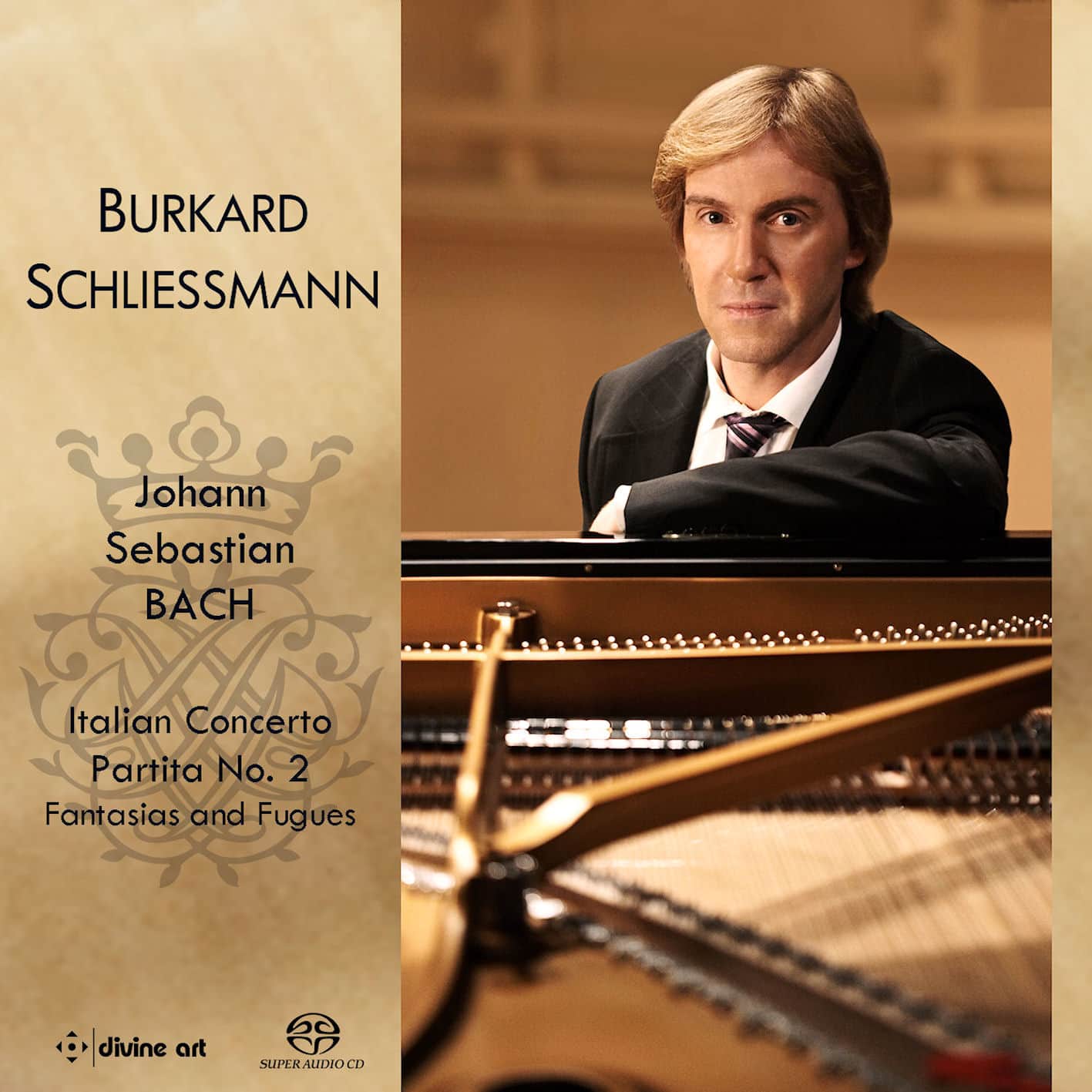
Bach: Keyboard Works
This album was awarded a silver medal in the Global Music Awards 2018 for ‘Outstanding Achievement’.
It is always good to welcome to our company a musician of the stature of Burkard Schliessmann, and also to present our first multichannel SACD in luxury packaging.
This album demonstrates once again the sheer genius of Bach but also the individual and highly considered interpretative style of the performer. Schliessmann is not a purist demanding rigid tempi and ‘traditional’ baroque styling but recognises the inner soul of the music and brings it to life in a new way – thus this recording will be welcomed as a new approach even to those who know the works very well.
Also a special inclusion on the disc is BWV 906, which Bach left as a Fantasia and an unfinished Fugue. The Fugue was completed by Busoni who also inserted the Adagio, BWV 968, which was arranged for piano either by one of Bach’s sons or by the publisher Altnickol. It makes for a highly rewarding complete work.