Catalogue Connection: 25754

  • Goldberg Variations – DDC25754 International Piano review

    Originally recorded in 2007, Burkard Schliessmann’s superb performance of Bach’s Goldberg Variations has now been reissued in Dolby Atmos format. Lossless and with an Apple Digital Master, the sound feels perfectly ‘placed’ so one hears every nuance of Schliessmann’s playing. And there is no doubt his reading has developed over many years: listening to it feels almost intimate.

    Right from the outset the Aria and Variation 1 reveal Schliessmann’s textural clarity. His finger-strength is remarkable, each line perfectly articulated. Playing on his own Hamburg Steinway, he allows himself some leeway with ornamentation, exuding spontaneity without ever losing the underlying pulse. As the performance unfolds, we meet the entire human condition, from humour (Variation 23) to the dark introspection of the so-called ‘Black Pearl’ (Variation 25). Schliessmann’s performance is carefully calibrated on both macro- and micro-levels. This, coupled with an understanding of Bach’s gesture and rhetoric, makes this reading absolutely compelling – as is Schliessmann’s highly-informed booklet note.

    So it is that the return of the Aria (heard after a noble quodlibet) holds great emotional power. Superb.

  • Goldberg Variations (Schliessmann – DDC 25754)

    If we didn’t know better, we might have imagined that Johann Sebastian Bach wrote his great Goldberg Variations with the foreknowledge that it would be performed several centuries later on by an artist with the temperament and patience of Burkard Schliessmann. Certainly, our German contemporary comes well equipped for the task, being a dedicated musical scholar as well as possessing the mature keyboard technique needed for the Goldbergs. As I remarked of this artist some time ago, he is the last sort of pianist you would expect to just play the notes as written, and without comment. That is important because Bach’s approach to the Variations, while exhaustive, was not perfectly intuitive.

    Nor was it intended to be. As he did in his Well-Tempered Klavier, Bach was working from a theory of harmony that was well in advance of the music of his day, with clear guideposts as to what the future held in store. The Goldbergs consist of thirty variations on an Aria da capo that is essentially a slow Sarabande. It is an emotionally moving, highly ornamented melody in three-quarter time with a descending arpeggio midway through that always gives me goose bumps, as often as I’ve heard it. These variations are also unusual in that they are built on the bass line of the aria, rather than its melody, a procedure that yields high dividends harmonically.

    The variations themselves occur in groups of three, with the third being an imposing canon in which the melody in one hand is imitated by the other in a succession of ever-increasing intervals, from a canon at the unison (Var. 3) to a canon at the ninth (Var. 27). Of particular interest is the way the variations in the second position in each group of three (Nos. 5, 8, 11, 14, 17, 20, 23, 26, and 29) may be taken to constitute what Baroque scholar Ralph Kirkpatrick described as “arabesques.” Performing them requires feats of prestidigitation, involving much hand-crossing and considerable freedom and flexibility of arms, hands, and fingers.

    Starting off with a stately French Ouverture in dotted rhythms, there is a lot of musical treasure to be absorbed in the Goldberg Variations in terms of harmonic theory, technical challenges for the performer and sheer auditory pleasure for the listener. The latter may rightly sense there is a compelling drama unfolding here, without knowing exactly how or why. We leave that to a skilled interpretive artist of the calibre of Burkard Schliessmann. Suffice it to say these variations never fail to intrigue, in many ways. For many, the emotional deep point of the Goldbergs will be Variation 25, which famed harpsichordist Wanda Landowska described as the “black pearl” of the set. Its message of solace and consolation for a weary world is as much in need as ever in our time. Another is the repeat of the Aria da capo at the very end, a moment that always bring a lump to my throat. As Schliessmann rightly surmises, the notes are the same as we heard at the beginning, but there’s a difference. They are sadder, softer, wiser. We feel we have been on a long journey.

  • Goldberg Variations DDC 25754 Fanfare review (3)

    In the Jan/Feb 2022 Fanfare (45:3), I reviewed At the Heart of the Piano, a three-disc release from Divine Art (DA), showcasing Burkard Schliessmann in music by Bach (arr. Busoni), Schumann, Liszt, Scriabin, and Berg. For the greater part, these are reissues of recordings previously released on the Bayer label. I summarized my appreciation for Burkard Schliessmann’s artistry:

    Schliessmann plays all of this challenging repertoire with an impressively assured technique that is always at the service of the music. Schliessmann is a pianist who avoids such exaggerations as italicizing passages to showcase his virtuosity, extremes in tempo, or an excessive application of rubato. That said, Schliessmann’s interpretations exhibit a convincing ebb and flow, and the ability to draw upon a wide range of colors and dynamics to create the appropriate sound world for the work at hand. Schliessmann is also an artist with a keen sense of pacing. Both the Bach/Busoni and Schumann Symphonic Etudes are notable both for the accomplished and expressive way Schliessmann executes the variations, and the manner in which he connects one variation to the next.

    A new release from DA (again, a reissue of a Bayer recording) presents Schliessmann in the Everest of solo keyboard variations. In the Jan/Feb 2008 Fanfare (31:3), James Reel interviewed Schliessmann, and offered a most positive review of the initial Bayer release of the pianist’s recording of Bach’s Goldberg Variations:

    For the most part, Schliessmann presents this as music of optimism and joy, the exact opposite of much of Simone Dinnerstein’s recording, reviewed in the previous issue. Oh, Schliessmann does know when and how to get serious, as in the extended (though not distended) traversal of the 25th variation (discussed in the accompanying interview). Yet even here, the playing is not self-consciously weighty; he doesn’t try to make Bach sound like Beethoven… if you want something more in the tradition of Glenn Gould’s first recording, minus some of the peculiarities but plus the repeats, Schliessmann’s account is highly satisfactory. I share James Reel’s enthusiasm for this recording. The admirable qualities I noted in my review of At the Heart of the Piano are evident here as well. And Schliessmann does a superb job of realizing Bach’s all-embracing musical and emotional journey. In such episodes as the opening and closing Aria, and the aforementioned Variation No. 25, Schliessmann adopts a strikingly expansive, introspective, and poetic approach. But when the occasion merits, there is also a welcome lightness of touch, and even playfulness. In his extensive and thought-provoking interview with Reel, Schliessmann notes how essential the jeu perlé technique is not only to Mozart and Chopin, but Bach’s Goldberg Variations. And Schliessmann’s combination of precision and elegance in fleet passagework is most gratifying throughout this recording. The Super Audio CD sounds quite impressive on my conventional two-channel stereo system; Schliessmann’s Steinway D-274 concert grand emerges with richness and clarity. The pianist’s superb liner notes further enhance this admirable release. Recommended.

  • Goldberg Variations DDC 25754 – New Classics review

    Johann Sebastian Bach’s ‘Goldberg’ Variations is the last of a series of keyboard music works that the composer published under the title of Clavierübung. Many people consider this the most serious and challenging composition that has ever been written for harpsichord. Based on a single bass theme, the variations prove Bach’s profound understanding of many musical styles as well as  his exceptional performing technique.

    This largest of all clavier pieces encapsulates the whole history of Baroque variation, as Beethoven’s Diabelli Variations later did for the Classical period. It requires a performer capable of virtuoso techniques and this outstanding recording the work is by the outstanding German classical pianist Burkard Schliessmann, winner of the esteemed Goethe-Prize of Francfort/Main 2019 and one of the compelling pianists and artists of the modern era. He has developed a considerable personal following over the years as an international concert artist giving performances of music by Bach, Beethoven, Mozart, Schumann, Chopin, Liszt, Brahms, Scriabin, and the Second Viennese School up to the Avantgarde.

    This recording of the Goldberg Variations was originally released in 2007 (Bayer – SACD only, not digital) and was highly acclaimed, winning the Critics Choice 2008 (American Record Guide) and Recording of the Year 2008 (MusicWeb International). Newly remastered in 5.0 Dolby Atmos audio, this brilliant recording is now offered as a hybrid 5-channel SACD/CD and in finest digital audio quality. ‘Ambitious and really spectacular.’ – AllMusic.

  • Burkard Schliessmann: Goldberg Variations (DDC 25754) – Fanfare review 2

    This performance was recorded in 2007 (there was an interview and review around it in Fanfare 31:3); this is the 2022 remastering, available also on Dolby Atmos. I have followed Atmos since launch, and feel it is a force for good; and if anyone needs convincing, this release will do the trick. The sound here is anything but “floaty” (a frequent criticism of Atmos); it just feels perfectly positioned. We hear everything as Schliessmann intends; this review auditioned both via Atmos and the physical Super Audio Compact Discs, and it is Atmos that feels the most involving. The sound feels purer, more crystalline; if tehre is a visual analogy, it is like one’s first upgrade to Bluray from DVD. The aim of all of this – recording ,transmission medium, player, piano – is to make us forget they are there and to bring us to Bach via Schliessmann, Divine Art and Dolby Atmos conspire to come closer to this ideal than anyone else. On a purely musico-emotional level, I derived more pleasure from the Apple Music Atmos medium.

    Schiessmann’s decision to play Bach on the piano might lose some purist listeners, but it would be their loss. The intellect that has gone into this realization is huge; similarly, the emotional range. As one listens, it feels as if the wisdom of centuries is somehow filtered down via some sort of alchemical distillation into the theme. Schliessmann gives the theme pace (one can hear the shadow of a slow dance in the background). The Aria also demonstrates the superior quality of his own Hamburg Steinway (the recording was made in Teldex Studio, Berlin). That “his own Hamburg Steinway” is significant, as Schliessmann knows this instrument inside and out; it is an extension of himself. Listen to the glistening clarity of “Variatio I,” and his way with the ornaments, free and improvisatory, and yet the pulse remains ever intact.

    It is the freshness of the play of voices that impresses so much; dialogues proliferate (listen to the ever-so-civilized one in Variatio 3). This approach also enables a real sense of humor (Variation 23). Schliessmann’s touch is impeccable; so much reminiscent of that used by Argerich in her classic DG recordings. Yet his rapport with Bach is if anything closer. By bringing a sense of play to this performance (and with it, light), Schliessmann almost invites us to reframe Bach’s intricacies as expressions of joy. This is the pair opposite of the lumbering high seriousness of Lang Lang’s disaster of a traversal (DG). Tempos, even when he reinvents a variation (as in the Tempo di Giga, Variatio 7), feel perfectly judged. There is no hunt of awkwardness that even the best can bring (I think particularly of Variatio 8) where even Angela Hewitt (either Hyperion version, or even in a live performance I attended in Manchester, UK) can sound just a touch off-track; the same could be said of Schliessmann’s cat-and-mouse way with Variation14.

    The sheer variety of touch on display is remarkable. Variatio 13 seems to demonstrate this aspect of Schliessmann’s performance in microcosm. At the heart of all of this seems to be an awareness of Affektenlehre; listen to how the sighs of the Variatio 15, of the grand gestures of the Ouverture that opens the second part (Variatio 16). The remarkable Variatio 25 (sometimes called the “Black Pearl” variation) becomes the emotive heart of Schliessmann’s account; just shy of ten minutes’ duration, he makes sure we hear the sheer modernity of Bach’s writing. Interestingly, the decorations of Variatio 26 feel modern after that, ahead of their time (as Bach was, of course), as does Variatio 28 (with its neighbor-note oscillations that explode into joyful lines).  Yet the nobility of Variatio 30 is absolutely of its time.

    The return to the beginning, the Aria, at the end has the effect of closing this cycle of a Universe co-created by Bach and Schliessmann. This is important, as it means that what we experience in this traversal is exactly what variation form brings: the examination of an object (the “Aria”) from a multiplicity of viewpoints.

    The booklet note is extensive, a university-grade lecture, and cherishable in its own right. Schliessmann’s recorded Bach is human, alive. It rejoices in its own endless ability to create from a germinal cell (the “Aria); its exuberance is never-ending. 
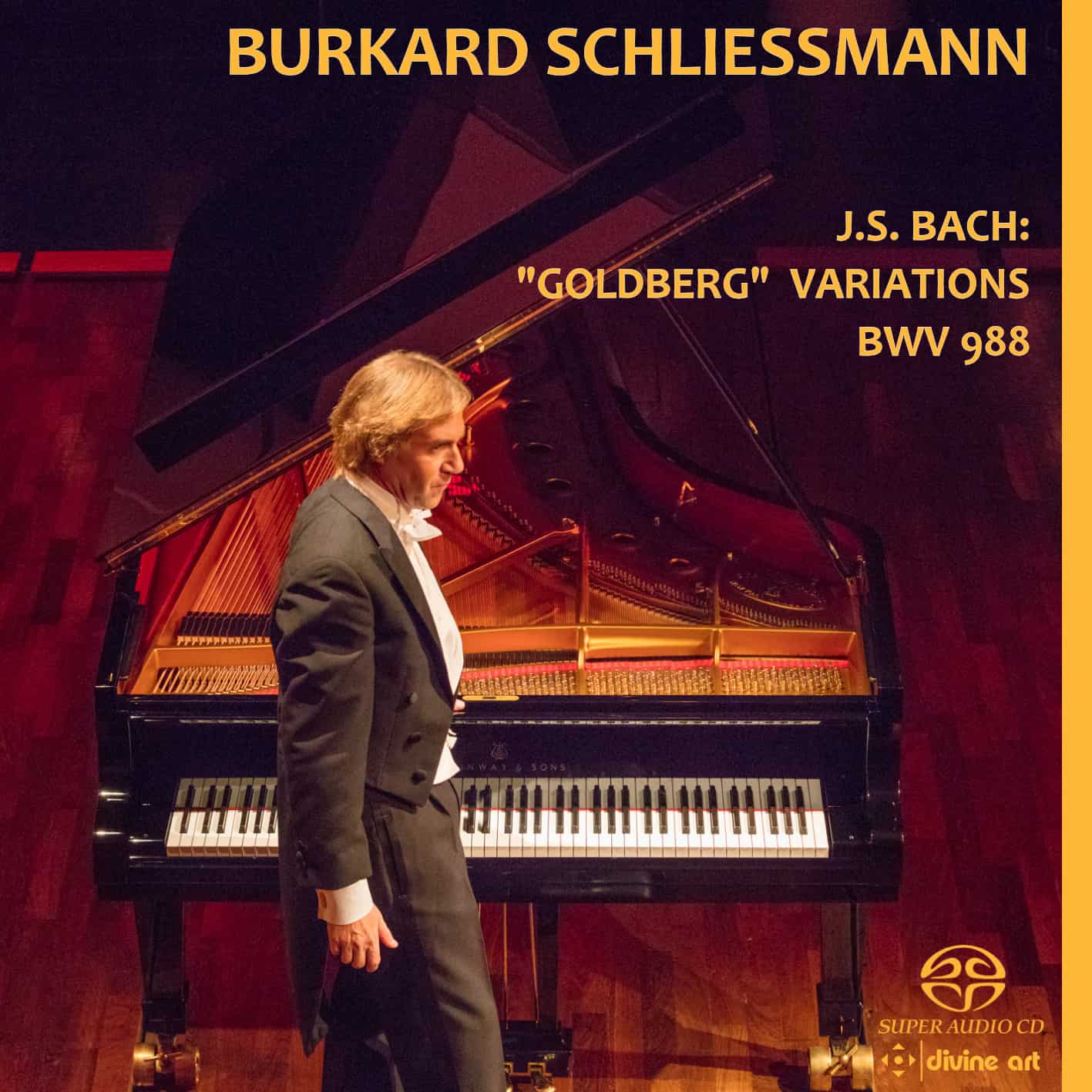
  • Goldberg Variations DDC 25754 – Fanfare review 1

    In 2009, the original release from Bayer (100326) made my best of the year list. I found the SACD recorded sound to be about as perfect as technology allows and Schliessmann’s playing comparable to the intellect and control of Gould without his eccentricities or vocal embellishments. Here, with Divine Art’s new release, the sound quality moves up a notch and the recording becomes readily available again. Newly remastered in 5.0 Dolby Atmos audio, it is available in both two channel HD stereo (my review copy) and offered as a hybrid 5-channel SACD/CD.

    I enjoyed having a reason to revisit this and my opinion has not changed in 14 years. It is still one of the top Goldberg Variations. I also refer readers back to an intriguing interview and superb review of Schliessmann’s original Bayer release by James Reel in FANFARE 31:3.

    The title page of the first edition of the Goldberg Variations (1741) begins with Clavier Übung (Keyboard Practice). This was the fourth publication of Bach’s to carry this titleand all were published during his lifetime. The first was the six Partitas, second was the Italian Concerto and French Overture, the third was an odd collection of organ pieces including a Prelude and Fugue, 21 Choral Preludes and 4 Duets.A host of great pianists have played and continue to play these harpsichord pieces on a single 88-note keyboard. Bach’s music defies whatever medium it is played on. Yes, there are significant difficulties in doing so and great pianists like Schliessmann overcome these without drawing attention to those difficulties. I am consistently impressed with the phrasing and delineation of the voices under Schliessmann’s fingers. He draws the listener into Bach’s world of counterpoint. These variations can get quite complicated and are often in at least three voices. Keeping these distinct, especially on one keyboard requires detailed and difficult attention to the phrasing of the inner voices. His tempos are a little more relaxed than Gould’s and of course there is no low level singing in the background. I have enjoyed this recording for quite some time now and will continue to with this new Divine Art release. (5 stars)

  • Schliessmann: Goldberg Variations DDC 25754 – Audiophile Audition review

    Divine Art reissues Burkard Schliessmann’s July 17-19, 2007 recording of Bach’s epic Goldberg Variations, remastered in 2022 at the Teldex Studios, Berlin in a process dubbed Dolby Atmos. The broad approach to Bach’s construct, an Aria and 30 Variations, including repeats, stretches the performance time to some 83 minutes, more competitive with the 1995 St. Petersburg traversal by Rosalyn Tureck than that of  Schliessmann’s professed affinity for the strictures of Glenn Gould, whom Schliessmann quotes extensively in his florid, booklet commentary. Unlike Gould, Schliessmann does not attempt to compromise his Steinway Grand Piano D-274 with touches approximating harpsichord sonority. Rather, the close resonance of the keyboard recommends this high flown, intellectual performance, in modern sound, as a distinct musical entity in the Bach performance canon. Kudos to Recording Producer Friedemann Engelbrecht and Sound Engineer Julian Schwenkner for the vivid imagery their collaboration has fixed for this survey.

    The sonic immediacy of the remastering follows Schliessmann in his essentially harmonic approach to this monumental conception, essentially an ouroboros whose beginning and end, the Aria, encloses itself. The bass line provides the impetus to the entire structure, the various melodies and dances a mere accompaniment and elaboration of the bass. At every third variant Bach introduces a contrapuntal gambit, inserting a series of canons that graduates in spatial intervals as the music proceeds, from the unison to the ninth degree. Bach then resorts to his Homeric sense of humor, applying his polyphonic mastery to what he calls a quodlibet, a combination of profane, popular tunes that, by Bach’s musical alchemy, achieves timeless nobility.

    The cleanliness of articulation, perhaps tending to the dry and pungent, manages to add a decisive, rhythmic spice to such events as the Variation 7 in Gigue tempo. The overt virtuosity of Variations 14 and 15 ring with dexterous authority, while the tragic Variation 25 in its minor mode lifts us to another world whose veil has been lifted. The sense of an evolving structure appears foremost in Schliessmann’s concept, as we move through elaborations and ornaments, determined, geometric forms to a higher sensibility that Bach always regarded less as an aesthetic exercise, but as a moral imperative. The intricacies of Bach’s stunning achievement here, in the “Keyboard Practice” of 1742, have been well documented by commentators and scholars. That the music transcends explanatory pedantry poses the challenge for any performer technically equipped and intellectually intrepid in the face of consummate, creative mastery. Schliessmann joins those blessed with the mission to deliver Bach’s vision in that fusion of ratio and eros, intellect and intuition, that endow the realization with poetic mystery. An hour-and-one-half spent on hallowed musical ground might suffice for a Sunday service.

  • Goldberg Variations, B. Schliessmann DDC 25754 – Infodad review

    Burkard Schliessmann is very thoughtful in his performance of Bach’s Goldberg Variations, but his recording, originally dating to 2007, is a highly polarizing experience, and the very fine re-release on the Divine Art label only confirms the difficulty of knowing just how to react to it. This work remains a litmus test, or perhaps a Rorschach test, for keyboard players – and often for listeners as well. The issue with Schliessmann’s interpretation is not just a matter of his use of a piano – a historically inappropriate decision, to be sure, but one made by many performers and sure to continue being made by plenty more – nor even his willingness to employ the very Romantic and post-Romantic piano sound and capabilities to emphasize various elements of the music. In fact, Schliessmann actually does use period practices here and there, as in runs of short-value notes; but when he does so, the attentiveness seems grafted onto a very different sort of performance and does not come across as a genuine attempt to be somewhat historically informed. For example, one reason Schliessmann may adopt that particular short-note-value element – in Bach’s time, notes in such runs were played somewhat unevenly – is that the performance as a whole has a rhythmic freedom, a willingness to stretch and compress elements in the service of emotional communication, that goes well beyond what is usually incorporated into the Goldberg Variations.

    To give Schliessmann his due, it seems that he wants, above all, to make contemporary listeners comfortable with Bach’s music, to have them hear this piece not as a museum piece and not as a doorway to an earlier time, but as a work with as much to say in the 21st century as in Bach’s own time. The difficulty, though, is that Schliessmann’s is scarcely the only way to make this sort of connection with modern listeners. The rhythmic freedom that Schliessmann adopts deliberately is so pervasive that it seems, after a while, to become a mannerism. Tempo changes are another issue: Schliessmann does not really employ rubato, which would involve speeding up an element and then slowing down another to compensate – instead, his tempo choices often seem rather arbitrary, interfering with the sense of flow and forward motion of the music in an attempt to make it more expressive and involving. Also, there is an unevenness to Schliessmann’s handling of ornamentation, so that it seems crucial in some variations and an afterthought elsewhere. What the performance lacks, then, is consistency. This is clearly music about which Schliessmann has thought carefully, and which he wants to present in a way that today’s audiences will find congenial, meaningful, and salutary. To Schliessmann, that turns out to mean handling it sometimes with neo-Romantic (or proto-Romantic) flair, sometimes with a kind of diffidence that downplays the elegance of the work’s construction. Certainly this recording shines some new and different light on a very-well-known piece, a cornerstone of the keyboard repertoire. And listeners looking for something unexpected from the Goldberg Variations should find at least occasional elements of Schliessmann’s performance intriguing. But taken as a whole, it is hard to take as a whole: it is a collection of individual elements that often engage, sometimes misfire, but rarely connect effectively as parts of a total experience.

  • J S Bach: “Goldberg” Variations, BWV 988 (Burkard Schliessmann)

    J S Bach: “Goldberg” Variations, BWV 988 (Burkard Schliessmann)

    Burkard Schliessmann is a unique interpreter, never afraid to find a new expression and always searching for the heart of the music and the composer’s inspiration, whether in the Romantic world or that of J.S.Bach. Among other awards, Schliessmann won three silver medals at the Global Music Awards 2017 for his Divine Art Chopin album, and has been awarded the Goethe-Plakette by the city of Frankfurt.

    This recording of the Goldberg Variations was originally released in 2007 (Bayer – SACD only, not digital) and was highly acclaimed: “ambitious and really spectacular” (AllMusic); “thoughtfully simple, always finely worked out” (FonoForum); Critics Choice 2008 (American Record Guide); Recording of the Year (MusicWeb International). Newly remastered in 5.0 Dolby Atmos audio, this brilliant recording is now offered as a hybrid 5-channel SACD/CD and in finest digital audio quality.


    Please note: the digital albums offered here are two-channel HD stereo. To obtain the 5-channel digital album visit a Dolby Atmos supplier (Apple/Amazon)